The Khakee Ressalah
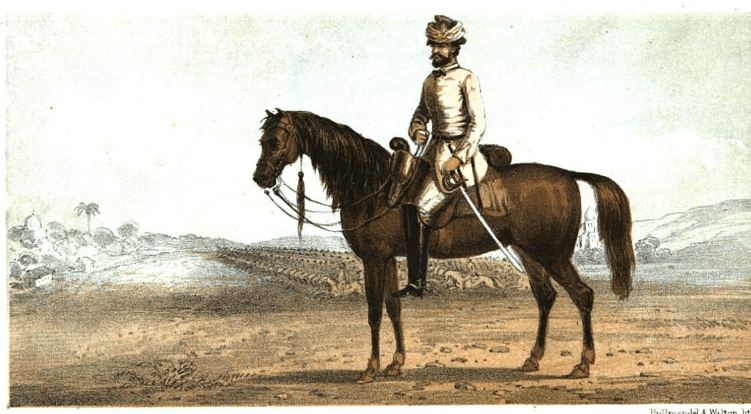
The Meerut Light Horse, also known as The Meerut Volunteer Cavalry (which also went under the fanciful name “The Khakee Ressalah”), operated mostly in the Meerut area and surrounding districts. They mustered at most 50 horsemen, made up of officers who had lost their regiments to mutineers, volunteer Sikhs, merchants without a business, civilians who had been chased from their posts and just about anyone who could ride a horse. The force was variously augmented by an ad hoc infantry made up of musicians from the mutinied 11th BNI and sowars offered up by loyal rajahs in the district. For artillery support, they had two small mountain guns, manned by Indian artillerymen.
“Few of those who so gallantly volunteered for a life of peril and adventure in lieu of patient anticipation while awaiting the issue of the struggle at Delhi, had any military experience to assist them, and their drill had to be commenced; but they possessed the hereditary courage of their race: they could all ride; many of them were sportsmen, some of them crack shots, and admirable swordsmen. Made of such material, is it to be wondered at that they traversed the most distracted portions of the district in the height of the revolt? -that they fearlessly faced, with the support of two little mountain train guns, manned by native artillerymen of doubtful loyalty, forty native Nujeebs, and forty of the Rifle Regiment, the assembled hordes of one of the most enterprising leaders this rebellion has produced, and, with little or no loss to themselves, routed and destroyed in hundreds the same class of men as those whose unbridled villainy produced such mischief in the station on the night following the outbreak? that, maddened by the insults and massacres inflicted on their own relations, on their own brothers and sisters, they executed, if let loose on a rebel village, a vengeance which made it a terror and a fear to the country around?” (Dunlop)
Their doings were mercenary in style – swift strikes at short range, mostly against recalcitrant Gujars who were taking advantage of the breakdown of order to revert to their predatory habits. The Khakee Ressalah were disbanded in 1861.
Sources:
Dunlop, Robert Henry Wallace. Service and Adventure with the Khakee Ressalah; or, Meerut Volunteer Horse, During the Mutinies of 1857-58. London: Richard Bentley, 1858.
Great Britain. Bulletins and Other State Intelligence, Compiled and Arranged from the Official Documents Published in the London Gazette. 1859, Part II, July to December. “India Office, September 27, 1859: No. 5, No. 1043 of 1859.” London: Harrison and Sons, 1859.
Nash, John Tulloch. Volunteering in India: An Authentic Narrative of the Military Services of the Bengal Yeomanry Cavalry During the Indian Mutiny and Sepoy War. London: George Philip & Son, 1893.
Volunteer, A. My Journal; or, What I Did and Saw Between the 9th June and 25th November 1857: With an Account of General Havelock’s March from Allahabad to Lucknow. Calcutta: C. B. Lewis, Baptist Mission Press, 1858.
Links:
Peter Duckers. “The Bengal Yeomanry Cavalry.” DCM Medals Articles. https://www.dcmmedals.co.uk/the-bengal-yeomanry-cavalry/.
 Mutiny Reflections