In Pursuit
The Nasirabad mutineers had been pursued for a time by two officers, Lieutenants Heathcote and Walters, the former the D.A.Q.M.G. of the Rajpootana Field Force (as the Nasirabad garrison had been called) and the latter of the civil office – they were accompanied by a body of armed retainers belonging to the states of Jodhpur and Jaipur – they followed them nearly to Delhi. However, the men told the officers they would not fight and made no secret of their sympathy with the rebels; instead, they kept well behind the mutinied regiments. No stragglers were found, and while they did dispose of some plunder along the way, it was surprising they managed “to carry along their sick and women and children and baggage in their hasty march, ill-equipped as they were, is not one of the least curious parts of their strange history.” As for the Neemuch Brigade, the pursuit was hardly more successful.
Captain Showers organised at Dungala a party of volunteers, consisting of the officers who did not go to Udaipur – Captain John Hill and Captain Ellice of the 1st Bengal Cavalry, Lieutenant Barnes of the Bengal Horse Artillery and four sergeants – Supple, Nesbitt, Lane and Mellor. He had under him a force of 50 cavalry, 500 infantry, two guns and six camel swivel guns. He was further reinforced by men sent by the Pratapgarh raja, consisting of 20 cavalry and 80 infantry. He directed the main body to proceed straight to Chitor, which, according to his intelligence, was on the line taken by the rebels in their retreat, while he rode in a roundabout way with Barnes to Neemuch. Here, he acquainted himself with the particulars of the mutiny, and when leaving Neemuch, he took with him Captain Lloyd, who had control of the Raj troops at the nearby Mewar posts and Lieutenant Stapleton of the 1st Bengal Cavalry, who volunteered to go along.
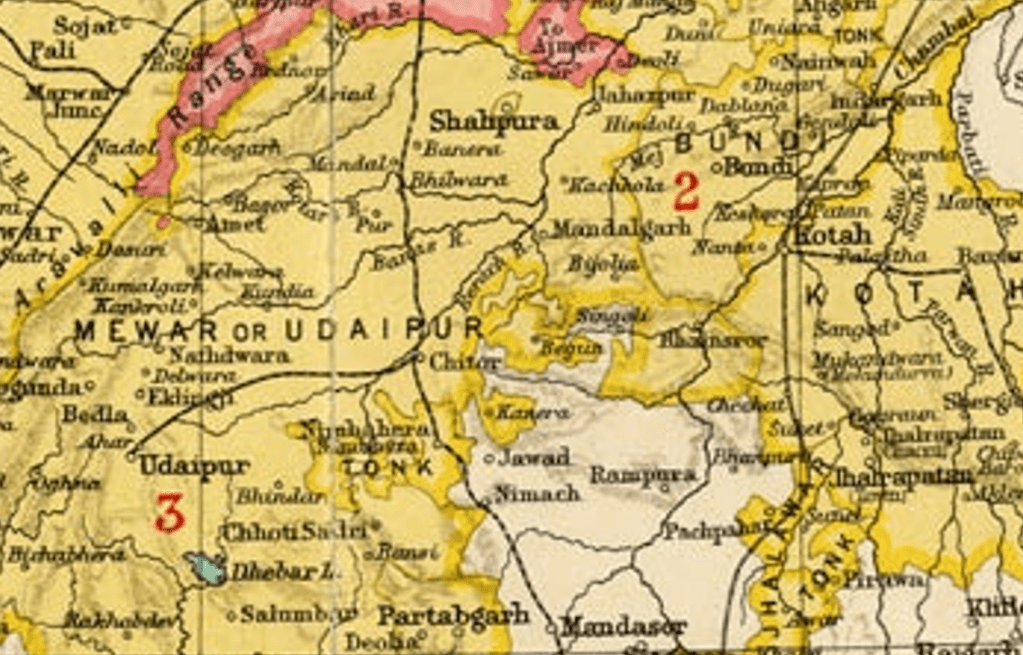
He proceeded to Nimbahera where, according to scouts, the Neemuch Brigade had halted for two days. They had a good headstart on Showers, but instead of continuing the march, he halted to talk to the headman. He came out, “attended by a troop of armed men with lighted matches, himself holding a pistol in his hand, while answering evasively the questions I put to him.” The rebels, he said, had indeed been there, but he hadn’t allowed them through the gates. They had camped out on the open plain with no shelter and had moved on. There was nothing to be gained, so Showers moved on to Chitor. He had marched 120 miles in four days and still only found himself on the line of the mutineer’s retreat. Gathering up his forces, they moved onwards. At Gaungrar, Showers learned a party of cavalry had just passed through barely an hour before he arrived; they were apparently interested in disrupting the dak (postal services) and had made a point to hunt dak runners. It was thus necessary to stop, organise protection for the runners and secure their routes. The march then continued.
Along the way, the first stragglers fell in with Showers’ troop; two were men once in the employ of George Lawrence and had been left guarding his property at the Mewar Agency. Instead, as soon as their employer turned his back, they plundered everything they could carry. As it was, the route was strewn with property of “various description” – everything the rebels could no longer take along. Meanwhile, Showers started writing letters. He wrote to Agra, and he wrote to Neemuch and to Brigadier Macan at Nasirabad.
(Dated) Camp Sanganeer,
15th June 1857.
“My dear Brigadier,
I have arrived thus far with a force of Meywar troops in pursuit of the Neemuch mutineers, and we march tonight to Shahpoora where we shall be within a forced march of them. They are marching via Kekree, as I informed Colonel Lawrence by letter a day or two ago. I had previously written to him before leaving Oodeypore, on the 7th inst., to say that I proposed pursuing the mutineers, and should be ready to co-operate with such trustworthy Meywar troops as I could collect if he should think proper to move the Nusserabad Brigade to intercept them in their passage through the Ajmere district. Not having received any reply from Colonel Lawrence and concluding that he is not in your neighbourhood, I think it right to submit the proposal I made to him for your consideration and would beg the favour of an immediate answer. As the mutineers are marching daily, the question does not admit of delay. The vital importance of striking an effective blow on this body need not be dwelt on. . . . Even should the mutineers have passed Kekra before you could move to the attack, a hot pursuit would certainly disorganise them, and their guns, at least, fall into our hands, jaded as the cattle must already be by the hot pursuit I have carried through Meywar. … I have had great difficulty in keeping the post open, as the mutineers had organised a system of cutting off the runners. As these men have to thread their way through the jungle tracts in disguise, their packets should be in the smallest possible compass. Suggesting, in conclusion, the appointment of a European Post Master, as adopted at Neemuch, to give us control over the native correspondence and to reduce the bulk of the packets for selected essential despatches.
(Signed) C. L. SHOWERS.”
On the 17th of June, Showers had still not heard from either Macan or Lawrence. Meanwhile, the Neemuch Brigade had laid Deoli to waste and had hurried on their way to Agra. Showers continued on in their wake. Meanwhile, the Neemuch Brigade had met up with the Mahidpur cavalry. The women and children of the ruined station, who had been hiding in a nearby village, were brought to Showers and promptly sent off to Ajmer. The long-awaited replies from Lawrence and Macan arrived on the 20th, and both disagreed with Showers’ plans. Lawrence was clear and to the point.
“ However much I desire to strike a blow against the mutineers with the Troops here, I do not feel myself justified in running any risk in the present state of national feeling, and the destruction of the mutineers is to me very secondary to the preservation of Ajmere, which, I am quite sure, would fall were we to move from this, to say nothing of the immediate rise of the country which would ensue.” The letter from Macan simply agreed with Lawrence. Their interests were in holding Rajputana, with all of its querulous chiefs, petty rajas, and formidable barons would give them work enough in the months to come; Showers was told to stop his pursuit. Disappointed and quite sure that Lawrence was wrong, Showers returned to Neemuch, bearing a very large grudge.
Sources:
Chick, Noah Alfred. Annals of the Indian Rebellion. Calcutta: Sanders, Cones, and Co., 1859.
Cochrane, J., comp. Narrative of the Indian Mutinies of 1857, Compiled for the Madras Military Male Orphan Asylum. Madras: Military Male Orphan Asylum Press, 1858.
Intelligence Branch, comp. The Revolt in Central India 1857-59. Simla: Government Monotype Press, 1908.
Malleson, G. B. History of the Indian Mutiny, 1857-1858, Commencing from the Close of the Second Volume of Sir John Kaye’s History of the Sepoy War. Vol. III (1889). London: Wm. H. Allen & Co.
Prichard, Iltudus Thomas. The Mutinies in Rajpootana: A Personal Narrative. London: John W. Parker and Son, 1860.
Showers, Charles Lionel. A Missing Chapter of the Indian Mutiny. London: Longmans, Green, and Co., 1888.
Rajputana (Agency). The Rajputana Gazetteer. Vol. 1. Calcutta: Office of the Superintendent of Government Printing, 1879
 Mutiny Reflections