The Troops
1st Bengal Cavalry – left headquarters wing stationed at Neemuch
Raised in 1787
Fought at Laswarrie, Cabul 1842, Maharajpore, Alliwal, Punjab, Chillianwallah and Guzerat.
The right wing was at Mhow under Major Harris, and five troopers were on duty at Kherwarra up to the 19th of May.
72nd Regiment of Bengal Native Infantry
1825 raised as 4th Extra Regiment becoming 72nd Regiment of Bengal Native Infantry
Battle Honours: “Punjab,” “Mooltan,” “Guzerat.”
1st Brigade of Horse Artillery, 4th Troop – transferred to Neemuch from Agra. Thei commander, Colonel Mackenzie was in Delhi at the time of the mutiny leaving Captain Walker in command
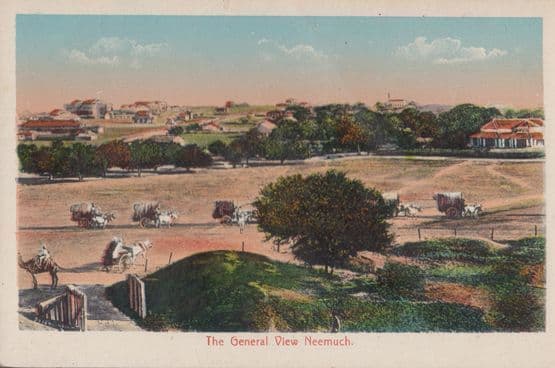
Located 120 miles south of Nasirabad, Neemuch was garrisoned by the 72nd BNI, Fourth Troop First Brigade Horse Artillery (Native), left-wing 1st Light Cavalry and the 7th Regiment of the Gwalior Contingent. The station commander was Colonel Abbott of the 72nd. The greased cartridges had never made their appearance in Neemuch, and although the outbreaks at Meerut and Delhi had caused some excitement, there was no outward sign of mutiny.
The problems for the officers started on the 28th of May with a rumour that the Suddar Bazaar was being plundered. The men of the 72nd and the 7th Gwalior Contingent rushed for their arms while their officers tried to restore order. They only managed to control their men by having the native officers stand in front of them and remonstrate with the troops that their behaviour was unwarranted. They were then told to take an oath of loyalty to the Government and their officers. Although this stayed the tide, nothing in Neemuch was as it seemed.
On the 2nd of June, it was evident the mutiny at Nasirabad was already known, and the officers, unlike those in that station, were less enamoured with their men than Pritchard had been. As a cautionary move, Abbott called upon the Raja of Kota and the Rana of Udaipur to march some of their troops towards Neemuch for the protection of the station. The request was quickly responded to by not only Captain L. Showers, officiating Governor-General’s Agent at Marwar and by Major Burton, Political Agent to Kotah.
In Neemuch, Captain Lloyd laid plans to save the European community. It was decided that without a defensible position in the station, in case of an uprising, they were to make their way 12 miles south of the station to the village of Daru on the road to Udaipur from whence the Rana’s troops were advancing at the first sign of trouble.
According to the official report of the outbreak, from Captain Lloyd to Colonel Lawrence, he states,
“Colonel Abbott slept every night in a tent in the lines of his regiment without a guard or sentry, and latterly all officers did the same, even with their families. One wing of the 7th Regiment Gwalior Contingent held the fortified square and treasury, and the other wing was encamped close to but outside the walls. Captain Macdonald, commanding the corps, resided entirely in the fort for the purpose of better observing and controlling his regiment.
‘On the morning of the 2nd, Colonel Abbott informed me, in his own regimental lines, that, from the occurrences of the previous night and from information he had received, he was of the opinion that the outbreak could not be delayed more than a few hours.
I left him to secure a few of my most valuable records and endeavour to secure a line of retreat for fugitives by the Oodeypore road by means of a detachment of police sowars. Meanwhile, Colonel Abbott undertook to assemble all the native officers of the force and endeavour to bring them to a sense of their duty and to remove the distrust in each other, which there was reason to believe was one cause of the prevailing excitement. After some discussion, all took oaths, on the Koran and Ganges water, that they now trusted each other and would remain true to their salt. The commanding officer was requested to swear to his confidence in their faithful intentions and did so, when the meeting broke up, all apparently being satisfied and loyally inclined. All continued quietly up to the evening of the 3rd.”
Around 9.30 pm of the 3rd of June, five troopers of the cavalry galloped out towards the lines of the 72nd, calling, ” Get ready! Get ready!” The men stormed to the bells of arms and demanded their weapons, ostensibly to defend themselves against a cavalry onslaught. As all the officers had taken to sleeping in the lines, they were there when the NCOs came and begged the commanding officer to give the men their arms. The request was acquiesced to, and all the men retired peacefully to their huts.
Meanwhile, Lieutenant Walker, who was with the artillery guns, was not having an easy time of it – his men were far from restive and by now were positively mutinous. He managed to restrain them for two hours when suddenly some of them rushed the guns and fired off two. The signal to rise had been given. The cavalry rushed to join them, followed in quick succession by the 72nd. The 72nd came out of their huts, formed into companies in the rear of the respective bells of arms while the cavalry was seen, with lit torches in their hands, heading off to the gaol. They released the prisoners and set the officers’ houses ablaze while the artillery began moving their guns.
“The tumult increased: the commanding officer of the 72nd Regiment was endeavouring to restore order on the right; the companies of the left-wing attempted to join the mutinous artillery by the front, across the parade, but on being ordered back, they returned; afterwards, however, they went off by the rear. Order was now at an end; a company of the 72nd, led by an old mutineer, Subadar Nuthoo Pattuck, joined the artillery; the cavalry galloped about the road firing off their pistols at everything and nothing, and the only thing that remained to be done, was for the European officers and families to abandon the station. As the cavalry had possession of the centre of the cantonment commanding the road leading from the 72nd lines in the direction of Dharroo, their only plan was to try and reach Jawond, which place was distant ten miles, in a northerly direction, and on the route of the advancing troops of the Kotah Raja. The officers were assembled in the regimental quarter-guard, and the artillery, becoming aware of this, brought a gun to bear on it. The native officers assured them their lives would be sacrificed if they remained any longer; so, after making an unsuccessful attempt to get the colours, they determined to leave the station. This was about one o’clock in the morning. Of the fate of the civil officers, of the artillery, cavalry, and Gwalior Contingent officers and their families, they were in total ignorance; but there was no time for inquiry, and no means of making any; so, guided by the flames of the burning houses and the pale light of the moon, they set out on their way to Jawud.“
Captain Macdonald of the 7th Gwalior Contingent was not an easy man to thwart. On the eventful night, he had 200 men accoutred, with their muskets loaded and standing on the walls of the fort, while he himself intended to sleep in one of the bastions, to be on hand if needed. His orderly woke him as soon as the signal guns sounded. From his position, Macdonald could see the cavalry rushing through the cantonment, setting fire to the officers’ houses.
The gates of the fort were that night under the charge of the 3rd company of the 7th Gwaliors, under command of their subedar, Hari Singh. Macdonald, realising the crisis was finally at hand, ordered a messenger be sent to Lieutenant Rose, his second in command, who happened to be in the lines of the left wing of the regiment. Rose was to proceed with haste to the Macdonald’s position. The captain heard Hari Singh repeat the order, but he did not see a messenger leave the fort. When he asked, the subedar said the message had been sent – in truth, Rose never received it.
Hearing nothing from McDonald, Rose proceeded with the pre-arranged plan – he was to parade the left wing with the view of joining his commanding officer. While getting his men under arms, a shot was fired by a sepoy of the 4th company, harming no one. He marched his men to the fort – only to find they refused to enter.
Calling on Macdonald, he entreated the officer to come down and talk to them. They hesitated but briefly before obeying Macdonald’s request. They entered the fort – an additional company was told off to each side of the square, the gate was then closed, and the drawbridge was raised. Believing the gate would be the first part attacked, Macdonald instructed Ensign Davenport 12th Bombay Native Infantry, doing duty with the Contingent, to join the party at the gate while he sent another party onto the walls, to act as support should the gate need defending.
“Captain Macdonald then went round and visited all the posts, endeavouring to induce the men to remain faithful, and promising a pecuniary reward to them if the treasure, &c., was preserved. He was met everywhere by assurances of loyalty and good behaviour, the only doubt expressed of their making an effectual defence behig in the event of guns being brought to bear upon the place. He then pointed out to them that nothing but heavy ordnance could be of the slightest avail against the fortifications, and this the mutineers were totally unprovided with, the guns of the troops being nothing more than six-pounders. The mortar would be useless in the hands of any but an experienced European officer. The colours of the regiment were unfurled and placed on the bastion, and the men called on to protect them from dishonour.”
The next two hours passed without incident – suddenly, Macdonald was aware of movement. Men were quietly leaving the walls in small parties – when Macdonald asked Hari Singh what they were about, he answered they were going to get their bedding. Macdonald ordered them back. Half an hour later, the incident repeated itself, and at the same moment, Lieutenant Gordon and Ensign Davenport came up.
Davenport had endeavoured to hold the gate for nearly four hours, with a few men handpicked by the old subedar Hari Singh. During which time he watched the cavalry riding about, thrusting lighted torches – which had been tied to the ends of long poles – into the thatch of the bungalows. In the chaos, two guns fired – the signal, Davenport surmised in hindsight, for the Gwalior Contingent to switch their allegiance. Davenport tried to stop Singh from opening the gates – for his pains, he was told to shut his mouth and be quiet unless he fancied being “treated to a little cold steel.” Taking the intimation as his final and only warning, Davenport begged permission to be allowed to report to Macdonald. Singh let him go. The gate was thrown open on Hari Singh’s orders.
Macdonald, Rose, Gordon and Davenport hurried down – the gate was indee, wide open, and the men were assembled in the courtyard, fixing their bayonets. Entreaties only stopped the flood for a moment – it was soon clear the 7th Regiment of the Gwalior Contingent had no regard left for their officers. In a last-second, almost mad attempt, Macdonald seized one of the Colours and Gordon the other – they then tried to call their men back, to rally around the Colours, but the report of two guns fired by the artillery put an end to that. Macdonald saw just in time that the cavalry was now advancing. He had no choice but to let his men leave. They took officers outside the gate and told them to go: when the officers hesitated, them men said if the Bengal cavalry, artillery and infantry saw them, they would be murdered and the Contingent could not and would not save them.
Only two men of the 7th Regiment Gwalior Contingent remained with their officers for the first 63 miles of their flight from Neemuch – making their apologies, they returned to their comrades. Sadly for them, their consideration cost them their lives – upon returning to the regiment, they were put to death as traitors.
Meanwhile, the cavalry and horse artillery rampaged through Neemuch, killing the family of Sergeant Supple of the artillery, who was in the lines. In the chaos of the night, Supple could not leave his post and his wife, 23-year-old Ellen, with three children, it turned out, could not leave the house. The swiftness of events cut off her escape, and she did the only thing she could – she shut herself in the house as the mutineers closed in. They fired shots at the windows and at the door while the terrified family cowered inside. The door finally gave way, and the murderers rushed inside. Mrs Supple and her children were swiftly killed, and the bungalow plundered. As for Sergeant Supple, he tried to reach the house but found his way blocked by swarms of mutineers – even if he had managed to get there, it would only have been to bury his family. Torn with grief, Supple returned to the officers – he told them he had nothing left to live for – one of them replied, he did – for revenge.
Unfortunately, Supple would be maligned by the newspapers as a neglectful husband, and his dead wife would be raised to a heroine, who with one shot (from a gun she did not possess) deposed of several mutineers before resigning herself to her fate. For her children, a grisly end was imagined by the reporters – they were taken by the legs and tossed into the roaring inferno of the burning bungalow. It was stories like these that fuelled a near maniacal contempt of Indians and prompted many men to declare themselves willing to kill everyone who crossed their path. The death of Mrs. Supple, though barbaric, was hardly as descriptive as the newspapers would have had the public believe: but truth is sadly one of the many casualties of war.
Sources:
Chick, Noah Alfred. Annals of the Indian Rebellion. Calcutta: Sanders, Cones, and Co., 1859.
Cochrane, J., comp. Narrative of the Indian Mutinies of 1857, Compiled for the Madras Military Male Orphan Asylum. Madras: Military Male Orphan Asylum Press, 1858.
Intelligence Branch, comp. The Revolt in Central India 1857-59. Simla: Government Monotype Press, 1908.
Malleson, G. B. History of the Indian Mutiny, 1857-1858, Commencing from the Close of the Second Volume of Sir John Kaye’s History of the Sepoy War. Vol. III (1889). London: Wm. H. Allen & Co.
Prichard, Iltudus Thomas. The Mutinies in Rajpootana: A Personal Narrative. London: John W. Parker and Son, 1860.
Showers, Charles Lionel. A Missing Chapter of the Indian Mutiny. London: Longmans, Green, and Co., 1888.
Rajputana (Agency). The Rajputana Gazetteer. Vol. 1. Calcutta: Office of the Superintendent of Government Printing, 1879)
 Mutiny Reflections