The Misconceptions
The Battle of Narnaul covers between two and four pages in most works current at the time. Lieutenant Edward Vibart, who was there, was more interested in presenting the general colour of the battle, the cloudless sky, and the crisp November air while describing, at some length, Colonel Gerrard’s death without mentioning if he had actually witnessed it himself. Vibart manages, in his entire narrative, to keep himself out of it, although the rifle he found in the rebel camp after the battle, which was of good English make, brings out much enthusiasm in the young man. Lieutenant Wynyard Warner spends much time grumbling about the march it took to get to Narnaul and then describes his own experiences in some detail, but compared to the vivid descriptions he provides for Delhi, Narnaul does not receive the same merit. This could be because he was writing a letter to his aunts and did not want to belabour them with the military aspects but felt they would be entertained more by domestic details, such as growling camels and shivering in the cold. The author of the article in Blackwoods is colourful and picturesque to a great degree, but it would appear he was writing for a very apt audience back home, whom he aimed to please and incite to a chest-swelling pride. The dispatches are routine, stark and in some instances, not very clear, with the writers jumping from incident to incident and not necessarily in order.
In modern literature, the sage of mutiny, Christopher Hibbert, reduces Narnaul to a mere line towards the end of page 326. In other works contemporary to this century, it is not mentioned at all. So, while the Battle of Narnaul was important in the context of the Jodhpur Legion, it did not achieve any lofty goals besides proving, yet again, that the people of Haryana had much to fear from the men of Delhi and rebellion, for the Rajasthani jagirdars, the local rulers who had sent troops that marched and fought with the Legion it would have little advantage but their displacement and possible death by hanging as in the case for the unfortunate Nawab of Jhajjar. However, by the time the Battle of Narnaul played out, the Jodhpur Legion itself was no longer of much consequence as the name would have one believe – no one mentions in any detail who they were fighting against; the legion as a whole is hardly noted and there is a fleeting reference to the Jaipur troops who had upped and left Captain Eden some weeks earlier.
The “Revolt of 1857 in Haryana” by C.K. Yadav, who gives a description of the battle from the Indian perspective, ends with the stark words, “The battle of Naroaul was undoubtedly one of the most decisive battles of the Uprising of 1857. The English felt jubilant over their success in this confrontation for, it resulted in the complete rout of all the rebels, and thus marked up the close of the crucial period of the struggle in the Haryana region and northern Rajasthan.”
That the force was large and formidable and led by able commanders who should have put Gerrard to the sword, no one disputes. Malleson found it absurd that the rebels had abandoned their position because Gerrard was slow bringing up his column; the rebels then tried to take it back, only to realise Gerrard was not going to budge. They met him on the open field but were pushed back; they tried to hold their camp, but the disorganisation in their ranks led to the gradual disintegration of order. They were pushed back again until all that was left was a serai which seemed, even in their minds, of little use to hold. By then, most of the army, including the Legion, had left the field. There is no doubt the troops on both sides fought with courage and well proved their mettle in battle, but unfortunately, the Indian side could not hold their line and were unable to break the British one.
Had the Jodhpur Legion, instead of stalling aimlessly at Auwa until the 10th of October, consolidated their forces with, for example, the leader at Mandsaur, tried to forge an alliance with Kunwar Singh of Jagdishpur or even the mighty Gwalior Contingent, history might have had a different outcome for the Legion. Instead, they continued their march towards Delhi with the vain hope of garnering enough momentum among the rebels in Haryana to launch their own campaign and return to Rajasthan. But there was no one to lead them and, above all, no one who would make their cause with the Legion, who were finally reduced to the level of foot soldiers to errant nawabs and bickering landowners, each with their own bone to pick. It was an ignoble end to an army that could have changed history. In that respect, their last fight at Narnaul proves one thing – the Jodhpur Legion was made for better battles.
It is thus unfortunate that the Battle of Narnaul is reduced, in our modern age, to some very disappointing narratives. Let us look at just some of these:
- Indian Culture
https://indianculture.gov.in/
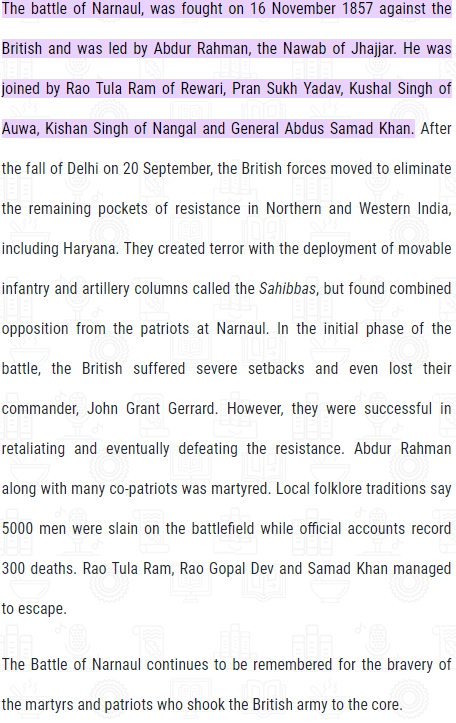
As we know from C.K. Yadav and others, Nawab Adbur Rahman was arrested at Jahjjar in October by Brigadier Showers and sent to Delhi, a prisoner. He was nowhere near the Battle of Narnaul. Kushal Singh of Auwa had sent the Jodhpur Legion away and was not present at the battle, although other jagirdars of Rajasthan had marched towards Delhi with the Legion.
As for the number 5000, we can safely say this is folklore until we can establish, beyond any doubt, how many men were present at the battle on the side of the Indians. The official estimate is 1000 infantry and 2500 cavalry with eight guns. It is quite a reach that the British, with their limited numbers of not more than 2’500 men, would have been able to inflict such devastating casualties. The British army, however, was not shaken to the core. They left the field smug.
2. The Battle of Nasibpur
Wikipedia, Simple English
The Battle of Narnaul (also called the Battle of Nasibpur) was fought on 16 November 1857 between the British Raj and Ahirwal Kings during the First War of Indian Independence.[1] In 1857, Pran Sukh Yadav, Rao Tula Ram (ruler of Ahirwal), Rao Gopal Dev and Rao Dhan Singh (Jagirdar of Charkhi-Dadri), with their army of 5,000 infantry and 2,000 cavalry, fought with the British at Nasibpur fort in Narnaul.[2] The battle was one of the most ferocious battles of the First War of Indian Independence.[3] During the Battle of Narnaul at Nasibpur on 16 November 1857, the British lost 7000 British soldiers and their commanders Colonel Gerrard and Captain Wallace. More than 2000 British soldiers and officers Captain Craige, Captain Kennedy and Captain Pearse, were wounded.
The battle, as we know, was not fought at the fort but mainly on an open plain between two hills before it moved into the town. Cavalry charges would have been of little use when dealing with a fort.
Nor can this particularily strange paragraph cannot even be explained by the sources it cites:
- History of India by Dr Malti Malik (rerprint, 2016). page 356
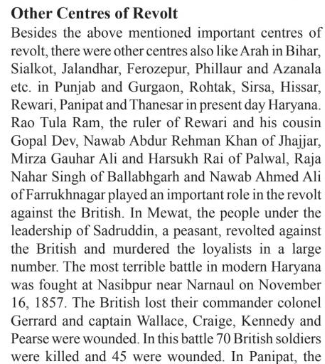
2. Glimpses of Haryana – Buddha Prakash page 110, (1967)
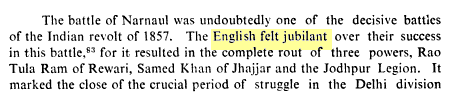
Curiously, this is word for word written C.K. Yadav’s book
No. 3 – The Tribune India – Nasibpur Joins List of Legendary Battlefields
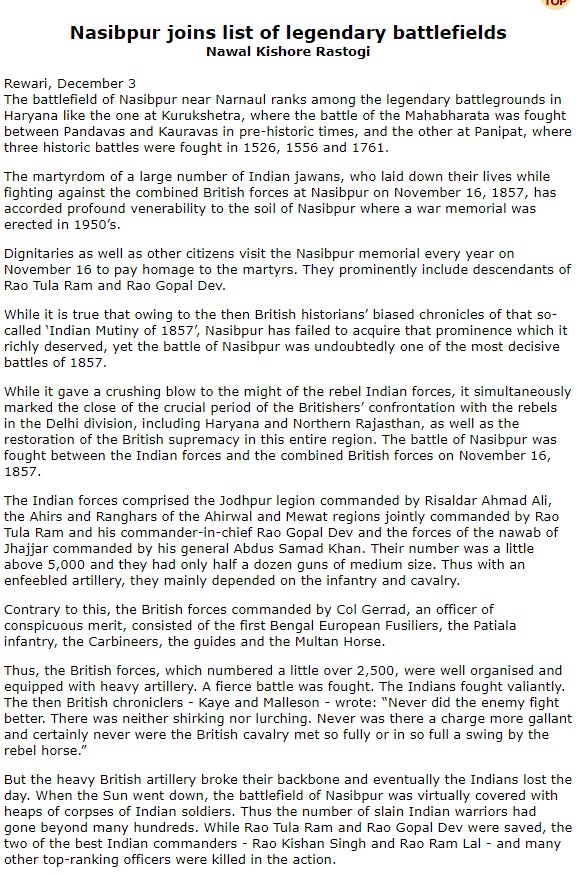
4. Narnaul
Wikipedia, the Free Encyclopedia
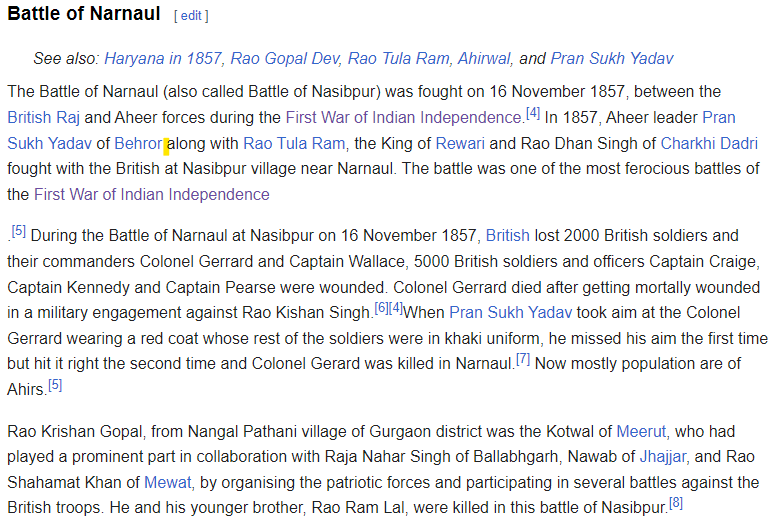
The numbers are reversed – there are now 2000 dead and 5000 wounded. The sources here, as can be well imagined, are the same as those of the previous Wiki except that Number 6, label “Central India Campaign” should bring you to the Defence Journal but the the page no longer exists while a search of the site reveals no results. Although I cannot verify if Pran Sukh Yudav shot Gerrard, as no one seems to make mention of this otherwise, we can leave this open to possibility. However, we do know Gerrard was shot by a man hidden in a ravine, so it seems a little odd that an important leader would put himself in such a vulnerable position to take potshots at a man in a red coat.
5. Unsung Hero Details
https://amritmahotsav.nic.in/unsung-heroes-detail.htm?13078
This next one will probably reign fury down on my head, however, I will take my chances.
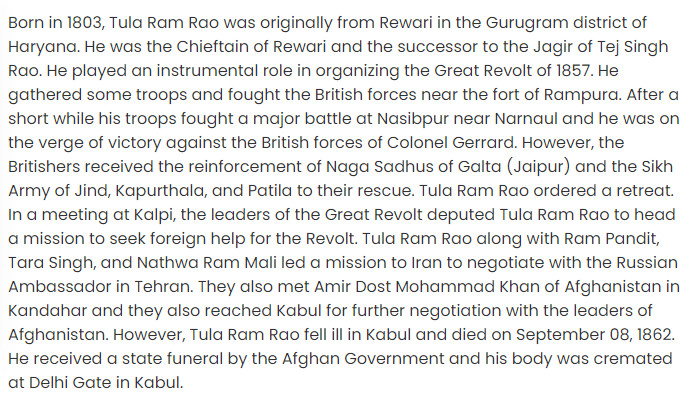
I will leave it at this:
– He was not on the verge of winning, although this might be in the eye of the beholder.
– Gerrard did not receive any reinforcements during the battle.
Two blogs also take up the case of Narnaul, however, since they do not deal exclusively with the battle, their mentioning of the number 70 regarding the British casualties is peculiar but does not distract essentially from the narrative they are bringing forth in their works but neither of them cite as to where they came up with that particular number.
I do not want to disparage anyone with this post. Yet, it is also important to note that sources do exist which are accessible and would certainly put an end to some of this rather strange information available, regarding the Battle of Narnaul. It was a valiant battle, well fought – there is no need to cloud its memory with exaggerations.
Sources
1. https://indianculture.gov.in/node/2815600#:~:text=The%20battle%20of%20Narnaul%2C%20was,and%20General%20Abdus%20Samad%20Khan.
2. https://simple.wikipedia.org/wiki/Battle_of_Nasibpur
3. https://en.wikipedia.org/wiki/Narnaul
4. https://amritmahotsav.nic.in/unsung-heroes-detail.htm?13078
5. https://haryanaheritage.blogspot.com/2013/02/monuments-related-to-1857-in-narnaul.html
6. https://guidobillstein.com/2017/08/31/narnaul-haryana-where-they-fought-the-british-english/
 Mutiny Reflections
I would be pretty too if I was an elephant shot by a six-pounder.
LikeLiked by 1 person
Yes indeed, poor elephant! I have a few accounts of elephants in 1857 battles, I just didn’t expect it in Narnaul! Francis Cornwallis Maude talks about animals a lot in regard to his artillery battery, it is quite interesting how the animals managed the mess of war.
LikeLike