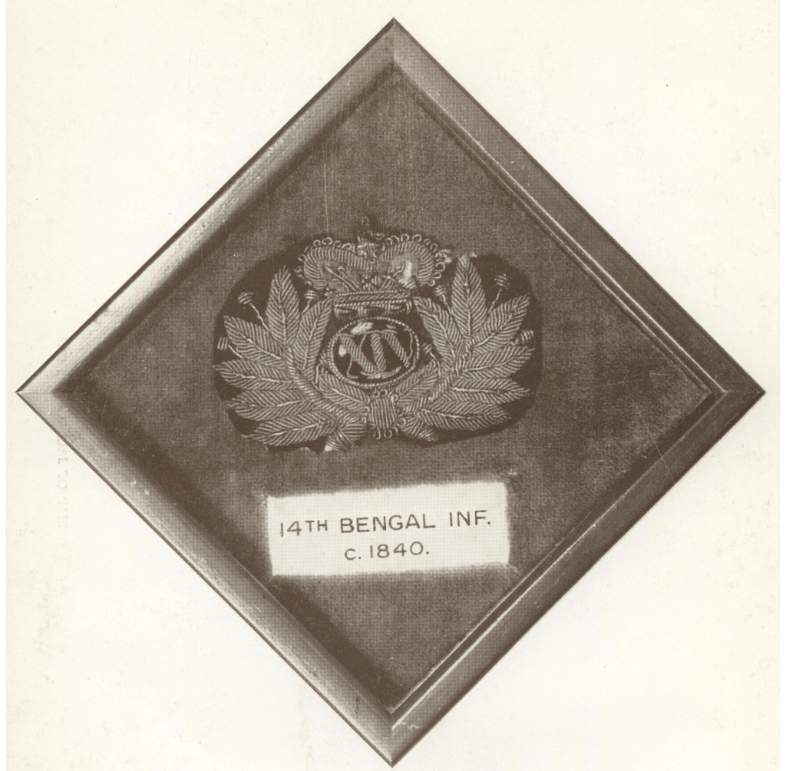
Described as a British officer’s forage-cap badge1 (c. 1840) of the
14th Regiment of Bengal Native Infantry, it is made of gold wire
on to black cloth and styled somewhat in the manner of a naval officer’s
cap-badge, the constituent parts being a wreath of laurel leaves, a roundel
bearing the Roman numerals XIV, and (surmounting the whole) the
Victorian crown.
With a view to preservation, the badge has been mounted on buff
velvet (this colour having been that of the regimental facings) and
enclosed in a diamond-shaped wall-frame painted scarlet. (https://www.jstor.org/stable/44230521)

The 14th Bengal Native InfantryEscottan-ki-Pultan
Battle Honours : Seringapatam, Maharajpur, Ferozeshur.

  • 1764 raised 20th Battalion by Captain Scotland
  • 1764 ranked as 16th Battalion
  • 1765 posted to the 2nd Brigade
  • 1775 renumbered the 11th Battalion of Bengal Native Infantry
  • 1781 became the 5th Regiment of Bengal Native Infantry
  • 1784 became the 10th Regiment of Bengal Native Infantry
  • 1796 became the 1st Battalion 10th Regiment of Bengal Native Infantry
  • 1824 became the 14th Regiment of Bengal Native Infantry
  • 1857 mutinied at Jhelum 7 July

In 1861, the title was handed to the Regiment of Ferozepore, which became the 14th (The Ferozepore) Regiment of Bengal Native Infantry in 1864. They would later be known as the 14th (Ferozepore) Regiment of Sikh Infantry.

The 14th BNI had been raised as the 20th Battalion in 1764 as a consequence of the Nawab of Oudh supporting Mir Mohammad Kasim. It was deemed necessary to form two further battalions of sepoys – the 20th was raised at Jellasore (Jaleswar) in Orrisa by Captain James Scotland in March 1764. Scotland had only received his captaincy 4 months earlier and had first visited India as a midshipman. On a second voyage to Calcutta, he joined the army. While it is possible he was present as an ensign during the Manipur expedition of 1762 and at the capture of Patna in 1763, Scotland was not a long-lived soldier. The honour of raising a regiment would be one of his last exploits. He resigned his commission in 1766 and returned home. He died “near Edinburgh” on the 8th of June 1772.
However, his regiment lived on. In 1775, they were renumbered the 11th and then only 6 years later, the 5th Regiment. Three years later, the designation was changed again, and they became the 10th Regiment and, in 1786, the 10th Battalion. Ten years later, this, too, changed. Until 1824, they would be known as the 1st Battalion, 10th Regiment; coupled battalions of the Bengal Army were then reshuffled into distinctive one-battalion regiments, and until they mutinied Jhelum, they were known as the 14th Regiment of Bengal Native Infantry. Throughout it all, and much to the honour of Scotland, the corps continued to be known as Escotten-ki-Paltan, or Scotland’s Regiment. They had fought far and wide in their short history, as the 1/10th they gained their first battle honour at Seringapatam in 1799 for which they were allowed to embroider a star of their Colour. As the 14th, they were present at Maharajpur during the 1843 Gwalior War and at Ferozeshur during the 1st Anglo-Sikh War. These, too, were subsequently added to their regimental colours.
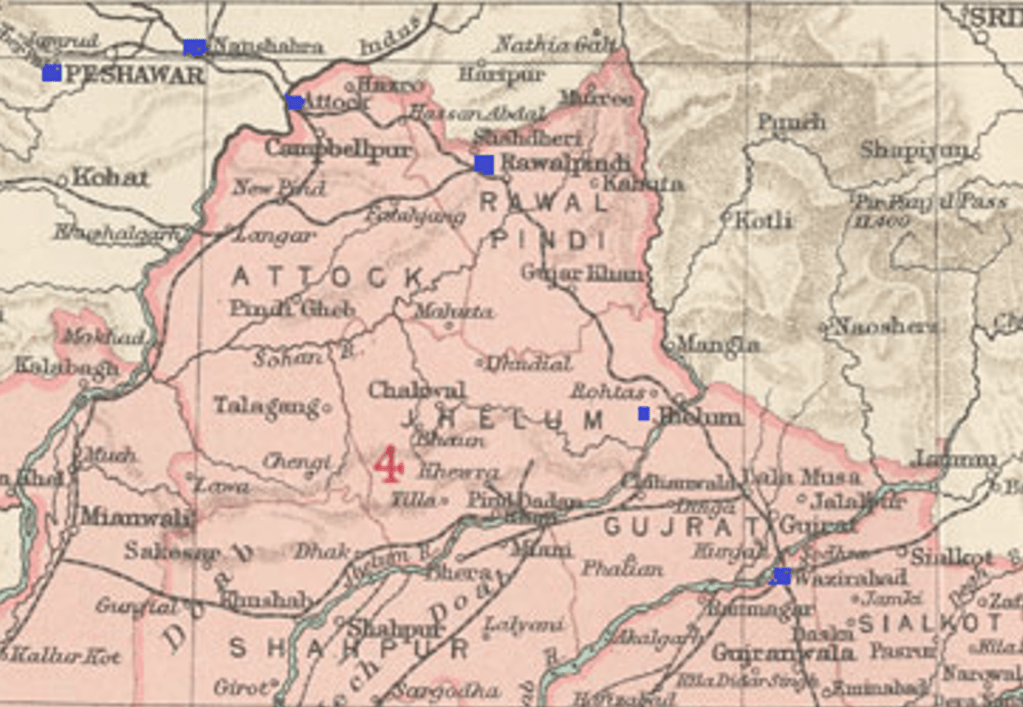
In July 1857, the 14th BNI was stationed at Jhelum, Rawalpindi Division, in the Punjab.
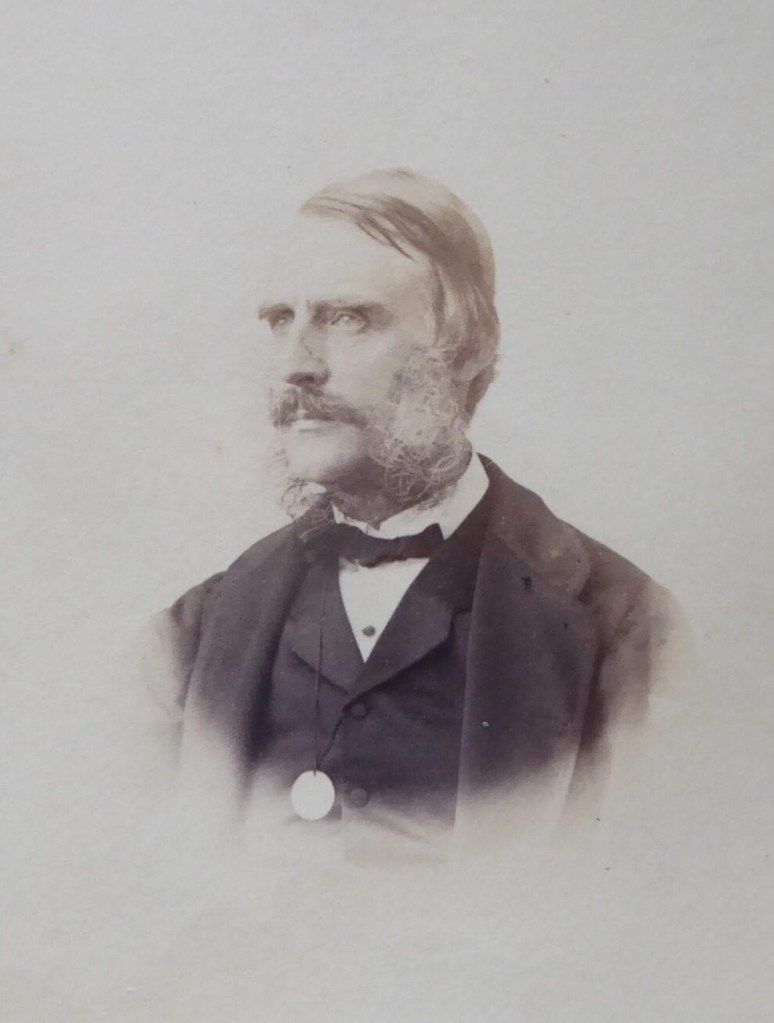
Of all these regiments, the 14th had been eyed with suspicion for some time – already in May, Lawrence’s spies had been actively at work, bringing him worrying reports about the state of the 14th. They were, in his estimation, not to be trusted. As far as the station was concerned, resistance would have led to swift capitulation; had the 14th decided to rise, there was not a single building in Jhelum capable of resisting cannon and only a handful of European officers.

The troops at Jhelum were almost entirely Poorbeahs and consisted of the 14th and 39th NI and Major Knatchbull’s native field battery. The first intelligence of the outbreaks at Meerut and Delhi reached Jhelum on the 13th of May. However, not the ones to despair, Major Knatchbull was completely convinced of the fidelity of his men, Colonel Gerrard was assured the 14th BNI harboured no mutinous desires, and Colonel Macdonald of the 39th, with a little more reserve, firmly believed his men would never fire on their European officers. The Deputy-Commissioner, Major Clement Browne, tried to send away the ladies; they refused to go; he then proposed the letters of the 14th should be intercepted as this move could force the hand of the 14th. As such, Browne ordered the Magazine be kept as a rendezvous, situated midway between the civil and military stations. If the 14th did mutiny, at least the remaining officers could hope to find some safety in the only defendable building in the station, although it too was hardly built to withstand a determined artillery attack. As such, “anxiety was the order of the day…” and all eyes turned to the government.
Before we can move further into the events in Jhelum, we need to understand the affairs in Punjab.

The State of Affairs: May- July
Troops of the Rawalpindi Division
John Laird Mair Lawrence, 1st Baron Lawrence, Chief Commissioner of the Punjab

Sir John Lawrence was under no illusions where the troops of the Bengal army were concerned, particularly those in the Punjab. He had managed to outwit them in Lahore; other regiments had felt the wrath of retribution at Peshawar.

The Moveable Column under John Nicholson was in Phillour, 200 miles distant from Rawalpindi. Towards the end of June, on intelligence received, Lawrence called on Nicholson to bring the column back up – on the 28th of June, with two corps, the 33rd BNI and the 35th BNI were disarmed at Phillour. He then left the 33rd, under the watchful eye of Tulloh’s newly raised 21st Punjab Infantry at Jallandar, along with some men of the Karputhala Raja. He then took the 35th LI over the Beas River and dropped them at Jundhiala, one march away from Amritsar, thus bringing the Column to Amritsar. As such, no one could understand what Lawrence was doing, and he was condemned for wasting valuable time. The Column should have been well on their way to Delhi, instead, they were hopping around the Punjab at Lawrence’s behest. Fortunately, John Lawrence was not a man who particularly cared for the opinions of other mortals. His word, where the Punjab was concerned, was law in itself.
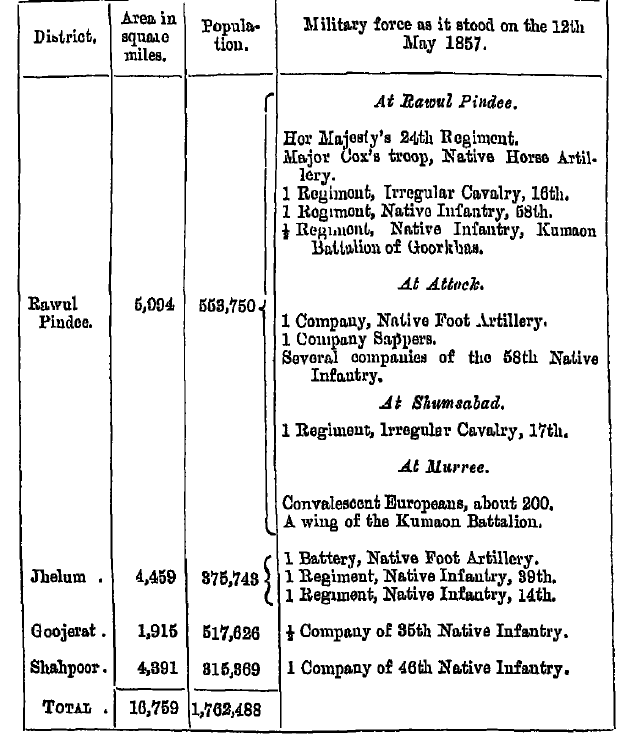
At the start of July, Lawrence still had the 58th at Rawalpindi, the 14th at Jhelum, the 46th at Sealkote with a wing of the 9th Cavalry ( the other wing had been sent with the Moveable Column), the 59th at Amritsar, the 4th at Kangra and Nurpur, the 2nd Irregular Cavalry at Gurdaspur – against these armed regiments all he had was HM’s 24th at Rawalpindi with a battery, the 52nd Light Infantry was off with the Moveable Column and a few locally raised Punjabi levies. He could not move HM’s 81st as they were tied down in Lahore keeping an eye on the disarmed corps, and the troops at Peshawar were otherwise occupied. A further Moveable Column composed of detachments of HM’s 24th, Captain Miller’s Police Battalion Horse and Foot was hastily organised to be despatched should any regiments in the Jhelum area mutiny. To relieve the companies of the 58th at Rawalpindi from temptation, the treasury and jail were taken from their control and handed over to the Police Battalion.

Their Fate is Sealed

To bring some relief to Jhelum, it was decided that the 39th Regiment needed to be moved away from the station. In the middle of June, they were sent by a very circuitous route, following the left bank of the river, where all communication with the station was cut off, and the dak link did not exist. The regiment was told they were to be engaged against a petty but lawless chieftain and, as such, marched without a murmur. To prevent any junction with the mutinous 46th BNI, who were guarding the treasury at Shahpore, the Shahpore detachment was sent out of the way before the 39th reached the station, thus ensuring the 39th continued to march to their intended destination, Dera Ismail Khan. A small party of 33 men had been left behind at Jhelum; while they would subsequently follow the example of the 14th NI, the rest of the regiment quietly gave up their arms to their commander, Colonel MacDonald, without a murmur.
Shortly after the departure of the 39th, the small party of Europeans arrived in Jhelum. They only remained a short time, but it appeared to have a good effect, and they were able to remove the native battery to Lahore, where they would shortly after be disarmed. All that was left now in Jhelum was the 14th Bengal Native Regiment. Regardless of what the officers of the 14th believed, Major Clement Brown did not believe in any remonstrances of fidelity from the 14th. Intelligence from various sources, each independent of the other, that there were two parties in the regiment. One, harking after the mutiny, the other, for biding their time.
“Then came the nightly meetings at which first one and the other opinion prevailed the debate; the turbulent party were ready to seize and pretext for flinging the regiment into mutiny, and at one time nearly succeeded in doing so, because there was some delay in the issue of pay from the non-receipt of the abstracts…”
Major Brown informed Colonel Gerrard to apply immediately for the pay in anticipation – however, the state of affairs could not continue, and finally, John Lawrence deemed it necessary, well before any overt act of mutiny had been committed, to disarm the regiment.
Unlike in other stations, this too was not done in haste. Firstly, the 14th was weakened. Two companies were sent to Rawalpindi on detachment duty, and then, in one stroke, the intention was to disarm both the 58th and the 14th simultaneously. However, before this could be achieved, on the 1st of July, John Lawrence sent a little force, consisting of three companies of the HM’s 24th (260 strong) under Lieutenant-Colonel Ellice, three horse-artillery guns under Captain Cookes and 150 of Miller’s Police Battalion, with sealed orders. Their orders were to proceed down from Rawalpindi, where they would form a junction on the 3rd of July with the Multani levies under Lieutantn Lind (460 cavalry and 250 infantry). Lind was then to place himself and his men under Ellice’s command. On the morning of the 6th of July, they reached Deenah, one march from Jhelum. Here, Ellice opened the sealed orders – he was to proceed to Jhelum and disarm the 14th NI. Colonel Ellice wasted no time in detaching half of the Multani Horse, sending them off in advance with orders to proceed through the cantonments and then over the river to dispel any suspicion; they were then to guard the opposite bank. Ellice then rode into Jhelum himself to consult with Colonel Gerrard to make arrangements for the disarming of the 14th the next day.
HM’s 24th had been having a hard time of things. At the beginning of the outbreak, they had been ordered to march Wazirabad from Peshawar, but owing to the state of things in Peshawar, they were ordered back on the 8th of June. Then, three companies under Major Woodhouse were ordered off the Attock, possibly the least hospitable place in India in terms of heat, where they boiled and kicked up their heels for nearly a month. As soon as the detachment left with Ellice, the remainder were shifted to Rawalpindi by forced marches. On the first night, they marched 30 miles, but with no carriage available, 12 men died of apoplexy and heat stroke before they reached their first camp. The detachment was fairing only little better, and as things would show, their appearance in Jhelum would not have the effect anyone hoped for.

The Disarming of the 58th and the 14th at Rawalpindi

At Rawalpindi, the 7th of July dawned, harsh and bright.
“There was a brigade of all arms – four companies of the HM 24th, the three remaining guns of the Horse-Artillery, some of Captain Miller’s Mounted Police, and the 58th NI with 2 companies of the 14th NI all drawn up in the open space between the European barracks and the church…”
The men had been told they were to hear a general order read – “that the heirs of soldiers killed in action would receive pensions “- the secrecy of the disarming was so complete that not even the native officers suspected the parade was anything more than had been implied. The order was read.
“The Brigadier (Colonel Campbell of the Artillery) gave the word for the infantry and artillery to wheel to the left. Round went the 24th, round thundered the guns, down crashed the trails of the limbers – and off broke the sepoys!”
At the risk of their lives, the European officers dashed after their men, trying to stop any panic and to persuade them to lay down their arms peacefully. Thoroughly shocked, the 58th complied, and as soon as they arrived in their lines, at the behest of their officers, the sepoys gave up their arms. Not so the two companies of the 14th.
They took to their heels and were soon seen fleeing towards the city, muskets in hand. Miller’s Mounted Police went in pursuit, and Captain Miller was injured, a musket ball breaking his arm. Several sepoys were cut down by the horsemen, yet the rest managed to escape from Rawalpindi. Unfortunately for them, by previous arrangement with the surrounding villages, a price had been set for just this case – by the morning of the 8th of July, their heads were brought in expeditiously for the collection of the promised reward. If any of the men of the 14 survived, they were never seen or heard from again.
If the men of the 14th at Rawalpindi are anything to go by, it can only be apprehended that the disarming at Jhelum would hardly be a simple affair.

The Disarming of the 14th BNI at Jhelum

At Jhelum, a similar scene to that in Rawalpindi was unfolding – however, with dramatically different results.
“Before gunfire on the 7th, the horse artillery guns, under Captain Cookes, and the remaining half of Lind’s Mooltanee Horse, had, by previous arrangement, moved in and taken up ground on the extreme right of cantonments to guard that flank and cut off any communication with the city. The day dawned, but the Europeans were not in sight: at length, they appeared, filing down the neighbouring high ground, and on reaching the level, they deployed into line. The 14th NI were at the time on their own parade ground, in open columns; about a hundred Sikhs had just been separated from the rest and were standing apart. As soon as the sepoys saw the European force advancing, they knew what was meant and began loading. Colonel Gerard and the other officers remonstrated, but in vain; and, perceiving their own danger, rushed forward from the regiment towards the Europeans (as also did the Sikhs), and were followed by several stray shots from the sepoys, but no one was touched. The sepoys at once broke and fell back on their lines, making the quarter-guard their advanced position and placing a small body across the road leading to it.

If there was meant to be an element of surprise, it failed, for as Captain Gerrard wrote in his report:

” I paraded the men of the 14th Regiment N.I. for the purpose of withdrawing all the Sikhs and Punjabees, and on his arrival in the morning, for the disarming of the down countrymen. The men were paraded at 4 o’clock a.m., the Sikhs were marched off, and on the appearance cf the force under Col. Ellice on the parade ground, I attempted to explain to the men that they would be called upon to give up their arms for the present; but that if they continued to behave as well as they had hitherto been doing, that they would get them back, and that the 14th Regiment would still be borne on the strength of the army.
I had scarcely uttered the words when the whole of the Grenadier company commenced loading their firelocks, and although every effort was made by myself and my officers to dissuade the men, they loaded, and as we retired from among them towards the approaching force, they fired on us, which hastened our movements.

His final words to his regiment prompted them to load and open fire on their officers.

Five hundred yards off, the Multani Horse was ordered to charge. With Lind in the forefront, down they thundered towards the sepoys – not a shot was fired until at 30 yards, the sepoys opened a withering volley. Undeterred, the sowars raced forward, cutting down men on their right and left but the sepoys were quickly under the shelter of the nearby verandahs, on the battlemented- top of the quarter guard and most cleverly, in their huts, firing through loopholes they had previously prepared as if anticipating just such an attack. Lind’s horse was shot dead; as his charger fell, rolling the lieutenant in the dust, his men faltered and made to retreat. In those first ten minutes, they had lost nine dead and 28 wounded out of 240 sowars; sixty horses were killed and wounded. As they made their way back, the Multani Infantry and Miller’s police took up the charge, but they proved ineffectual. Many of them were raw recruits having but lately raised and barely trained; above all, they carried matchlocks and had no experience of battle against well-armed and disciplined sepoys. The six-pounders were brought into play, but the sepoys had chosen their positions carefully – the grapeshot hardly told on their defences and the guns. So they held their lines and the quarter guard. The battlements on the building had been thoughtfully provided and constructed as “an improvement in station architecture” – little did the engineer of the day suspect that his work would one day be used in quite such a manner. From their huts, behind walls and from the loopholed battlements on the quarter guard, the sepoys kept up a brisk and deadly fire.
Fifty men of the 24th under Ellice now took the chance to rush the quarter-guard – out in the open as they were and under the determined fire of the sepoys, with retreat no option, a resounding charge was the only way forward. They quickly carried the quarter guard, but Ellice was dangerously wounded in the neck, the bullet coming out close to his spine, and the thigh while his horse was shot dead. His sudden departure from command caused momentary confusion in the 24th, allowing the sepoys to rush from their lines to those of the 39th. The Multani Cavalry charged again, but they could not drive the sepoys out of the huts – this singularly harassing work was left to the infantry and the bayonet, with the sepoys of the 14th putting up as much of a fight as the Europeans could stomach. Lieutenants Streathfield and Chichester were both wounded, and the infantry was falling fast.

Meanwhile, in a curious change of events, the 100 Sikhs who had turned away from the mutiny, having been told they when seperated on the parade ground they were to accompany the 24th to Rawalpindi, were deployed with the police and placed under the command of Lieutenant Battye and Lieutenant Macdonald – they were swift to join in on the fight against their former comrades in arms. The affair could not be allowed to continue – a well-aimed shell blew up the regimental magazine, and the sepoys quickly retreated to the village of Saemlee, still 300 strong. The outworks of the village were quickly taken, but the sepoys still showed no signs of letting up; unfortunately for them, until darkness came, they also had no means of retreating. The firing dwindled and then stopped, but not before Captain Spring of the 24th lay mortally wounded on the field. It was now one o’clock in the afternoon. The men of the 24th, after a long march and seven hours of fighting, were well done up. During the short respite, they took the opportunity to avail themselves, with as much liberality a hungry and thirsty man may do, of the stores left behind by Major Knatchbull in the 39th mess house. For a moment, “order was lost” among the Europeans, and it was left to the Multani Horse and the artillery to keep watch on the village.

Around 5 p.m., Gerrard, who had assumed command after Ellice was wounded, resolved to drive the 14th out of the village. The Multani Horse and the police were placed on the left flank to cut off the sepoys’ retreat, and the artillery was brought to the front but despite Captain Cooke remonstrating them in every term he had in his vocabulary for being too close, they opened a very ineffectual fire “the sepoys, safe behind the walls and houses, picking off the gunners with fatal precision, while the grape spent itself on the mud walls or passed over their heads.”
Now, instead of rushing the village at the point of the bayonet, the Europeans inexplicably did nothing. Captain McPherson of the 24th, with six men, made the only “gallant dash” of the day, but they were left unsupported, and he was forced to fall back, fortunately for him, without the loss of a man. In the meantime, the infantry had been wasting their ammunition, and as it began to fall short, they fell back. The artillery, in their pointless position, were suffering terribly, and as men and horses fell, they too were forced to retire. Unable to drag it along, their howitzer remained where it was. The whole force was soon out of range of the sepoys’ firing; in their turn, the sepoys now sallied out and captured the howitzer, spiked as it was and dragged it with the limber into the village. While they did toss the gun into the river, they kept the ammunition. As the sun set over this very uneasy standoff, it was clear the village could not carry on after dark. As such, the men lay on the ground and bivouacked unsheltered for the night while a watch was kept up on the uncompromised walls of the village.
A telegraph was sent with all haste to Rawalpindi. Colonel Browne of the 24th was sent off with all haste to take command, and further detachment, under Lieutenant Holland, was ordered to march to Jhelum. They had only just reached the halfway point between Goojur Khan and Rawalpindi when they were told to turn and make for Jhelum. So, it was another forced march for the 24th, and when they arrived, they had to be ready for a fight.
Or not.
It was found that sometime between the dark of night and dawn, the sepoys had abandoned the village, leaving it empty. Unfortunately, escaping Jhelum was the beginning of their troubles. They had not reckoned with Deputy Commissioner Major Clement Browne. Browne, like the sepoys who had loopholed their huts, had anticipated that Jhelum would not be disarmed peacefully. As such, he had set to work well before they left the village to make any thought of escape impossible.

Sir Robert Montgomery, Commissioner at Lahore

When the sepoys reached the river at the rear of the cantonment, they found Browne had ordered all the boats seized by a detachment of police who had deftly replaced the regular sepoy guard. All the ferryboats were under Browne’s control along the banks; after a march, some private boats were found moored along the cantonment gardens – some sepoys managed to push off and cross the river but to their consternation, the party of Multani Horse, despatched previously for just this occaision, were waiting for them. Of this party, hardly a handful lived to tell the tale. Another boat with 12 sepoys managed to catch the stream- they had escaped the Multani sword, but a worse fate awaited them.
After four days of drifting down river, their boat stranded, and they were taken prisoner at Jhung by an assistant commissioner named Hawes and a detachment of police. Hawes wrote to Robert Montgomery, requesting instructions:

180 of the sepoys managed to escape, via the Manglas Ford, into Kashmir and to their relief, Gulab Singh guaranteed their safety – but they could not know that within 2 months, Singh would be dead and the Kashmiri authorities quickly threw out 120 of them, back to the Punjab and straight to their very short trials for mutiny.
Of the 500 sepoys on the 7th of July, 150 were killed in the fight on the same day – ultimately, only 50 would remain unaccounted for. One of them would be found far afield at the capture of Lucknow in 1858. He would be killed by Captain Scott of the 9th Lancers, who took from him the Union Flag that had once occupied the top-left canton of the regimental colours. 36 years later, that relic appeared in a saleroom in the Sotheby’s saleroom in London and sold to a collector for the price of £ 17 5s.

As for the force that had taken to the field against the 14th, they lost 44 killed and 109 wounded.

In the ranks of the wounded was a young civil engineer named Scott who had “gallantly volunteered.” Captain Spring succumbed to his wounds shortly after the battle. Captain Gerrard, now without a regiment, would fall not many months hence, before the walls of Delhi.

So ended the 14th Regiment of Bengal Infantry, the once proud Escottan-ki-Pultan who had fought their last valiant fight, far from their homes, in the land of dust.

Village on the road near Rawalpindi, 1878

Sources:
Cave-Browne, J. The Punjab and Delhi in 1857. Vol. 2. Edinburgh: William Blackwood and Sons, 1861.
Cardew, F. G. A Sketch of the Services of the Bengal Native Army to the Year 1895. Calcutta: Office of the Superintendent of Government Printing, 1903.
Cooper, Frederic. The Crisis in the Punjab from the 10th of May until the Fall of Delhi. London: Smith, Elder and Co., 1858.
Gimlette, G. H. D. A Postscript to the Records of the Indian Mutiny. London: H. F. & G. Witherby, 1927.
Paton, George, Farquhar Glennie, William Penn Symons, and H. B. Moffat, eds. Historical Records of the 24th Regiment from Its Formation in 1689. London: Simpkin, Marshall, Hamilton, Kent & Co., 1892.
Punjab Government. Mutiny Reports: Reports on Events in the Cis-Sutlej Division. Vol. 8, Part 1 of Selections from the Punjab Government Records. Lahore: Punjab Government Press, 1911


Link:
Relic of a Bengal Sepoy Regiment – J. P. Entract, Journal of the Society for Army Historical Research – Vol. 46, No. 187 (AUTUMN 1968) , pp. 153-155 (4 pages). Published By: Society for Army Historical Research – https://www.jstor.org/stable/44230521


2 thoughts on “The Battle of Jhelum

Leave a comment