Colour Sergeant Cornelius Coughlan, 75th Regiment of Foot – Dates of Acts of Bravery, June 8th and July 18th. The Honourable VC
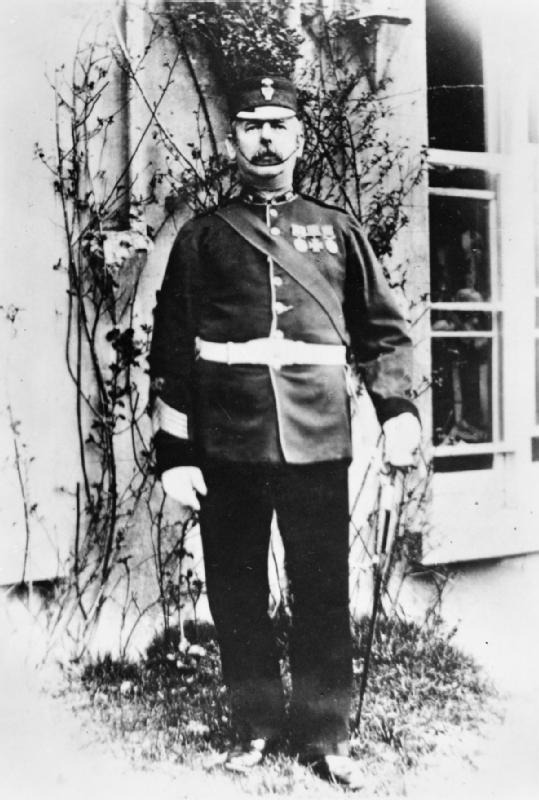
28-year-old Colour-Sergeant Coughlan serving with the 75th Regiment of Foot would have been one of the men who was ordered to take the guns at Badli-ki-Serai, not by firepower but by bayonet. 74 men of the 75th lay wounded, many dying and others killed outright in the first few minutes of the charge. Yet they stormed the guns, always pushing forward until the guns were reached and the serai was open to a relentless attack.
Here, in the horror of battle, came the valiant Sergeant Coughlan, pushing his way with three others into a serai to rescue Private Michael Corbett, who lay on the ground, severely wounded. Despite Coughlan’s best efforts, Corbett died.
“For gallantly venturing, under a heavy fire, with three others, into a Serai occupied by the Enemy in great numbers, and removing Private Corbett, 75th Regiment, who lay severely wounded...”
Coughlan would step up again on the 18th of July during the Siege of Delhi.
“…Also for cheering and encouraging a party which hesitated to charge down a lane in Subzee Mundee, at Delhi, lined on each side with huts, and raked by a cross fire; then entering with the said party into an enclosure filled with the Enemy, and destroying every man. For having also, on the same occasion, returned under a cross fire to collect dhoolies, and carry off the wounded; a service which was successfully performed, and for which this man obtained great praise from the Officers of his Regiment.” (The London Gazette, November 11th, 1862, pp 5346)
The London Gazette, however, omits the more astonishing detail of the charge on Sabzi Mandi.
When the 75th charged the enemy, their commanding officer was shot dead. Undaunted, Coughlan encouraged the wavering men not just by word but by example, rushing forward to continue the attack. His action was followed by victory – the Kabul Gate was stormed and taken, and besides that, the men captured several guns. The achievement did not escape attention and led to a memorial tablet and monument being erected over the Kabul Gate – and it was Coughlan’s name inscribed on the tablet.
Perhaps his most notable feat of valour was during the siege of Delhi. When his regiment charged the enemy, the commanding officer was shot dead, but Sergeant-Major Coughlan, undismayed, encouraged the wavering men by word and example and returned to the attack. The engagement was followed by victory, and the Kabul Gate was stormed and taken, in addition to the capture of several pieces of cannon. This achievement was so noteworthy that a memorial tablet and monument were erected over the Kabul Gate, and inscribed on the tablet was the name of Sergeant-Major Coughlan. Queen Victoria wrote a personal letter complimenting him on his bravery and expressing regret that she was unable to pin the Victoria Cross on his breast herself. He served for thirteen years in India as a Gordon Highlander and for a further 21 years back in Ireland in the 3rd Battalion, Connaught Rangers. He died in 1915 at the age of 87.
District Orders, Devonport, 4th January 1863
The Major General commanding the Western District, having had the honour, in compliance with Her Majestry’s command transmitted through the Right Hon. the Secretary of State for War, to present this day on a General parade, the most honourable decoration of the Victoria Cross to a most deserving N.C.O., Colour Sergt. Cornelius Coughlan of the 75th Regiment; desires to record the fact in District Orders. This is the first occasion during the three years he has commanded the District, that the honour of presenting the V.C. has devolved on him. He used the word “honour” advisedly, for our beloved Sovereign has been graciously pleased to express her deep regret that she is unable to decorate Colour Sergt. C. Coughlan herself. The Major General acts therefore as her representative, and he takes the opportunity of impressing on the Soldiers under his command, that the acts of bravery, for which Colour Sergt. Coughlan obtained the prize anxiously sought for by all ranks of Her Majesty’s Naval and Military Service, and which are recorded by the subjoined extract from the London Gazette of the 11th November 1862, were not mere instances of reckless daring, but exhibitions of cool courage productive of much benefit to the Service. It is by such deeds the V.C. is to be won, and not uselessly risking valuable life. The Major General feels it incumbent on him to record the high character borne by Colour Sergt. Coughlan in his Regt.; Lt. Col. Radcliff considers him a pattern N.C.O., and states, since he entered the Regiment he has never even been reprimanded.
Coughlan would further receive an Indian Mutiny Medal with 2 clasps.

He would serve 13 more years in India with the 75th, after which he returned to Ireland and transferred to the 3rd Battalion (reserve) of the Connaught Rangers, settling down in Westport, County Mayo. Later in life, he served in the South Mayo Rifles. He was also a family man, having married Margaret in 1856, and together they had four children. At the time of his death, four of his grandsons were serving in the army.
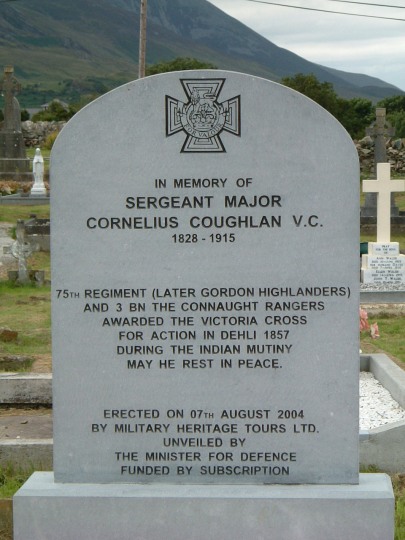
Sergeant-Major Coughlan would live in Westport until his death on the 14th of February, 1915, at the age of 87. Although his funeral was fitting for a hero and comprised of a firing party of the Royal Field Artillery, the Fife, Drum and Bugle Band of the 10th Hants Regiment, politics determined he would not receive a headstone until 2004. For nearly a century, Sergeant-Major Coughlan would lie in an unmarked grave. Following the 1916 Easter Uprising, it was determined that Irish soldiers who had worn the British uniform were persona non grata, and Coughlan, although he had been dead a year, never received the honour of a headstone. It would take a change not just in attitude but in politics to allow a nation to honour their heroes.
His medals are held by the National War Museum of Scotland, Edinburgh Castle.
 Mutiny Reflections