Captain Charles Gough – 5th Bengal European Cavalry
Only one VC was won in August, and it was awarded for a multitude of brave acts that went beyond Delhi. The recipient was Charles Gough of the 5th Bengal European Cavalry, who famously saved the life of his brother Hugh at Kurkowhah while serving under William Hodson on his Rohtak expedition.
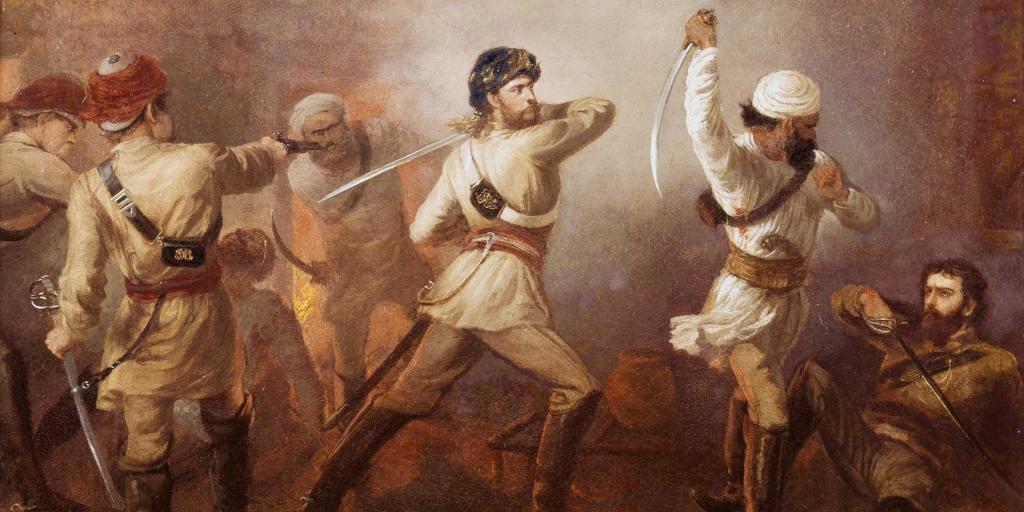
One of a series of 55 paintings depicting Victoria Cross subjects executed between 1859 and 1862 by the British artist Louis Desanges.
The action was described by his brother, rather than by Charles himself:
“An episode occurred during this little fight which I must relate with a feeling of the deepest gratitude to the gallantry of my brother Charles, who fortunately was so near at hand. When the enemy made their desperate rush I was rather in the forefront of the party awaiting them, and in the melee which took place, I was forced backwards, and, suddenly making a false step from the roof on to a lower roof about a foot down, fell or was forced on my knees. While thus half falling, one man made a cut at me with his heavy sword, which cut right down my riding -boot. Another was aiming a better-directed blow, when my brother, seeing my danger, rushed forward and attacked the two, killing both, and thus undoubtedly saved my life. As it was, the hilt of my sword was forced into my wrist by a sword-cut, inflicting a slight wound.” (General Sir Henry Hugh Gough, Old Memories, pp 89-90)
Born in 1832 in Chittagong (now in Bangladesh) to George and Charlotte (née Becher) Gough, Charles, like his brother Hugh, was educated in England. Charles returned to India earlier than Hugh when, at the age of 16, he joined the 8th Bengal Cavalry. His brother, Hugh, only a year younger, was commissioned in 1853 as a cornet in the 3rd Bengal Light Cavalry. While Hugh was still in England, Charles took part in the 2nd Sikh War (1848-49), seeing action in Ramnuggur, Chenab and the battles of Sadoolapur, Chillianwalla and Goojerat. In 1857, Charles Gough was in the Guides’ Cavalry and rode with them to Delhi. Here, he met his brother Hugh, who had been sent up from Meerut.
Already recognised as brilliant cavalry officers, Hodson enlisted the brothers for his Rohtak expedition, Charles leading the Guides and Hugh as a part of Hodson’s Horse. Returning to the Ridge, Charles was almost immediately embroiled in the action on the 18th of August, leading the Guides Cavalry in a charge against the mutineers. In the hand-to-hand combat which ensued, Charles killed two mutineers after a prolonged fight, leading to his second citation for a VC. Charles transferred to Hodson’s Horse and was present at the Second Relief of Lucknow under Sir Colin Campbell, and had three more mentions in despatches. He received, in all, four citations for the Victoria Cross.
“First, for gallantry in an affair at Khurkowdah, near Rhotuck, on the 15th of August, 1857, in which he saved his brother, who was wounded, and killed two of the Enemy.
Secondly, for gallantry on the 18th of August when he led a Troop of the Guide Cavalry in a charge and cut down two of the Enemy’s Sowars, with one of whom he had desperate hand-to-hand combat.
Thirdly, gallantly on the 27th of January 1858, at Shumshabad, where, in a charge, he attacked one of the Enemy’s leaders and pierced him with his sword, which was carried out of his hand in the melee. He defended himself with his revolver and shot two of the enemy.
Fourthly, for gallantry on the 23rd of February, at Meangunge, where he came to the assistance of Brevet-Major 0.- H. St. George Anson, and killed his opponent, immediately afterwards cutting down_ another of the Enemy in the same gallant manner.” – The London Gazette, 21 October 1859, No. 22318.
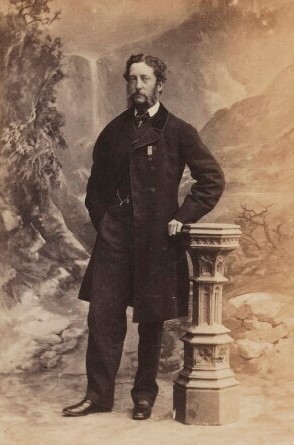
War would remain the mainstay of Charles’ career. Although he returned to England on sick leave following the mutiny, in 1864-65 he took part in the Bhutan Expedition and on the outbreak of the 2nd Afghan War, he was back in the thick of things, appointed brigade commander of the Peshawar Valley Field Force under Lieutenant Sir General Samuel Browne. Once again, it was an opportunity for Gough to show his prowess as a cavalry officer, leading the assaults on Kabul and the attack on Ali Masjid. He would receive the campaign medal with two clasps, followed shortly by a KCB. Upon returning to India, Gough took over command of the Hyderabad Contingent and finally, as commander of the Bengal District following his promotion to Major General in 1885. He finally retired to Ireland in 1895. His soldiering days now over, Gough spent the remaining years of his life as a country gentleman, writing a book on the Sikh Wars. He died in 1912.
Both his sons, John and Hubert, entered the military, and they, like Charles and his brother, had distinguished careers. His youngest son, John, received his VC in 1903 in British Somaliland but was sadly killed in France in 1915. Hubert’s career was somewhat more colourful than Johns’; however, it belongs rightly in the annals of WWI and the history of the 5th Army.
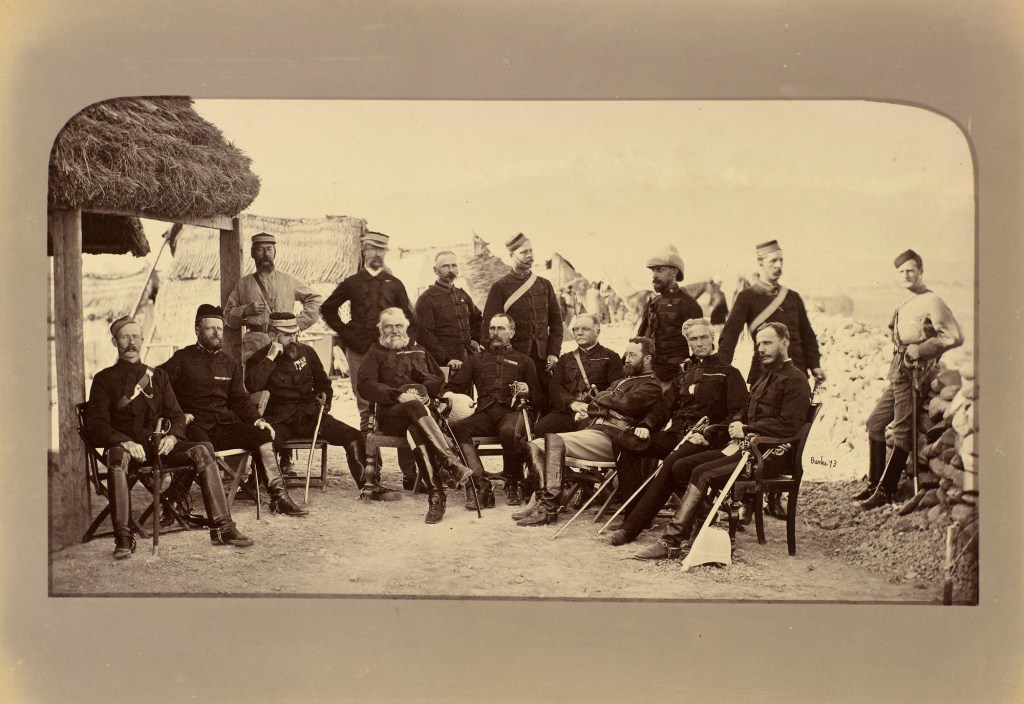
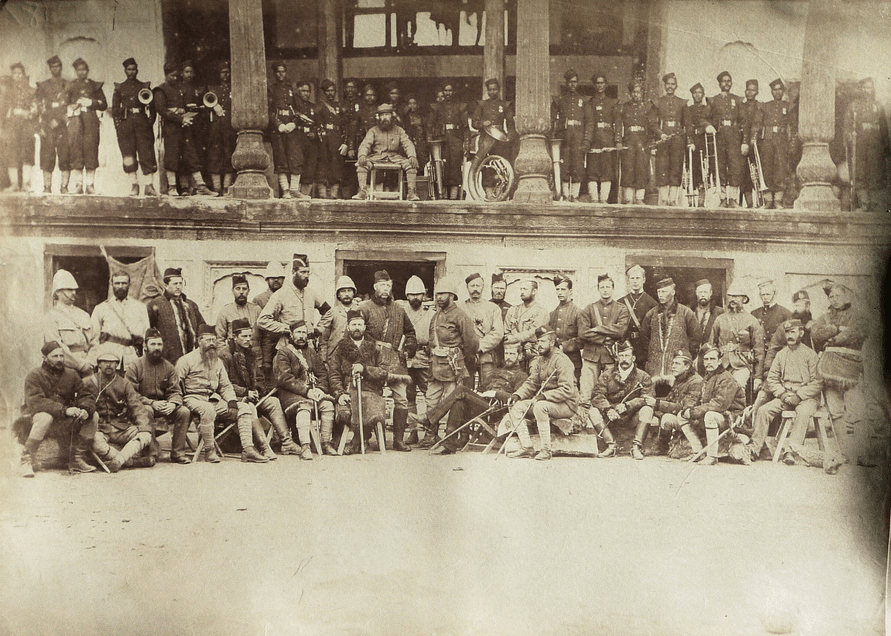
Back row (left to right): (unidentified); (unidentified); Major John Slade; (unidentified); (unidentified) and Brigadier General John Doran.
Front row, left to right are: Lieutenant Gilbert Hamilton; (unidentified); Colonel Charles Macgregor; Lieutenant General Sir Samuel Browne (1824-1901) VC, Commander of the Peshawar Valley Field Force; Brigadier-General Frederick Ernest Appleyard (1829-1911); Brigadier-General Sir Herbert Macpherson (1827-86) VC; Brigadier-General Charles Gough VC and Brigadier-General John Adams Tytler (1825-80) and (unidentified)
Sources:
Anson, Brevet Major O. H. G. S. With H.M. 9th Lancers During the Indian Mutiny. Edited by Harcourt S. Anson. London: W. H. Allen & Co., 1896.
Barter, Richard. The Siege of Delhi: Mutiny Memories of an Old Officer. London: The Folio Society, 1984.
Best, Brian. The Victoria Crosses that Saved an Empire. Barnsley: Frontline Books, 2016.
Cave-Browne, Rev. J. The Punjab and Delhi in 1857. Vol. 2. Edinburgh: William Blackwood and Sons, 1861; repr., London: Forgotten Books, 1911.
Griffiths, Charles John. A Narrative of the Siege of Delhi: With an Account of the Mutiny at Ferozepore in 1857. Edited by Henry John Yonge. London: John Murray, 1910.
Hibbert, Christopher. The Great Mutiny: India 1857. London: Allen Lane, 1978; repr., New York: Viking Press, 1980.
Leasor, James. The Red Fort: An Account of the Siege of Delhi. London: Werner Laurie, 1956.
Malleson, Colonel G. B. The Indian Mutiny of 1857. London: Seeley and Co., 1891.
Links:
Army Museum of New South Wales. “Alfred Spencer Heathcote, VC.” https://www.armymuseumnsw.com.au/Alfred_Heathcote.php.
Memorials to Valour. “Victoria Cross.” Accessed May 24, 2026. https://www.memorialstovalour.co.uk.
Phototheca Afghanica. “The Second Anglo-Afghan War (1878-1880).” https://www.phototheca-afghanica.ch/index.php?id=329.
Stewart, Iain. “Thomas Hancock VC.” Victoria Cross. https://victoriacrossonline.co.uk/
Victoria Cross Online. http://vconline.org.uk/
 Mutiny Reflections
Aside from the valour, these men all seemed to be cut from the same cloth soaked in wanderlust!
LikeLiked by 1 person
For sure! I think they were cut from very different cloth in more ways than one. It never ceases to amaze me how unabashedly brave they were and then went on as if what they had done was nothing in particular. The VC was a new kind of award and only recently open for men of the East India Company which were considered by men of the Queen’s service an inferior branch of the army and in part the idea of winning one certainly spurred on some of the acts of bravery, yet I think many of these men were inherently possessed of a strong sense of duty and honour which led them on. The Indian Mutiny was one of the last conflicts which saw fighting at such close quarters and they would have been very close to their foes to do what they did. There is a trend today to mock these men yet I wonder how many of our friendly keyboard “warriors” would be able to keep up even at half a pace with a Hodson or a Nicholson, have the clear judgement of Tombs or the cold determination of a Gough. I doubt any of them would make the muster.
LikeLiked by 1 person
Agreed. The old maxim of walking a mile in another’s shoes certainly holds true here!
LikeLiked by 1 person