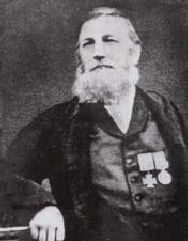
Private James WilliamThompson, the 60th Rifles
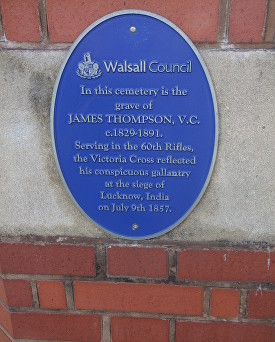
On the 9th of July, another man made his name for bravery – however, like Private Murphy, who swam with as much vigour as Mowbray Thompson and Lieutenant Delafosse, they are remembered for Cawnpore and not Murphy, who died largely unknown. Such is the case of James Thompson. His deed, though no less admirable than that of Hills and Tombs, has been forgotten. Very little is known about the early life of James William Thompson. Born in 1830 at Hadley, near Yoxall in Staffordshire, James had worked as a farm labourer before enlisting in the 1st/60th Rifles in 1852. After the Meerut uprising, Private Thompson, along with Alfred Heathcote, marched with his regiment as part of the Delhi Field Force and fought at Badli-ki-Serai.
The citation which appeared in the London Gazette is short and terse.
” For gallant conduct in saving the life of his Captain (Captain Wilton), on the 9th of July, 1857, by dashing forward to his relief, when that Officer was surrounded by a party of Ghazees, who made a sudden rush on him from a Serai, – and killing two of them before further assistance could reach. Also recommended for conspicuous conduct throughout the Siege. Wounded. Elected by the Privates of the Regiment.” The London Gazette of 20 January 1860, No. 22347, p. 179
The incident, however, though perhaps not on the scale of Hills and Tombs, was no less admirable.
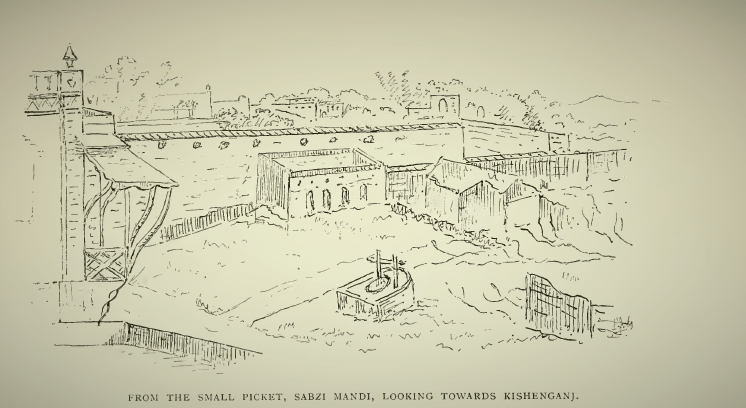
On the 9th of July, Captain F.R. Wilton led his company to the Sabzi Mandi, where they were surprised by a party of rebels who had been hiding in a serai. The rain had fouled Wilton’s pistol, which misfired, leaving him defenceless. Surrounded as he was by a particularly vicious band of mutineers, there was little hope he would survive. Private Thompson, seeing the straits his officer was in, leapt forward, killed two of the attackers with a bayonet, charged the rest, who turned and fled, and then dragged Wilton to safety. Thompson then went back to doing his duty.
During the final assault on Delhi, Thompson was severely wounded, his left arm was amputated at the shoulder, and he was invalided out of the army. Captain Wilton, fortunately, did not forget Thompson’s bravery and gave him a position, for a short time, as a gamekeeper at the Wilton estate in Scotland. In 1865, Thompson returned to his home in Staffordshire, where he took up work as a watchman in a colliery. However, fate and time were unkind to James Thompson. By 1890, he was penniless and living in poverty, and the following year, he died, at the age of 61. He was buried in an unmarked grave in Queen Street Cemetery in Walsall. The council eventually placed a memorial plaque commemorating Private James Thompson, VC.
Sergeant-Major Richard Wadeson, 75th Regiment of Foot
Wadeson Wins the Victoria Cross
Saving one man under fire would be commendable enough, but Wadeson saved two on the same day. On the 18th of July, the objective was to push the rebels out of Sabzi Mandi and subsequently establish a picket which would extend the British lines on the Ridge. The action was severe and the fighting brutal.
“The force sent to dislodge them was under command of Colonel Jones, of the 60th Rifles, who made his arrangements with singular judgment and tact and insisted on a regular formation being kept by the troops, instead of the desultory style of action in vogue during previous sorties. There was, however, some very hard fighting in the gardens and serais, where we were received by a storm of bullets; but the men being persuaded to keep well under cover, the losses were not very serious, the casualties amounting in all to about ninety officers and men. The enemy, as usual, suffered severely, more especially from the fire of our field guns, which mowed them down when collected in groups of two and three hundred together.” (Griffiths, Narrative of the Siege of Delhi)
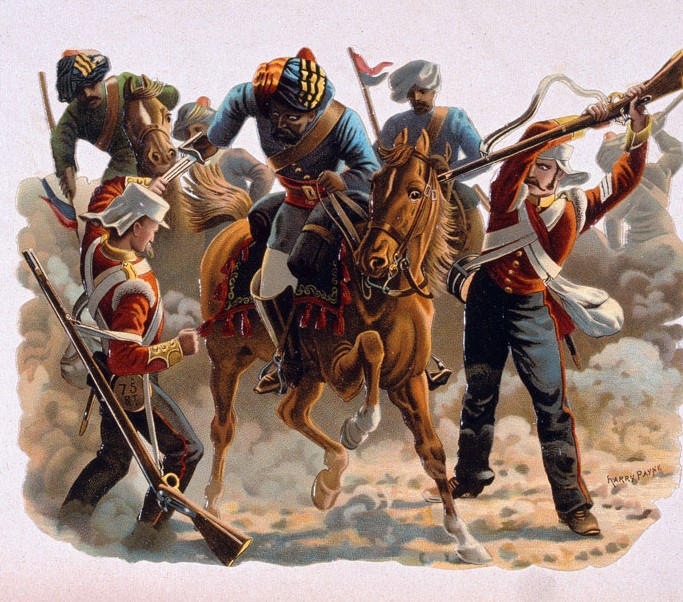
During the fighting, Richard Wadeson saved the life of Private Michael Farrell of the 60th of Foot. Attacked by a rebel sowar, Farrell was unable to ward off the attack, as it is, the sowar being mounted and Farrell on foot, it was hardly a fair fight. Wadeson, on the spur of the moment, ran his bayonet through the cavalryman, and Farrell was saved. He then returned to the fight only to come across the wounded Private Barry of the 75th trying with little success to ward off an attack by another sowar. Wadeson ran forward and bayoneted the attacker, thus saving Barry. Both Farrell and Barry survived, the latter with a slight wound in his shoulder. For these acts, Wadeson was nominated by his regiment for the Victoria Cross.
The Accidental Shooting of Captain Thomas Greensill
Richard Wadeson was involved in the unfortunate and accidental shooting of Captain Thomas Greensill of the Engineers on 20 July, which resulted in Greensill’s death. While this might have blighted a man’s career, it was fortunate for Wadeson that cooler heads were willing to take a calmer view of the entire incident and also to overlook the fact that the man he shot was none other than a nephew of General Sir Abraham Roberts, K.C.B. Richard Barter describes him as “…little Tommy Greensill…He was very youthful and small, so that he looked quite a boy without a sign of hair on his face, and his quiet manners and amiability made him a favourite with all…”
When the dhoolie bearers brought him up from the Metcalfe Piquet and spoke to him, “On lifting the curtain, there lay poor little Greensill, very pale and quiet. It was a very hot night, and the perspiration stood in thick beads on his forehead, and he looked wan and pitiful as the light of the lantern flickered on his face. There was no blood about, and I began to hope there was not much the matter when he lifted up his shirt, and I saw that he had been shot through the stomach rather low down on the left side. The wound was not bleeding, but his bowels were protruding, and I feared the worst. I said, “My God, Greensill, how was it?” “Ah,” he said bitterly,” they didn’t give me time, they fired too quick, one of our own fellows, one of your Regiment, Barter.” The doctors ascertained there was nothing they could do for Captain Greensill – after making him comfortable with what remedies they had at hand, Barter was informed there was no hope. Towards midnight, after several hours of terrible suffering, Greensill managed to make out his will, and by morning, he was dead.
Richard Barter took up the investigation into his death personally, as Greensill had been shot by one of Barter’s men, Sergeant-Major Richard Wadeson, who Barter had but recently recommended for a promotion to ensign. The shooting was a regrettable accident, as Barter soon found out. Greensill had been shot by Wadeson while out reconnoitring between Metcalfe House and the city.
It had become necessary to find out where the enemy was posting their sentries at nightfall to know where best to attack them in the morning – Wadeson was told off for the mission, and Greensill, just finishing his tour of duty as Field Engineer, happened to be at Metcalfe Piquet. He volunteered to join Wadeson; each man was accompanied by two others.
“After going beyond our line, they found a kind of ravine running straight down towards the Enemy piquets. The sides were lined with low brushwood, and Greensill and his men when down into it, having agreed with Wadeson that they were to communicate by a whistle and that he was on no account to come out of the ravine. Wadeson and his men were to keep on the high ground on the right side of the ravine and creep through the bushes there as far as they could do with safety….The men who went into the ravine with Greensill told me that after going some way through it, it became very dark with overhanging trees, and the silence was positively terrible.”
Greensill and the two men proceeded some three hundred yards through the ravine. Not having heard anything from Wadeson and his party, and what with the silence, the darkness and a fear of snakes hiding in the brush, they decided to “…creep up the bank which they did and crouched down under the shade of some trees. They hadn’t been there long when from the rear, they were fired at, and Greensill was wounded; they heard no whistle and no challenge.” Wadeson did not deny shooting Greensill, but he was not aware at first that he had done so. “Wadeson’s story is that after going on some way, he saw a white figure, and he and his men, judging by the colour at once, decided it must be the enemy’s sentry. They whistled two or three times and challenged in a low tone. When not receiving an answer, Wadeson took the firelock from one of his men or had one himself, I am not sure which, and fired at the white figure…”
The problem was, Greensill had forgotten to redye his uniform – the constant sun and washing had taken the colour out of his clothes. Barter had told him to do it in order to prevent mistakes as the enemy was in the habit of wearing white attire. Greensill hadn’t followed the advice. Although it was a simple mistake, it cost him his life. Barter was opened minded enough to admit there was enough blame to go around.
“It’s difficult to reconcile the two stories but to my mind, Greensill was wrong to come out of the ravine after promising not to do so; if he felt nervous he should have retired back through it, and not come out where he did, and there is no doubt but that the white uniform caused his death for the two men who were with him dressed in khaki were not seen by Wadeson and his men. With regard to Wadeson, whether he whistled or challenged or not, he was wrong to have fired: if the figure he fired at was the Enemy’s sentry he had evidently not observed him and there was no necessity for shooting him; on the contrary, it was wrong in every way to do so. It would only create unnecessary alarm and defeat the purpose of the expedition by causing the Enemy to shift his chain of picquets. Wadson had only lately been promoted to an Ensigncy and was too fond of using the firelock himself. I suppose it is hard to break an old dog from his tricks, and I can’t help thinking that both parties were excited and nervous, and who can blame them, it’s a far different thing sitting in a comfortable room from crawling through a jungle in India…to get a look at a ruthless Enemy who never spared… and might be stalking you the whole time, only waiting for you to get far enough within his Line to capture you and polish you off at his liesure. However it happened, poor little Tommy Greensill lost his life, and his small, boyish figure stretched that night, mortally wounded by the hand of a brother officer, was truly a sad sight. …” (Barter, pp28.30)
Barter, although not exonerating Wadeson from blame in the incident, put it down to nerves and bad judgment. He had high hopes for Sergeant-Major Wadeson – the incident with Greensill, though deplorable, would not affect Wadeson’s subsequent career.
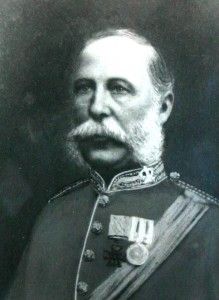
The Army and Navy Gazette says: “Lieutenant Colonel R. WADESON, V.C., who had succeeded to the Lieutenant-Colonelcy of the 75th Regiment, makes the third officer commanding a regiment who has obtained his commission from the ranks.
Colonel Wadeson obtained his ensigncy in the 75th from sergeant-major, June 2, 1857; became lieutenant, September 19, 1857; captain, December 9, 1864; and major, July 17, 1871. He served with the regiment in the Indian campaign of 1857 from the outbreak on May 12, including the battles of Budinkeserai, siege operations before Delhi, and repulse of sorties on June 12 and 15, and night attacks on the camp on June 18 and 23, and July 14 and 18; storming (severely wounded) and capture of Delhi (medal with clasp and Victoria Cross). He obtained the Victoria Cross when an ensign for “conspicuous bravery at Delhi on July 18, 1857, when the 75th was engaged in the Subjee Mundee, in having saved the life of Private Farrell when attacked by a sowar of the enemy’s cavalry and killing the sowar. Also, on the same day, for rescuing Private Barry, when, wounded and helpless, he was attacked by a cavalry sowar, whom Ensign Wadeson killed.”
In 1875, Wadeson received his lieutenant colonelcy and was appointed commander of the 75th, becoming only the 3rd regimental commander in the British army to have risen from the ranks. Following his promotion to brevet colonel, in March 1881, he became Lieutenant Governor of the Royal Chelsea Hospital, where he resided until his death in January 1885 at the early age of 58. He was buried with full military honours at Brompton Cemetery.
 Mutiny Reflections
Aside from the valour, these men all seemed to be cut from the same cloth soaked in wanderlust!
LikeLiked by 1 person
For sure! I think they were cut from very different cloth in more ways than one. It never ceases to amaze me how unabashedly brave they were and then went on as if what they had done was nothing in particular. The VC was a new kind of award and only recently open for men of the East India Company which were considered by men of the Queen’s service an inferior branch of the army and in part the idea of winning one certainly spurred on some of the acts of bravery, yet I think many of these men were inherently possessed of a strong sense of duty and honour which led them on. The Indian Mutiny was one of the last conflicts which saw fighting at such close quarters and they would have been very close to their foes to do what they did. There is a trend today to mock these men yet I wonder how many of our friendly keyboard “warriors” would be able to keep up even at half a pace with a Hodson or a Nicholson, have the clear judgement of Tombs or the cold determination of a Gough. I doubt any of them would make the muster.
LikeLiked by 1 person
Agreed. The old maxim of walking a mile in another’s shoes certainly holds true here!
LikeLiked by 1 person