The Battle of Bithur – Our Hardest Fight of All
Cholera continued to ravage Havelock’s camp – on the 15th of August, he reported to Sir Patrick Grant that on this day alone, ten of his men, all of the same regiment, had died, and in his force, numbering 1415, there were 335 men disabled by sickness or wounds.
“But,” he added, “ I do not despair. I march tomorrow against Bithoor, but it seems advisable to
look the evil in the face, for there is no choice between reinforcements and gradual absorption by disease. The medical officers yesterday recommended repose, but I cannot halt while the enemy keeps the field, and, in truth, our health has suffered less fearfully even in bivouac than in Cawnpore”
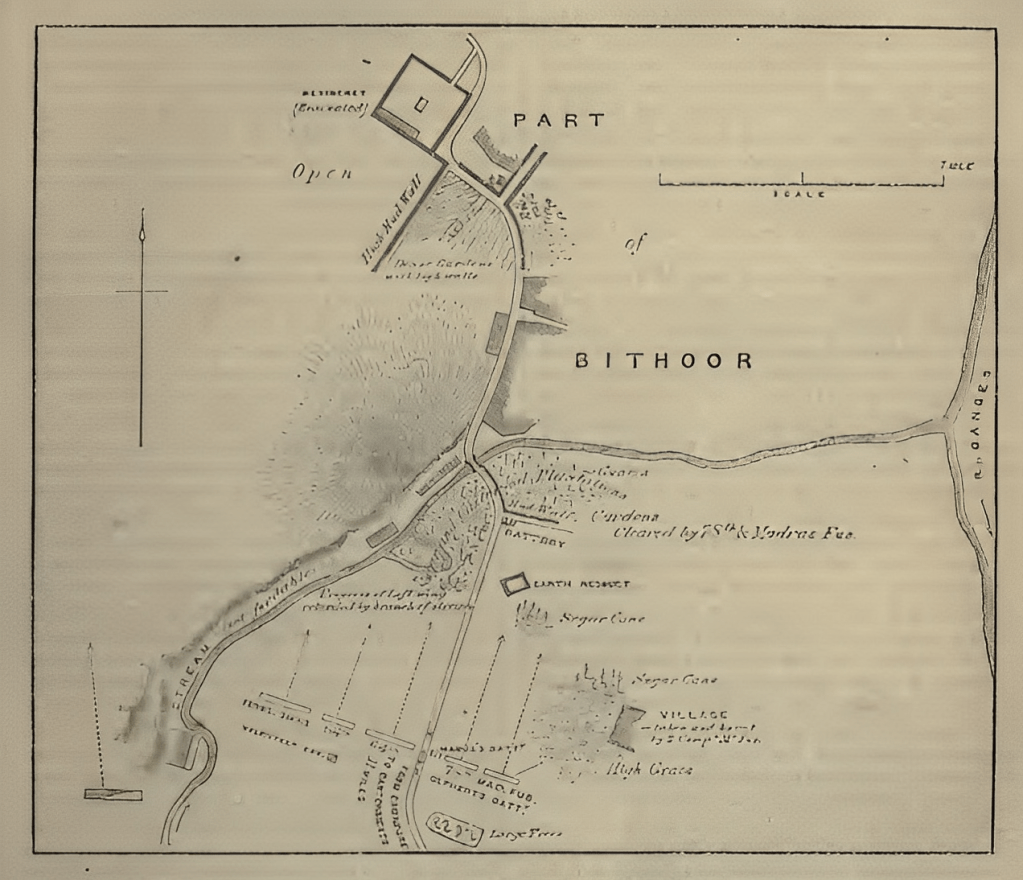
Havelock allowed his troops to rest on the 14th and the 15th of August. On the 16th, however, at 4 a.m., the bugles sounded and the force assembled. They were ready to march shortly after sunrise, leaving Neill with 100 men in charge of the entrenched camp. Havelock was going to meet the combined rebel forces of the 17th, 28th, 31st,34th and 42nd NI, the 2nd Regular and 3rd Irregular Cavalry, the Nana’s own retainers and 2 guns. In all, they amounted to no less than 4000 men. They were sitting in a marvellously well-entrenched position, in “mud quadrangles” and sheltered by plantations of sugar cane. Two villages, on either flank, were connected by earthworks and acted as supports for the whole position. The rebels had not neglected to place a considerable number of troops in either village to the left and the right. It was here, in Bithur, that the Nana Sahib was “defending what was left of his household gods and altars.” Despite their preparations, the rebels had made one mistake – instead of deporting the main body of their force behind an unfordable stream that ran in front of the town, which had only one narrow stone bridge to cross, they had thrown themselves forward in front of the bridge, which left their only means of retreat in their right rear.
Havelock marched his men the eight miles to Bithur – the right wing formed by Maude’s Battery (but without Maude, as he was ill), the Madras Fusiliers and the 78th Highlanders, while the left was composed of the 64th, 84th, the Sikhs and Olphert’s Battery. Havelock would employ his by now signature tactic – direct echelon from the right. However, before he could do so, seeing how well entrenched the rebels were, he made his men lie down, and for the next 20 minutes, poured as heavy a fire as his guns could manage, supported by the Enfields into the enemy position. The artillery opened up at 1000 yards, but soon limbered up again and advanced to 700. A considerable body of cavalry appeared on the left – a few shells thrown among them drove them off. The rebels unmasked their artillery, but it consisted of only 2 guns. After a few rounds, Maude’s Battery again limbered up and this time, reopened at canister range. The mud quadrangles stood fast, and the only answer then was the bayonet.
Covering the infantry with the Madras Fusiliers, he gave the order to advance. When his troops were within 20 yards of the quadrangles, up sprang the men of the 42nd, dressed in their red coats. They had waited until the British were at closer range and then opened up with destructive fire. Meanwhile, the artillery continued their advance as did the men of Havelock’s army.
“As the Fusiliers moved in extended order on the right, they were suddenly assailed by a sharp fire from a high outwork that had been thrown up in front of a village. Major Stephenson, then in command of the *Blue Caps,’ Neill having remained in Cawnpore, at once wheeled three of his companies to the right, and came to close quarters with the 42nd B.N. I., who really fought with great resolution from behind their ‘moorcha.’ Havelock said that ‘he had not seen fire kept up so well since the days of Ferozshuhur ‘ (in the Punjab).”
The 42nd fought with determination, but they were unable to stop the British. As their comrades fell around them, they lost heart and retreated to their support in the two villages.
“Our Artillery meantime carried on their usual duel with the enemy’s, but had unusual difficulty in silencing the latter, owing to the protection afforded by the earthworks; so that the rebels had to be driven out of their works mainly at the point of the bayonet; and the principal credit of this hardly-won success was certainly due to the Infantry.”
With each advance, the rebels were driven back into the villages. For a moment, they were stopped and the British troops threw themselves on the ground for a moment’s rest. The day was not done and quickly the bugles sounded the advance. They would need to carry the villages, not by might or artillery but by brutal hand-to-hand combat, taking each house and every winding lane.
“One Highlander and a Madras fusileer, reduced to a rifle between them, entered a building where there
were seven Sepoys and killed the whole of them. Some of the mutineers, enraged at their defeat, broke their muskets and withdrew, weeping.“
The mutineers defended their guns with “great spirit” but it was not enough. They were driven off, and the guns were captured. The cavalry attempted to attack Havelock’s rear, killing 30 camp followers and plundering the mess property of the volunteers. It did not matter – Bithur was carried and won by Sir Henry Havelock. It was his hardest fight but not his crowning glory. His force was too small and exhausted to give chase and most of the rebels were able to flee unharmed.
“The enemy was now in full retreat, but our troops were too exhausted to pursue them. Here again the
General had reason to regret the want of cavalry. “ Had I possessed cavalry,” he wrote, “not a rebel or mutineer would have reached Sheorajpore alive. ” The General had been indefatigable in his efforts to augment his handful of Volunteer Horse, which, though not exceeding eighteen when first formed, had now been increased to the number of eighty. But this gallant little squadron was too valuable to be hazarded in an unequal contest with the enemy, though it was impatient to be let loose on them.”
He lost 50 men in the battle, but seven men of the 84th died of sunstroke and the Madras Fusiliers lost 5 to the same cause. Havelock received intelligence that the mutineers had fled mostly to Fatehgarh but a detachment had branched off to Sheorajpore, only 12 miles from Cawnpore but he could not follow. His men bivouacked for the night in Bithur and returned to Cawnpore the next day, in case the rebels at Sheorajpore decided to move on the town.
He issued the following Order of the Day, the last Sir Henry Havelock would ever write.
“ The Brigadier-General congratulates the troops on the result of their exertions in the combat of yesterday. The enemy were driven, with the loss of 250 killed and wounded, from one of the strongest positions in India, which they obdurately defended. They were the flower of the mutinous soldiery, flushed with the successful defection at Saugor and Fyzabad; yet they stood only one short hour against a handful of soldiers of the State, whose ranks had been thinned by sickness and the sword. May the hopes of treachery and rebellion be ever thus blasted! And if conquest can now be achieved under the most trying circumstances, what will be the triumph and retribution of the time when the armies from China, from the Cape, and from England shall sweep through the land? Soldiers! In that moment, your labours, your privations, your sufferings, and your valour will not be forgotten by a grateful country. You will be acknowledged to have been the stay and prop of British India in the time of her severest trial.”
Waiting for him in Cawnpore on the 17th of August, 1857, was a copy of the Calcutta Gazette, dated the 5th of August. It contained the nomination of Major-General Sir James Outram to the military command of the very country in which Havelock had been operating. Havelock had in fact been superseded -and the only notification he received was that one stark announcement in the Gazette. The men in Calcutta had judged him – Havelock had not failed but he had not lived up to their expectations. In the same way, Neill had had to make way for Havelock, so Havelock for Outram.
Whether Sir Henry ever ranted against this harsh judgement, he never revealed; he was a soldier of honour and obeyed his orders. He informed the new Commander-in-Chief, Sir Colin Campbell, (who had taken up the reigns on the 13th of August from Sir Patrick Grant), that though his position in Cawnpore was fraught with danger, where he would remain, if reinforcements were held out to him he could continue to hold this one dusty town.
So ended Sir Henry Havelock’s first Oudh Campaign, He had fought no less than 9 battles and lost none. And there was still Lucknow.

Sources:
Annand, A. McK. “The Indian Mutiny Letters of Lieutenant William Hargood, 1st Madras Fusiliers.” Journal of the Society for Army Historical Research 43, no. 176 (December 1965): 190–215. https://www.jstor.org/stable/44226401.
Brock, William. A Biographical Sketch of Sir Henry Havelock, K.C.B. London: James Nisbet and Co., 1858.
Groom, William Tate. With Havelock from Allahabad to Lucknow, 1857. Edited by Helen M. I. Groom. London: Sampson Low, Marston & Company, 1894.
Headley, J. T. The Life of General H. Havelock. New York: Charles Scribner, 1861.
Hervey, Charles. Lieutenant General Crommelin, C.B., Royal (Bengal) Engineers: A Memoir and a Retrospect. Exeter: Printed by W. Pollard, 1887.
Malleson, G. B., ed. Kaye’s and Malleson’s History of the Indian Mutiny of 1857–8. Vol. 2. London: Longmans, Green, and Co., 1892.
Marshman, John Clark. Memoirs of Major-General Sir Henry Havelock, K.C.B. London: Longman, Green, Longman, and Roberts, 1860.
Maude, Francis Cornwallis. Memories of the Mutiny. Vol. 1. London: Remington & Co., 1894.
My Journal, or What I Did and Saw Between the 9th June and 25th November, 1857: With an Account of General Havelock’s March from Allahabad to Lucknow. By a Volunteer. Calcutta: Baptist Mission Press, 1858.
North, Charles Napier. Journal of an English Officer in India. London: Hurst and Blackett, 1858.
Shepherd, J. W. A Personal Narrative of the Outbreak and Massacre at Cawnpore, During the Sepoy Revolt of 1857. 4th ed., rev. and enl. Lucknow: Methodist Publishing House, 1894.
Sherer, J. W. Havelock’s March on Cawnpore, 1857: A Civilian’s Notes. London: Thomas Nelson & Sons, 1910
 Mutiny Reflections
What more can I say, but being impressed by the continuation of you high quality research and the accompanying images. I have to admit I have been completely ignorant about this chapter of the English history. However, most impressive are the detailed descriptions of the involved individuals actions and suffering, details which are usually excluded from historical records.
LikeLike
Thank you! The records are out there but they rarely find place in the telling. My goal with this site is to bring history alive through the people who lived the events, be they generals, soldiers, civilians and their families.
LikeLike
Hi Eva! So glad that I came across this interesting read. Thanks for sharing.
LikeLike