The Third Battle of Basharatganj
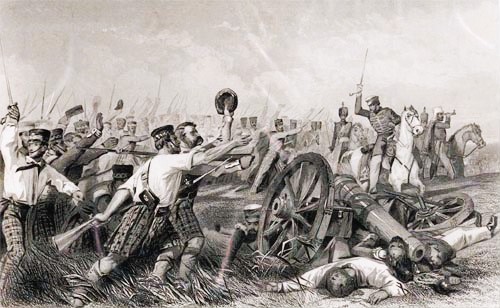
Havelock found the rebels ready to meet him on the well-trodden battlefield, but they had changed their tactics. Instead of concentrating their efforts on Basharatganj, they had entrenched themselves in the village of Booriya a mile and a half in advance. The position had been carefully chosen and fortified with more than their usual skill.
Their right was established on a village on the main road when they had set up a battery, while on the left, on a mound, some 400 yards in the distance, they had posted three guns. In front of them lay a swamp, covered with greenery which looked like dry ground. Here, they planned to ensnare Havelock and destroy his army.
The 78th Highlanders, the Madras Fusiliers, the Sikhs and a portion of the Volunteer Cavalry formed Havelock’s right wing and began their advance – straight to the swamp. Havelock immediately withdrew the men before they became entrapped in the morass. The Highlanders were now moved to the high road, while the Fusiliers, supported by four guns, passed around to the right. As for the insurgents, their artillery kept up a most exemplary fire – the worst Havelock’s men had yet encountered. His artillery was unable to make the slightest impression on them – the insurgents had taken care to shelter their guns by earthworks, and the only way to silence them was by the bayonet. The insurgents’ infantry, too, kept up a most galling fire, protected as they were by the artillery.
To the rebels, one can but imagine their shock and surprise when the Highlanders, reduced in numbers to no more than 100, continued their steady advance straight up to the guns. When within 100 yards of them, they suddenly changed their pace to a rush, and, supported by the flank movement of the Fusiliers, they stormed the guns and bayonetted the gunners. The infantry broke and fled while the Highlanders captured the guns and instantly turned them on the fleeing men, increasing the confusion and slaughter. They had opened the way into Basharatganj. With one shout, the British charged the town. It was the final battle for Basharatganj – the rebels would not face Havelock on those grounds again.
Satisfied, Basharatganj was once again free of insurgents, Havelock fell back again on Mungalwar and on the 13th of August, crossed the river to Cawnpore.
In the meantime, Brigadier-General Neill had been busy.
On the 5th of August, acting on intelligence that the daughters of a loyal Indian, one Narain Rao ( a relative of the Nana’s but not sold to his cause), had been kidnapped by the mutinous 42nd, then, and aided by a rabble of various accounts, the 42nd had proceeded to plunder part of Bithur and sack the Nana’s former residence. Neill at once sent off a party, commanded by Captain J. Gordon on the 6th of August, by steamer to Bithur, accompanied by Rao. With only 40 men of the Madras Fusiliers, 25 Sikhs and six gunners in charge of two 6-pounders and a 5 1/2-inch mortar, Gordon set off at 4 in the morning. While passing Bithur, Gordon noticed the roof of one of the Nana’s houses thronged with men – he instructed the gunners to open fire on them. As soon as they were dispersed, he set a party on the shore to try and find the missing daughters and recover as much of the Rao’s property as they could, both of which they managed with success. Meanwhile, the steamer continued to bombard the houses closest to the shore, and Gordon managed to sink 16 boats, putting a considerable dent into the Nan’s shipping endeavours. By 6 o’clock in the evening, Gordon was back in Cawnpore.
On the 8th of August, Gordon left Cawnpore once again on the steamer, this time to intercept the troops of the Nana Sahib that had begun, on the evening of the 7th, to cross the Ganges, three miles above Bithur. With the same number of troops, Gordon set off again at 4 in the morning. This time, however, as he passed Bithur, he was greeted by heavy musketry fire from the shore. As it was obvious a much stronger force was now encamped at the place, Gordon set his guns to work, and the Fusiliers plying away with their Enfields. The sepoys followed the steamer as she sailed past, taking advantage of the cover provided to them along it for the next three miles. By now, the current was so strong that the steamer could no longer proceed — taking advantage of Gordon’s problem, the mutineers took possession of a house on the bank and commenced a heavy fire on the steamer; Gordon promptly shelled them out of their abode. He then sent out scouts to ascertain if any troops were crossing the river- satisfied they weren’t, Gordon turned the steamer back to Cawnpore.
Just as she passed Bithur, the steamer struck a sandbank, which, at least for Gordon, was happily beyond the range of musketry fire. They were forced to remain thus for the rest of the night. In the morning, realising the steamer was still, to all appearances, stuck, the rebels brought their guns to bear on her, but they were too late. The strength of the current had enabled the steamer to cut its way through the sandbank, and Gordon returned to Cawnpore. His report to Neill gave an estimate, according to what he had seen, of a force of no less than 2000 men amassed at Bithur. Neill was not in a position to attack them, but he could make a show for anyone else who might be watching.
The next morning, he marched out two hundred of his men and four guns three miles up the Bithur road, passing the city on the way. He would continue to repeat the movement for the next three days – a sign that he was neither beaten nor weak. As an exercise in morale, it succeeded. The well-wishers came forward while the rebels and their friends stayed away from Cawnpore.
 Mutiny Reflections
What more can I say, but being impressed by the continuation of you high quality research and the accompanying images. I have to admit I have been completely ignorant about this chapter of the English history. However, most impressive are the detailed descriptions of the involved individuals actions and suffering, details which are usually excluded from historical records.
LikeLike
Thank you! The records are out there but they rarely find place in the telling. My goal with this site is to bring history alive through the people who lived the events, be they generals, soldiers, civilians and their families.
LikeLike
Hi Eva! So glad that I came across this interesting read. Thanks for sharing.
LikeLike