“Write to Sir James Outram, that I wish him to return to India immediately, and the same to General Jacob — we want all our best men here.”
So wrote Lord Canning to Lord Elphinstone at Bombay, in June 1857, nearly a month after events had transpired in Meerut and Delhi. Sir James was commanding the Persia Expeditionary Force and found himself at Bushahr on the 13th of June when the summons came – return to India with all haste. Taking General Lugard and other staff officers with him, Outram embarked on the next ship bound for Karachi. As for General Jacob, he would cool his heels a little longer in Persia until anyone could ascertain what the pleasure of the Government was – should Jacob remain in Persia as the head of the force now that Outram was gone, or should he return to Scinde. Outram would decide when he had any answers at all.
His journey to Karachi was uneventful, unlike Havelock who had been shipwrecked, Outram arrived rested and ready – he proceeded immediately to Bombay, arriving on the 26th of June. He waited patiently until the 9th of July for orders and instructions that never came.
While biding his time in Bombay under Elphinstone’s roof, Outram gathered as much intelligence as he could regarding the rebellion – thus armed with what information he could find he left Bombay on the 7th of July and proceeded to Galle. Only after he left, did instructions arrive for Outram – he should be placed in charge of the troops in Central India; this order was quickly rescinded and in a subsequent telegram, Outram was ordered to make haste and travel to Calcutta. By the time Outram received this message, he was in Madras and well on his way to Calcutta. He arrived on the 31st of July. Lady Canning, who had not been terribly flattering in her first appraisal of General Havelock, was less so when she saw Outram. On the 1st of August, she wrote,
“The steamer arrived and brought Sir J. Outram, whom we have squeezed into the house. He is a very dark-looking Jewish-bearded little man, with a desponding, slow, hesitating manner, very unlike descriptions, or rather the idea raised in one’s mind by his old Bombay name of the “Bayard of the East”, and this year’s Bombay saying of `A fox is a fool and a lion a coward y the side of Sir J. Outram.’ He never can have done the things Sir C. Napier accuses him of, but he is not the least idea my idea of a hero.”
The Bayard of the East
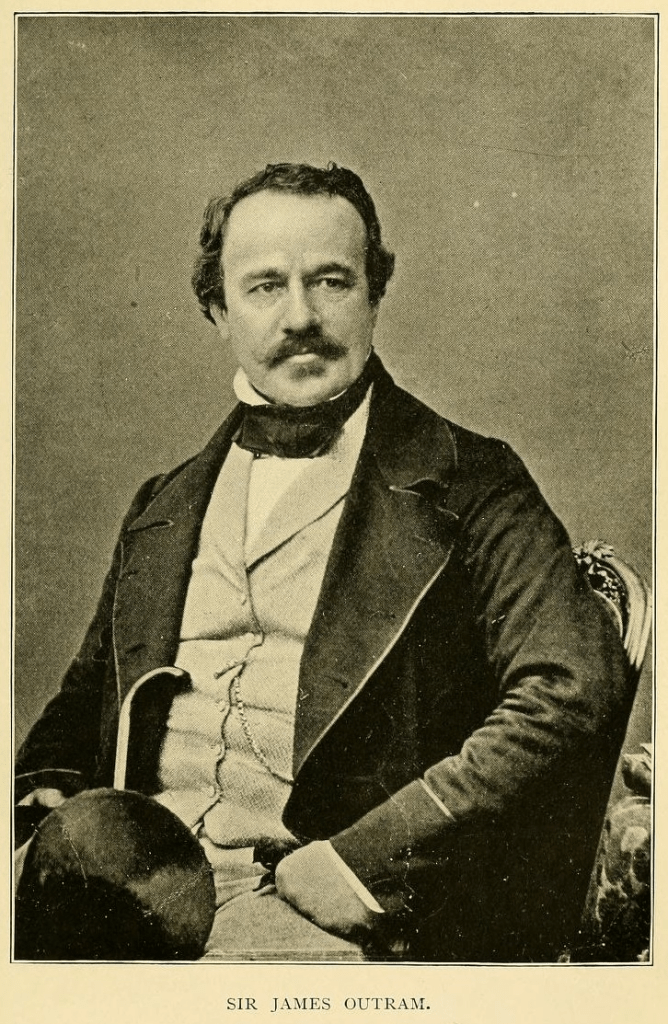
The son of Benjamin Outram, a civil engineer and Margaret Anderson, the daughter of the renowned writer on agriculture, James Outram was born in 1803 at Butterley Hall, in Derbyshire. The untimely demise of his father in 1805, saw his mother take hold of the reigns of the family which consisted of 5 young children, of which 2 were boys, Francis and James, both destined for careers in India. Her husband’s sudden death left the widow Outram nearly penniless – her husband had been wracked with debt and what little his estate yielded, she put together with the £200.- a year she received from her relatives. Although determined at first to remain in the vicinity of Butterley Hall, in 1810, Mrs. Outram packed up goods and children and moved them all to Aberdeen.
As the daughter of Dr. James Anderson, she was due an annuity from the Government – Mrs. Outram obtained it, however, through an appeal she launched directly to Lord Melville in London. The lord had little chance against Mrs. Outram. Some twenty years after the incident, she wrote her own account of the attack:
“My spirit rose, and, in place of meanly supplicating his favour like a pauper soliciting charity, I addressed him like a responsible being, who had misused the power placed in his hands by employing my father’s time and talents for the good of the country, and to meet his own wishes and ends, then leaving him ignobly to suffer losses he could not sustain, but which his high-toned mind would not stoop to ward off by solicitations to those who had used him so unjustly. I then stated my own situation, my dependence and involved affairs, and concluded by saying that I could not brook dependence upon friends when I had claims on my country by right of my father, adding, ” To you, my lord, I look for the payment of these claims. If you are an honest or honourable man, you will see that they are liquidated; you were the means of their being incurred, and you ought to be answerable for them. In making this application I feel that I am doing your lordship as great a favour as myself, by giving you an opportunity of redeeming your character from the stigma of holding out promises and not fulfilling them.” All this I stated and much more in as strong language, which was so different from anything his lordship expected, or was used to meet with, that he afterwards told me he never was so taken by surprise or got such a lecture in his life.’
The grand lady lived well into her 80’s, with a sparkling wit and shrewd mind until the very end.
With his mother’s forceful nature and his own chivalrous spirit, there was little doubt that James Outram would succeed. It was his brother Francis however, on whom everyone had pinned their hopes. Called the “beau ideal of all that is elegant and refined” Francis received his early training at Christ Hospital. Still, the grant of a cadetship saw him ensconced at Addiscombe where he soon became a “distinguished scholar and superior draughtsman” and he left Addiscombe after three terms instead of the customary four to enter Chatham as an officer of Engineers. It was a promising start.
As for James, he was a small, pale child, quiet and sedate in his ways who showed more talent as a sportsman than a scholar early on. Like his brother, James had a talent for drawing and mathematics but when it came to actual learning, he was “the reverse of studious” and given over to the art of practical jokes of which his masters at Udney were the butt – they retaliated with swift and uncompromising punishment, which James, to their surprise, took manfully. By the time he reached 13, James had gained a reputation as the protector of bullied boys, a stalwart friend, courageous without question and the best man on the field.
Although James had spoken often and clearly of his wish to be a soldier, his mother believed he would be better off in the church – submissions were duly made, appeals delivered and it looked as if she would have her wish, if James had not mentioned to his sister,
“You see that window; rather than be a parson, I’m out of it, and I’ll enlist for a common soldier!”
His mother, though dismayed, did acquiesce to her son’s demands – a parson he would not be but the question was, how to make him a soldier. The intervention of one Captain Gordon, who happened to be on a visit to Mrs. Outram one fine afternoon, was gratefully taken and he obtained for James a direct Indian cadetship. A better offer came in its wake in the guise of a nomination to Addiscombe. For James this would have meant following in his brother’s footsteps down a path where he could not meet the lofty goals set by his esteemed sibling: “Frank,’ he argued, referring to his elder brother, “when only half the allotted time at Addiscombe, gained all the highest prizes there, and got into the Engineers. If I remain the whole three years, I shall at the best come out only as cadet for the infantry. It’s much better, therefore, that I should at once go out as a cadet…” and he chose Captain Gordn’s offer instead.
On the 2nd of May, 1819, on the good ship ‘York’, Ensign James Outram sailed for India and arrived, later that year, in Bombay.
His energy and enthusiasm for his chosen path in life soon gained attention and Ensign Outram, in 1820, was appointed acting adjutant to the 1st Battalion of the 12th Regiment on its formation in Poona; in 1825 he was sent to Khandesh, in charge of training a light infantry corps composed of Bhil tribesmen. By 1835, a new challenge awaited the young man as he was sent to Gujarat to the Mahi Kantha region as a political agent. But the outbreak of the 1st Afghan War catapulted Outram back into army life, as ADC on the staff of Sir James Keane – in Afghanistan, he took part in several daring raids and won his spurs capturing an enemy banner at Ghazni. Four years later, now Major Outram, he was back in political work, as an agent first to Lower Sindh and then Upper Sindh. It was here he gained his sobriquet, bestowed on him by Sir Charles Napier – “The Bayard of India ” – when Outram successfully defended the Hyderabad residency against 8000 angry Beluchis.
Major Outram went home on leave in 1843 and returned to India with a new rank, brevet lieutenant-colonel and an appointment to a command in the Mahratta Country. The government however was getting a little tired of Outram. He was a man who never minced his words nor stood by when injustice was committed – they took it a little too personally when Outram insisted on exposing corruption wherever he found it, regardless by whom; in 1854, he was transferred with much haste and little ceremony to Lucknow where he would remain as resident until after the annexation of Oudh. In 1856 he became the first chief commissioner of the province but fate had other plans for James Outram. In 1857, now a lieutenant-general, he was appointed commander of the Persia Expeditionary Force and quickly achieved the goals expected by his paymasters – the Treaty of Paris was signed in March 1857 and all hostilities ceased, concluding the 1st Anglo-Persian War.
As for his talented brother Francis, a military career proved too much for a man of his disposition. His standard of honour and painful sensitivity to even the smallest slight made him hardly the best material for soldiering. He argued with his superiors and while recognised as a fine engineer, he was a difficult man to understand. On the final occasion when he clashed with his superior officers, over a matter of a cash sheet, Francis Outram found himself court-martialled and demoted 6 steps. Had he returned home as expected, likely a reversal would have been obtained, but the severity of the sentence was more than he could bear. Ill and unaware that the “nature of his personal responsibility in the matter exaggerated” as a subsequent investigation would find, Francis Outram took his own life, before the final judgement was passed, slashing his throat at the age of 27, unable to bear the shame and dishonour of his sentence. So died Francis Outram, 2nd Lieutenant, Bombay Engineers.
Outraged by the treatment his brother had received at the hands of the court, James Outram took the unusual step of writing directly to the Governor of the Presidency, Sir John Malcolm, seeking vindication for his brother, stating that should there have been any discrepancy in the accounts, he, James Outram would pay the difference as a matter of honour, and he would be indebted to Sir John for bringing his brother’s defacto murderers to justice. While an investigation would eventually prove Francis had been neglectful of the accounts rather than a thief, they came too late for a man whose career had been destroyed by the errant findings and opinions of a few boorish officers.
We left James, now Sir James Outram, in Calcutta at the receiving end of Lady Canning’s unflattering description. Fortunately for her, the bayard did not possess the same sensitivity as his poor brother nor did he have the time to engage in salon discussions – there was a war to be fought and he had better things to do than exchange pleasantries with Lady Canning.
On the 2nd of August, a delighted Lord Canning wrote,
“The arrival yesterday of Lieutenant-General Sir James Outram in Calcutta happily makes the services of that distinguished officer available to the Government of India at this juncture, and I propose that the Dinapore and Cawnpore Divisions should be combined in one command and entrusted to Sir James Outram.”
With a few amendments to the original minute and the usual quarrelling among Canning’s council, Sir James was approved for the new position. The decision, however, was the cause of several debates none the least, the presumed supersession of Brigadier-General Henry Havelock – although effectively none ever took place as Havelock had never had command of the Cawnpore Division, being merely the commander of the field force, and his rank as such did not entitle him to command a division, it was considered a “gross breach of courtesy” for Havelock to learn of Outram’s appointment through the Gazette and not, as would have been correct, from the government itself.
It implied, furthermore, that Havelock was incapable; his lingering at Cawnpore was seen by some as nothing more than want of will – even Neill had implied Havelock was acting dishonourably by retreating over the river – but nothing could be further from the truth. However, as we have seen on other occasions, with the treatment of Mr. Tytler in Patna or the ongoing harassment of Colvin at Agra, the men most dangerous to the safety of the East India Company were huddled together in Calcutta, writing memos.
While some minds may have been displeased with Havelock, the Commander-in-Chief was not one of them. Three days after Outram’s appointment appeared in the Gazette, he wrote to Havelock –
“I leave you to the unfettered exercise of your own judgement, assured that you will do whatever is best for the public service; and God grant that you may be able to avert from Lucknow the frightful atrocities committed at Cawnpore.”
At the time, Grant did not anticipate Havelock would return to Cawnpore to await reinforcements so his neglect to tell him of Outram’s appointment could be seen as being of little consequence for Havelock. As for Outram, he would deal with the slight on Havelock’s character in his own way, as we shall see. The position Outram was going to fill in the division was not that of Sir Henry Havelock but the one left open by the untimely demise of Sir Henry Lawrence.
For now, Outram had been appointed to the Dinapore Division to restore order in Bengal and Bihar and to establish a base of operations for the coming months. He had been given the Cawnpore Division as it included Allahabad, a city of strategic importance. All supplies and stores would be forwarded there before further distribution, while reinforcements could be channelled through Allahabad on their way to Lucknow. It was therefore essential the road remained open, something Havelock himself was attempting through his actions in Oudh.
On the 6th of August, Outram boarded a steamer bound for Allahabad. With him went Mr. W.J. Money of the Civil Service acting as Outram’s private secretary, Lieutenants Sitwell and Chamier as his ADCs and from the Engineers, Outram requested Robert Napier to act as his Military Secretary and Chief of Staff.
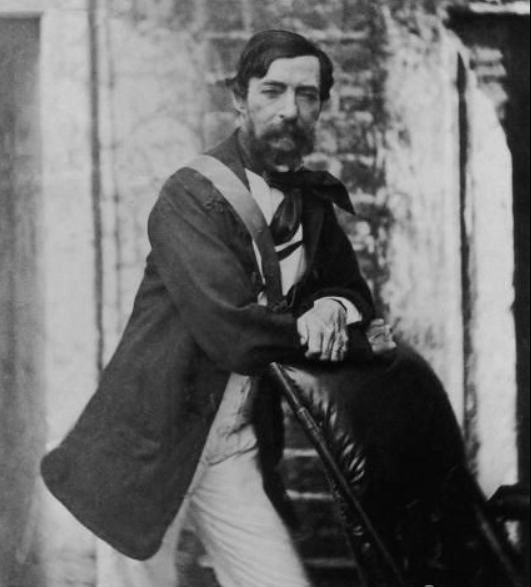
Napier was a man of some standing and had a reputation as an excellent officer. He had seen war – the first Sutlej Campaign saw him in command of the Engineers at Moodkee, and in 1845 when he temporarily joined the 31st Regiment of Foot for the Battle of Ferozeshah. Though severely wounded at that particular incident, Napier shook himself off and fought his way through Sobraon a year later. Herbert Edwardes called for Napier to aid in the siege of Multan in 1848, and he joined Lord Gough at the Battle of Gujrat and then attached himself to Sir Walter Raleigh Gilbert in pursuing the defeated Sikhs – Napier could be found not just at Jhelum but at the surrender of the Khalsa, and at Attock. With war done and medals a-plenty clinking on his chest, Brevet Lieutenant-Colonel Robert Napier went back to engineering – for the next three years he would be instrumental in the construction of the Lahore-Peshawar Highway, while planning new cantonments, building canals and irrigation channels to turn deserts into fields, and when he had some time to spare, strengthening frontier defence posts.
In 1852, leaving his drawing board behind, Napier joined the 1st Black Mountain Hazara Expedition, to command the right column and then a year later, he joined a similar expedition in the Peshawar district against the Bori Clan. With the thanks of the government in his pocket and a medal and clasp to join his already impressive collection, Napier was promoted to Brevet-Colonel in the Army in 1854, and in 1856, at the request of Sir John Lawrence, he returned to engineering, as the Chief Engineer of the Punjab.
Even enthusiastic engineers deserve furlough and in the autumn of 1856, Napier sailed for England but in May 1857, he was already on his way back to India while the mutiny was still unheard of in England. When Napier arrived in Calcutta, he found himself appointed Chief Engineer of Bengal and shortly after, was sailing up the Ganges with Outram. Punjab’s loss was Bengal’s gain – a more daring and resolute officer the army had seldom seen, an unmatched master of both civil and military engineering, Napier had acquired ” a sound knowledge of the business of war which had been improved by the practical skill only to be gained in the field.” For Outram, Robert Napier would remain the best soldier he had ever served with.
 Mutiny Reflections
Great, thanks for the share.
LikeLiked by 1 person