The Second Battle of Basharatganj – August 4th
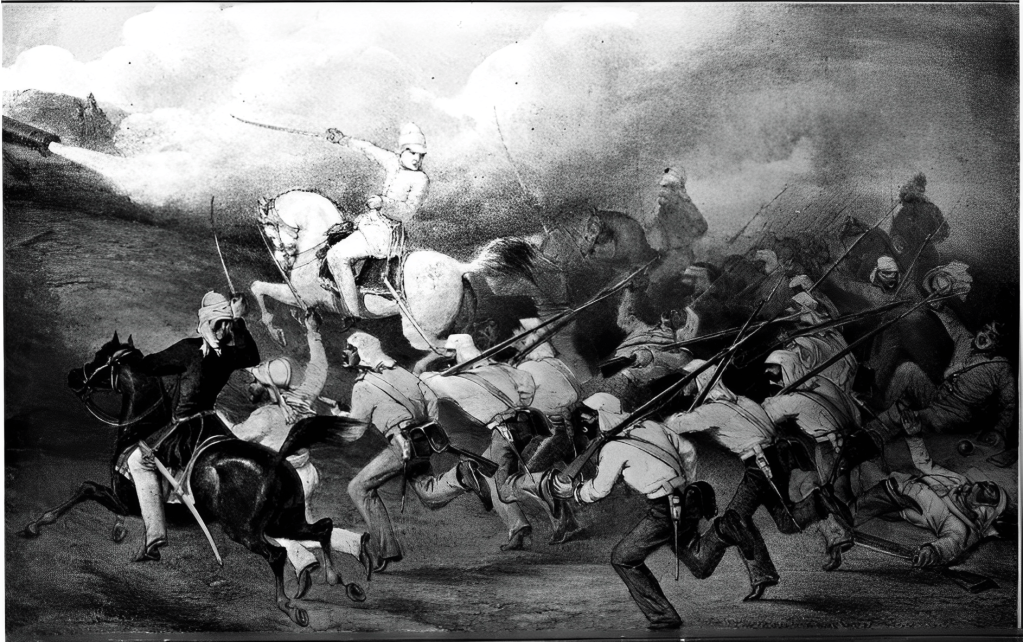
With the reinforcements bringing his force back up to 1400 men, Havelock pushed on once again towards Lucknow.
“I was stopped the day before yesterday by the bugles sounding the assembly. We had to march to meet the enemy at Busharut Gunge, from which place we had driven him on the 29th. We slept at our arms at a place about four miles from the enemy’s position, and yesterday morning went at him and gave him the best licking he has had yet, but we could not take his guns. They were all horsed. The enemy was so numerous that we were twice completely surrounded, and our rear guard threatened, so we had again to beat a retreat to our old position.
The General yesterday divided his force into three divisions, and we found ourselves taken from the Highlanders and brigaded with the 64th. We were the rear division, but at last, we got an order to move to the right flank and cover three guns that had been sent round to harass the enemy as they crossed the bridge on the other side of the town. We lined the edge of the water and kept up a jolly fire for a long time, wondering when the bridge was to be taken. At last, we heard a cheer, and the 84th dashed over it with four guns, but they did not seem to get any further, and the bridge being now crowded with guns and limbers, etc., the enemy opened from the front.
Then was the cry, *’ Where are the Fusiliers ?” and away we went some distance back to get onto the road and threaded our way through the mass which choked the bridge, and supported by the
Highlanders cleared the village in a crack. As we were forming on the other side, ready to make a rush, Havelock said, ** Hurrah! blue bonnets, that’s right, show ’em the way, and we did show them the
way in style.
But the day’s work was awful, three hours’ fighting and twenty miles march. We got back at about 8.30 p.m., and horror! I found I was for an outlying picket. I got some food at 10 p.m., rolled in a cloak, and had a jolly sleep. I write this from the picket, from which I shall not be relieved till 5.30 this evening. Pleasant! but unavoidable.” (Lt. Wm. Tate Groom)
While Unnao was still unoccupied by the rebels, Bashiratganj had been retaken. Their position was similar to that of the 29th of July and Havelock was determined the same mistakes would not be repeated. He ordered the advance by road of the heavy guns, supported by the Enfields of the Madras Fusiliers and the 84th Foot while the Highlanders, the Sikhs and Maude’s Battery would turn the village on the left. While Lieutenant Crump of the Madras Artillery quickly dislodged the insurgents from their outer defences, Havelock ordered the infantry to advance. Once again, however, the turning movement upon the rear gate remained incomplete – it was only the efforts of Maude’s Battery that prevented the escape of nearly all the insurgents. As the battery in the front continued to ply its deadly work against the front fortifications by silencing the rebel guns and forcing them back out of Bashiratganj, the rebels still managed to lodge themselves into villages on the left and right of the town, out of which they could only be dislodged at the point of the bayonet. The fighting was long, protracted and vicious.
The victory for Havelock this time was nearly insignificant. He managed to capture only 2 small iron guns that had already been taken once before, on the 29th of July. Although ordered destroyed, the commandant of the artillery had “dismantled them so imperfectly” that it was a work of a few hours for the insurgents to put them back to use.
The losses were 2 killed and 23 wounded – the insurgents had lost over 300. However, once again, Havelock already had 75 men on the sick list – cholera claiming its victims with a steady hand. He had also used up one-fourth of his ammunition. To proceed to Lucknow, he knew he would have to cross the river Sai which was heavily defended. The force in Oudh had been multiplying rapidly as mutinied regiments hurried across the plains to join the uprising at Lucknow – intelligence brought to Havelock said they now mustered some 30,000 men. The zamindars too had thrown in their lot with the rebels and were assembling their own levies, in some cases as many as 600 men. Lieutenant Fraser-Tytler observed that all the dead at Bashiratganj had not been sepoys – they had been the men of the local chieftains.
On the 5th of August, Havelock received intelligence that made his decision to retire once again on Cawnpore easier to bear – the formidable Gwalior Contingent was said to be moving on Kalpi. If the report was true, the Gwalior Contingent could not only menace Cawnpore from Kalpi but destroy all communication with Allahabad.
In a telegram to the Commander-in-Chief, Havelock wrote,
“The only three staff officers of my force whom I consult confidentially but in whom I entirely confide, are unanimously of the opinion that an advance to the walls of Lucknow involves the loss of this force.”
It was a heavy blow for Sir Henry Havelock. As determined as he was to move towards Lucknow, it was proving to be impossible. For every battle he fought, he depleted his munitions and his force – it was one step forward to only take another three back nor could he abandon Neill to his fate in Cawnpore. Again, he ordered his force to fall back on Mangalwar but what remained at Basharatganj was a scene most horrible to witness. Hundreds of corpses strewed the streets, many of them mangled beyond recognition, arms and legs lying yards away from the men to whom they had once belonged.
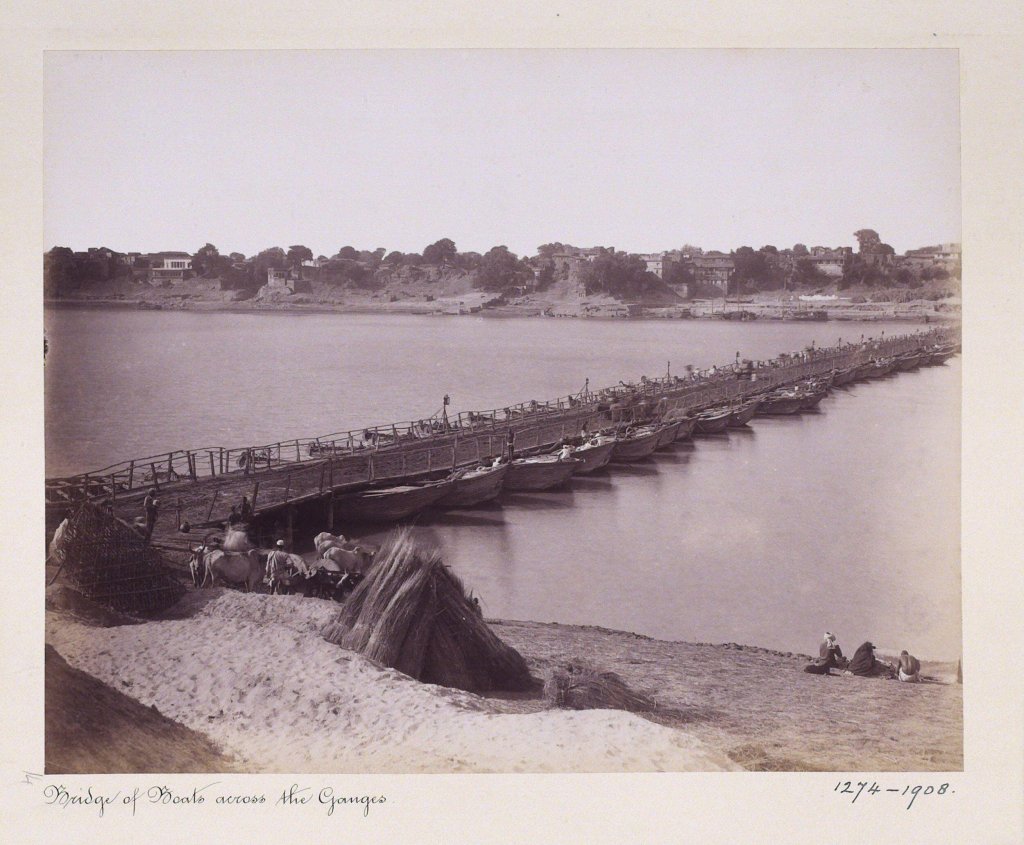
Havelock now intended to hold Mangalwar. The causeway to the Cawnpore side of the river was complete. While Lieutenant Moorsom had taken up the task of constructing a road across the island swamps complete with bridges of boats, it was Captain Crommelin who succeeded in completing the work – employing workmen to finish the roads and connecting the three islands not just with each other but the Oudh bank of the river, he designed a floating platform, made by lashing together four of the strongest boats covered with planks, could be used to move an entire battery at once, when drawn by the steamer. Rafts were constructed using the strongest boats to cover the channel, 500 yards wide, between the larger island and the Cawnpore bank.
The intention, for now, was to draw off as many troops as possible from Lucknow – while Havelock could not reinforce, much less relieve Brigadier Inglis, he could present the rebels himself as a target, forcing them to weaken their strength in Lucknow. For now, he would rest his men in Mangalwar but they would be far from idle. Orders would be given and then countermanded, making life for Lieutenant William Groom rather harassing. On the 10th of August, he wrote,
“Last night I went to dine with the Highlanders. Just as I sat down to dinner an orderly came to inform me that my company was to march immediately. Part of 300 men and two guns that were to go off on a secret expedition with one day’s food. I swallowed my dinner and rushed home, packed up my bed, and anxiously waited for the order to move. At nine we were told that the movement was postponed until further orders. At nine this morning I was informed that I was on duty and that the whole force was to move somewhere at 10 a.m. I was to remain behind with twenty men and thirty-five sick, the whole of the bedding and ammunition.”
Willis of the 84th, who now commanded the corps, and was field officer of the day, was informed by Havelock that when the force departed, he would be in charge of the Mangalwar position and the baggage. At his disposal, he had 200 men – guards and pickets – and six guns. At 10 a.m., the army fell in and remained under arms until noon when the order came and the expedition was postponed. At 4pm, Groom was again told he was to move off with 100 men within the next half-hour; 100 men of the 84th were to join him – again, nothing came of it. He unpacked his bed and hurriedly wrote a few lines to his family, hoping to catch the next post.
The next day was hardly better.
As he was preparing for bed, an order came he was to be ready to march at daybreak on the 11th with one day’s ration. Accordingly, he turned out his men at reveillè as usual, the General “sounded the retreat or the rather the disperse, a few minutes after sunrise.” No one knew what Havelock was doing – he was keeping his decisions to himself while the men under his command waited and wondered. Some said they were going to be sent to Agra – “I don’t exactly see how we can possibly manage that…” wrote Groom, others believed Havelock had lost his mind.
The problem Havelock faced was not a lack of intelligence, it was too much of it. Neill, in Cawnpore, believed he would soon be menaced by the 42nd who had mutinied at Saugor and together with other rebellious regiments, had gathered 8 miles from Cawnpore. Havelock replied he could ill-afford to send Neill any reinforcements, but was prepared to spare 300 men and three guns, but insisted they cross the river at night and the blow “must be struck the next morning and the troops returned without delay.”
The next day Neill informed Havelock the mutineers had decided to retire and were no longer threatening Cawnpore – but on the 11th he despatched the following communication,
“One of the Sikh scouts I can depend on has just come in and reports that 4000 men and five guns have assembled today at Bithoor, and threaten Cawnpore. I cannot stand this; they will enter the town, and our communications are gone; if I am not supported I can only hold out here; can do nothing beyond our entrenchments. All the country between this and Allahabad will be up, and our powder and ammunition on the way up, if the steamer, as I feel assured, does not start, will fall into the hands of the enemy, and we will be in a bad way. J. E. N.”
The only way to preserve Cawnpore then was to abandon for a time, the position at Mangalwar and recross the river. On the same day, Havelock proceeded to send across the baggage and the spare ammunition – everything he possessed except the men, their arms, bedding and guns. While thus occupied, spies brought him word that 4000 insurgents with guns had descended upon Bashiratganj. To continue crossing the river with such a formidable enemy in his rear was confounding – if he continued to cross, they would undoubtedly attack his column as they moved over. It would also be a further loss of the prestige Neill had told him of. A report of any kind purporting the British had been chased out of Oudh would have been detrimental to the highest degree. The very act of leaving Mangalwar would have been enough to set such rumours in motion – Havelock could not leave the Oudh bank but he could not abandon Neill. He decided instead to go on the offensive.
On the afternoon of the 11th of August, the small army moved again to Unnao and spent a very wet and uncomfortable night under trees, in the pouring rain. At dawn, Havelock drew up his men and marched them back to Basharatganj.
 Mutiny Reflections
What more can I say, but being impressed by the continuation of you high quality research and the accompanying images. I have to admit I have been completely ignorant about this chapter of the English history. However, most impressive are the detailed descriptions of the involved individuals actions and suffering, details which are usually excluded from historical records.
LikeLike
Thank you! The records are out there but they rarely find place in the telling. My goal with this site is to bring history alive through the people who lived the events, be they generals, soldiers, civilians and their families.
LikeLike
Hi Eva! So glad that I came across this interesting read. Thanks for sharing.
LikeLike