Forjett Leaves Bombay
For all his hard work in 1857, the Indian merchants of the city were quick on the uptake and on the 19th of October, when the congratulations addressed to Forjett were published in the Bombay Gazette, they presented him with plate in the value of 1250 guineas. They further showed their gratitude by taking out a subscription in 1859, for the princely sum “of upwards of £1300 sterling for the purpose of offering to him a more enduring token of their esteem.” The cotton merchants, not to be outdone, sent him a purse of £1500 which Forjett received after his retirement in England, “in token of their strong gratitude for one whose almost despotic powers and zealous energy had so quelled the explosive forces of native society that they seem to have become permanently subdued.” The Back Bay Reclamation Company allotted him 5 shares shortly after he left the city for good – and when the price reached a high point, they sent him a draft for £13,580.
Charles Forjett could not complain of the esteem in which he was held by the Indians of Bombay; the Government granted him an extra pension and bestowed a commission in the Army on his son, F.H. Forjett, serving with the 26th Regiment Bombay NI. From the public, he received a purse of £3,850, raised by subscription by both European and Indian residents. A street, which still exists in Mumbai today was named for him. Forjett was praised and applauded but he was not honoured.
While everyone was willing to admire Forjett and present him with money, shares and speeches, the Government neither bestowed upon him a knighthood nor admitted him to any of the Orders of Chivalry. Even his pension was a slight – it was paid in rupees. After the decline of the value of the currency, Forjett earnestly petitioned the government to have it paid in Stirling, the request was denied. There is little wonder Forjett was left feeling more than a little sore. In 19th century India, a man no matter how dedicated could still be judged for the colour of his skin or for that matter his parentage. Forjett was not considered one of them and his methods of extracting information had given him a somewhat suspicious reputation. Afterall, as incorruptible as he was, Forjett was also opinionated and honest, something not every Englishman in Bombay could aspire to be. What ever the reasoning of the Government might have been they at least did not carry their grudge over to his son.
Charles Forjett retired in 1863 and left India never to return. He moved to England and bought
26 acres of land near Hughenden, and designed his home, which he named ““Cowasjee Jehangir Hall” in honour of a well-known Parsi philanthropist. Forjett died in 1896, aged 79.
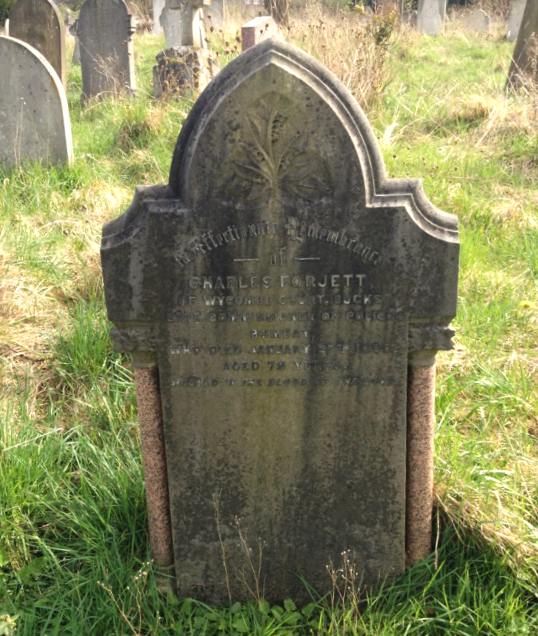
In Affectionate Remembrance of Charles Forjett of Wycombe Court, Bucks Late Commissioner of Police, Bombay, who died January 27, 1896 Aged 79 years.
He died in the Blood of the Land
Sources:
Cadell, Patrick Robert. History of the Bombay Army. London: Longmans, Green and Co., 1938.
David, Julian Saul Markham. “The Bengal Army and the Outbreak of the Indian Mutiny.” PhD thesis, University of Glasgow, 2001.
Douglas, James. Glimpses of Old Bombay and Western India. London: Sampson Low, Marston & Company, 1900.
Edwardes, S. M. The Bombay City Police: A Historical Sketch 1672-1916. London: Oxford University Press, 1923.
Forjett, C. Our Real Danger in India. London: Cassell, Petter & Galpin, 1877.
Holmes, T. Rice. A History of the Indian Mutiny. London: W. H. Allen & Co., 1883.
The Indian Express. “Mumbai: Forjett Street Named After Maverick Police Chief.” May 14, 2018. https://indianexpress.com/article/cities/mumbai/mumbai-forjett-street-named-after-maverick-police-chief-5170705/.
Jacob, George Le Grand. Western India Before and During the Mutinies: Pictures Drawn from Life. London: Henry S. King & Co., 1872.
Jacob, John. The Views and Opinions of Brigadier-General John Jacob. Collected and edited by Lewis Pelly. London: Smith, Elder & Co., 1858.
Kaye, John William, and G. B. Malleson. Kaye’s and Malleson’s History of the Indian Mutiny of 1857-58. Edited by G. B. Malleson. 6 vols. London: Longmans, Green, & Co., 1907–1914.
Parsi Khabar. “Forjett Street: Singer, Sailor, Soothsayer, Spy.” May 16, 2018. https://parsikhabar.net/history/forjett-street-singer-sailor-soothsayer-spy/16550/.
Southern Methodist University Digital Collections. “Group of Deccani Brahmins.” DeGolyer Library, Central University Libraries. Accessed May 26, 2026. https://digitalcollections.smu.edu/digital/collection/eaa/id/1167/rec/1.
Wood, Evelyn. The Revolt in Hindustan 1857-59. London: Methuen & Co., 1908
 Mutiny Reflections
The events of that tumultuous year brought out the best and worst in people. What we can learn now is what many have forgotten – the resilience of humanity.
LikeLike
I love these posts. An insight into ages gone by, but somehow relevant to the current day and age. We could learn how to better govern ourselves I think, if everyone went through this site page by page.
LikeLiked by 1 person
I agree with Peter, fascinating. Thanks.
LikeLiked by 1 person
As ever, many thanks for these; they really are a great read! It often seems that there is little mention of what was happening in either Bombay or Madras during the Mutiny, so this was fascinating to read.
LikeLiked by 1 person
Bombay is fascinating and much neglected since most of the action was in Bengal. This the 2nd of a series of three posts and one VC, so there is more to come! I will tackle Madras as well.
LikeLiked by 1 person