The Maharaja and Durand
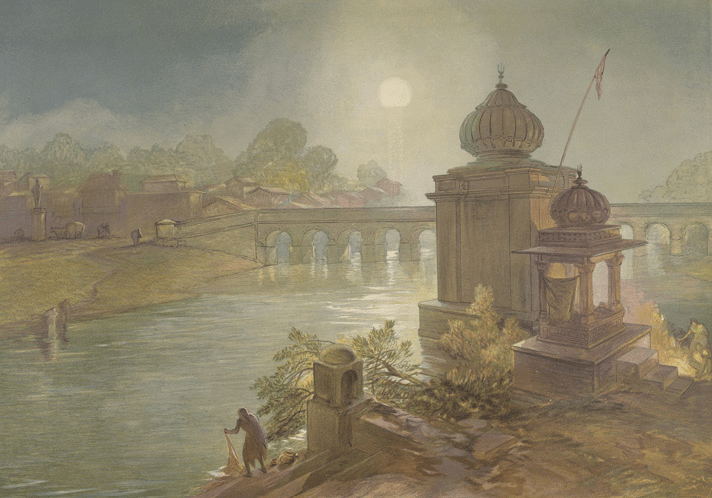
William Simpson, “India, Ancient and Modern: A Series of Illustrations” (1867)
On the 11th of May, Durand wrote to Canning:
“I have no reason to suppose that any of the contingents in Central India have as yet shown any disposition to sympathise with the disaffected movement. Rumours of an uncomfortable feeling existing among the Mhow native troops I have heard but nothing definite and nothing to which I attach any importance.”
Mhow was an important military station some fourteen miles southwest of Indore. The garrison consisted of one artillery company of 91 Europeans and 93 Indians, the right wing of the 1st Bengal Light Cavalry with 13 Europeans and 282 Indians, and the 23rd BNI with 16 Europeans and 1178 Indians. Colonel Platt of the 23rd BNI commanded the station. He was an officer with more than 30 years with his regiment and was, at least by some of his men, well-liked.
At Indore, there were no European troops at all, only a regiment of the Malwa Contingent, 200 in all, to protect the treasury and other important buildings. The men for the contingent were mainly sepoys, recruited along the same lines as in the regular Bengal army – in all but name, little to differentiate the contingent from the Bengal Army.
However, like the Gwalior Contingent, the Malwa Contingent was “paid by one master, governed by another master and owed allegiance to no one.” Forty miles away from Indore at Sidarpore was stationed the Malwa Bhil Contingent. It consisted of recruits from the tribes of Western and Central India while at Sehore, 100 miles away, the Bhopal Contingent had its headquarters. Holkar too had his own army which, like in Gwalior, was regulated by the terms of the treaty and consisted of 642 artillerymen, 3820 of cavalry and 2145 infantry. He was bound to provide a contingent of horse to the government, which was a part of his army but could be called for service elsewhere.
The news from Meerut and Delhi more than unsettled Durand. He had anticipated, through most of his career, that something of this nature could happen – however, while Sir Henry Lawrence believed in the good of men and trusted where trust was due, Durand, unfortunately, chose to be suspicious. His first instinct was that of a soldier – Indore, being without European troops, needed reinforcements. In a first step, he ordered 270 men of the Bhil Malwa Contingent to Indore. He then sought an interview with the Maharaja on the 15th of May and applied for the assistance of his troops. The intention was to have them ready in case an uprising occurred before the Sehore troops could arrive. Holkar promised every assistance, but he also stated he was unsure if his men would be able to cope with the regular troops, casting some doubt at the same time on their loyalty. He also had very little ammunition, and should an uprising occur, he would need three hours’ notice to move his men from their lines to the Residency. Durand listened attentively and ordered the requisite ammunition to be sent from Mhow.
On the 17th of May, Major Harris, commanding the cavalry, informed Durand that not all was well in Mhow. A council had been formed, comprising (very much like at Agra) everyone who had an opinion to discuss the state of affairs. They had also waited until Colonel Platt was safely off on a hunting trip before presenting the views. The officers of the 23rd BNI were doubtful of their men and requested troops from Indore. The order was countermanded, but not before Holkar had made preparations to comply, which caused some confusion in Indore. It was one of those rash measures that Durand was wary of and for him, as long as Platt trusted his men, he counselled Mhow the officers had, in his opinion, two courses open to them – they could either have undiminished trust in their men or show “overt mistrust” and take the consequences. His words had little effect. The officers and Mhow were, for lack of a better word, afraid.
Hungerford, of the artillery, shotted his guns; the magazine was provisioned with all haste, and if he did not have enough to do, Durand had to “check everywhere proposals for hurrying ladies and children off no one knew wither; for moving detachments here, there and everywhere…The alarm at Mhow among the officers and ladies was quite distressing.” He would continually try to persuade Harris, right up to the middle of June, “don’t be alarmed nor alarm others. If you listen to all the nonsensical rumours afloat here and everywhere, you will have enough to do…Duty often lies in a bold, firm baring, and a little, very little daring.” Colonel John Platt, on the other hand, had a view which was more in line with that of Durand, but it would eventually turn out to be misplaced.
Platt arrived in India in 1820 as an ensign appointed in the 2/5th Native Regiment. He transferred to the 23rd BNI in 1824 and had seen service with them at the siege and capture of Bhurtpoor. Following his furlough, he joined the 2nd Volunteer Battalion, Bengal Army and subsequently as commandant of the 2nd Regiment Oudh Light Infantry, during which he advanced to the rank of major. In early 1850, he was appointed lieutenant colonel of the 23rd BNI. Platt and Captain Fagan of the same regiment were convinced of their men’s loyalty – and they had not done anything to warrant the fears of the other officers. In 1856, Platt had been offered to join a European corps, but his men in a body entreated him not to leave them. For him, his regiment could do no wrong, and his officers were fearful of nothing. Durand did not trust the 23rd, but he trusted Platt’s abilities.
Meanwhile, Durand, who had previously been an agent to the Bhopal court, believed that the Bhopal Contingent would be least likely to mutiny. As such, he sent for a strong detachment of cavalry and infantry, with 2 guns, to march to Indore. As Durand was unable in his political position to exercise any military duties, the command of both the Bhil Malwa Contingent and the Bhopal Contingent and the arrangements for the protection of the Residency fell to Colonel Stockley of the Bhil Corps. The requested troops arrived in Indore on the 20th of May.
The Nawab of Bhopal
Between 1819 and 1926, the princely state of Bhopal was ruled by four remarkable women. Despite the male claimants, the Begums stood their ground. It all started, however, by accident.
The first female ruler, Kudsia Begum, was widowed by the thoughtless actions of an eight-year-old boy, her younger brother, who accidentally shot her husband, the Nawab of Bhopal, on a hunting trip. It was not intentional – the boy was playing with the Nawab’s gun, which he took from his belt, and it went off. This effectively left Bhopal without a ruler; with the consent of the nobles of the court and EICo, it was decided the late ruler’s nephew should ascend the throne and marry Kudsia Begum’s daughter in the bargain. Until the boy came of age, Kudsia Begum would rule as regent. Although Sikandar Begum would finally be married to Jahangir Muhammad Khan in 1835, Kudsia Begum continued to rule the state. The nawab in waiting died in 1844, and Kudsia Begum retired in favour of her daughter. Her political prowess and prudent handling of state affairs compelled the EICo to suspend their position in the Bhopal court and declare her sovereign in her own right. Her daughter, Shah Jahan Begum, born in 1838, was recognised as her heir, and Sikandar Begum ruled as regent until her daughter came of age.
It must be noted here that the ruling women of Bhopal were not bound by tradition as many other Indian women of the time were. They refused to observe purdah or confinement to the women’s quarters, and they were highly educated, both academically and physically. They were excellent horsewomen who participated in field sports and hunted. They were trained in martial arts and mastered not just sword fighting but archery and lances. Sikandar Begum did not rule just from her court – besides commanding the army, she routinely inspected the courts, the treasury and the district offices, paying visits to villages in her jurisdiction to ensure that the reforms she was implementing were being carried out. The welfare of her people was paramount to her, and her 21-year reign has been looked at as the golden age of Bhopal, which, when she handed it over to her daughter, was the most stable princely state in India. Although she was staunchly supportive of the British in 1857, she was also a fiercely independent ruler. Sikandar Begum was a woman who knew her own mind and could disregard the bad counsel of her court – disregarding the bevvy of relatives and ministers who surrounded her, who tried to persuade her to throw in her lot with the mutineers.
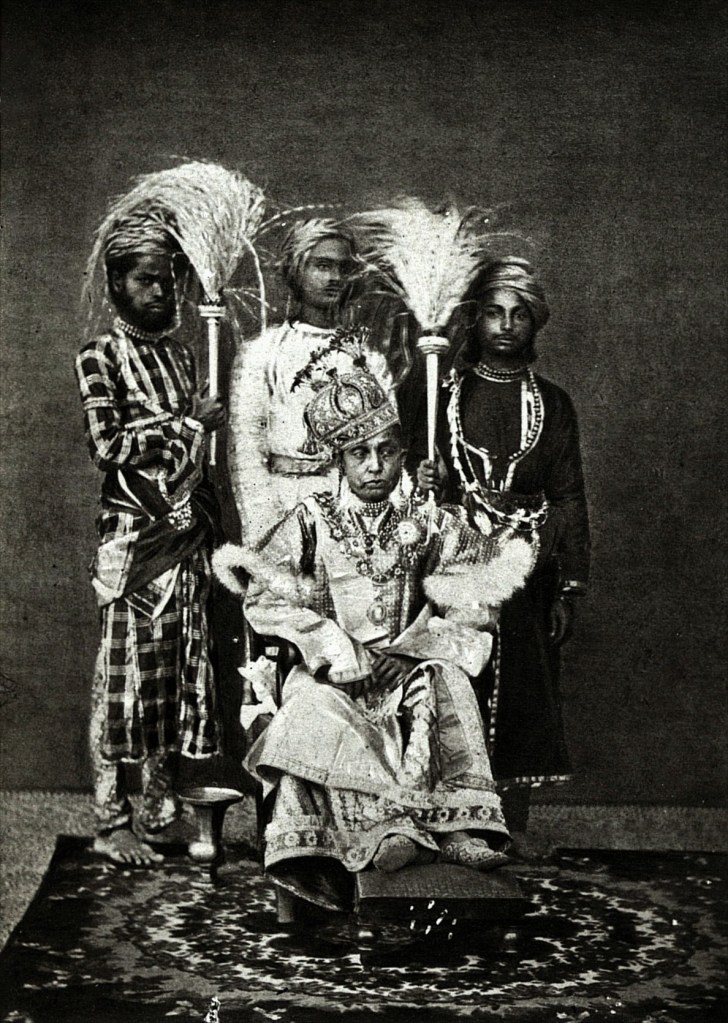
In the early days of the rebellion, she banned the publication of seditious literature. Of these, 500 copies of a poster calling for rebellion were found in Bhopal- these were seized, and the unfortunate sepoy who found inspiration from it was dismissed from the army after he refused his wages. His dismissal allowed him to take up another banner – he went to Delhi to fight for Bahadur Shah Zafar instead. Her army was not particularly pleased with her decision to dismiss the man, but for now, they still held their peace.
With a wide network of spies, which she expanded during the coming months, Sikandar Begum was able to keep a rather far eye on the doings of the states surrounding Bhopal. She also remained in contact with Henry Marion Durand. It would appear that Durand was able after all to get along with an Indian ruler – in the six years he had spent in Bhopal as Political Agent to her court, he had built up a trust of the fine Begum and when he would face his trouble in Indore, it was to her he would turn. Unfortunately, he was wrong about the Bhopal Contingent. Even the iron hand of Sikandah Begum could not stay the tide of mutiny in her army. Colonel Travers reported to Durand that the men of the 23rd BNI from Mhow were tampering with his men. It was also reported that agents of the Nana Sahib were acting incognito in Indore, Mhow and elsewhere, sowing the seeds of rebellion throughout the regiments, Holkar’s men and the general population. It was simply a matter of time before the storm clouds burst over everyone. Durand chose to carry on and wait.
 Mutiny Reflections
Another fascinating account!! Thank you for the effort you have taken with this!!
Once again, many of the same surnames are re-appearing. Is this Durand related to he of ‘Durand Line’ fame?
LikeLiked by 1 person
It is named after his son, Henry Mortimer Durand, who was responsible for it.
LikeLiked by 1 person
Thank you!
LikeLike
Interesting how the different personalities affected the events. Surprising that Durand could get along with Sikandra Begum – she sounds really interesting.
LikeLiked by 1 person
I think Durand and Sikandra Begum were probably quite similar, both strong personalities who could likely understand each other. She listened to Durand and with her he didn’t feel threatened. I think his problems with Holkar weren’t Holkar per se but because he had been taught by a man Durand disliked. It’s been hard to decipher it all, and the records are either very pro Durand or very against him. There seems to be no middle ground. I personally don’t like him much!
LikeLiked by 1 person