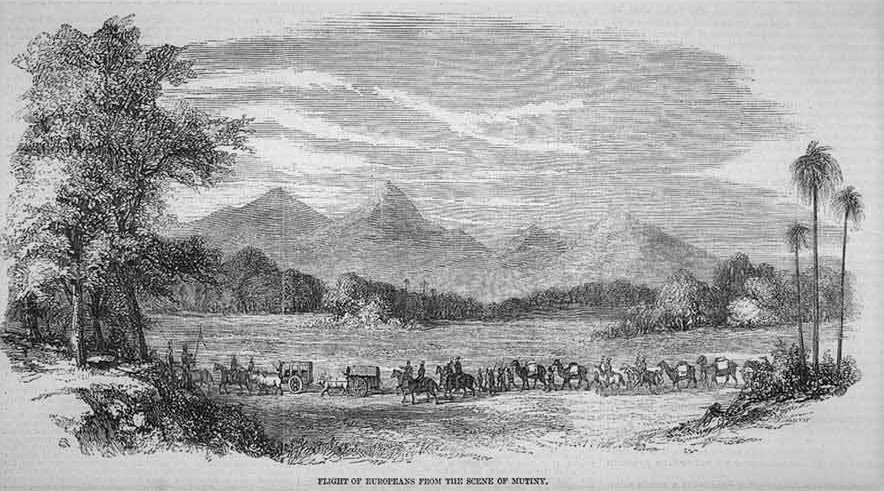
The Ladies Continue Their Journey
We left Mrs Peile and Wood and the severely injured doctor hiding in a village. A young boy had fashioned a wooden pipe for the doctor so he could drink, and Dr Batson, hiding in the nude, refused to meet them, sending over a wine glass and some senna to relieve the suffering of Dr Wood. The party was still barely out of Delhi, and their journey to Karnal was still uncertain of success.
After a night’s rest in an open field on a bed of straw provided to them by the villagers, Mrs Wood rose early and went in search of Dr Batson. Unfortunately, he had already been moved on, and no one could tell her where to, so she returned to her little party. Worse news followed – the villagers, as those Batson had encountered, were given to believe that anyone caught harbouring fugitives would be destroyed. Quarrel after quarrel ensued; some wanted to continue hiding the ladies, others were for turning them out – until finally, Mrs Peile took the decision, and, on the 14th of May, under a scorching sun, they set out, carrying Doctor Wood between them. Throughout the day, they walked, rested when they could and then walked some more until, at 2 am, they could not move any further. They had had nothing to eat or drink the whole day, and finally, even their willpower gave out. Crawling under brushwood, well sheltered by trees, the Woods lay down, while Mrs Peile kept watch. She had not long to wait.
Presently, she heard horses’ hooves – a great many of them -, and without much delay, they were found out by troopers of the 2nd Irregular Cavalry, proceeding on furlough from Punjab to Agra. The men insisted they would not harm them, but as there were three of them, it was impossible to take them to Agra. They did, however, provide them with water, chapattis and some sugar, the most food they had had in so many days. After many entreaties, the troopers unloaded a baggage pony and placed Mrs Wood on it while the doctor was settled onto a horse, a fine white Arab. There was no conveyance for Mrs Peile, but she settled herself in front of the one the troopers, the one “who had acted kindly towards us.” And so they rode away – back to Delhi.
Early in the morning, the troopers set the party down, promising to send word if they could get them through the city undetected. However, now accustomed to treachery, the ladies decided that staying where they were was probably much worse than retracing their steps again. As soon as the cavalry was out of sight, they walked away as swiftly as they could, reaching Alipore early in the morning on the 16th. Here, they hid themselves under some trees near a walled garden, close to the side of the road. The doctor was, by this time, too ill to move. Expecting him to die at any moment, “it was a matter of consultation, in the event of his expiring, what we two helpless ladies could do to inter his body, to preserve it from insult from the natives and the voracity of the jackals and vultures…” Doctor Wood, however, did not die.
Alipore was situated only 12 miles from Delhi, no great distance considering they had been on the road for five days. The next day, they struggled on, first only two further miles to the next village, where, although refused entrance, they were given some milk – a man accompanied them to their next hiding place ( under a bridge), but it was only a short rest – hassled by some villagers, they continued on, resting by the side of a well. So it continued until, finally, chased as it were from pillar to post, the fugitives finally took refuge in a large hole in the middle of a field. Here, in their miserable state, they remained until nightfall. The next day, they reached the village of Balghur – and eventually, on the orders of Rani Mungla Dabee, they were permitted to stay the night. The next day, they moved on to another village.
On the 18th, they received word that a fellow fugitive was in Balghur – it proved to be Major Patterson, and shortly after, word came that another man had also turned up. Much to Mrs Peile’s delight, it was her husband.
“They were both so altered in appearance that it was some little time before I recognised them, the former wearing very old clothing, the latter dressed as a table servant. Their poor feet were literally bleeding from the rough stones and thorns, and were most frightfully swollen.” But they were alive.
The Troubles of Captain Peile
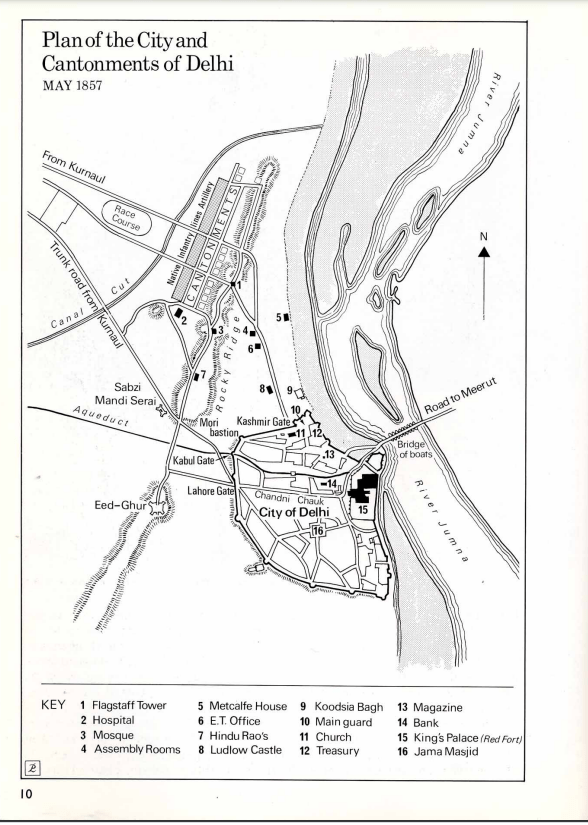
Leaving his wife and the Woods on what he thought was a safe road out of Delhi, Peile returned to the quarter guard of his regiment. There he found Lieutenant-Colonel Knyvett and Ensign Gambier of the 38th, Lieutenant Addington of the 74th and several others, all without a plan. One by one, they shifted off for themselves, leaving the Kynvett, Gambier and Peile on their own. Reasoning with the men was useless, but Peile decided, just for honour’s sake, to at least save his regiment’s colours. Requesting Kynvett’s permission, he set off on horseback with Gambier to find the sentry.
The sentry was less than forthcoming, refusing to give up the colours unless Knyvett himself came and gave the order. But Knyvett was long gone, and when Peile turned around, to his great astonishment, he found that Gambier had taken flight, hurrying off to Meerut.
Determined to make one more attempt, Peile dismounted and, having called some still loyal men together, they entered the house in a body, which at least had the effect of convincing the sentry to give up the colours. Satisfied, Peile went back outside – only to find his “groom had decamped, taking his horse, and what was almost worse to him, a large quantity of cheroots…”
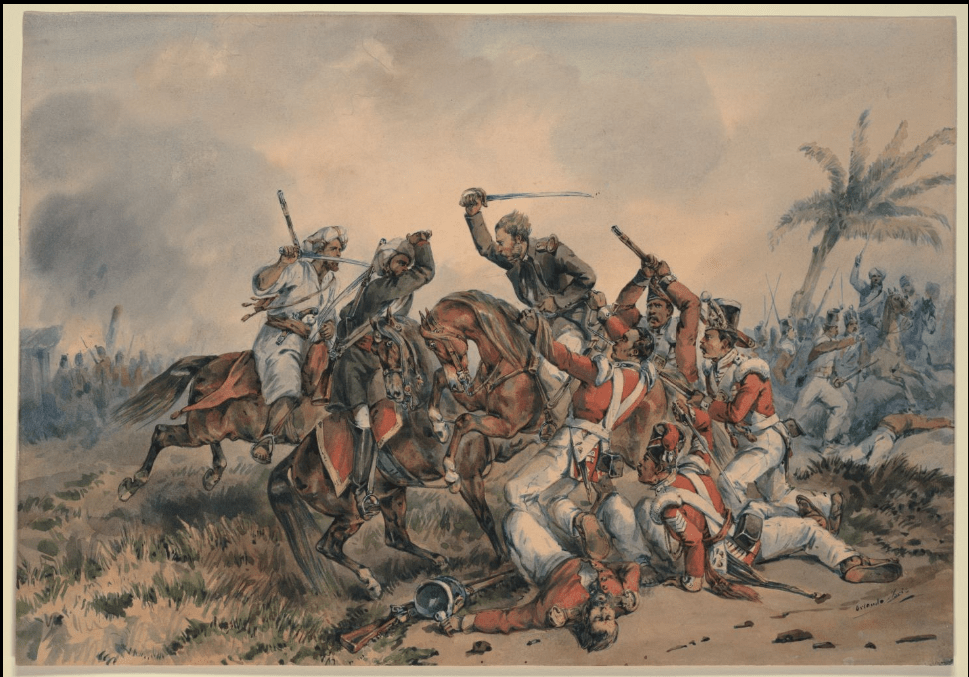
Unable to carry the colours on foot, Peile gave them back to the sentry. As he came outside again, a trooper took aim. He fired and missed, the ball going through Peile’s basket helmet. As he was in close range, Peile now drew his own pistol and shot the man dead. Another trooper now levelled his musket at him, but it was knocked aside by a sepoy of Peile’s company who had stood by him the whole evening – he ran his bayonet through the trooper.
His men now crowded around him, bidding Peile to run across the parade ground – but to stay away from the lines as the 74th and the 54th were busily killing any Christian they found. He took their advice and ran, eventually finding himself in the Company Gardens.
He must have been there at the same time as his wife, but in the dark and with the excitement all around them, they missed each other. Peile was discovered hiding under some brushwood by a band of miscreants who dragged him out, stripped him of his ring, studs and clothes, and left him in nothing but his undershirt and his socks. So completely convinced the man had money on him, they “threw him down, and while one man knelt on his chest, another, having torn off the sleeve of his shirt, attempted to strangle him with it.” Captain Peile fell into unconsciousness.
When he came to, Peile managed to crawl his way to the crossroads of the city and the cantonment, where, by chance, a government servant took pity on him and brought him to a police house, where he was provided with a little clothing and could sleep on the ground in some straw.
At daybreak, Peile had no choice but to leave. Barefoot, he covered the 12 miles to Alipore in a matter of hours, arriving there at 10 in the morning. Between being attacked by plunderers and then being aided by friendly villagers who gave him some food and a little more clothing, he managed to struggle onwards, helped in one village as quickly as he was turned away from the next, until at last, a farmer took pity on him and let him hide under his roof. After a stay of a few days, spent intermittently being hidden by the farmer in fields and sheds and even at one point conversing with cavalrymen of the 3rd who were looking for 2 officers they were determined to kill – Peile was not one of them, so they spared his life.
Six days after he escaped from Delhi, Peile was informed by men of the 4th Company, 38th Light Infantry – who were passing by the village on their way home, having stocked themselves up with cartloads of plunder – that they had passed 2 ladies and the doctor sahib of the 38th on the road. Peile was now determined to be on his way. The farmer was very upset at his determination but gave him some clothes and 1 rupee and then accompanied him with eight armed men to the Karnal road, where “with tears in the old man’s eyes, he bid (him) farewell.” In the village of Rani Mungla Dabi, he met Major Paterson – and shortly after his wife.
 Mutiny Reflections
Heart rendering to read, a reminder that humanity has learnt nothing. Looking at the exodus of those fleeing the middle east, Afghanistan or trying to escape across the Mediterranean, their stories are still waiting to be written.
LikeLike