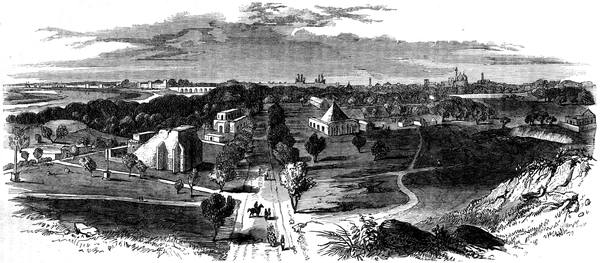
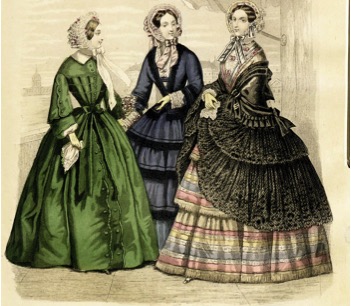
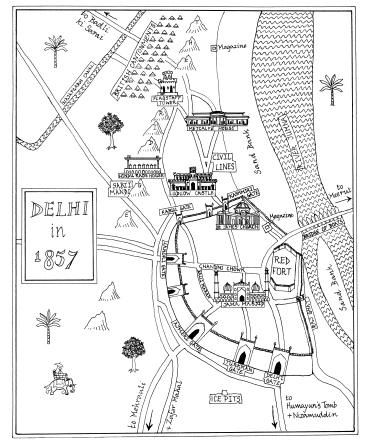
Continuing on from where a general retreat from Flagstaff Tower had been sounded, we now enter a chaotic world of escapes – some successful, others less so. It must be remembered that this is India, in May. The rains had not started, the temperature could have been 40° C, and although the retreat started towards late afternoon, the difference to midday would have been negligible. Those fleeing would not have had any real idea of where to go, there was no news as to which direction was actually safe -some struck out for Meerut (the sepoys were all in Delhi so it was presumed it was probably safer there than anywhere else, besides being the closest station), others for Karnal, and still others simply fled with no actual idea of where they were going at all. It must further be realised that many of those who found themselves in the predicament were not accustomed to being out and about in the heat, usually spending their days in darkened bungalows or in underground rooms called tykhannas. The ladies, especially, would have had very little experience of India outside of their own homes, unless they had been born in the country. They had had little time to prepare, and in the case of Mrs Scott, who had been pulled out of her bath and hurried up to Flagstaff Tower in her silk dressing gown, they were neither dressed nor prepared for the occasion. The attire below would have been similar to that worn by the ladies on the 11th of May.
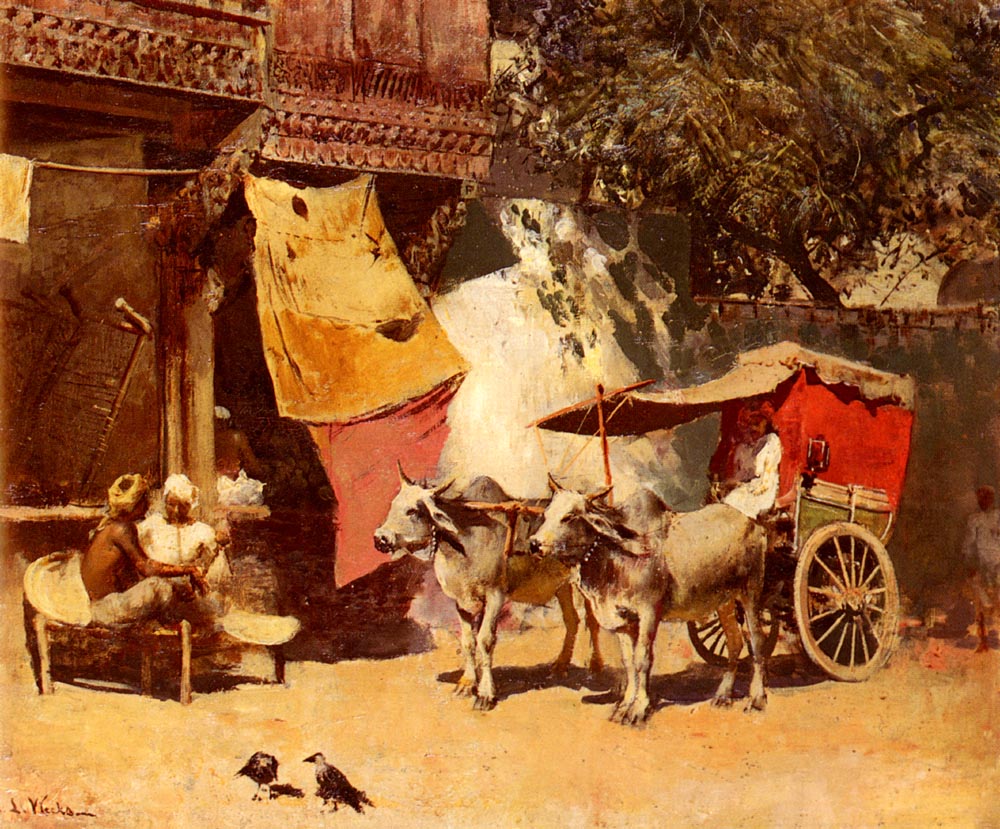
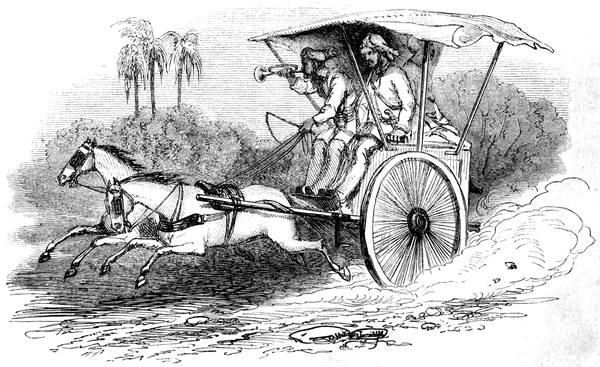
Their means of transportation would have been adequate for a ride around the cantonment, perhaps a buggy ride through the city, but certainly not meant to be overburdened with too much weight, pulled by horses unaccustomed to this kind of treatment, over rough roads and scrubland. There was no time to organise – everyone who could, and even some who barely could, did their best to save themselves, and in general confusion, they now fled Delhi. The arrival of the dead bodies of the officers on a cart at the tower had had the desired effect – and suddenly, everyone was more than willing to listen to Captain Tytler. His wife writes,
“..and then there was indeed a stampede, everyone rushing to their carriages to see who could get off first…”
Her husband, with his ever-collected presence of mind, had ordered his palki gharry to Flagstaff Tower – it was, however, only meant for two people. As Captain Gardner did not think of sending for his own carriage, Captain Tytler now squeezed in 6 people, with Harriet and her maid sitting with their backs to the horses, Harriet’s daughter Edith on her lap and her little son Frank, crouching in terror at his mother’s feet, hiding in her petticoats. Mrs Gardner sat opposite with her little boy. The Captain then told the carriage driver to follow the guns as he rode off on his horse to return to his men, as he had promised.
As Harriett and her carriage left Flagstaff Tower, she saw, to her horror, Colonel Ripley, still alive,
“..on hearing we were all taking refuge, (Colonel Ripley) ordered his doolie (litter) bearers to carry him in his bed to where we were. He had only that moment arrived, as we were leaving the place. I can never forget his poor death-stricken face, and could realize his feelings of despair at coming to be with his comrades and then being left by them to his sad fate. It was nobody’s fault. There were not enough conveyances as it was to save the lives of those in the Flag Staff Tower. Those who could get away on horseback or in carriages had a chance to escape. Those who had not almost to a man met their deaths on the way…”
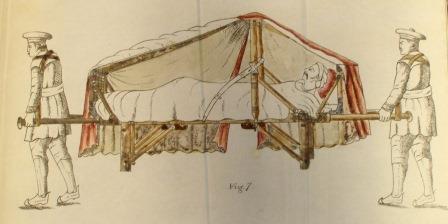
And so it was for Colonel Ripley. His bearers carried him a short way, and it would appear he was then abandoned at the Ice Pits just outside the city walls, where he was murdered by men of the 38th BNI.
Harriet, as we have seen before, was not one to take orders lightly. The plan, as far as she knew, was to follow the guns to a place called Baghpat (some 34 kilometres from Delhi, on the Meerut road), then to spike the guns, and leave them there thus disabled and proceed to Meerut. The servants, however, had other plans and tried to take Harriet back to the cantonments instead of turning onto the Baghpat road. Fearing murder, she insisted on following the guns – but these were now trundling down the wrong road.
Mrs Fanny Peile saw the confusion as well as Harriett Tytler did. Yet her tale would take a different route altogether. “On the retreat…pen cannot describe, senses can scarcely imagine. The utter confusion that ensued among the more tender. Husbands calling for their wives, wives for their husbands, children for their parents, and the whole for their conveyances.”
Mrs. Wood and Mrs Peile were hoping for seats in Mrs Patterson’s carriage – but it had been “surreptitiously taken away, and she was herself dependent on others.” Mrs Peile managed to find a place for her little boy in another carriage, but there was no room for her, and the child was carried away in the direction of Meerut with little hope of ever being seen again. The two women now found place in a buggy through the kind offices of a Mr Berkley – she later discovered it in fact belonged to “Mr M’Quirther, magistrate of Kurnal, who was then at Delhi for medical advice, but who since then has met a watery grave, in trying to effect his escape. He was never seen after the attempt was made to swim the canal at Delhi on the 11th of May.” The unfortunate 37-year-old Mr John Peach Mac Whirter (Mrs Peile misspelt his name) was a widower who would leave behind four young children. The children would subsequently be saved by servants and eventually be made over to relatives who forwarded them hastily to family in Scotland. The fate of Mr Mac Whirter was not absolutely established as his body was never found, but had he been able to alight his own carriage, perhaps his life might not have been so terribly short.
On the road away from Flagstaff Tower in the appropriated carriage, to her horror, Mrs Wood was greeted by the sight of her husband, Dr Wood, being carried in a dhoolie, his own carriage following behind.
Dr Wood had been returning from the city to the cantonments in his carriage, following the retreating guns, when two men “levelled their muskets at him, whereupon two of the 38th men…regarding the respect he held by the Sepoys of his regiment, stepped forward and exclaimed to the others.”Maro mat, Doctor Sahib hy” (Don’t kill, it is the doctor), but it was of no avail…” The doctor received a shot to his face, which blew off half his lower jaw.
His carriage driver, realising suddenly what danger they were both in, drove speedily to the doctor’s bungalow, and then, conveying the wounded man indoors, succeeded, with the help of other men, to have him carried in a dhoolie towards the Flagstaff Tower.
Several men of his regiment flocked around him, assuring the ladies they had nothing to fear from them – Captain Tytler had taken command of the regiment –
“in lieu of Lieut.-Colonel Knyvett, otherwise they would not have answered for the consequences, as the whole regiment had, according to their statement, obtained a Budnam (bad character) in consequence of the Rangoon affair in 1852, and they were determined, some day or other, to take their revenge.” For now, at least some of the men were not looking to cut any throats. They had not proceeded long on the road when the dhoolie bearers refused to walk any further and dropped Dr Wood. “We were compelled to remove the doctor from the dooley into his carriage; all his clothes were actually dripping with blood, after which we once more commenced our perilous and dreary journey, on an unknown road, a distance of 72 miles.”
They were making for Karnal.
THE FLIGHT OF THE LADIES – MRS. PEILE AND MRS. WOOD
At this point, Captain Peile, thinking his wife and Woods were safely on their way, decided, together with Major Paterson, who had joined them on foot, to return to his lines to endeavour, with the major, to talk sense to his men. As officers, their duty was with their men, but they could little perceive what would happen to the ladies they left behind.
It did not take long before the ladies met their first sign of trouble, at the place where the cantonment and the crossroads meet – a body of armed men, known as Gujars, surrounded the women and the wounded doctor. A young man, professing to be a servant of Lieutenant Holland, greeted the women and advised them to leave the main road – he and his companions would act as their guides. Utterly ignorant of the danger they were about to face, the little group complied. Half a kilometre down the road, their protectors suddenly turned on them with demands for money, and if the women didn’t give it up, they would kill them outright.
Mrs Peile and Mrs Woods had a problem – they had money, but it was secreted away in their jewellery boxes, which they had hidden in pockets within their dresses. They could not give them the money without revealing the jewels. They decided to plead instead, begging their adversaries for their lives and stating that they did not have any money. Disgusted, the men decided instead to rifle through the two carriages – and made off with the possessions of the unfortunate Mr. Mac Whirther (a bottle of brandy, a pistol case, with 2 revolvers) – the sound of guns in the distance made the men think twice about murder but just for good measure, one of them hit Mrs. Woods on the head with a stick and tore off her head dress, which was decorated with shiny bobbles. Then they ran off, leaving the two women and the doctor to fend for themselves.
Retracing their steps back to the Grand Trunk Road, they flagged down the drivers of the two guns that were proceeding at full speed down the road. Upon being hailed, the drivers stopped and, when asked which way they should go, they cheerfully informed them that it really mattered very little which way they should go, Karnal or Meerut; either way, they were soon to be dead. One of the drivers proved to have a little more heart – seeing the doctor’s bleeding face, he consented to help them find medical care for him and accompanied them to the Company Garden, close to the cantonment and behind the 74th’s parade ground. Their chaperone left them there, but they were not alone for long. Two men, professing to be gardeners, offered to hide them in their tool house and provided a bedstead for the doctor. The men then lit a fire of brushwood – within minutes, hundreds of villagers, all armed to the teeth, descended on the garden.
The carriages were broken to pieces and the horses stolen, and one villager, as he tore off the lining of the carriage roof, proclaimed it would make an admirable coat!
The women were searched, but the jewellery boxes remained untouched, nor did they find the money that was hidden under the doctor’s head. What they did find was Mrs Peile’s small box of irreplaceable treasures – three miniature portraits of her husband, her father and her little son. These disappeared into the night.
As the villagers were arguing over the spoils, the chaperone returned, not with a doctor but with lint and strapping with which they could at least dress the doctor’s wounds. As they commenced their surgical operations, another band of men assaulted them -“and with their usual aptitude in the science of pilfering, were not long in discovering Mrs. Woods’ jewel case….” claiming she didn’t have the keys, a hatchet was speedily procured and the lock was roughly hacked off...” and so eager were our visitors in procuring a souvenir of Mrs. Wood, that brooches, rings, chains &c., were in the scuffle scattered about the ground, where, however, they were not destined to remain long without a claimant.”
Now the gardeners returned – this time offering to lock them into an adjacent tool shed for their safety. Too scared to say no but terrified the men might burn them alive once inside, the women consented just the same.
“..for about ten minutes later, after our first entry, another party was heard approaching…but finding on examination that the door was locked, they burst it open with a crash. So dark was it inside the hut, made still more by the lurid glare of so many burning bungalows of cantonments but a very short distance from where we were, it was impossible at first to distinguish who or what were the newcomers; but on my beseeching one of them the preserve our lives, he directed us to go outside, and on our complying with his mandate, he, in company with others, commenced again searching us, and stripping us of the greater portion of our clothes, while the remainder were looking for anything we might have hidden inside…” The small money bag was found, and the marauders left to find other victims.
It was around 2 o’clock in the morning when they decided to leave the gardens and find shelter elsewhere – supporting the doctor between them with the help of a groom who had remained faithful, they made their way to a nearby village. For once, no one molested them, and after being given a drink of milk, the first sustenance they had since morning, they were allowed to sleep the rest of the night on the ground, the doctor only having been provided with a charpoy.
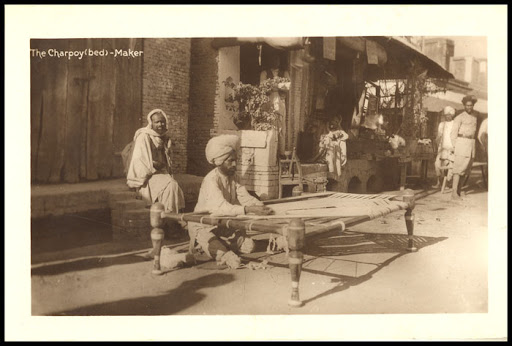
At dawn, the village zamindar requested them to go inside a cowshed to prevent them being discovered by any roving bands of sepoys. Shortly after, just such a band arrived, roughly demanding carts and bullocks from the villagers – hastily, these were procured, and the sepoys left without finding the doctor and the ladies.
In the evening, they were given a few chappatis – and seeing that the zamindar was not particularly pleased with their presence, Mrs Peile begged him that they be allowed to proceed to Karnal. The groom, on the pretence of going to his dinner, never came back.
They left the village accompanied by the watchman and a few other men. What the men did not bet on was Mrs Peile speaking Hindustani, and she overheard them making plans to kill the fugitives “a little further on.” She offered the speaker her wedding ring and begged him to leave them – they would struggle on alone.
The ladies now found themselves in Ochterloney Bagh (also called Shalimar, which had been the gardens and summer residence of David Ochterloney, former British Resident to the Mughal Court at Delhi. Although he had died in Meerut in 1825, his legacy lived on: “the garden being quite three miles round, we were some time before we reached the crossroads,” where once again, they were attacked by a band of robbers, who insisted on taking Mrs Peile’s dress. They did realise, however, that it was made of the most common cloth and returned it to her. Their next stop was Badli ki Serai, just under two kilometres from Shalimar.
Begging again for their lives from the next group of robbers, they only managed to carry the doctor another four kilometres before lying down on the side of the road, where they remained until daybreak on the 13th of May.
The next morning, friendly villagers offered them shelter in their village and some food; an enterprising young man made a wooden pipe for the doctor so he could at least take in some liquid through his mangled jaw. It was here they learned that not far off, another fugitive was hiding – it was Mr Batson, doctor to the 74th BNI. Mrs Wood immediately sent him word – and would he come to remove the shattered pieces of Dr Wood’s jaw? The answer came, and it was certainly not what the ladies expected. Dr Batson would not come as he was without any clothes, but he did send over “a wine glass and some senna as appropriate medicine for Dr Wood.” For a moment, we shall leave the Woods, and Mrs Peile hidden in a village barely seven kilometres from Flagstaff Tower and turn our attention to the strange tale of Doctor Batson.
 Mutiny Reflections