He Who Volunteered to go to Meerut
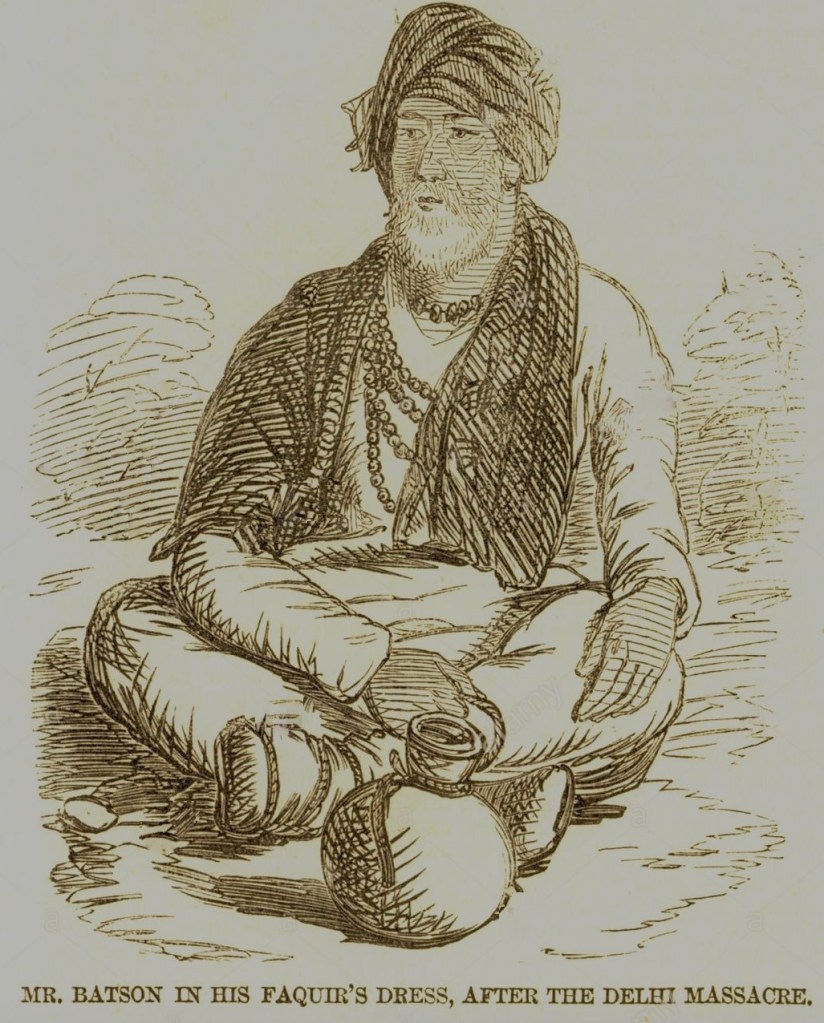
Taking leave of his wife and three daughters at Flagstaff Tower on the 11th of May, Doctor Stanlake Henry Batson, aged 47, volunteered to carry a letter to Meerut in the hope of persuading the European troops to come to the rescue. Brigadier Graves jumped at the offer and, placing a letter in Batson’s hand, sent him on his way. Bidding his family goodbye, Batson left the tower behind him, but not before he had disguised himself, of all things, as a fakir. Like Kavanagh months later in Lucknow, Batson too coloured his face, hands and feet with any dye that came in handy. Although not at all certain he would reach Meerut (77 kilometres as the crow flies), he was willing to take the chance.
Doctor Batson set off towards Meerut, thinking to cross the Bridge of Boats, but upon arriving, he found it had been cut. So, he retraced his steps towards the Cantonments and tried to cross the river Jumna via a ferry close to the Powder Magazine, but again, he was thwarted. The sowars of the 3rd Native Cavalry had reached the Cantonments, and in their wake, the neighbouring villagers, comprising Gujars and Jats, had rushed in to plunder the city. The bungalows were on fire, and chaos reigned. Fired upon twice by sepoys, Doctor Batson now fled towards the parade grounds, but he was seized on the way by some villagers who proceeded to strip him of his clothes.
“I proceeded, naked as I was born, towards Kurnal in the hope I might overtake the Officers and ladies who had fled in that direction, but before I proceeded a mile, I saw two Sowars, who had evidently failed in overtaking their Officers. They rode up to me with drawn swords and exclaimed, “Ferungee! Hy! maro, maro!” I threw myself in a supplicating position, and being intimate with the Mahomedan religion and speaking in Hindoostani, I commenced uttering the most profound phrases on behalf of their Prophet Mahomet and begging they would spare my life if they believed that Imam Mendhee would come to judge the world. I made every moral appeal to the ( after escaping the first cut they made at my throat, which I did by falling down – they being mounted, could not well reach me,) my entreaties were listened to, and they let me go, saying,” Had you not asked for mercy in the name of the Prophet, you should have died like the rest of the Kaffirs.”
The sowars let him go, but Doctor Batson did not proceed far. Scarcely a mile up the road, he was accosted by ” a lot of Mahomedans who rushed up to me…They then dragged me away to a village about a mile or more from the road, and tied my arms behind me, after which one of them said, “Kureem Bux, go and fetch your sword and we will cut off the Kaffir’s head. ” While Kureem Bux was gone to fetch his sword which was to launch me into eternity and cry of ‘“‘Dhar, dhar,” was made by the villagers, and Mahomedans who were keeping me ran off to look after own interests.”
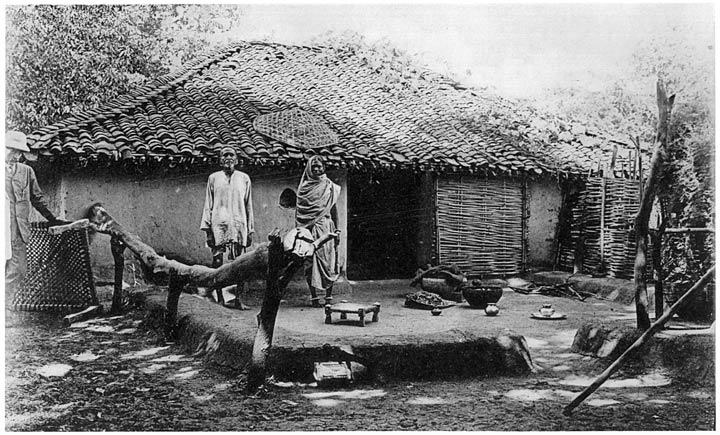
Freeing his hands, the doctor now ran with all his strength in the direction of Karnal but was stopped in his tracks by the appearance of some ironsmiths, who had worked previously at the Delhi Magazine. Entreating him to follow them, “don’t fear, come with me to my village, and I will find you food; if you go on, you will surely be murdered…” For once, no one was trying to kill the hapless doctor – the ironsmiths treated him with the utmost kindness; one gave him a dhoti and a cap, another milk and chapatis and yet another a charpoy to sleep on. It was probably from here that Mrs Wood had heard of the doctor’s existence, and although she did set out to look for him, the villagers thought it prudent to move him along. A declaration had been made, supposedly by Bahadur Shah, that any village harbouring English fugitives would be put to the sword.
A few days later, he found himself in another village, but the hospitality on account of the fearful proclamation was somewhat wanting. Doctor Batson was removed from the village to a mango tope – where he was left to shift for himself. At night, a villager would sneak up and leave him some bread and water in a bag. “I am unable to describe my feelings during this trying time; I was all day in the sun, in the extreme heat, and alone at night when the jackals, &c., came prowling about and crying….After five days and nights in this tope of trees, I was again taken back to the village and concealed in a bhoosa (grain) house; I was here shut in for 24 hours; the heat and suffocation I cannot find language to describe. I do not know which was the greatest misery, the tope of trees in solitude, or the bhoosa kotee…” The anxious villagers finally sent Batson on his way in the company of a fakir yogi who promised to take him anywhere he pleased.
What Doctor Batson did not take into account, although he had been born in India and spoke the vernacular, was accustomed to the local practices and had a profound understanding of both Hinduism and Islam; he possessed a pair of eyes of the most startling blue. Although the fakir dressed him as best he could, and Batson was eager to pass himself off as a Kashmiri, he could not disguise his eyes. His new friends treated him well, but eventually they cut him loose, and he was forced to wander the Indian countryside on his own, making his way with the help of a beggar, to Harchandpur – where the zamindar named Franz Gottlieb Cohen Farasu (Farasu being his pen name – under which he wrote poetry in Urdu and Persian) kindly sent him on to Meerut. Doctor Batson was finally reunited with the men who were left of his regiment. His wife, Caroline Mary (nee Wilmore) and their three daughters, Emma, Lydia and Mary, had managed to escape to Ambala.
He had spent 25 days “wandering about in villages and topes, and were it not that I speak the Hindoostani language as fluently as I can English, I must have been murdered. I look upon my escape as the most miraculous and providential possible. I am unable to describe what I have endured…“
Doctor Batson would live another 12 years, retiring from the army, dying of dysentery in Dinapore in 1869. Captain Holland had also made his escape from Delhi, but providentially, he was discovered the next day by a group of friendly Ahir villagers. They fed and sheltered him for a number of subsequent weeks in various villages and eventually found a way to forward him to Harchandpur. From here, he was sent to Meerut at the end of May. He, too, had been given up for dead.
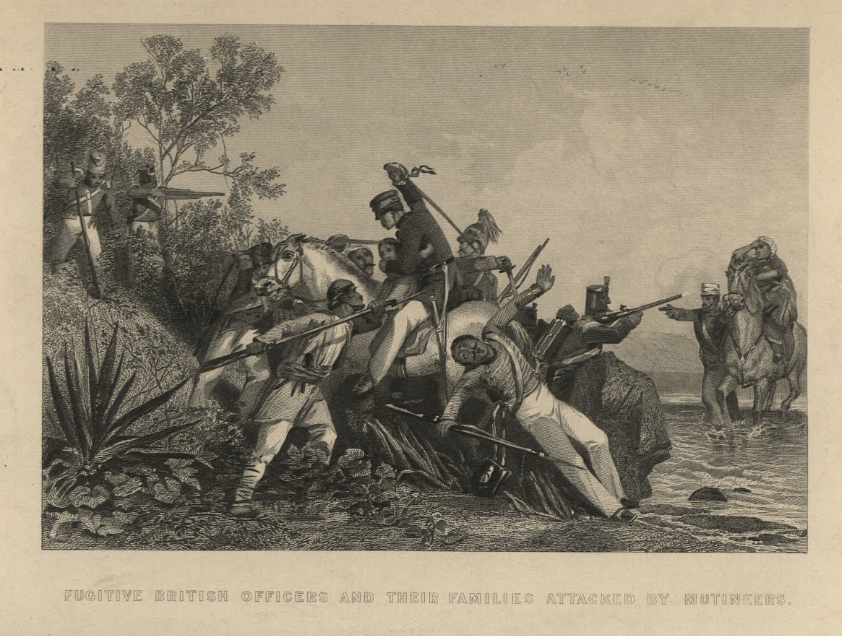
In the meantime, as the bungalows in the cantonment burned and Delhi was pillaged, groups of men, women and children were scrambling around the countryside, making their way along as best they could through the hot May night, hiding in scrub brush and under trees, begging for sustenance from villagers and hoping beyond hope that someone would rescue them. But in Meerut, the only station close enough to save them, the deathly inactivity continued.
In the next chapter, we shall immerse ourselves in the fate of the ladies we have left behind still so close to Delhi, back to the feisty Harriet Tytler, her intrepid husband Robert, and their companions the less masterful Gardners, and we shall learn of the fate of Edward Vibart and his little party, holed up on the 11th of May in the tykhannas of Theo Metcalfe’s house. We shall also meet George Wagentreiber of the Delhi Gazette and his brave wife Elizabeth, daughter of none other than Colonel James Skinner, as they set off on a startling escape of their own.
Sources:
Dalrymple, William. The Last Mughal: The Fall of a Dynasty: Delhi, 1857. London: Bloomsbury, 2006
David, Saul. The Indian Mutiny: 1857. London: Penguin Books, 2003.
Leasor, James. The Red Fort. London: Werner Laurie, 1956
Madras Military Male Orphan Asylum, comp. Narrative of the Indian Mutinies of 1857.Madras: The Asylum Press, 1858
Peile, Mrs. History of the Delhi Massacre. Liverpool, C. Tingling, 1858
Robinson, Jane. Angels of Albion. London: Viking Press, 1996
Tytler, Harriet. An English Woman in India. Oxford University Press, reprint, 1986
 Mutiny Reflections