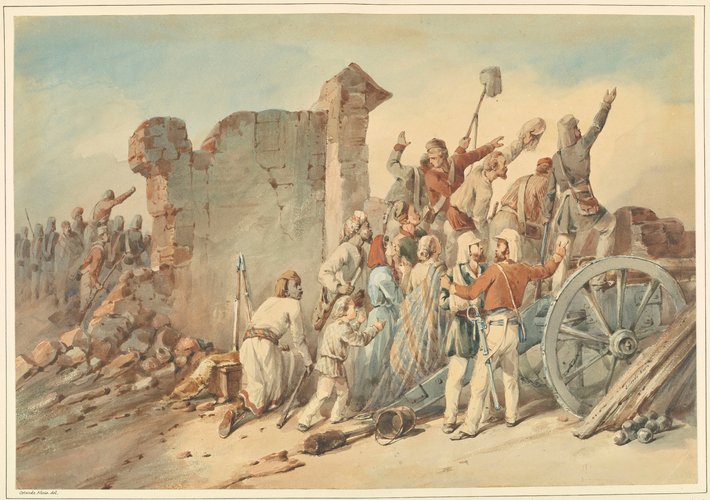
    If your officer's dead and the sergeants look white,
   Remember it's ruin to run from a fight:
   So take open order, lie down, and sit tight,
      And wait for supports like a soldier.
         Wait, wait, wait like a soldier...
                                                                  -  From “Barrack Room Ballads” - Rudyard Kipling


The final VCs were awarded on the 17th and the 18th of November and thus concludes this chapter on Lucknow.
53rd Regiment of Foot – the 17th of November, The Mess House
Sergeant Major Charles Pye
On the 17th of November, in line with the secure route of retreat that Sir Colin planned, the next building to be taken was the Kursheed Manzil or as it was then known, the Mess House of the 32nd Regiment.
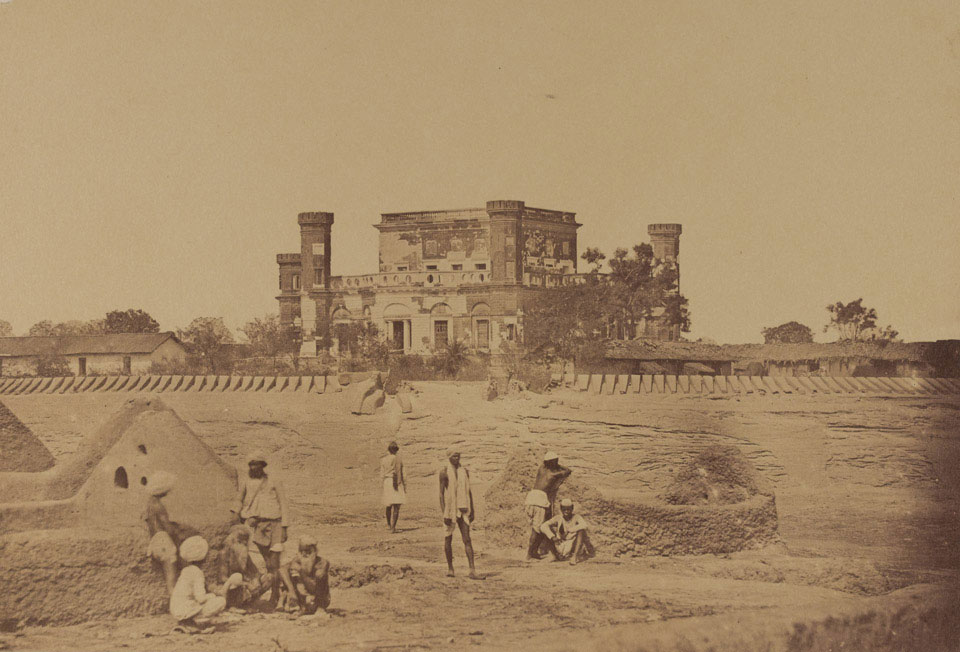
From early morning, Peel’s guns pounded away at the building with the support of the batteries of Maude and Olphert from their positions and at noon, Longden moved his mortars forward and joined in – when the time came for the assault, Sir Colin Campbell would have been rather certain the position could be carried without much opposition. He gave the honour of leading the charge to Captain Garnet Wolseley of the 90th. With a company of his regiment, Captain Hopkins and a detachment of 60 men of the 53rd, Captain Powlett leading ta few men of the 2nd Punjabis and Barnston’s Detachments now under the command of Captain Guise, Campbell gave Wolseley a little speech adding if the captain could not take the building he was to place his men under shelter and report back. His words were not lost on Wolseley or the men who would soon be in the charge.
“…the conviction that inspired them sharpened the rowels of the spur which stimulated all ranks in my company at the moment and made them determine that no breechless Highlanders should get in front of them that day. I overheard many of them express that determination in very explicit Saxon English. But some Scotch generals were at this time prone to magnify the noble deeds of Scotch battalions in a way that seriously irritated those from England and Ireland.”
So Wolseley formed up his men and the advance began. To their surprise, there was no opposition at all. The rebels had scattered out the back and rushed to the Moti Mahal before Wolseley or any of the other captains had a chance to engage anyone. It was, when all things were considered, a rather bloodless affair. Yet as soon as it was captured, the rebels opened a heavy fire on the position; Wolseley had not been given any orders on what he was to do if he indeed did capture the house so he took the initiative and captured the Moti Mahal, while Captain Irby ran over the Tara Kothi.
As for Pye, we cannot say for sure when he won his VC but it was decided by the men of his regiment that he deserved to have it.
“For steadiness and fearless conduct under fire at Lucknow, on the 17th of November, 1857, when bringing up ammunition to the Mess House, and on every occasion when the Regiment has been engaged. Elected by the non-commissioned officers of the Regiment.” (No. 22212″. The London Gazette. 24 December 1858. p. 5513)
Wolseley made the following observation about the 53rd Regiment, “No corps in India had a more deservedly high fighting reputation. It was mostly composed of reckless, dare-devil Irishmen, but at that time many of its company officers were middle-aged men who had been too long in India.”
While this might sound somewhat hard-hearted, Wolseley was not altogether wrong. The 53rd had indeed been a long time in India – since 1844, but Charles Pye had been there a little longer.
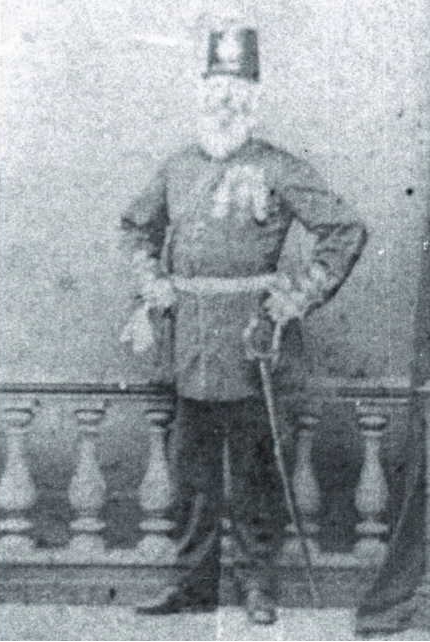
His life began as the son of Thomas and Alice Pye, on the 24th of September, 1820 in Rickerscote. His father was alternately a labourer and a brickmaker in Rickerscote and in Birmingham where the family lived for some time.
Unfortunately, times were hard – in 1836, Thomas Pye, now a widower, was convicted of burglary and transported for life to New South Wales. As for his 12 children, they had been deposited in the care of Pye’s brother and sister-in-law back in Rickerscote after the death of their mother. There was nothing for it: Thomas would not see his son or indeed, any of his children for a very long time.
As for Charles, at the age of 20, enlisted in the 40th Regiment of Foot at Coventry, Warwickshire – when Garnet Wolseley was just ten years old, Private Charles Pye was fighting the Battle of Maharajpur in India, in December 1843. In 1844 he transferred to the 21st Regiment of Foot and fought his way through the st Sikh War (the Sutlej Campaign) and received the campaign medal, inscribed with Mudki and three clasps for Ferozeshur, Aliwal and Sobraon. He started his career with the 53rd shortly before the commencement of the Second Sikh War (the Punjab Campaign) before engaging in the skirmishes against the hill tribes in the on the Peshawar front in 1852. Then came 1857 and he would be present from the start of the actions of the 53rd – from Kudjwa to the occupation of Sultanpore in 1858. On the 2nd of July, 1858 he was promoted to ensign and shortly after received his Victoria Cross by post in 1859. He became adjutant in 1859 and was promoted to lieutenant without purchase on the 9th of April 1860. A week later, Pye bundled his family together and they left India with the 53rd Regiment and returned to England. By 1862, Pye had received his discharge – England perhaps held no charm for Pye and the family emigrated to New Zealand. Unsurprisingly, he was commissioned as a captain in the Colonial Defence Force and took an active part in the Maori Wars between 1863-65 seeing action at Rangiawhia and Orakau in 1864 and he received the campaign medal in 1871.
Pye tried his hand as the owner of the Duke of Edinburgh goldmine, but he was not a dab hand at business and he lost heavily when he was led into speculating – he ended up bankrupt. How he turned himself around is anyone’s guess but in 1875, Pye sailed to Australia to meet his father who, after 40 years was still a resident of that fair land. Unfortunately, Charles Pye contracted bronchitis and died on the 26th of July, 1876 while on that visit. He was buried in the Tower Hill Cemetery at Korkoit near Warrnambool i n Victoria. All of his medals are on display at the Auckland War Museum in New Zealand.
Medal entitlement of Sergeant Major Charles Pye, 53rd Regiment
New Zealand Medal ( 1860-66 )
Victoria Cross
Gwalior Campaign Star ( 1843 )
Maharajpoor Star
Sutlej Medal ( 1845-46 )
Reverse: “Moodkee 1845”
3 clasps:
“Ferozeshuhur” – “Aliwal” – “Sobraon”
Punjab Medal ( 1848-49 )
Indian Mutiny Medal ( 1857-58 )
2 clasps:
“Relief of Lucknow” – “Lucknow”
23rd Regiment of Foot – the 18th of November
Lieutenant Thomas Bernard Hackett
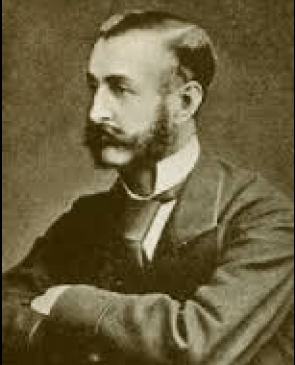
Born on the 15th of June 1836, he was the son of Thomas Hackett and Jane Bernard Shaw, in Co Tipperary, Ireland. In 1854, he entered the army by purchase as an ensign in the 23rd Regiment of Foot – by 1855 he had been promoted to lieutenant. Hackett served in Crimea, fighting at the Sebastopol and the assault on the Redan. Shortly after, he found himself with his regiment in India.
The only action on the 18th of November which matches Hackett and Monger’s daring do would be in the charge led by Sir Colin Campbell himself. He had wanted to open a shorter route by crossing the Dilksuha Bridge, but to do so, the route needed to be secured. As we know, Biddulph, while explaining the plan of attack on the hospital compound, was shot dead; Hale took over and led the storming party instead.
While Hale was attacking the hospital, heavy firing was heard from the direction of the Barracks. This was followed by the rebels’ attempt to storm the piquet between the Sikandar Bagh and the barracks. They were quickly repulsed by Captain Remington’s troop of Horse Artillery with 2 companies of infantry, the 23rd and 53rd Foot, who had been rapidly brought up by Sir Colin Campbell himself. He would later congratulate Remington for “the brilliant manner in which his troop had come into action.”
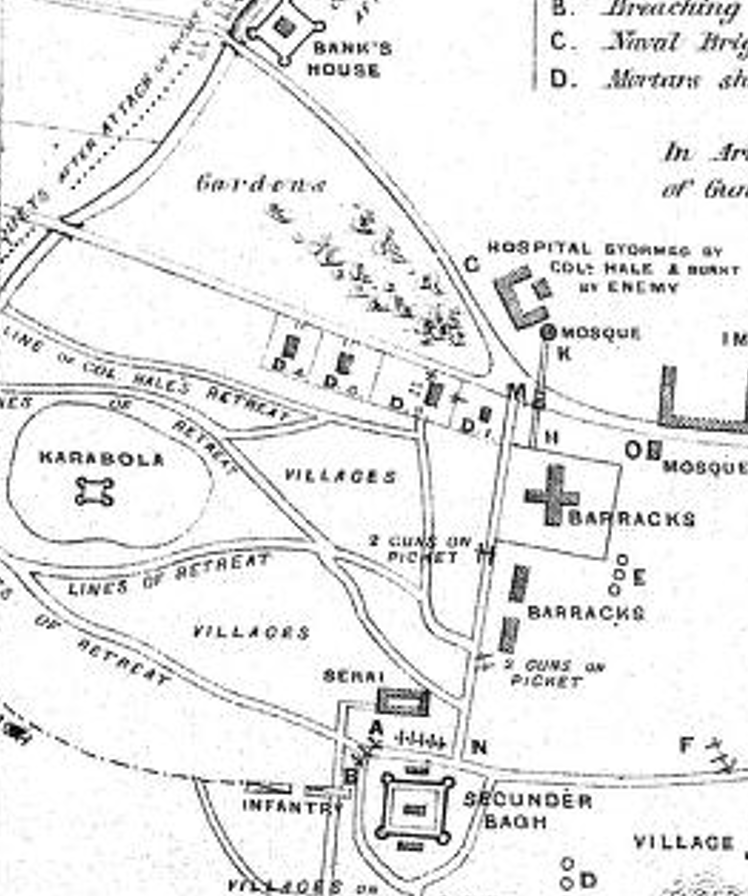
As for the second part of the citation, it is very likely that the rebels, just as they had at the hospital, were attempting to set the thatch of the surrounding bungalows on fire.
“For daring gallantry at Secundra Bagh, Lucknow, on the 18th November, 1857, in having with others, rescued a Corporal of the 23rd Regiment, who was lying wounded and exposed to very heavy fire. Also, for conspicuous bravery, in having, under a heavy fire, ascended the roof, and cut down the thatch of a Bungalow, to prevent its being set on fire. This was a most important service at the time.”
The question that remains, is Hackett the second man who joined Harington in saving the wounded man of the storming party. If the events are explained in this way, and the action does not take place directly at the Sikandar Bagh but correctly at the piquets between the Sikandar Bagh and the barracks, then both Hackett and Monger are the nameless men in Bourchier’s statement. The wounded man was indeed a corporal of the Indian Army. 23rd. The only one mentioned who fits this description as injured on that day is Corporal Daniel Bayliss.

As for Hackett, he saw out the mutiny, received his VC from Sir Colin Campbell in 1860, and purchased his captaincy in the 23rd. With his regiment, he would then fight in the Ashanti War of 1873. He ended his career as a Lieutenant Colonel. Unfortunately, he also ended his own life at the age of 44 in a hunting accident on the 4th of October 1880, when, while, out with friends shooting partridge, the trigger of his gun became entangled in a thicket and it discharged accidentally. He was wounded in the abdomen and died shortly after. Hackett was buried in Lockeen Churchyard, Borrisokane, County Tipperary, Ireland. Although Hackett was married at the time of his death, he had no children.
Private George Monger
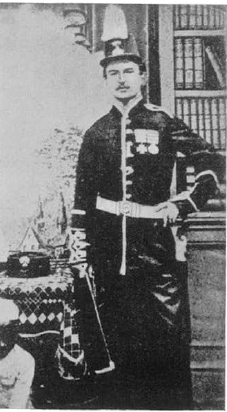
“For daring gallantry at Secundra Bagh, Lucknow, on the 18th of November, 1857, in having volunteered to accompany Lieutenant Hackett, whom he assisted in bringing in a Corporal of the 23rd Regiment, who was lying wounded in an exposed position.” (No. 22248” The London Gazette. 12 April 1859. p. 1482)
Born at Woodmancott, Hampshire on the 3rd of March 1840, George Monger was by far one of the youngest men at Lucknow on the 18th of November, 1857. Just 17 years old, he had joined the 23rd two years previously as a drummer boy. He was sent out to India with his regiment and served through the mutiny; at Lucknow, he served as a medical orderly. As Bourchier describes a drummer who remained with the wounded man, it is possible that this was Monger. Like Hackett, he received his VC from Sir Colin Campbell in May 1860.
Eight years later, we find Monger has been discharged from the army, having continued serving with the 1st Class Army Reserve until poor health necessitated taking medical discharge. He then eked out a living as a stonemason and plasterer for J.C. Kenwood in Hastings, Sussex. Asthma prevented him from working and with his ever-increasing family, (nine children in all, of which at least 2 died in infancy), he was catapulted into severe poverty – to make ends meet, Monger and his wife sold their household goods, most of their garments and he either pawned or sold his medals. The situation was dire indeed; a local retired soldier, one Major-General Sherer, apprised of their plight, raised a subscription for Monger and his family. George’s health never recovered, and he died of tuberculosis on the 9th of August 1887. He was buried with military honours.
Hastings and St Leonards Observer – Saturday 20 August 1887
“George Monger’s Funeral — On Saturday, the mortal remains of the late Mr. George Monger, the Victoria Cross Hero, were interred in the Borough Cemetery at Ore, the obsequies being appropriately of a military character. The cortège was composed of the combination hearse and mourning coach, a detachment of the Hastings Rifle Volunteers, and the band of the corps playing “The Dead March” from Saul. There were a good many people also present. The service was conducted by the Rev. D. A. Doudney and amongst the mourners were: Major-General Sherer, Lieutenant-Colonel Tubbs, Mr. J. C Kenwood, the Rev. F. G. Hughes, and Major Cafe.
The Union Jack and the Victoria Cross were placed on the coffin, and when the shell had been lowered into the grave, a firing party discharged three volleys of blank cartridges from their rifles over his tomb. The service was very impressive throughout.”
His overgrown grave was discovered in 1990 by a workman and subsequently restored by local army cadets.
DEFENDERS OR SPENDERS?

'WHEN our men are at the front, and the army bears the brunt
Of the conflict, as our enemies in War's embrace, they meet,
Mid the weird-inspiring skirl of the pibroch, and the whirl,
And the sound of flying squadrons, and the tramp of charging feet,
Then we seem to hear the rush of the battle, and the hush
That comes before the battle, like the calm before a storm,
And we bless “the thin red line,” and we toast them o'er our wine,
And we call them our DEFENDERS, and we love their uniform.

But when “Peace with Honour” comes, and the rattle of the drums
Is silent, and the Stock Exchange no longer holds its breath,
And the pibrochs skirl no more, for of those they led before
There are men by hundreds lying in the cruel arms of Death,
Then we ponder over pence and the question of expense
Regains its old importance, now they've won our little fight;
And we hasten to forget that we owe them any debt,
And we think of them as SPENDERS, and their uniform we slight. '
                                                                                                 - From the ' St. James's Gazette, May 5, 1892
Sources:
Bourchier, George. Eight Months’ Campaign Against the Bengal Sepoy Army during the Mutiny of 1857. London: Smith, Elder, and Co., 1858.
Ewart, John Alexander. The Story of a Soldier’s Life; or, Peace, War, and Mutiny. 2 vols. London: Sampson Low, Marston, Searle, & Rivington, 1881.
Gordon-Alexander, William. Recollections of a Highland Subaltern: During the Campaigns of the 93rd Highlanders in India, under Colin Campbell, Lord Clyde, in 1857, 1858 and 1859. London: Edward Arnold, 1898.
Roberts, Frederick Sleigh. Forty-One Years in India: From Subaltern to Commander-in-Chief. Vol. 1. London: Macmillan and Co., 1911.
Wilkins, Philip Aveling. The History of the Victoria Cross: Being an Account of the 520 Acts of Bravery for which the Decoration Has Been Awarded, and Portraits of 392 Recipients. London: Archibald Constable & Co., 1904.
Wolseley, Garnet. The Story of a Soldier’s Life. Vol. 1. London: Archibald Constable & Co., 1903.
Links:
https://vcgca.org/
https://www.nam.ac.uk/
https://www.memorialstovalour.co.uk/
https://victoriacrossonline.co.uk/
https://www.soldiersofshropshire.co.uk/wp-content/uploads/2021/11/Charles-Pye-VC-word.pdf
https://convictrecords.com.au/convicts/pye/thomas/1823
https://www.construction.co.uk/construction-news/126899/stafford-heroes-clock
http://www.thepeerage.com/p62215.htm
https://historymap.info/George_Monger_(1840-1887)
https://friendsofhastingscemetery.org.uk/mongerg.html
 Mutiny Reflections