When shakin’ their bustles like ladies so fine,
The guns o’ the enemy wheel into line,
Shoot low at the limbers an’ don’t mind the shine,
For noise never startles the soldier.
Start-, start-, startles the soldier…
– Verse from “Ballad Room Barracks”, Rudyard Kipling
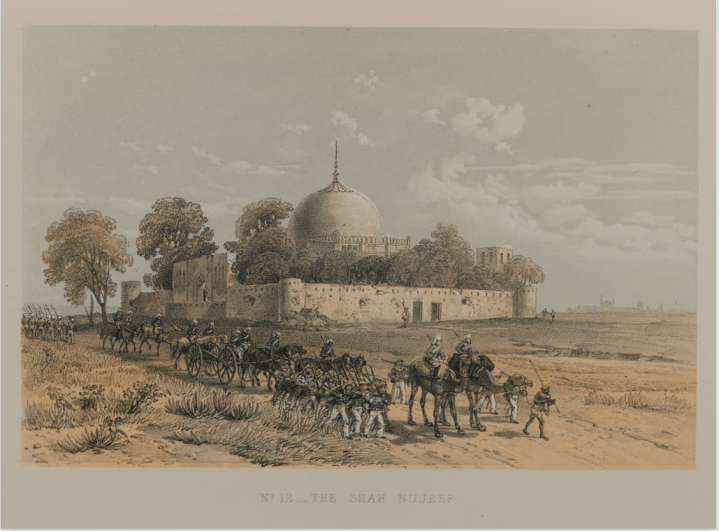
The Shah Najaf – the 16th of November
The Naval Brigade
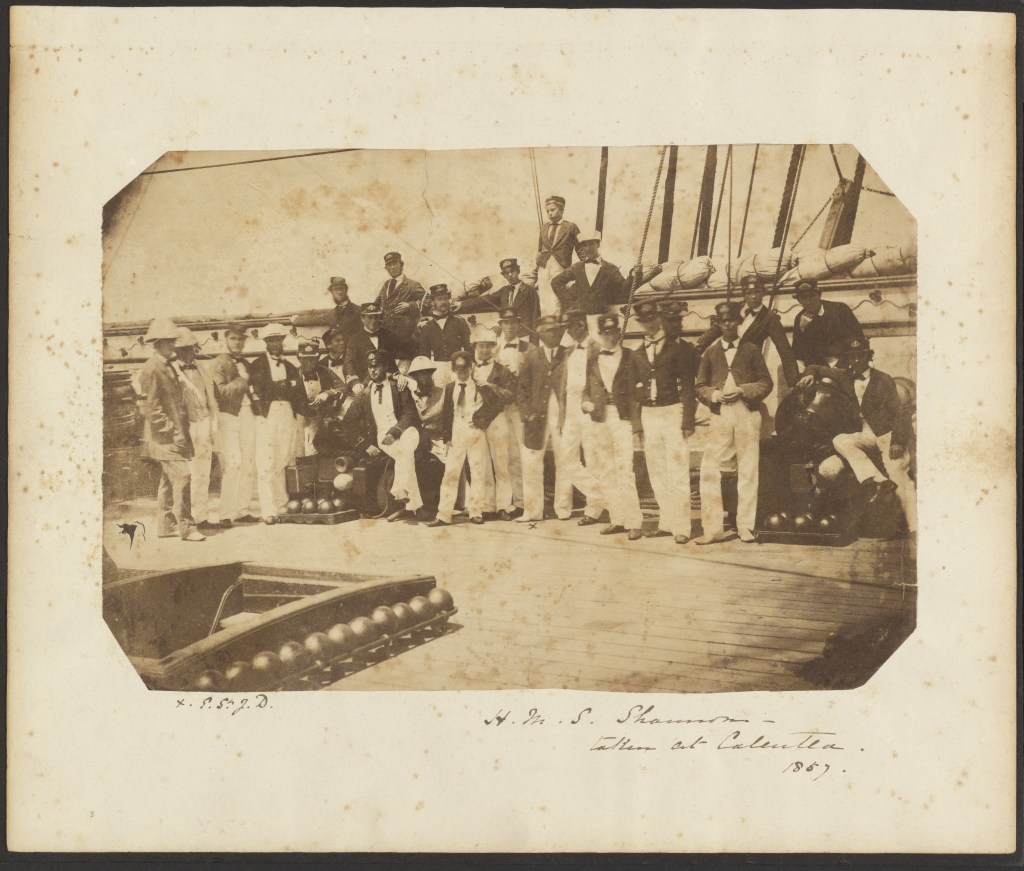
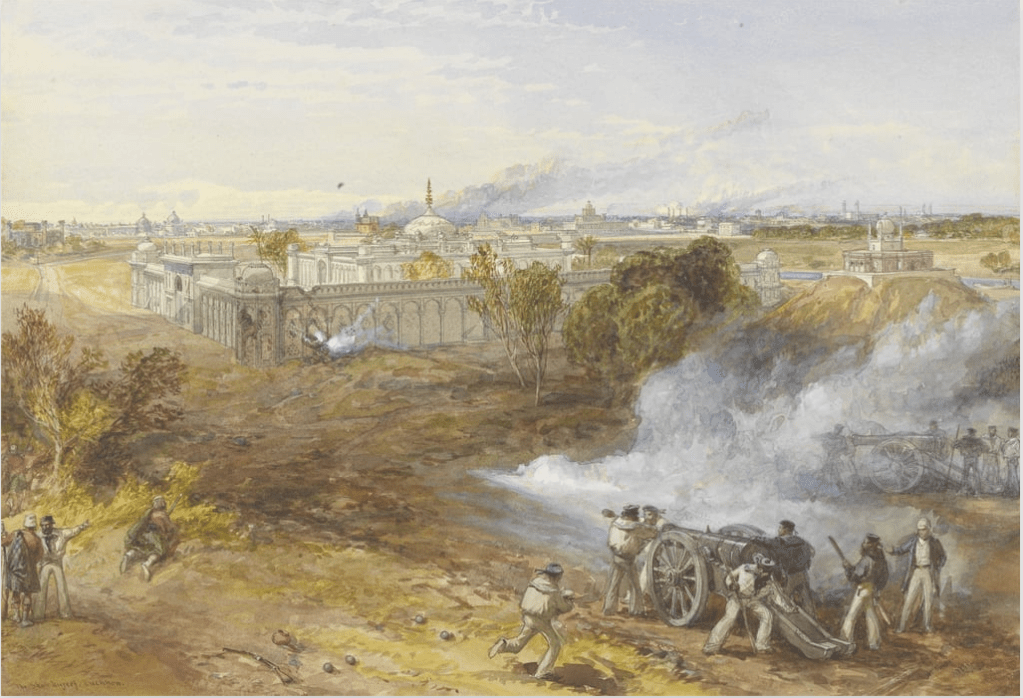
“It was well into the afternoon when the fighting at the Sikandarbagh died down and the force was able to push on against slight opposition as far as the Shah Nujeef…Barnston’s Battalion of Detachments was in the lead when they suddenly came under very heavy fire and Barnston himself was fatally wounded, upon wich his men began to pull back…More infantry were brought up, but the advance was impossible and soon an enemy gun opened fire from across the Goomtee. Its first shot blew up one of the Naval Brigade’s tumbrils.
The fire of the British guns was ineffective and there was no slackening in the enemy’s musketry. Three hours had passed since the advance had been halted, darkness was not far off. Sir Colin rode to the head of the 93rd and called on them to follow him, while, dragging their guns by hand, the sailors and Marines dashed right up to the all; as Campbell said in his despatch later, “Captain Peel led up his heavy guns with extraordinary gallantry within a few yards of the building to batter the massive stone wall. The withering fire of the Highlanders effectually covered the Naval Brigade from great loss, but it was an action almost unexampled in war. Captain Peel behaved very much as if he been laying the Shannon alongside an enemy frigate.”
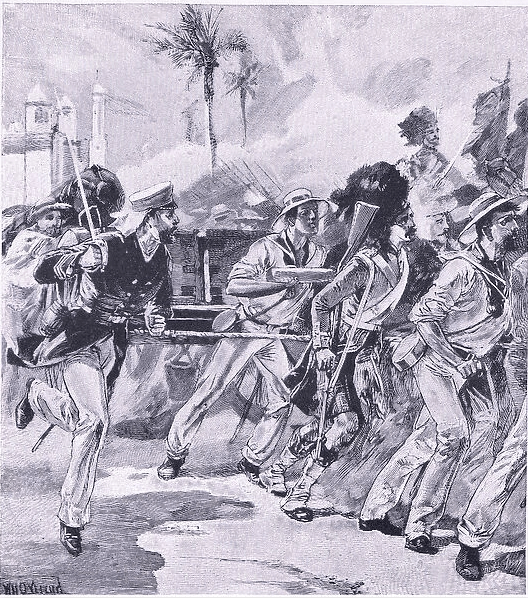
“The dust and the smoke was so great that it was almost impossible to see what effect the guns were having, but there was a tree nearby and Peel called for volunteers to climb it, both to observe the fire and to shoot the defenders within. Three men at once answered the call, Lieutenant N. Salmon and Leading Seaman John Harrison of the Shannon, and Lieutenant Southwell. The last-named was at once killed, and the others wounded, but they acheived their object, reported what was going on and put out of action a number of the enemy…Peel, manning all his guns worked his pieces with redoubled energy and under cover of the armed storm the 93rd rolled in one vast wave…”
Lieutenant Nowell Salmon and Leading Seaman John Harrison
“For conspicuous gallantry at Lucknow, on the 16th of November, 1857, in climbing up a tree, touching the angle of the Shah Nujjiff, to reply to the fire of the enemy, for which most dangerous service, the late Captain Peel, K.C.B., had called for volunteers.” (“No. 22212”. The London Gazette. 24 December 1858. p. 5512).
John Harrison was born in 1832 in Castleborough, Co Wexford, Ireland. On the 2nd of February 1850, he enlisted as a Boy Second Class in the Navy and served on the battleship HMS Agamemnon during the Crimean War. He transferred to the Shannon shortly before the Indian Mutiny.
Harrison was wounded during the final operations at Lucknow and he never recovered from his injury. Although he was promoted to boatswain’s mate and petty officer, he was discharged from the navy in 1859. He returned to England in time to receive his VC from Queen Victoria on the 4th of January 1859. Through the kind offices of Lieutenant Thomas Young, he managed to secure a post with the Custom and Excise, but ill-health plagued Harrison – he died, a bachelor, at his home in Westminster on the 27th of December 1865. He was buried in in Brompton Cemetery in a common grave. His VC remains with the National Maritime Museum in Greenwich, London.
While we know little about John Harrison, Lieutenant Nowell Salmon is quite a different tale.
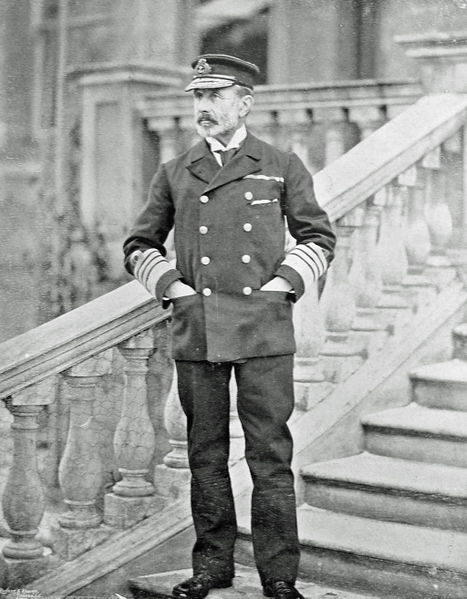
Photograph – Navy and Army Illustrated
The son of Reverend Henry Salmon, Rector of Swarraton and his wife Emily – the daughter of Admiral William Nowell – Salmon was born in 1835. Educated at Marlborough College, he joined the navy in 1847 at the age of 12, as a cadet. From 1851 to 1853 he served aboard HMS Thetis and received the Baltic Medal for the Crimean War. In 1856 he was promoted to lieutenant and in September of the same year, transferred to the Shannon under Captain William Peel. In 1858 he was promoted to commander for gallantry and a year later he could be found aboard HMS Icarus as commander on the West Indies and North America Station, and arrested Filibuster Walker, an action for which he received a gold medal from the Central American States.
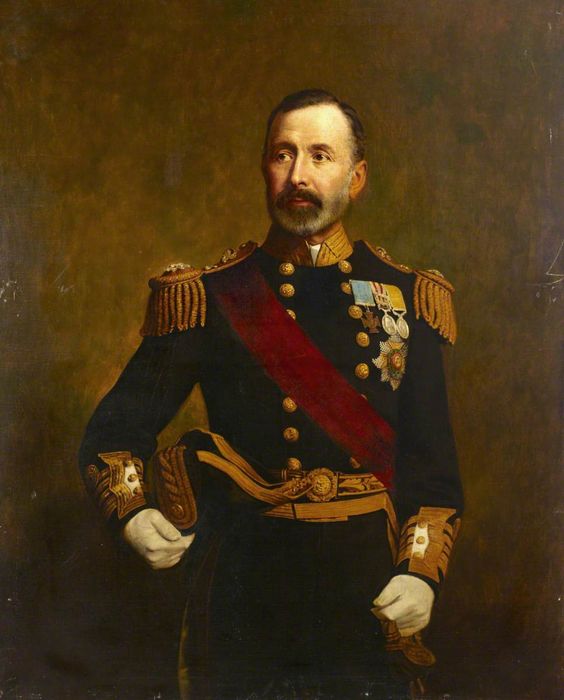
On the 29th of May, 1875, Salmon, on the occasion of the Queen’s birthday, received his CB. 1885 saw him promoted to Vice Admiral and in 1887, he was appointed KCB. The rank of admiral came in 1891 and further honours followed in 1897 ( GCB) and the rather flourishing title, “First and Principal Naval Aide-de-Camp” to Queen Victoria on 23 August followed the same year. The rank of Admiral of the Fleet was not far behind (1899) – Salmon was placed on the Retired List on the 20th of February 1905. He died in 1912.
The action for which Harrison and Salmon were awarded the VC is described in detail by Gordon William Alexander of the 93rd Highlanders.
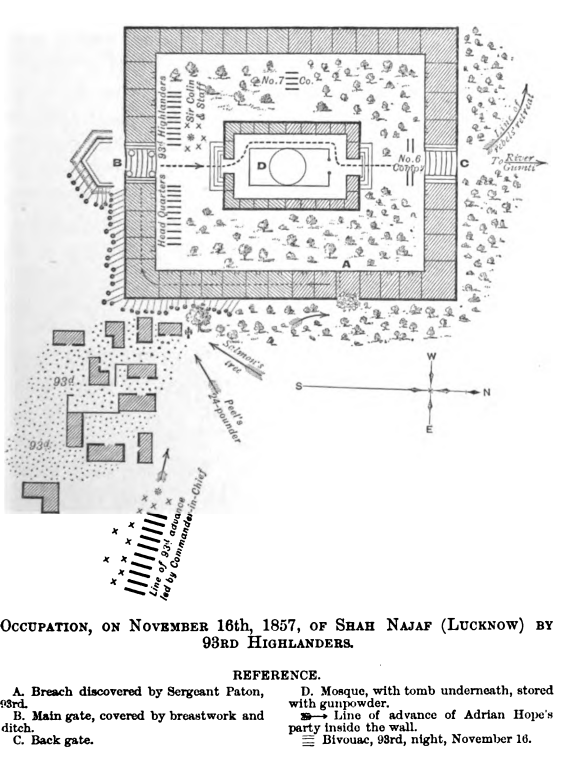
“Our Brigadier, Hope, was standing with his aide-de-camp and Brigade-Major a little to the left rear of Feel’s single gun, where I also was standing with a group of officers, somewhat sheltered from the view of the enemy by the thatched roofs of the huts, but not from the stray bullets which came through those roofs, when Captain Peel, whose gun’s crew were suffering severely from the musketry fire directed at them from the parapet on the top of the walls, called out that he would recommend any officer or man amongst them for the Victoria Cross who would climb the tree, and so, getting above the defenders of the parapet, try to keep down their fire by picking them oflf one by one. Lieutenant Nowell Salmon, R.N., of Her Majesty’s ship Shannon, immediately responded to the call, and proceeded to climb the tree like a cat — or a sailor! Brigadier Hope, taking in the situation at a glance, ordered me, as the officer standing nearest him, to pass up a continual supply of loaded rifles to Lieutenant Salmon. Lieutenant Salmon found, however, that he had to go a good way up the tree, which was barely fifteen paces from the wall before he could overlook the parapet. This necessitated another sailor — in this case one of the seamen — also climbing the tree as far as was necessary, to hand Lieutenant Salmon the loaded rifles and pass them back for our men to reload. As it was found awkward to pass the loaded rifles round the outside of the gable of the mud hut nearest the tree and to receive back the unloaded ones the same way, I directed some men of my own company inside the mud hut nearest to the tree (see plan) to knock a hole through the gable, which was easily done, and pass the loaded rifles out that way, the unloaded ones being passed back round the gable. But a link in the chain up the tree was then required, so I myself dropped into a hole, which had been hollowed out by the explosion of one of those otherwise harmless earthenware vessels filled with gunpowder, at the foot of the tree and under the muzzle of Peel’s 24-pounder, and commenced to pass the loaded rifles up to the sailor in the tree, who then passed them on to Lieutenant Salmon. Mr. Salmon, however, was soon severely wounded and had to let himself down to the ground, the sailor below him taking his place, but not so high up, else I could not have reached him. This sailor was shortly afterwards directed by Captain Peel to come down for the word had been passed that we must prepare to retire…”
Nowell Salmon himself noted when asked to proof Alexander’s account,
April 2, 1898. — I return your “extract ” ( from Alexander’s diary), which seems to me wonderfully correct. I have no corrections to offer, excepting that there were three volunteers to go up the tree. One was killed at its foot; the third referred to in the extract, and who handed up the rifles, was untouched. (Signed) Nowell Salmon.’
Seaman Robert Sitwell was shot dead and Nowell Salmon received a gunshot wound to the thigh.
The account is continued from Alexander, and relates directly to the next two VC winners.
“This sailor was shortly afterwards directed by Captain Peel to come down, for the word had been passed that we must prepare to retire, and I myself was called upon by Brigadier Hope to come away and give a hand in running the 24-pounder back out of fire, Peel’s men having been so decimated, that there were not enough now left to work the gun; in fact, a fine fellow…was, I believe, the only man who had not been wounded, and latterly he had been doing duty for two or three of the regulation number of gunners. As in the Crimea, so here (and indeed the whole world round today, as in 1857), nothing could excel the splendidly cool courage and magnificent devotion to duty under fire of our unsurpassable Jack Tars, officers and men!“
Alexander is of course referring to William Hall.
Captain of the Foretop William Neilson Hall
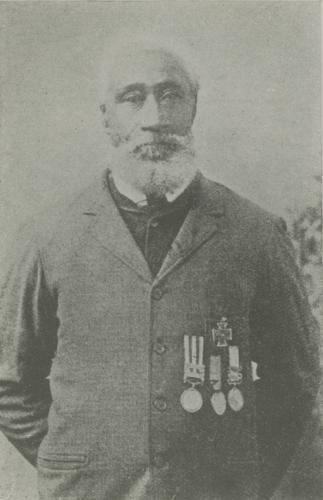
William Hall was a remarkable man. The son of freed slaves, he was born in Horton, Nova Scotia in 1827. He would be the first Halifaxian, the first Black person and the first Canadian naval recipient to win the Victoria Cross.
His parents were Jacob and Lucy Hall who had escaped American slave owners in Maryland during the War of 1812. They were brought to Canada by the British Royal Navy as a part of the Black Refugee Movement. They first lived in Summerville, where Jacob was employed in the Cunard shipyard until he purchased a farm across the Avon River at Horton Bluff.
William was at first employed in the shipyards at Hansport, Nova Scotia but it would seem the adventure of the sea had a hold of the young man – he joined a crew of traders based out of the Minas Basin and then briefly served in the United States Navy from 1847 to 1849 during the Mexican- American War, aboard the USS Ohio. Hall volunteered for the Royal Navy in 1852. He served as Able Seaman aboard the HMS Rodney, which included 2 years of service in the Crimea where he worked the heavy guns with the ground forces at the battles of Inkerman and Sevastopol. After the war, he briefly joined the HMS Victory but transferred to the Shannon as Captain of the Foretop.
Verney described Hall as “a man remarkable for his steady good conduct and athletic frame; at a foot race in camp he had distanced by far all the competitors; and I have never seen his superior either as swimmer or diver.”
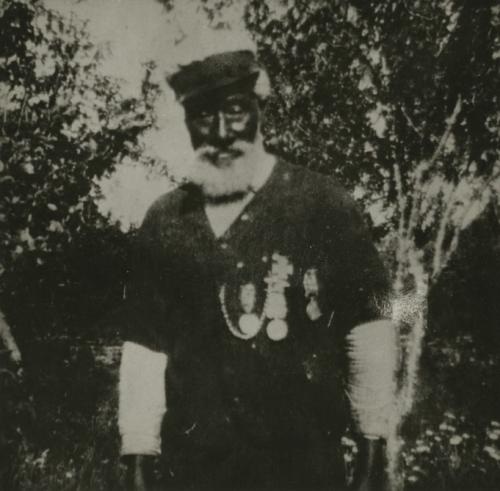
He did not receive his VC from the Queen, or indeed in the usual ceremony – he received his Cross in October 1859 aboard his new ship, the HMS Donegal in Queenstown Harbour, Ireland where it was presented to him by Rear Admiral Charles Talbot as “fellow seamen manned the ship’s yards, officers in full-dress stood by, the ship’s band played “God Save the Queen” as the medal was pinned on his chest.”
Hall would serve with the Royal Navy for the remainder of his career until his retirement. He retired with the rank of Quartermaster and was let out on pension as Petty Officer, First Class, July 4, 1876, with a Good Conduct Certificate. He settled on the family farm with his two sisters near Hantsport – although he was by all means well respected local figure in his community, William Hall gradually drifted into obscurity. He briefly emerged in 1901 when he was presented to the Duke and Duchess of Cornwall during their Halifax visit – Hall wore his Victoria Cross and other service medals at a military parade held for the prince. This was duly noticed by the prince who, after conversing with Hall, started bringing attention to his service. However, upon his death in 1904, William Hall was buried without military honours at Lockhartville. Thirty-three years later a campaign was started to to have his deeds recognised by the Canadian Legion and eight more would pass before he was reburied in the grounds of the Hantsport Baptist Church where a monument stands today, honouring his service.
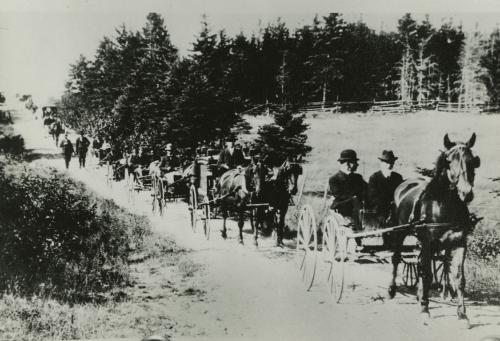
Obituary of William Hall in the The Register, September 8, 1904
“William Hall, of Horton Bluff, the coloured man who won the Victoria Cross during the Indian Rebellion, died on Thursday, August 25th, aged 78 years. Mr. Hall entered the British navy at an early age and served his country faithfully for many years. At the relief of Lucknow, he was one of a squad of mariners who volunteered for a very difficult service, and he received the Cross for standing to his gun while the company were engaged in blowing open a gate to make an entrance to the city. He and another man were left alone to work the gun, their comrades having been killed, and by their pluck and perseverance succeeded in effecting an entrance for the British troops. Twenty years ago Mr. Hall left the navy and settled at Horton Bluff, where he has dwelt since on a small farm. He was well known, and highly respected by all. At the time of the visit of the Duke of York to Halifax, Mr. Hall journeyed to the city and was kindly received by His Royal Highness. He is said to have been the only coloured man who ever held the coveted Victoria Cross. He was unmarried and lived with two sisters, Mrs. Robinson and Miss Rachel Hall. The funeral took place on Saturday, burial being made at the Brooklyn cemetery, near Lockhartville. – Acadian.”
Lieutenant Thomas James Young
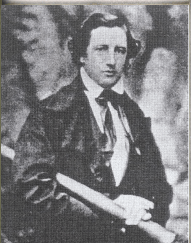
“Lieutenant (now Commander) Young, late gunnery Officer of Her Majesty’s ship ” Shannon,” and William Hall, ” Captain of the Foretop,” of that Vessel, were recommended by the late Captain Peel for the Victoria Cross, for their gallant conduct at a 24-Pounder Gun, brought up to the angle of the Shah Nujjiff, at Lucknow, on the 16th of November, 1857.” ( “No. 22225”. The London Gazette. 1 February 1859. p. 414).
From the records compiled on The Royal Victorian Navy (https://www.pdavis.nl/) for this valourous man, we find the following:
| 27 March 1852 | Lieutenant in Excellent, commanded by Henry Ducie Chads, gunnery ship, Portsmouth | ||
| 30 September 1852 | Lieutenant in Agamemnon, commanded by Thomas Maitland, Channel squadron | ||
| 1 September 1856 | Lieutenant in Inflexible, commanded by John Corbett, East Indies and China | ||
| 16 September 1856 | Lieutenant in Shannon, commanded by William Peel, East Indies (including the naval brigade during the India Mutiny) | ||
| 12 September 1863 | Commander (2ic) in Gibraltar, commanded by Robert Coote, Mediterranean | ||
Born in Chelsea, London in 1826, the son of one Thomas Young. He entered the Royal Navy as a cadet, at age 14 and received his promotion to midshipman on the 7th of December 1848. By 1852 he was a lieutenant. He served in the Crimean War where he received a Mention in Despatches for his part in the raiding parties on the Russian supply bases in the Sea of Azov. It would seem the gunnery course he absolved at the HMS Excellence would prove to be very useful to this intrepid young man. His medals would include
Victoria Cross
Crimea Medal ( 1854-56 )2 clasps:”Azoff” – “Sebastopol”
Indian Mutiny Medal ( 1857-58 )
2 clasps:”Relief of Lucknow” – “Lucknow”
Order of the Medjidheih ( 5th Class )
( Turkey )Turkish Crimea Medal ( 1855-56 )
Peel’s guns needed a gun crew of 6 men to operate it and each man was numbered, commencing with the officer in charge – when the officer fell, the Number 2 man would take his place, with each man moving up one position. The simplicity of the system ensured the guns never stopped firing and avoided any confusion as to who was to do what. Hall said, “After firing each round we ran our gun forward until at last my gun’s crew were actually in danger of being hit by splinters of brick and stone mortar from the walls were bombarding. Our Lieutenant, Mr Thomas Young moved about with a quiet smile and a word of encouragement, and when the last gunner next to me fell dead, Mr Young at once took his place.” Young was in command of the gun crews and he moved from gun to gun, standing next to Hall to load and fire, when there was no one else left.
With such a terrible loss of life for a wall that refused to come down, Peel ordered a cover of rocket fire and the withdrawal – Young and Hall continued to sponge, load and fire. The loss among the Naval Brigade on the 16th of November would be 4 killed and 18 wounded.
Although one of those wounded at Shah Najaf, Young would be able to join General Wyndham in the attack on Detea Fort the following year. After Captain Peel’s death at Cawnpore, Young received his promotion and led the final Naval Brigade Detachment back to the Shannon and sailed for home.
Queen Victoria personally presented Young with his VC at Buckingham Palace on the 8th of June 1859 – subsequently, Young received an appointment as Inspecting Commander of Coastguard at Kensington, Devon the same year. In 1860 he married Tasmanian-born Louisa Mary Boyes, the sister of another VC recipient (action at Shimonoseki, Japan on 6 September 1864), Duncan Gordon Boyes. Sadly Boyes would commit suicide in Australia in January 1869 and Thomas Young would die in March the same year, in France. He lies buried in the Protestant Cemetery in Caen.
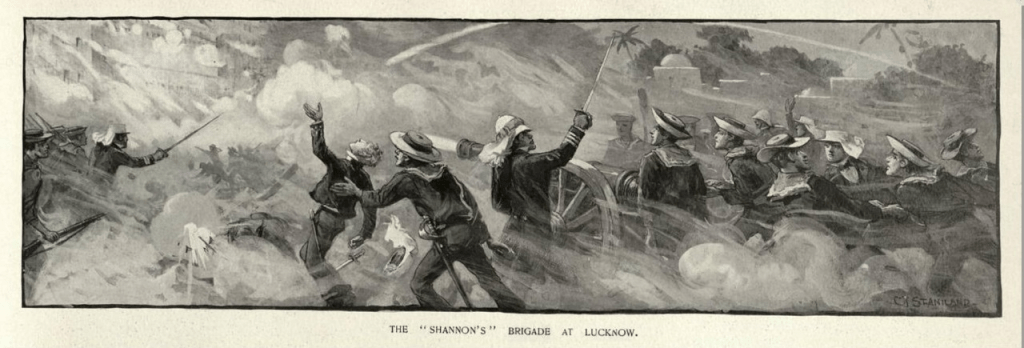
Without the capture of the Shah Najaf, it would have been difficult to provide a secure line of retreat for the Lucknow Residency – after three hours of bombardment, the walls surrounding the mosque were nowhere closer to falling and darkness was setting in.
“When the officers, headed by Brigadier Hope and Peel himself, had dragged the big gun back a bit, and a number of the men of the 93rd were running it back still further, some rocket tubes were brought up by other men of the Slmnnon, and that alarming-looking projectile, the war-rocket, was sent skimming close over the parapet of the Shah Najaf into the interior of the enclosure. Shortly after the rocket tubes opened fire the thatched roofs of the huts, which had hitherto screened us from the view of the enemy, were seen to be well alight, and Hope called out to us to look after the wounded, many of whom were inside the huts. Officers and men had now to exert themselves to their utmost in carrying off the wounded and dragging out our dead, while Hope, passing in and out amongst us, whispered to the officers that we were going to retire. Our fire had entirely ceased, except a rocket from the sailors now and then, when they could be fired with safety to us; the roofs of the huts were blazing all around us, and the enemy’s fire seemed to be redoubled, when suddenly their bugles rang out the ‘advance,’ followed immediately by the ‘ double,’ and their fire ceased. The officers of the 93rd, who had sheathed their swords long before this incident, hastily drew them again, shouting to the men to fix bayonets, the Brigadier, I noticed, also drawing his sword, for we all thought that these bugle calls preluded a sortie of the garrison in force…
So there we all were the men, like the officers, having put down their wounded comrades or released their hold on the dead, facing the grim walls of the place individually, and wondering what was going to happen next. Darkness had quite closed in by this time, and those walls appeared even more formidable than in the daylight, illuminated by the blazing thatch all round us. When the enemy’s bugles sounded the advance, Nightingale and I were dragging the body of some poor fellow of the 93rd away from the outside of one of the blazing huts. Releasing our hold for the moment, in the belief that it was the prelude to a sortie, we paused to see what would happen. We were standing a little to the rear of Brigadier Hope and his aide-de-camp, Lieutenant Butter, 93rd Highlanders — when Lieutenant Maxwell W. Hyslop and Sergeant Paton of the Light Company 93rd came up through some bushes on our right, and Hyslop reported to the Brigadier that they had found a breach in the wall to our right, which he (Hyslop) was sure we could climb…Hope, telling Hyslop to show the way, called to all of us within hearing of him to follow. With bayonets fixed, we proceeded down through some thick brushwood to our right, and found, not fifty yards off, the outer wall so broken down as to form a practicable breach, whether by the fire of some of our artillery or how, I never heard. The bricks and debris having fallen outwards, we did not find much difficulty in mounting this breach, which landed us on the broad ramparts formed by the roofs of the travellers’ rooms running all round the outer walls. Besides Brigadier Hope, his aide-de-camp and Brigade-Major, Captain Dawson of No. 4 Company, and Hyslop, who showed us the way, I think Burroughs was one of the party, and that there was a headquarter staff officer and an officer of sappers with us. Anyway, we mounted the rampart without difficulty, and looking down into the enclosure, could neither hear a sound nor see anything moving about. But it was now quite dark, and the trees within the walls rendered it pitch-dark inside.”
However, the last Victoria Cross awarded for actions at the Shah Najaf belongs to Sergeant John Paton alone.
93rd Regiment, Sergeant John Paton
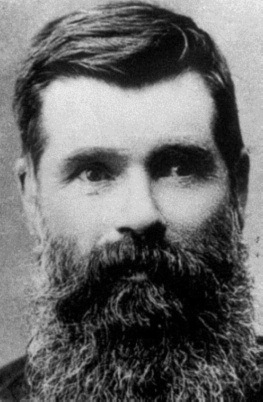
Perhaps Hyslop comforted himself, as Ewart did, that he had not been any less courageous than the others who took part in the actions of the 16th of November. It is no slight on John Paton, a well-deserving recipient, but perhaps still a little unfair to Hyslop.
Sir Colin Campbell never forgot a face or for that matter a name. He would have known that Paton had been one of the men in his famous Red Line at Balaklava. In an interview, when recalling his Crimea experiences, Paton would say, “It was at Balaklava we suffered most hardship, we were badly fed, badly clothed and badly armed. Were given guns in the Crimea which would not punch a hole through butter at 50 yards. The Russians used to laugh at us.”
John Paton was born in 1834 in Stirling, Scotland, the son of the soldier Matthew Paton and his wife Isabella. Although he had intially enlisted in the Black Watch, Paton volunteered for the 93rd at the outbreak of the Crimean War. Twelve days after arriving he was already embroiled in the Battle of the Alma. He then fought at Balaklava and served for nearly a year before Sevastopol. He returned home with this regiment and with the rest of the 93rd, was diverted to India from the China expedition.
At Lucknow, (leaving Hyslop aside), Paton was nominated for the VC by his regimental comrades (Clause 13) and would later recall the whole incident so,
“At Lucknow, we had several hard fights in one day, but we pushed on to the besieged Residency and had [Sir Henry] Havelock out the next night together with the women and children. It was there I won the Cross. My bonnet was shot away and my pouch, also a button from the front of my coat, besides having the arm of my overall torn by a bullet. Yet then, as afterwards, though always in the thick of it, I never received a scratch, although many and many a time, my beloved comrades dropped on either side of me.”
The Victoria Cross gave Paton a few more things to say.
“The much-vaunted VC carries a pension of £10 per annum. Now it must be remembered that men who got the VC are generally pretty badly broken up in achieving it. I was not, but most of those gaining it have been left minus a leg or an arm, or have been in some way incapacitated.£ 10 a year seems but a paltry sum to recompense men so badly smashed. My complaint is not a personal one, as I have explained I came through without a scratch.”
Back in England and stationed at Dover, Paton would be remembered for one rather curious altercation with a famous personage – the teenage Prince of Wales, future King Edward VII.
Prince Edward, it would appear was disturbing Paton (who was cleaning his accoutrements at the time), by “interfering, first with this and then with that until I lost my patience at the finish” and he clipped Edward under the ear. His horrified officer asked Paton if he had any idea who he had just smacked, to which Paton replied he didn’t and he didn’t care! While he did not have time to apologise, Paton heard later that the Queen said it served Prince Edward right.
“We were expected,” said Paton,” notwithstanding our experiences in active wartime, to take our places and be drilled amongst the raw recruits under officers wealthy enough to buy commissions, if not courageous enough to earn them. Many of us, including myself, rebelled against this and left the army.”
And leave he did – all the way to Australia.
On arrival in New South Wales, Paton joined the prison service. For ten years he was chief warder at Port Macquarie, then chief gaoler at Deniliquin from 1875 until 1888 (where his wife acted as matron). In 1888 he was appointed governor of Berrima gaol and two years later, he succeeded as governor at Goulburn gaol. Paton retired from the prison service on 29 February 1896 and Summer Hill, in Sydney’s inner western suburbs, until his death in 1914 age 81. He was buried with full military honours.
However, we cannot close the story of John Paton’s VC without the words of our rather opinionated Highlander, William Gordon Alexander:
“For distinguished personal gallantry at Lucknow, on the 16th of November, 1857, in proceeding alone round the Shah Nujjiff under an extremely heavy fire, discovering a breach on the opposite side, to which he afterwards conducted the Regiment, by which means that important position was taken. Elected by the non-commissioned officers of the Regiment.” (No. 22212″. The London Gazette. 24 December 1858. p. 5514).
“The Gazette here makes three glaring misstatements, which I have given above in italics. Ab this breach was only some fifty yards to the right of the place where we had been standing huddled near Peel’s gun all the evening, he had not to go ’round’ to ‘the opposite side’ of the enclosure to discover it. As to the
‘ extremely heavy fire’ the whole fire from the east wall had been directed at us who were crowded together at the south-east comer, and I doubt, after it was found that we remained there, and made no attempt to reconnoitre the wall to our right, if a single Sepoy was told off to defend the breach Sergeant Paton discovered; there certainly was no firing whatever from the parapet of the Shah Najaf to our right, for the excellent reason that until Sergeant Paton and Lieutenant Hyslop stole up through the brushwood in that direction there were none of us to fire at.“
We will also leave the last word to him as we close the chapter on the taking of the Shah Najaf.
“The breach to which Adrian Hope and those who followed him, like myself, were led by Lieutenant Maxwell Hyslop and Sergeant Paton, was neither a narrow nor any other kind of a fissure, but an indentation in the wall of the enclosure, of which the bricks and debris had rolled down outwards…We paused and listened, by the Brigadier’s personal commands, because all was so quiet inside, and it was too dark to see more than twenty paces before us. After, perhaps, some fifty men had scrambled up, and as we were still uncertain of the movements of the enemy, we moved cautiously along the parapet to our left, the officers in front — even the Brigadier had his sword drawn — and the men with fixed bayonets and loaded rifles, on as broad a front as the ramparts would permit. As the pipe major had turned up, someone suggested that he should commence playing ‘The Campbells are coming’ to let Sir Colin Campbell, and possibly the garrison of the Residency, know — for both artillery and musketry fire had considerably slackened then — that we were inside the Shah Najaf. On a call of ‘Pipers to the front!’ however, two or three more pipers turned up, and, placing them in front of the men, we started again, midst of great laughter and cheering, the pipers playing ‘The Campbells are coming,’ along the ramparts towards the main gate, which we reached without opposition or any sign of the enemy at all.”
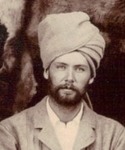
Although we cannot ascribe anything to Hyslop as such, we can at least give him a fair mention:
Maxwell Wither Hyslop, the son of Colonel Archibald Geddes Hyslop (EICO, Madras Artillery, born 1797, retired 1849, died 1868) was born in Nagpore, India in 1837. His mother was Sarah Jane Firth, who had herself been born in Bangalore in 1810. The Hyslops were, at any rate, a fighting family. An uncle had served with the Bengal Infantry (Lt.Col Maxwell Hyslop) and a scattering of Hyslops appeared in the army well up to WW1.
Maxwell joined the 93rd as an ensign by purchase in 1854. He served in Crimea from the 14th of July 1855, including the siege and fall of Sevastopol. He received the Crimea Medal with clasp and the Turkish Medal. He then served throughout the Indian mutiny, including the relief of Lucknow, the defeat of the Gwalior Contingent at Cawnpore and the pursuit to Seraighat, the actions at Pusgaon and Russulpore and the final evacuation of the Fort of Mithowlie.
He was promoted to lieutenant on the 9th of March 1855 and gained his captaincy by purchase on the 18th of February, 1860. Lieutenant-Colonel Maxwell Wither Hyslop died in 1905 in Bedfordshire.
Nor was Maxwell the only Hyslop involved in the Indian Mutiny – his rather unfortunate older brother, Lieutenant Henry Firth Morison Hyslop of the 74th NI was murdered on the 13th of May, 1857 near the Hindun River, while escaping from Delhi. He was 27 years old.
There would be another war for his son , Brigadier Henry Hugh Gordon Hyslop to fight in and for which he received the following citation for his services with his father’s regiment in 1915:
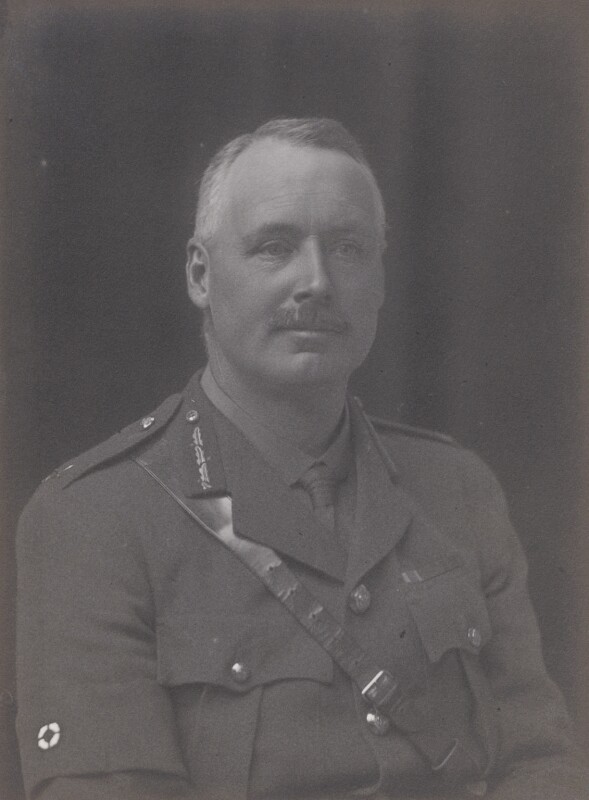
by Walter Stoneman
bromide print, 1917
NPG x168520
“The King has been graciously pleased to give orders for the following appointments to the Distinguished Service Order in recognition of the meritorious services of the undermentioned Officers during the war:- To be Companions of the Distinguished Service Order. “(Gazette Info: Gazette Issue 29111, 18/02/1915)
That, however, was a very different battle and for now, we must remain in Lucknow.
Sources:
Best, Brian. The Victoria Crosses That Saved an Empire: The Story of the Mutiny VCs. Barnsley: Frontline Books, 2016. Quotes from an interview with John Paton.
Burgoyne, Roderick Hamilton. Historical Records of the 93rd Sutherland Highlanders, Now the 2nd Battalion Princess Louise’s Argyll and Sutherland Highlanders. London: Richard Bentley and Son, 1883.
Ewart, John Alexander. The Story of a Soldier’s Life; or, Peace, War, and Mutiny. 2 vols. London: Sampson Low, Marston, Searle, & Rivington, 1881.
Forbes-Mitchell, William. Reminiscences of the Great Mutiny 1857–59: Including the Relief, Siege, and Capture of Lucknow, and the Campaigns in Rohilcund and Oude. London: Macmillan and Co., 1893.
Gordon-Alexander, William. Recollections of a Highland Subaltern: During the Campaigns of the 93rd Highlanders in India, under Colin Campbell, Lord Clyde, in 1857, 1858 and 1859. London: Edward Arnold, 1898.
Holmes, T. Rice. A History of the Indian Mutiny: And of the Disturbances Which Accompanied It Among the Civil Population. 5th ed., rev. and enl. London: Macmillan and Co., 1897.
Knollys, William Wallingford. The Victoria Cross in India. London: Dean & Son, 1886.
Roberts, Frederick Sleigh. Forty-One Years in India: From Subaltern to Commander-in-Chief. Vol. 1. London: Macmillan and Co., 1911.
Verney, Edmund Hope. The Shannon’s Brigade in India: Being some Account of Sir William Peel’s Naval Brigade in the Indian Campaign of 1857-1858. London: Saunders, Otley, and Co., 1862.
Wilkins, Philip Aveling. The History of the Victoria Cross: Being an Account of the 520 Acts of Bravery for which the Decoration Has Been Awarded, and Portraits of 392 Recipients. London: Archibald Constable & Co., 1904
Links:
https://vcgca.org/
https://www.nam.ac.uk/
https://www.memorialstovalour.co.uk/
https://victoriacrossonline.co.uk/
https://museum.novascotia.ca/blog/what-do-we-remember-when-we-remember-william-hall
https://maritimemuseum.novascotia.ca/collections/william-hall-vc
https://vansda.ca/trailblazers/william-hall/
https://sites.rootsweb.com/~canbrnep/whobit2.htm
http://www.victoriacross.org.uk/bbyountj.htm
https://www.winters-online.net/MerH/g1/p41.htm#i2040
https://regimental-books.com.au/product/john-paton-vc-the-hero-of-lucknow/
https://www.memorialsinportsmouth.co.uk/vc/salmon.htm
https://www.pdavis.nl/ShowObit.php?id=1264
http://www.airgale.com.au/hyslop/d4.htm#i47376
https://www.geni.com/people/Lieutenant-Col-Maxwell-Wither-Hyslop/6000000024862475245
 Mutiny Reflections