   When first under fire an' you're wishful to duck,
   Don't look nor take 'eed at the man that is struck,
   Be thankful you're livin', and trust to your luck
      And march to your front like a soldier.
         Front, front, front like a soldier...
                                                                            - Verse from "The Young British Soldier" - Rudyard Kipling
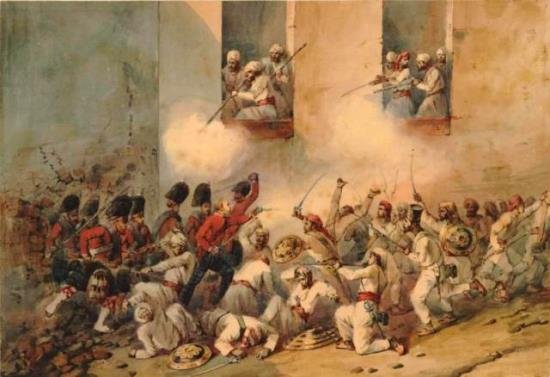
The Sikandar Bagh
93rd Regiment of Foot
Captain William George Drummond Stewart
“Captain Stewart was an officer of remarkable coolness in action, nothing ever appearing to
disturb his equanimity in the very slightest degree“. (Brig. Gen. A.E.J. Cavendish)
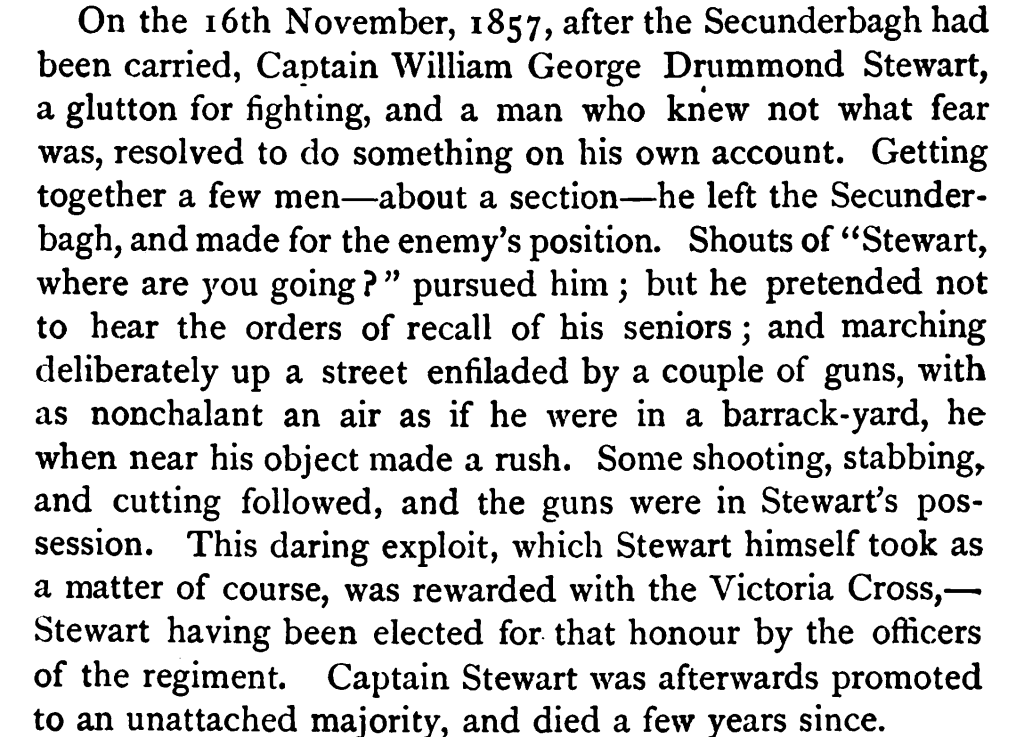
This is, of course, a fictionalised account written for school boys by one Major Knollys. If only we could leave it here. However, Major Knollys fails to point out to his readers the charge was made before the advance on the Sikandar Bagh.
As the guns began battering the Sikandar Bagh, Colone Leith-Hay with 2 companies the 93rd drove the rebels out a large enclosure opposite the western face of the Sikandar Bagh, with Captains Cornwall and Stewart, along with Captain MacDonald and Lieutenant Fullerton with 4 companies and a section of the Grenadiers were sent out to keep down the flack fire from 2 guns the rebels had brought forward. As the guns raked the road leading away from the Sikandar Bagh to the Barracks –
“Stewart, perceiving the annoyance which these two guns were causing, and the injury that they might still
cause, called upon his company (No.2), and at the head of it, increased in weight and numbers by a few
men of the other companies, and of the 53rd, who had joined our men, dashed forward in the most gallant
style, captured the guns at the point of the bayonet, turned the guns on the flying rebels, and then, pushing
forward at the double, while Captain Cornwall, with his company (No.3) and the men of other companies, followed in support, assaulted the large pile of building called the barracks, situated in the left front of the
Sikanderbagh, drove the enemy out, and established themselves in it.” [“Historical Records of the 93rd Sutherland Highlanders” Roderick Hamilton Burgoyne, late 93rd Highlanders, London, 1883] .
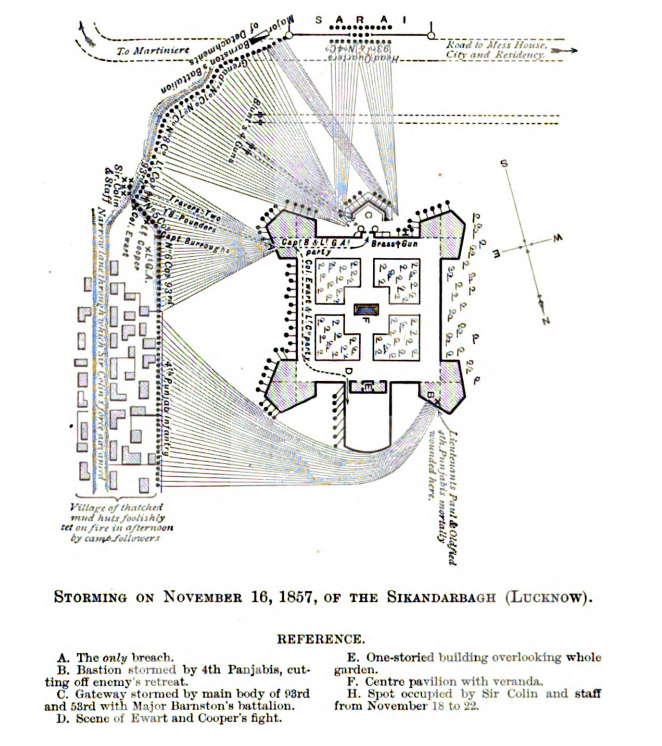
“Some companies of the 53rd, and Nos. 2 and 3 Companies of the 93rd, under Captains Cornwall and Stewart, supported by two of Blunt’s guns, pushed forward across the plain, after the occupation of the Sarai, towards a large fortified building to their left , built in the form of a cross, called The Barracks
at about half a mile almost due south from the Sikandarbagh . The only approach to this building was defended by two well-served guns, as well as by a steady and close fire of musketry, from which the two companies suffered considerably, several of the officers being wounded, and many men killed and
wounded during the advance; but Stewart led straight on the guns, and captured them with a rush, the enemy bolting and leaving the two companies in possession of this very important post. Stewart was most justly awarded the Victoria Cross for this exploit, but in a manner which the framers of the Royal Warrant instituting that decoration never contemplated…” (Alexander)
As it was, Captain Stewart was the only officer of the 93rd Regiment to receive a Victoria Cross for the actions under Sir Colin Campbell at Lucknow in November 1857. He was elected through a ballot, scarcely winning by one point over Lieutenant-Colonel Ewart.
William George Drummond Stewart was born in 1831, the son of Sir William Drummond Stewart, a Scottish nobleman who had very little to do with George’s life (he was known by his second name throughout his life). His mother was a servant girl, Christine Maria Battersby who Sir William would eventually marry but in 1832, after a violent argument with his elder brother, who had inherited the estate, Sir William would up and leave to seek a life in America, leaving his wife and son behind in Scotland.
Young George would be installed in the Jesuit-run school, Oscott College near Birmingham and in 1848, obtained his appointment in the 93rd as an ensign by purchase. In 1853, while stationed in Portsmouth, he had a prolonged dalliance with the daughter of a merchant. The girl died giving birth to his twin sons, and George left the boys in the care of his mother and uncle. He did not attend their baptism and only the names of those two relations are listed on their certificates. As for George, Crimea was calling and he would serve with this regiment in that war until July 1856 when the regiment returned home. Promoted Captain on the 29th of December 1854, Stewart received the Crimean Medal with clasps for Alma, Balaclava and Sebastopol, the Turkish Medal and the Order of the Medjidie (5th Class).
The 93rd was already en route to China when news of the mutiny in India reached them. They arrived in Calcutta on the 27th of September and began their march to Lucknow. The rest, as we have seen, worked out rather well for Captain Stewart.
He received his VC in a special ceremony at Umbeyla, in the Punjab on the 6th of December 1858, receiving it from Sir Robert Garrett before the gazette had even been officially announced in London. After nearly 4 years of active service, he returned home. Following his promotion to major but with no opening in the 93rd available to him, Major Stewart opted to go on half-pay and leave the army.
It would appear he went back to his somewhat rakish ways in his early retirement, and while he did serve for a short time as Assistant Inspector of Volunteers, he found time to have an affair with a young lady named Miss Wilson, the daughter of fishing tackle maker in Edinburgh. While she tried to rope him into marriage, the child he had with her died and this put an end to this rather sordid affair. It is, however, his death that probably raised a few more eyebrows.
On the 19th of October, 1868, while in Hythe, Hampshire, Stewart attempted to give a demonstration of sword swallowing – with a stick. While he would have seen similar feats performed in India, it is unlikely he had undertaken any serious study in the subject – as it is, he managed to impale himself and died of agonising internal injuries two days later. The inquest returned a verdict of death by inflammation of the lungs rather than a misadventure most likely brought on by an unsound state of mind, or even drunkenness. There have been suggestions made that Stewart in fact committed suicide though swallowing a stick is certainly a highly unusual and miserably painful way to die.
He had been given orders by his uncle to never contact his illegitimate sons, who grew up never knowing their father was Captain Stewart, VC. He was buried in the same vault as his mother in the Church of St. Mary, Grandtully, aged just 37. On the death of his uncle Sir Archibald, the baronetcy became extinct.
Colour Sergeant James Munro
In 2002, an article appeared in the Press&Journal, Aberdeen Edition and read as such:
A FORGOTTEN Highland war hero is to be honoured 145 years after he won the Victoria Cross for rescuing a wounded officer under fire.
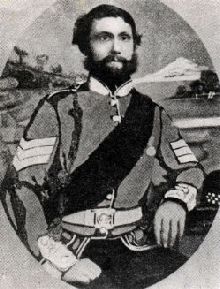
It emerged yesterday that despite receiving this country’s highest award for gallantry from Queen Victoria in person, Colour Sergeant James Munro was left a broken man. Instead of being the toast of the town as so many heroes were in Victorian times, he died a mental and physical wreck alone in a Highland asylum, the victim of the terrible wounds he received when he returned to the fray.
Investigations by the Army has discovered that Col Sgt Munro died in Craig Dunain Hospital, Inverness, which in Victorian times was called the lunatic asylum, and his body was buried in a pauper’s graveyard in the grounds. The tiny walled cemetery closed in 1893, and since then has lain overgrown and forgotten. But now, in honour of Col Sgt Munro, the Army has cleared away the trees and bushes masking the sad little burial place, and soon a plaque marking his last resting place will be erected, possibly along with a storyboard telling of his bravery and the background to the cemetery.”
Born on the 11th of October, 1826, at Easter Raiche, Nigg, Easter Ross and the son of a wright, (James Munro and his wife Effie), James joined the army at the age of 20 and was attested for duty with the 93rd Regiment. Six years as a private were followed by promotion to corporal in 1853. By the time he was serving the Crimea, he was a sergeant. His record here is rather confused – Munro only received the Crimea medal with 1 clasp, for Sebastopol even though he served 18 months in the Crimea, Balaklava and Alma are missing. In 1857, he was promoted to Colour-Sergeant. It would appear he was in all a decent soldier – he received the Good Conduct Medal and from 1851, was even receiving Good Conduct pay. Yet something happened that changed Colour-Sergeant Munro.
“For devoted gallantry, at Secunderabagh, on the 16th November 1857, in having promptly rushed to the rescue of Captain E. Walsh, of the same corps, when wounded, and in danger of his life, whom he carried to a place of comparative safety, to which place the Serjeant was brought in, very shortly afterwards, badly wounded.” (No. 22445″. The London Gazette. 8 November 1860. p. 4126)
Curiously, no Captain Walsh appears on the returns for the 16th of November, nor any day before or after that. We do have Lieutenant E. Welch, the regimental musketry instrutor, listed as wounded on the 16th of November and Munro himself as wounded on the 17th. Nor was Munro elected by the regiment. The action in which Welch was wounded is described in some detail by Alexander:
” I was touched on the elbow by Lieutenant E. Welch, the regimental musketry- instructor, who asked me to direct the fire of some of my men on to a window of the one- storied building on the north face, some 40 or 50 yards from where we were standing and try to pick off a Sepoy who had done considerable damage in our ranks, having killed, Welch told me, Captain Dalzell, commanding the Light Company, and our interpreter , Captain Lumsden, of the 30th Native Infantry Regiment, as well as killing and wounding many 93rd men. This man would open the venetian shutters of the window to about only two inches, blaze away into the crowd of us in the centre of the square, and shut it so quickly again that none of the bullets aimed at this invisible marksman had then reached him. Not many minutes after I had complied with Welch’s request by diverting the fire of some of my men from the roof of the gateway to this window, Welch-who was short of stature, and was standing directly in front of me-turned round on his waist, as it were, without moving his heels, to say something to one of my men whom I had directed to rest his rifle on my shoulder to get a steady aim at the chink in the shutter as it was opened, when he received a bullet under the right shoulder- blade from this very man, and sank to the ground at my feet. He was not killed , as I and those standing round thought at the time, but very severely wounded. The surgeons could not find the bullet, and Welch was invalided home, and being unfit for active service in the future, obtained an appointment as a barrack-master in Canada, but died some seven or eight years afterwards from the effects of that wound, I have heard, the bullet which he had carried in his body all those years being found in his left groin.”
The citation for Munro appears relatively late so it would beg to reason he was recommended by Welch himself. Whatever the case may be, Munro did not fare well. Two musket balls tore through his loins, shattered his lower vertebrae and ripped away bone. It was not an injury he would have been expected to survive.
Yet survive he did but he was no longer fit for soldiering; his injuries were so severe in nature, that he returned to England and on the 26th of October, 1858, he was discharged on medical grounds. Thus ended his 12 years and 96 days as a soldier, but it was not the end of his life. Invested with the VC by Queen Victoria at Windsor Castle in November 1860 it would appear there was a stint of employment as a ranger at the Queen’s Park in Edinburgh – when he came to the notice of the police. He had become “demented and a kleptomaniac” much addicted to drinking; he was also suffering from a growing paralysis due to his injuries and “was demented in appearance.”
Ten years later he was removed to Inverness District Asylum; as his condition worsened over the next year he was placed in the Craig Dunain Hospital where he died on the 15th of February, 1871, just 45 years old. His body was buried in the hospital grounds – when the hospital closed, Munro was forgotten.
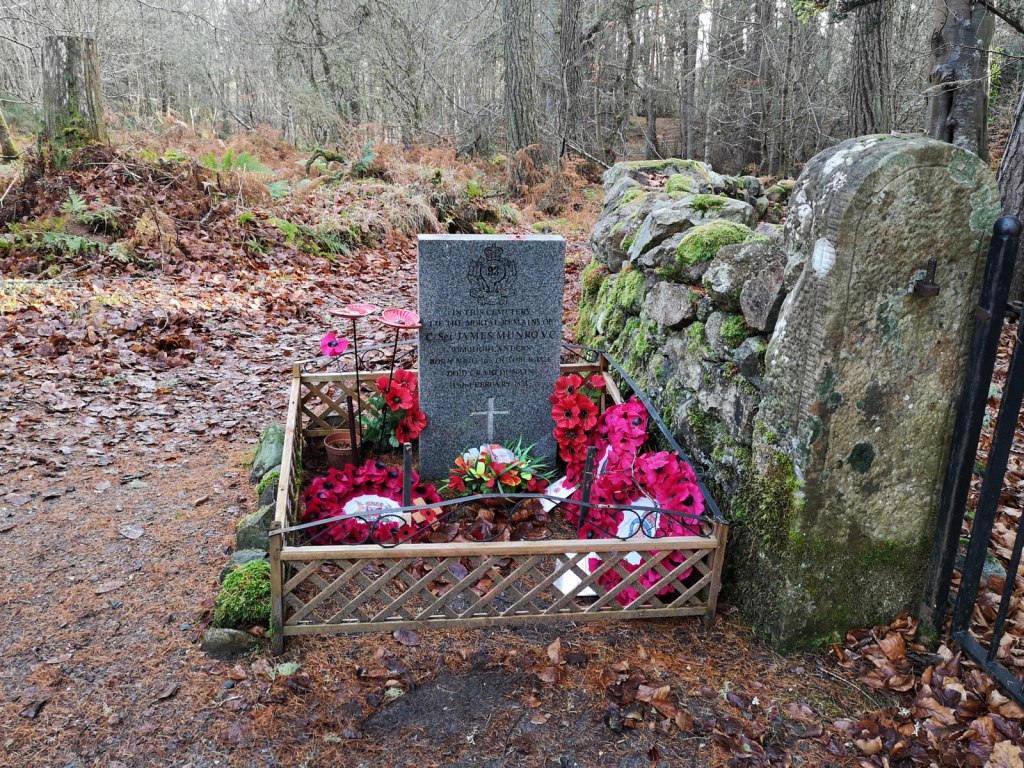
cc-by-sa/2.0 – © Julian Paren – geograph.org.uk/p/6009155
The next VC receipient faired but little better than poor Colour-Sergeant Munro.
Private David McKay
“For great personal gallantry in capturing an enemy colour after a most obstinate resistance, at the Secundrabagh, Lucknow, on the 16th of November 1857. He was severely wounded afterwards at the capture of the Shah Nujjif. Elected by the private soldiers of the Regiment.” (No. 22212″. The London Gazette. 24 December 1858. p. 5515.)
In his Story of a Soldier’s Life, Ewart makes an interesting note:
” I had recovered the Colour which I captured in the Secunder-Bagh, and it was with considerable curiousity that I drew off the crimson case. It was, I then found, a green one, of a triangular shape, with some Hindostanee words on it. As I did not understand the language, I procured an interpreter, and learnt it belonged to the 2nd Battalion of the Loodiana Regiment of Sikhs, the only Sikh corps which had mutinied. A precisely similar Colour had been captured by Private McKay of the 93rd grenadiers, at the assault of the Secunder-Bagh; so we had got the two Colours of the battalion, and they were now placed alongside the Colours of the 93rd and carried triumphantly to Cawnpore. McKay afterwards received the Victoria Crossand I was told that I had been recommended for it; the nales of theree other officers of the 93rd were sent in at the same time, and Sir Colin Campbell, who had become full Colonel of the regiment, by transfer from the 67th, decided that only one should receive the decoration, fearful perhaps that he might be accused of partiality. A meeting of the officers was in consequence held, and the matter was put to the vote…” As one officer was absent, who would have voted for Ewart, Ewart lost the VC by one vote.
The Colours belonged to the battalion of 2nd Ludhiana Sikhs that been sorely used in the uprising at Benares – it might have been a victory for Ewart and McKay but ultimately the mismanaged affair at that station in June had been caused by the British. Those Colours, had there not been such a fracas, might not even have been in Lucknow. Not that this really mattered to anyone.
Ewart left a detailed of his capture of the Colour; McKay did not but it would appear it was no less mad an action than Ewart and “attacked and killed an enemy sepoy ensign” before carrying the Colour away. Ewart, unlike McKay, ran off to offer the Colour to Sir Colin Campbell who was practically shaking with rage at Ewart’s action; it was a similar reaction he would have to Wolseley who captured the Moti Mahal without orders. Ewart lost out on the VC and Wolseley’s action was not even mentioned in despatches. Sir Colin had a dislike of officers who he saw as risking their lives for a medal; something Wolseley called the thinking of a small man. However, we must now return to Private McKay.
Born in 1831 to Angus and Christina McKay of Caithness, Scotland, the 2nd son of a large family of 13 children, the life of a farm labourer would not be th future for David, who joined the 93rd Regiment at the age of 19 in 1850. He would serve in the Crimea and on the 24th of October, 1854, as one of the immortal Thin Red Line at Balaclava.
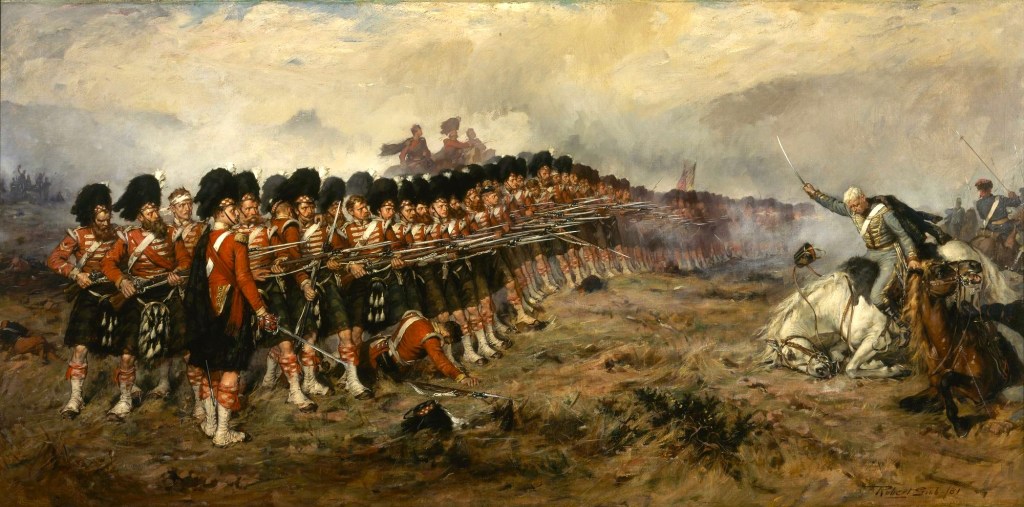
“…thin red streak tipped with a line of steel” – W.H. Russell
It was the attack on the Shah Najaf that effectively ended McKay’s career – he was severely wounded, shot through the lung.
McKay was promoted to corporal on the 24th of July 1857, and received his VC from Queen Victoria on the 8th of June, 1858. On the 17th of November, 1859, he was promoted to sergeant. McKay remained with the regiment for as long as was seen feasible and had served as a recruiting sergeant in Aberdeen before his medical discharge but would eventually be invalided out of the army in 1861. He enlisted as a sergeant in the 1st Kincairdshire Volunteers in 1863. From then McKay worked as a Manufacturer’s Storekeeper (1861-66), an Operative Tape Manufactory (1864) and a General Labourer (1868) – the work he took on was hardly sufficient to pay for food for his wife and four children and out of desperation, McKay sold his medals. He died, aged 48 in 1880, suffering from a valvular disease of the heart. He was buried in an unmarked grave in Lesmahagow Cemetery, Lanarkshire.
His V.C. was sold at auction at Debenhams, Tueson & Hicks, London to a private collection for in June 1901 and remains in private hands.
In 1998, his regiment honoured him with a headstone.
Private Peter Grant
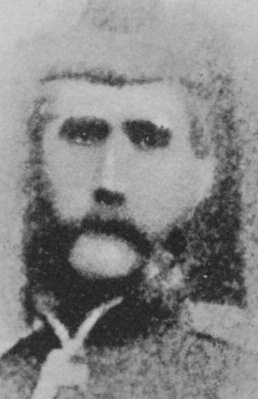
Ewart seems to feature rather heavily in these pages; however, had it not been for Private Peter Grant, he might have been here at all.
“For great personal gallantry, on the 16th of November, 1857, at the Secundra Bagh, in killing five of the enemy with one of their own swords, who were attempting to follow Lieutenant-Colonel Ewart, when that officer was carrying away a colour which he had captured. Elected by the private soldiers of the Regiment.” (“No. 22212”. The London Gazette. 24 December 1858. p. 5515).
Born in 1824 in Ireland, Peter Grant enlisted in the 93rd Regiment – there is little known of the man before his enlistment, but according to his medal entitlement, he served in the Crimea and received 1 clasp for Sebastopol. During the Mutiny he was present not just at the Relief of Lucknow but subsequently at the recapture of the city in March 1858.
The action for which he was elected by the regiment is interestingly enough not noted by Ewart; this might have been a simple omission on Ewart’s part who appeared to require much saving on that day. In his fight with a “tall fellow, who looked like a Sikh” and a “fierce-looking gentleman” both of whom singled out Ewart for combat. Thinking it “was too much of a good thing” but having a few of his men with him, Ewart pulled out his Colt and shot the two men. He then called on the Highlanders to go in with the bayonet. Shortly after, Ewart spied the Colour. Wounded as he was in the arm and hand, it would have been difficult for Ewart to retain the Colours he had fought for – judiciously, Private Grant had followed Ewart and was at hand. As Ewart retreated with the Colour, it was Grant who picked up a tulwar and fought off 5 men who wanted the Colour back. It is also possible that Ewart, in the thick of things did not see what Grant had done for him; fortunately, others did.
While things would go rather badly for Ewart in the coming weeks, as we shall see later, it went better for Grant. He managed to get out of the fray without a scratch and fought his way well through the coming months, receiving a second clasp on his Mutiny medal for Lucknow when the city was retaken in March 1858. He received his VC from Major-General Robert Garrett at Umbeyla, Peshawar on the 6th of December, 1859 and left India with the 93rd.
From there on, one cannot really say what happened to Private Grant but in 1868, the following appeared in the Dundee Advertiser on the 11th of January:
“On Friday, 27th December, Private Peter Grant, of the 93rd Regiment, was missed from where he lived in Dundee and was not again seen till yesterday morning, when his body was discovered by Constable Bremner floating in the river a little to the east of the Craig Harbour. Bremner had the body taken out and conveyed to the dead-house.
On the breast of Grant’s uniform coat were five medals and the Victoria Cross. One medal had two clasps, bearing on them “Relief of Lucknow” and “Lucknow, 1857″.(*) The others were for Pegu, Sobraon, Sebastopol, and the Crimea. The Cross had inscribed on it the name of the deceased and is dated 1857. In the pockets were found a four-penny piece, a penny, and a knife. Grant was stationed in Aberdeen and was here on a visit to his friends. It is said that he was last seen in Wheatley’s public house, Overgate.”
It is presumed that after leaving the pub, he fell in the river and drowned.
His VC and medals have never appeared at auction nor was it ever made clear what happened to them after he was found. It is possible they were buried with him in a pauper’s grave. In 2022, two benches were installed at the edge of the mass burial site to honour Peter Grant VC and Thomas Beach, VC.
53rd Regiment of Foot
Private James Kenny
While it is not necessarily uncommon to possess very little information regarding the lives of privates who won the Victoria Cross, Private James Kenny is one who remains anonymous. It is supposed he was born in Dublin, Ireland in 1824 but even that is not known for sure. However, the problem becomes even more confounded, when one reads Soldiers of Shropshire:
“It is unfortunate that no service records survive for him in the National Archives in Kew (in the archive
of Attestation and Discharge papers in series WO.97) nor in any other source, apart from skeletal
details in the Pay and Muster lists of the 53rd. This means that just about nothing is known about
him – family background, date of birth, occupation, dates and details of service etc… He does not appear in the 53rd regimental rolls for the first Sikh War (1845-46) – he may not even have been in the army at that time, let alone the 53rd, or may have been serving with another regiment or based elsewhere. There is, however, a Private James Kenny, no. 1841, in the 53rd roll for the second Sikh War (1848-49) and in receipt of the Punjab medal with clasp Goojerat…”
According to http://www.victoriacross.org.uk/pukennyj.htm it would appear to be the same person.
- Victoria Cross
- Punjab Medal ( 1848-49 )
- 1 clasp:
- “Goojerat”
- Indian Mutiny Medal ( 1857-58 )
- 2 clasps:
- “Relief of Lucknow” – “Lucknow
His VC citation too is hardly descriptive. His actions are not otherwise noted, save for these lines:
“For conspicuous bravery at the taking of the Secundra Bagh, at Lucknow, on the 16th of November, 1857, and for volunteering to bring up ammunition to his Company, under a very severe cross fire. Elected by the private soldiers of the Regiment.” ( “No. 22212”. The London Gazette. 24 December 1858. p. 5513).
For one moment, in the history of this unknown life, someone mentioned Private James Kenny. He died in Multan, having chosen to remain in India when the 53rd returned home, as a private of the 6th Bengal European Fusiliers. He was laid to rest in an unmark ed grave on the 3rd of October, 1862 and it is presumed his medals were buried with him.
We are not quite finished with Lucknow – the next post shall look at the Naval Brigade and their doings at the Shah Najaf.
Sources:
Best, Brian. The Victoria Cross in 100 Objects: The Story of Britain’s Highest Award for Valour. Barnsley: Frontline Books, 2021.
Bourchier, George. Eight Months’ Campaign Against the Bengal Sepoy Army during the Mutiny of 1857. London: Smith, Elder, and Co., 1858.
Burgoyne, Roderick Hamilton. Historical Records of the 93rd Sutherland Highlanders, Now the 2nd Battalion Princess Louise’s Argyll and Sutherland Highlanders. London: Richard Bentley and Son, 1883.
Ewart, John Alexander. The Story of a Soldier’s Life; or, Peace, War, and Mutiny. 2 vols. London: Sampson Low, Marston, Searle, & Rivington, 1881.
Forbes-Mitchell, William. Reminiscences of the Great Mutiny 1857–59: Including the Relief, Siege, and Capture of Lucknow, and the Campaigns in Rohilcund and Oude. London: Macmillan and Co., 1893.
Gordon-Alexander, William. Recollections of a Highland Subaltern: During the Campaigns of the 93rd Highlanders in India, under Colin Campbell, Lord Clyde, in 1857, 1858 and 1859. London: Edward Arnold, 1898.
Holmes, T. Rice. A History of the Indian Mutiny: And of the Disturbances Which Accompanied It Among the Civil Population. 5th ed., rev. and enl. London: Macmillan and Co., 1897.
Knollys, William Wallingford. The Victoria Cross in India. London: Dean & Son, 1886.
Roberts, Frederick Sleigh. Forty-One Years in India: From Subaltern to Commander-in-Chief. Vol. 1. London: Macmillan and Co., 1911.
Wilkins, Philip Aveling. The History of the Victoria Cross: Being an Account of the 520 Acts of Bravery for which the Decoration Has Been Awarded, and Portraits of 392 Recipients. London: Archibald Constable & Co., 1904
Links:
https://vcgca.org/
https://www.nam.ac.uk/
https://www.memorialstovalour.co.uk/
https://victoriacrossonline.co.uk/
https://www.soldiersofshropshire.co.uk/wp-content/uploads/2021/11/James-Kenny-VC-word.pdf
https://www.clanmunro.org.uk/munrovc.htm
https://www.pressandjournal.co.uk/fp/news/inverness/526875/inverness-victoria-cross-hero-remembered/
https://www.thecourier.co.uk/fp/past-times/3870910/victoria-cross-heroes-dundee/
http://www.victoriacross.org.uk/bbbeagra.htm
 Mutiny Reflections