Courage was never designed for show;
It isn’t a thing that can come and go;
It’s written in victory and defeat
And every trial a man may meet.
It’s part of his hours, his days and his years,
Back of his smiles and behind his tears.
Courage is more than a daring deed:
It’s the breath of life and a strong man’s creed
Edgar A. Guest. “Courage.”
This post deals primarily with the VCs awarded during Havelock’s march to Lucknow – although there are some which were presented for multiple valiant acts and are as such mentioned here, we will look at the actions Unao, Bashiratganj, Mangalwar and Alambagh.
Lance-Corporal Abraham Boulger, 84th Regiment of Foot
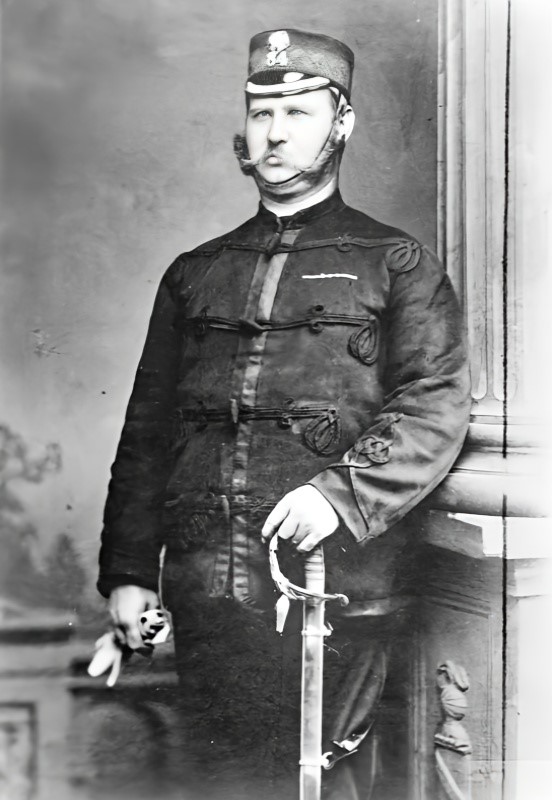
Date of Acts of Bravery, from 12th July to 25th September, 1857
For distinguished bravery and forwardness; a skirmisher, in all the twelve actions fought between 12th July, and 25th September 1857. (Extract from Field Force Orders of the late Major-General Havelock, dated 17 October 1857. No. 22154, The London Gazette, 18.June 1858, p.2957)
Abraham Boulger was born in Kilcullen, County Kildare, Ireland on the 4th of September, 1835 A man true to his regiment, he would serve in the ranks for 20 years and 261 days (not including 2 years boy’s service – ) with the 84th. His service in India would last from 1851 until 1858.
He was engaged in every skirmish while serving with Renaud’s advance force; when the force joined up with that of Sir Henry Havelock, Boulger would fight on both sides of the Ganges:
July 12, Fatehpur
July 15th, Aong
July 15th Pandu Naddi
July 16th, Cawnpore
July 29th, Unao
July 29th Bashiratganj
August 5th, Bashiratganj
August 12th Boorbeakee Chowkee (Bashiratganj)
August 15th, Bithur
September 19th, Nowbolganj
September 21st, Mangalwar
September 23rd, Alambagh
September 25th, the Relief of Lucknow
While Boulger was already noticed by Havelock for his always-in-front attitude, on the 25th of September he appeared to be thinking more of his regimental honour. We have already seen the confusion and chaos that was Havelock’s Advance on that day, and at the Charbagh Bridge, we find 21-year-old Boulger in a discussion with his captain. The advance was held up by the rebels at the far end, where they had erected a devastating battery.
Captain Willis would later write,
“In was in a front house at the crossroads when a gallant young lance corporal named Boulger came running up and said, ‘Oh Sir! The Madras Fusiliers are ordered up to take the battery. We can’t let them go in front of the 84th!’ ‘Certainly not,’ I said, although the Madras men had not yet had their turn in front. ‘If you will collect eight or ten men, I will go over the bridge with you.’
Boulger quickly organised the men and with Willis,‘…as the Fusiliers came up, we all charged together. As we rushed into the road, we received a shower of grape, which five men on my right and cut the legs right from under them. The leading officer of the Fusiliers (Lt.Bailey who as at my side) had his left foot shot off at the ankle.’
Willis would be struck above his left knee but would pick himself up, ‘ and finding no bones broken, rushed on for my bare life; and we were all cheering like madmen, and that one round was the last the enemy fired from those guns. The battery was ours in an instant; and Corporal Boulger, always in front, shot down the gunner just as he was going to fire another round.’ The 68-pounder that Boulger had so swiftly put out of commission was found to be loaded with grape canister, stones and glass. There was no time to waste – Boulger ran on and would be the first man to force through a masked battery in front. He would be present at the storming of the jail later that day. On the 29th Boulger would volunteer his services for a sortie to blow up a rebel magazine, destroy their mines, and would assist in bursting four mortars and spiking 13 guns. However, it came at a price. Boulger would be seriously wounded through the left thigh and his right hand from which he lost his middle finger.
He was recommended for the Victoria Cross by Captain Willis and received it on the 8th of June, 1859 from Queen Victoria at Buckingham Palace with a year’s service pay for Lucknow.
Soldiering was far from over for Abraham Boulger.
Between 1869 and 1871, Boulger found himself in cooler climes – in Halifax, Nova Scotia, but it was but a brief respite. In 1882 now raised in rank to Quartermaster, Boulger fought his way through the brief Anglo-Egyptian War seeing action at El Magfar, Kassassin and Tel-el-Kabir. With the honorary rank of Major for his services in the Egyptian Campaign, in 1883, Boulger would sail out with his regiment to Bermuda. He retired in 1887 with the honorary rank of lieutenant colonel and died in Westmeath, Ireland on the 23rd of January 1900. He was only 64 years old.
His medals included, besides the Victoria Cross:
- Indian Mutiny Medal ( 1857-58 )
- 1 clasp:
- “Defence of Lucknow”
- Egypt Medal ( 1882-89 )
- 1 clasp:
- “Tel el Kebir”
- Khedive’s Star ( Egypt )
- Army Long Service & Good Conduct Medal
Abraham Boulger’s Victoria Cross is on display at the York & Lancaster Regiment Museum in Rotherham, England.
Thus we have an introduction to the VC winners for Havelock’s march, the subsequent advance on Lucknow and the defence. Men from all ranks received the award; some of whom disappeared from history while others would continue to blaze a trail from war to war.
Private Patrick Mylott, 84th Regiment of Foot
“For being foremost in rushing across a road, under a shower of balls, to take an opposite enclosure; and for gallant conduct at every engagement at which he was present with his Regiment, from 12th of July, 1857, to the relief of the garrison.” (No. 22212. The London Gazette. 24 December 1858. p. 5513).
This rather unusual citation accompanied the VC of Private Patrick Mylott of the 84th Regiment of Foot and would remain rather mystifying – unless one is aware Mylott was awarded for actions from the 12th of July to the 25th of September.
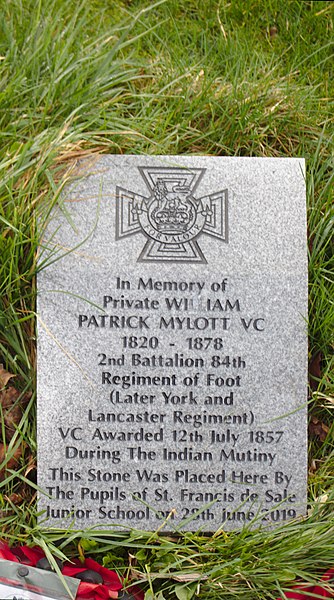
Born in the parish of Kilcommon, Hollymount, near Claremorris, Co. Mayo Ireland in 1820, Mylott enlisted in the 63rd Regiment in 1839 before transferring to the 84th on the 1st of January, 1847. He would have been serving in India before the mutiny, but so little is known of this near-forgotten Irishman, there is little to tell. His action is cited for the first battle of Havelock’s march, that of Fatehpur.
The battle was over quicker than it took most men to write about it but it secured for Mylott the admiration of his regiment and as the weeks rolled on, Mylott continued to show his mettle, in action after action, it was courageous Private Mylott, always in front. However, after Lucknow, he seems to disappear, nor does he appear in any of the literature of the time. He was elected for the VC by his regiment, so at least there is a record that there once was a very brave man, named Patrick Mylott.
The 84th left India in 1859 after 17 years service in India and Patrick Mylott left with them, arriving in time to receive his VC from Queen Victoria January 4, 1860, at Windsor Castle. He retired from the army after 21 years of service. Instead of returning to Ireland, Mylott chose to set up home in England.
Civilian life was unkind to Patrick Mylott. His life ended in December 1877, at Brownlow Hill Workhouse Hospital in Liverpool. He was buried in a paupers grave in the grounds of Anfield Cemetery. A headstone was erected in his memory in 1994 and relocated in the Anfield Cemetery, in 2019.
His medals including his Victoria Cross have disappeared.
- Victoria Cross
- Indian Mutiny Medal ( 1857-58 )
- 2 clasps:
- “Defence of Lucknow” – “Lucknow”
- Army Long Service & Good Conduct Medal
Lieutenant Andrew Cathcart Bogle, 78th Regiment of Foot
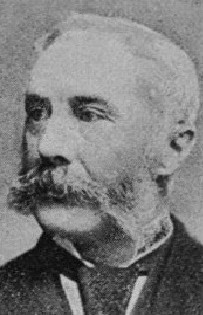
Born on the 20th of January, 1829 in Glasgow to Archibald Bogle, Esquire, and his wife, Andrew Bogle’s background was startlingly different to that of Abraham Boulger. After completing his education at Cheltenham College, Bogle took a commission (by purchase) into the 78th Regiment in 1849 the same regiment in which his older brother Robert was serving for the past 3 years. Bogle joined as an ensign but received his promotion to Lieutenant in 1853- he first saw active service in the very brief Anglo-Persian War in 1857 for which he received the Persian Medal with clasp. Very soon after, his regiment joined Havelock’s Column in Bengal. Like Boulger, Bogle would be present at all of the abovementioned actions but his moment would come at Unao on the 29th of July.
“For conspicuous gallantry on the 29th July 1857, in the attack at Oonao, in leading the way into a loop-holed house, strongly occupied by the enemy, from which a heavy fire harassed the advance of his regiment. Captain Bogle was severely wounded in this important service.” (No. 22303 The London Gazette. 2 September 1859. p. 3302)
Bogle’s gallantry was not lost on Havelock. In the General’s Orders on the 30th of July, even if the action of the day was somewhat wanting. Havelock wrote,
“ Soldiers, your General thanks you for your exertions today. You have stormed two fortified villages and captured nineteen guns. But he is not satisfied with all of you. Some of you fought as if the cholera had seized your minds as well as your bodies. There were men among you, however, whom he must praise to the skies. Private Patrick Cavanagh, of the 64th, died gloriously, hacked to pieces by the enemy when setting a brilliant example to his comrades. Had he survived, he should have worn the Victoria Cross, which never could have glittered on a braver breast. But his name will be remembered as long as Ireland produces and loves gallant soldiers. “ Lieut. Bogle, 78th Highlanders, was severely wounded while leading the way at Onao into a loopholed house filled with desperate fanatics. A special report of his gallantry will be sent to His Royal Highness the Commander-in-Chief. The ‘ hero of Inkermann’ well knows how to appreciate heroes.”
For Bogle, it was the end of the campaign, at least momentarily. Laid up with his wounds, he would return to the campaign under Sir Colin Campbell and serve through the later stages of the mutiny throughout 1858. Personally, however, success was mixed with tragedy. His brother, Captain Robert Bogle, was severely wounded on the 26th of September in the advance of the rear guard of the 78th to the Residency from the Moti Mahal. He never recovered and died on the 19th of November at the Alambagh, during the evacuation of the Residency.
Promoted to Captain on the 31st of August 1858, Andrew Bogle rose to Adjutant later the same year but transferred first to the 13th Regiment of Foot in 1859 and subsequently in the same year, to the 10th Regiment of Foot. He was presented his VC by Queen Victoria at Windsor Castle in 1860. In 1865 he was promoted to major. 1868 finds him serving with the 23rd Regiment of Foot and in 1870 he retired from the army altogether.
Bogle died at the age of 61 at Sherborne House, Dorset. His Victoria Cross is on display at the Highlanders Museum at Fort George, Inverness-shire, Scotland.
Sergeant Major George Lambert, 84th Regiment of Foot
George Lambert was born in Ireland, in Markethill, County Armagh, on December 16th, 1819. He joined the army in 1840 and served in ranks from the 6th of June of that year until the 11th of December, 1857. Of the 20 years he served in the 84th, 17 of those would be in India.
In 1857, Lambert rose through the ranks to sergeant-major and thus began his mutiny career, which was busier than most. Besides serving under Havelock and Campbell, Lambert served with the Azimgarh Field Force, and further in the final actions in the Shahabad District. From Ensign without purchase in December 1857, Lambert swiftly rose through the ranks to Adjutant on the 2nd of July, 1858 and finally Lieutenant, without purchase in September 1858. With his VC in hand, Lambert returned to England.
His Victoria Cross was awarded for 3 actions –
“For distinguished bravery in three of Havelock’s battles, namely at Oonao on 29th July, at Bithoor on 16th August, when the rebels were driven at the point of bayonet out of a strong position, and at the passage through Lucknow to the Residency on 25th September.” (“No. 22154”. The London Gazette. 18 June 1858. p. 2957)
The advance on Lucknow nearly cost Lambert his life – he was wounded by a severe blow to the head however fate had a more surprising end in store for George. The 84th Regiment arrived in England on the 2nd of September 1859 and received their new colours on the 3rd of May 1860 – unfortunately, without George Lambert.
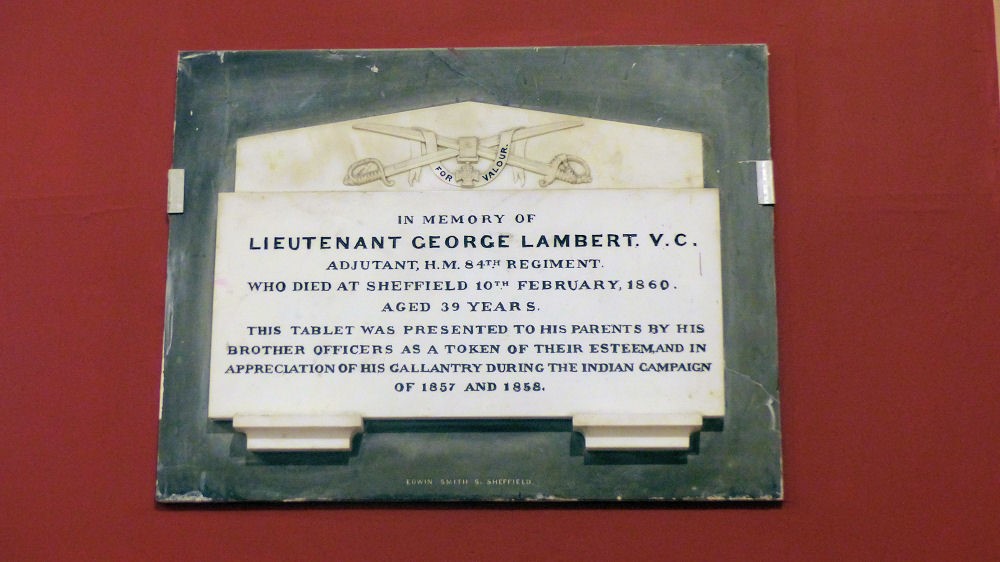
On the 10th of February, 1860, Lieutenant Lambert was on the parade ground at Hillsborough Barracks when he suddenly collapsed. He was buried with military honours eight days after his death. According to his death certificate, George Lambert died of a ruptured aortic aneurysm that flooded his right lung.
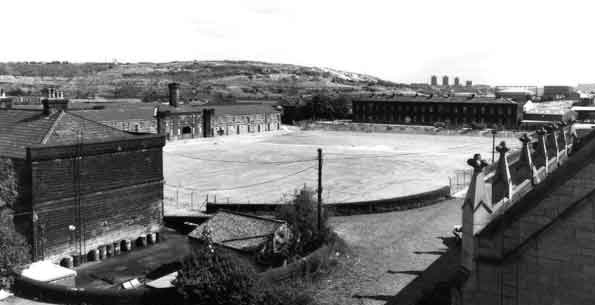
“The funeral of Lieutenant and Adjutant Lambert, of the 84th Regiment, took place on Thursday, at the St. Philip’s burial ground. The ceremony was conducted with military honours, the band of the regiment marching at the head of the procession, and playing the “Dead March” in Saul. Most of the deceased’s brother officers were present, and his charger was led after the body, bearing his master’s boots reversed. The usual volleys were fired over his grave at the conclusion of the service, and the procession then returned to the Barracks. Lieutenant Lambert was greatly respected by all who knew him, and his sudden decease is greatly lamented. His death was caused by the breaking of a blood vessel on Friday week, whilst on the parade ground of the Barracks. He had been somewhat unwell for several weeks, but not so seriously as to cause any apprehension, or to prevent him from fulfilling a part of his duties. He had risen from the ranks, having been in the service about 18 years, and had earned his honours in India.”
In his honour, the officers commissioned a marble tablet as a token of their esteem, which they subsequently presented to his parents. While the tablet states 39 years, Lambert was 41 at the time of his death.
 Mutiny Reflections