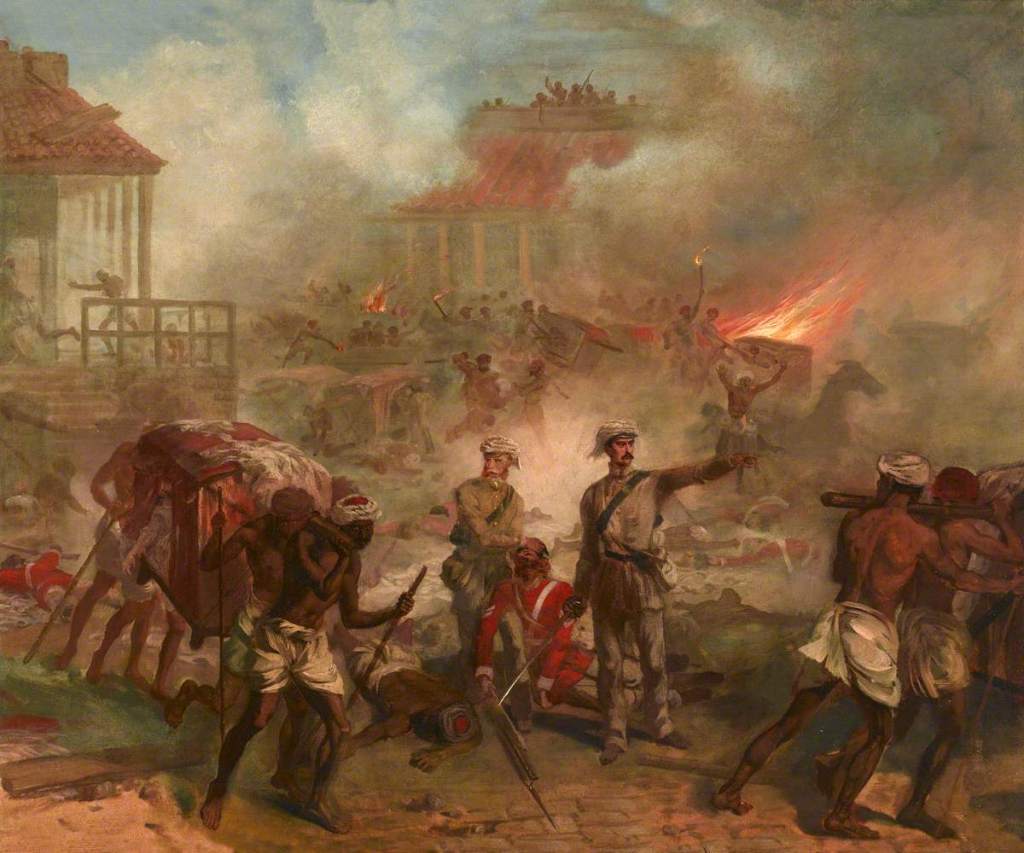
Saving the Wounded
“With morning came the recollection that our wounded, together with the heavy guns, were in the rear, upon which the insurgent Sowars had closed.
Many instances of bravery were shown by the escort in defence of these poor, helpless men. Well did staunch soldiers, on this occasion, merit the Victoria Cross for which they were recommended, so valiantly did they strive to resist hundreds by whom they were beset.” (Major North)
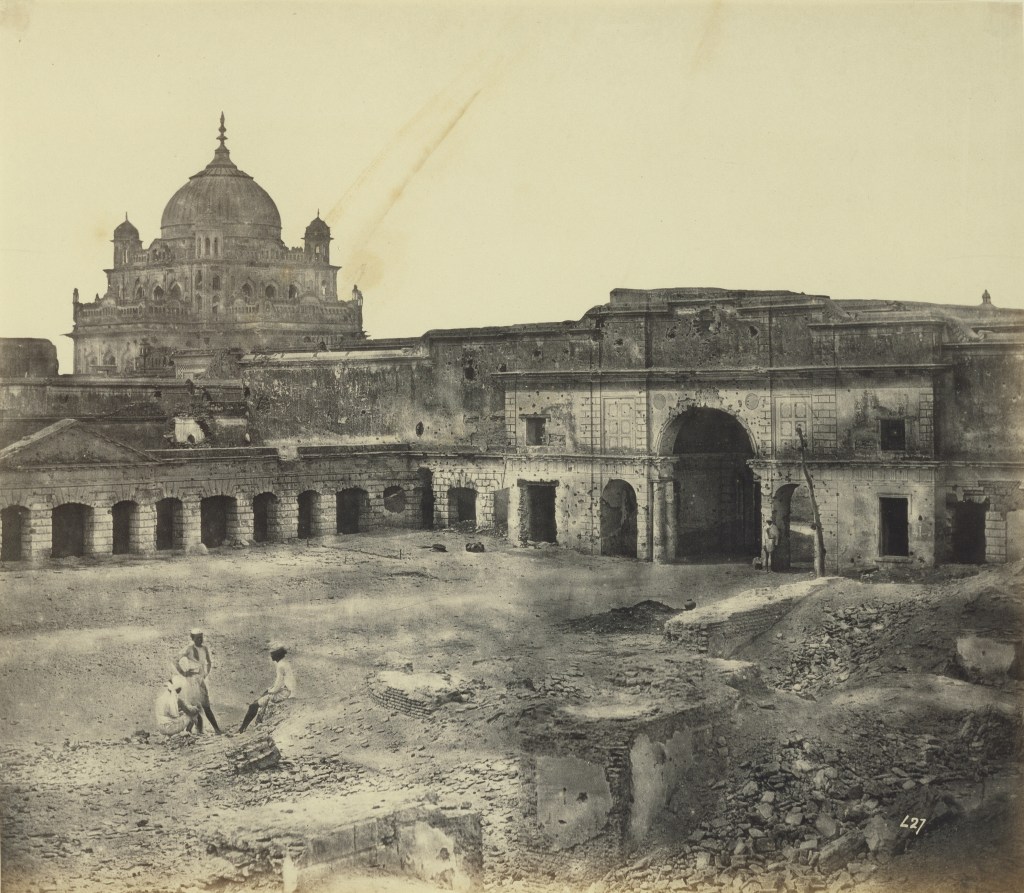
In the rush to reach the Residency, Havelock had allowed his force to become so extended that it would take two days for all, who still could, to reach the walls. They were sprawled all along the route – some were still in the Moti Manzil when Havelock was shaking hands in the Residency. Others had become entangled in the winding streets and alleyways of the city, some found refuge in the nearby palaces of Farhat Baksh and Chattar Manzil, where they bedded down for the night without food or provisions of any sort. It would therefore cost more lives to bring in the straggling parties, save the guns and find the wounded than was necessary. The night of the 25th was indeed the quietest the Residency had had in many months. The rebels, momentarily cowed by the relieving force, had retreated. However, no one ordered the men in the Moti Manzil (also called Moti Mahal) to advance to the Residency – they could have done so, wounded, guns and all, without much molestation and certainly without haste. In the night, Lieutenant Johnson and his men went out with led horses to search for the wounded and found no trace of the insurgents in any direction around the Residency. They succeeded in bringing in 20 men.
However, on the morning of the 26th, the rebels had rallied and resumed their customary assault on the Residency. Reinforcements to their numbers waged battles in the palaces against the divided British forces, leaving volunteers, such as Bensley Thornhill and Thomas Kavanagh to lead desperate parties out of the Residency under a hail of bullets to bring them in.
While Outram would consider the whole affair of the advance on Lucknow a “decided success”, the men under his command were less complimentary. Lieutenant Johnson found it “unsatisfactory, ” North called it an “appalling lesson” and demanded “straggling should be strictly prohibited, especially during hostilities; and a strict communication should be preserved with the front.” It was this neglect, he believed, that had cost so many lives. Maude wrote, “It is difficult to resist the conclusion that the affair was a muddle, however gloriously conducted, from beginning to end…The battle was won, it is true.. That is to say, nearly one-third of our little army forced their way or ran the gauntlet of the enemy’s fire, through a fairly open Oriental town, and got into the Residency somehow that night. And more than a third came in, in the course of the next day. But the remainder, who numbered nearly another third, were put hors de combat. Most of our wounded were left behind, and many of them were horribly burnt to death, as they lay in their dhoolies in a patch of neutral ground, afterwards called the “Dhoolie Square,” in one of the King’s’ Palaces. We lost the whole of our baggage, and the ammunition of our heavy guns.”
And so we come to the infamous Dhooly Square and the single incident that won, for six men, the Victoria Cross.
The incident so often cited for its barbarous outcome happened by accident and need never have occurred, had one man, Mr. John Bensley Thornhill, kept his head. He couldn’t and as a result, a chain of events fell into place with dire consequences not only for the men he was trying to save but sadly, for himself.
On the 26th of September when it was finally clear that not everyone had reached the Residency, it was found that among those missing was the son and ADC of Sir Henry Havelock, young Henry or Harry, as he was called. Wounded early on the 25th, he was placed in a doolie but the bearers never arrived at the Residency. For Thornhill, it was more than a mere act of goodwill towards a worried father – Harry Havelock, whom he had never met, also happened to be his wife’s cousin; he was family.
As a civilian employed in the Bengal Civil Service, John Bensley Thornhill was serving as Assistant Commissioner in Lucknow at the time of the outbreak. There was no want of pluck and courage in the man’s heart – during the siege he had twice been wounded but where the fighting was at the thickest, Thornhill was at the front of it. That he volunteered for this particularly dangerous sortie surprised no one.
At the start, everything went well. Thornhill left the Residency with an escort of 150 men and arrived at the Moti Manzil. Although they had arrived unmolested, the rebels could, at any moment, be aware of what they were up to and it was necessary to evacuate the Moti Mahal and proceed with haste to the Residency. Thornhill was hoping they could move off undetected. Unfortunately, where 20 minutes earlier, the road outside and the bazaar had been empty, it was now occupied by the rebels. From the very moment they left the gate of the Moti Manzil they were exposed to the terrific firing of the rebel battery from across the river; however, the men dashed the 40 yards to Martin’s House and met their first check.
“…while waiting there, their round shot tore through the walls of the house in every direction. After half an hour, when we had re-formed the doolies into some order, we again moved on. Major Simmonds’ party keeping ahead to clear the road. We ran on as quickly as we could across a nullah, about three feet deep in water, through which we waded, and there a number of the doolie-bearers and of the wounded were killed by the enemy’s grape. We thence continued our course along a high wall, which afforded us shelter.”
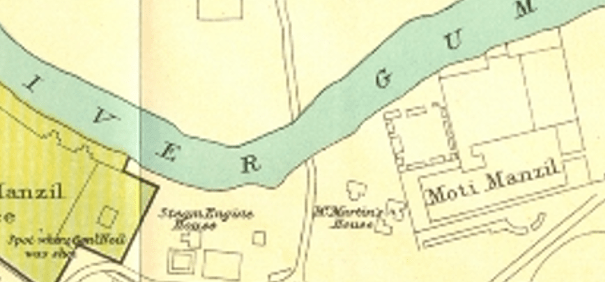
And then, for some unfathomable reason, Mr. Thornhill lost his way.
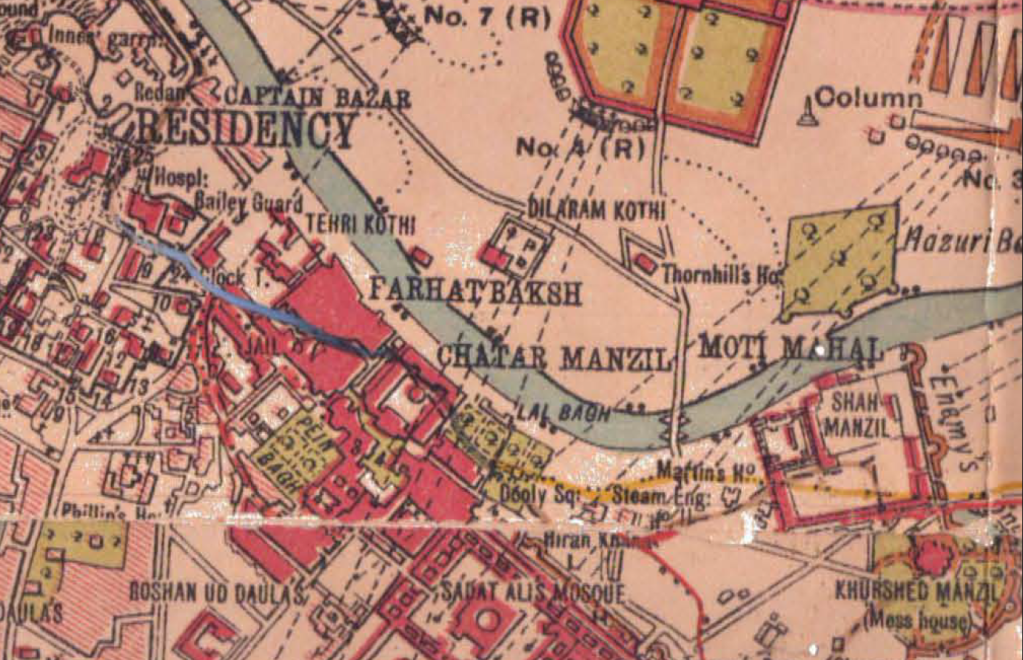
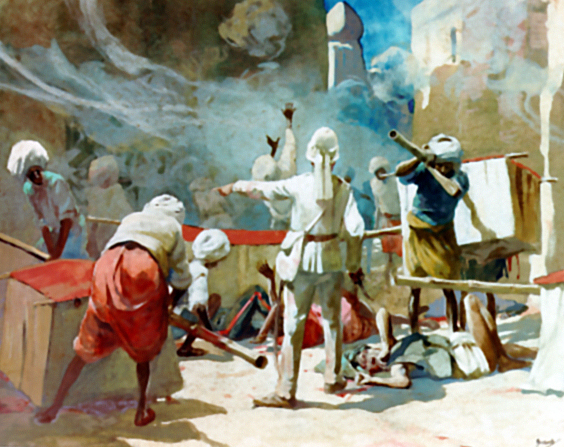
Instead of proceeding directly towards the Residency, Thornhill led the party into an oblong square, lined on both sides by sheds. As soon as they entered it, a heavy shower of musketry bullets rained down on them – the rebels had chosen their position carefully and were hidden behind walls and on the roofs of the sheds, and from the opposite riverside.
“We rushed on through the square as quickly as we could, and sheltering ourselves as much as possible under the arched sheds, passed through an arched gateway on the left side. exposed to a dreadful fire in front and rear. The enemy were crowded in a corner house, forming the angle of a street running opposite to this archway, and fired upon us within a few paces, so that their bullets would tear through several men. Here our men fell thickly, and all the doolies were deserted. A number of doolie-bearers had been killed, and the rest were dispersed and hiding in every direction. One or two of the doolies ran the gauntlet, and got through.”
Realising his error, Thornhill desperately begged Dr. Home to turn the remaining doolies back, but it was no longer possible. The only doolies which escaped the ensuing onslaught were those that had not entered the square. Thornhill, with Dr Bradshaw and the apothecary of the 90th, Mr. Hurst, rushed back through the archway to turn them back – for Thornhill, it was fatal. He was shot through the arm, shattering it, and then moments later in the left temple, taking off parts of the skull. Alive but insensible, he was brought back to the Residency along with the other wounded men, saved by Dr. Bradshaw.
Dr William Bradshaw, 90th Regiment of Foot
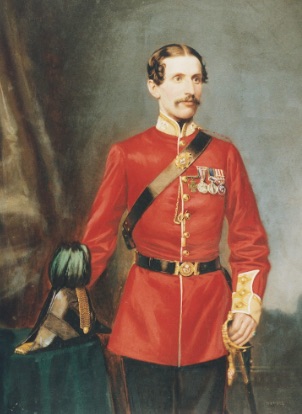
Born in Thurles, County Tipperary in 1830, at 27, William Bradshaw had already seen war having served in Crimea with the 50th Regiment of Foot. Shortly after the conclusion of the Crimean War, he transferred to the 90th and found himself in India.
In the ensuing chaos of the 26th of September, Bradshaw found himself separated from Home and the others. Not inclined to panic, Bradshaw and Hurst quickly assembled the doolie bearers and, gathering his bearings, Bradshaw retraced his steps until he found a path next to the river bank, and using the walls of the Chattar Manzil and the Farhat Baksh as cover, he reached the Residency with 20 doolies.
“For intrepidity and good conduct when ordered with Surgeon Home, 90th Regiment, to remove the wounded men left behind the column that forced its way into the Residency of Lucknow, on the 26th September, 1857. The dooly bearers had left the doolies, but by great exertions, and notwithstanding the close proximity of the sepoys, Surgeon Home, and Assistant-Surgeon Bradshaw, got some of the bearers together, and Assistant-Surgeon Bradshaw with about twenty doolies, becoming separated from the rest of the party, succeeded in reaching the Residency in safety by the river bank.“ ” (No. 22154, The London Gazette of 18 June 1858, p. 2959)
Bradshaw and Home were the last men to see Assistant Surgeon Robert Bartrum, attached to the artillery, alive. Bradshaw could provide is distraught widow, Kate, who had so plaintively waited for her husband to rescue her from the Residency, with a little comfort. He spoke of Robert in terms of the highest praise and told Kate of his “glorious death,” but in a letter written later by Home, the death was pathetically tragic.
“The shots were whistling all about us, and I said, “Well, Bartrum, I wish I could see my way out of this!” “Oh,” he said, “there is no danger whatever!” next minute he was shot dead beside me; two minutes before he had been speaking to me of the pleasure he expected in rejoining his wife and child at Lucknow.” Robert was shot through the temple; death was instantaneous but Bradshaw tried to see his body at least reached the Residency and placed it in a doolie. Unfortunately, the body was left behind and his final resting place was never ascertained.
Following in Bradshaw’s wake was another man – Private Henry Ward, who was looking after a very special charge – the son of Sir Henry Havelock.
 Mutiny Reflections