Between 1857 and 1858 a total of 182 Victoria Crosses were awarded for actions during the Indian Mutiny of which only 64 would be given to men serving the Honourable East India Company, including that of Lucknow Kavanagh.
Thirty-two VCs were won between the 30th of June – the Battle of Chinhat – and the 2nd of October – the attack on the Phillips Garden Battery. Astonishingly few were given to men serving during the siege itself. This first post shall explore their exploits.
Lieutenant William Cubitt of the 13th Bengal Native Infantry
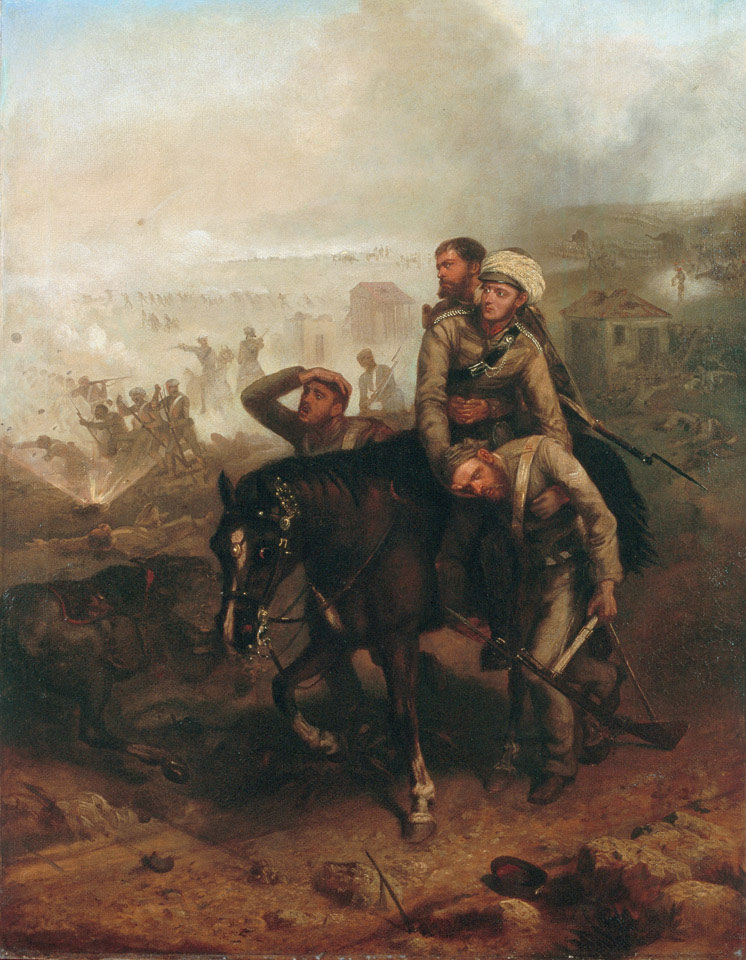
Oil on canvas, by Louis William Desanges, 1860
Born in Calcutta in 1835 to Captain William Cubitt, Assistant Secretary to the Government of India, Military Department and of the 18th Bengal Native Infantry. Captain Cubitt had entered the EICo services in 1805, at the age of 15, saw active service in the Nepal War and in the First Burma War. Promoted to major in 1839, he died scarcely a year later, leaving his widow and children to return to England. His widow remarried one William Archer Shee, the eldest son of the portraitist Sir Martin Archer Shee, in 1843.
Young William Cubitt was educated mostly by private tutors but he did attend school, firstly under Reverand John Buckland in Laleham. In June 1853, while residing in Manheim, Germany, his mother applied, on his behalf, for a cadetship in the Bengal Native Infantry. He passed his examination for a commission and on the 26th of July 1853, William entered the Honourable East India Company Army as an ensign on the 26th of July, 1853, to serve in the 13th Bengal Native Infantry and left directly for India. For the next four years, William trained his profession as a subaltern and gained his promotion to Lieutenant in November 1856. As for active service, he had seen some in the suppression of the Santhal Rebellion of 1855. 1857 found William and his regiment in Lucknow.
The intelligence received by Sir Henry Lawrence on the 29th of June should have been met with scepticism – the reconnoitring party reported the force gathered on the outskirts of Lucknow was minimal; his advisors who had not seen the field themselves insisted a victory would secure Lucknow for Lawrence through decisive and masterly force – in short, nothing could go wrong. The advisors believed the battle was won well before it was fought, and though not typical of a man so careful in his planning and thoughts, Lawrence gave way under pressure. He ordered a force of 700 men, consisting mostly of the 32nd Regiment of Foot, 230 of the remaining men of the mutinied regiments (13th, 48th and 71st), 40 Volunteer Cavalry, and 120 men, consisting of detachments of the once proud Oudh Irregular Cavalry – the 1st, 2nd and 3rd. Lawrence ordered 4 guns of the Horse Light Field Battery as artillery support, a further 4 of No. 2 Oudh Field Battery, and a prized 8-inch howitzer to take the field. Confidently, the force left Lucknow on the early morning of the 30th of June to meet, what they believed was a nominal force, hardly larger than Lawrence’s own.
On approaching Ismaelganj, they were suddenly fired upon by the rebels and the true nature of the battle quickly unfolded. Instead of the 700 Lawrence had been expecting, there were no less than 7000, well-armed and exceptionally well-led men waiting for him. They had taken up excellent positions behind stone walls and in the village of Chinhat – with little loss to themselves, they soon started wreaking havoc in the lines of the 32nd. The 13th Native Infantry managed to attack the village on its right flank, causing a momentary panic but the day was already lost as the 32nd, already exhausted under the merciless sun, without water and marching on empty stomachs, were unable to deploy with any rapidity. As their officers started to fall, the 32nd tried to return fire but some of the men found their muskets refused to fire. Loaded since dawn, the humidity had dampened their charges, forcing the men to draw the charges and reload. Trained by British officers and proving to have been very apt students, the rebels pinned down the 32nd with an onslaught of accurate musket fire.
“‘After an hour’s cannonade, the opposite artillery ceased its fire: in a few minutes rolling volleys of musketry from the village of Ishmaelgunge showed that Jack sepoy was there. The Volunteer Cavalry was ordered to move further to the right, and then, for the first time, I got a view of the plain between Ishmaelgunge and Chinhutt. It was one moving mass of men: regiment after regiment of the insurgents poured steadily towards us, the flanks covered with a foam of skirmishers, the light puffs of smoke from their muskets floating from every ravine and bunch of grass in our front. As to the mass of the troops, they came on in quarter-distance columns, the standards waving in their places, and everything performed as steadily as possible. A field day on parade could not have been better … Our artillery ceased its fire but beyond might be heard the crashing roll of musketry in Ishamaelgunge, where the 32nd, outnumbered by myriads, still maintained a struggle … a bustle in my rear attracted my attention: the rascally gunners were cutting their traces and were galloping away; the elephants for the howitzer gone … A few European gunners, the Volunteer Cavalry, and the 32nd remained; but now the enemy pressed on more closely – he unlimbered his guns and swept us with grape and canister; the deadly mitraille of musketry poured in one leaden shower from the swarming skirmishers. And now the valiant few of the 32nd are beaten near the village and come upon the road; their gallant Colonel (Case) falls dead as he approaches; some of our guns are spiked and abandoned (the howitzer among them), four are limbered, and gun carriages, covered with wounded men, gallop towards Lucknow. The 32nd also retreat; mixed up with them are some of the braves of the 13th Native Infantry – noble fellows, who were seen carrying wounded soldiers to the gun-carriages, abandoning their own wounded comrades on the ground. The Volunteer Cavalry form upon the left of the road; the rest of the handful of England’s army is in retreat. A cloud of insurgent cavalry is gathering on the far rear to the left of our retreating column. Do they mean to charge down among those staggering, half-dead heroes, who can scarcely walk along? The red and the blue flags thicken among them; when the tremendous voice of our leader (Captain Radcliffe of the 7th Light Cavalry), is heard, – ‘Three’s right!’ ‘Trot!’ and we sweep out of the trees and off the road, and we are within a quarter of a mile of our opponents. … now two light guns open on us, but the 9-pounder scarce whistled overhead when the stentorian ‘Charge!’ was heard; the notes of our trumpet sounded sharp above the din of the fight, and we rode straight at them; the cowards never bided the shock; they galloped like furies from the spot. Five hundred cavalry and two guns to be hunted by thirty-five sabres; it was a miserable fact … The battle of Chinhutt was done; the line of our retreat was marked by the bodies of the 32nd, their arms, their accoutrements; men were falling untouched by ball; the heat of a June sun was killing more than the enemy. Hard upon our heels they followed, and as we got into the Residency so did the round shot of the pursuing foe whistle in the air…” (John Lawrence, Volunteer Cavalry)
As they nobly fought, the Indian artillerymen swiftly switched sides, cut the traces on their horses, turned over their guns and joined the rebels. The Sikh Cavalry could not be induced to charge and at an opportune moment, fled. Chinhat was hardly a battle but an all-out slaughter. Officers screamed themselves hoarse as their men panicked and ran, even as the regimental surgeon, Dr. Darby called out in vain for the men “to stop for God’s sake and the remember Waterloo and Vimeira.” No one listened to him. The 32nd kept up a brisk fire, many of the men firing more than a hundred rounds of ammunition, but it was no use. Their commander, Colonel Case was shot and was last seen, lying with his eyes wide open and sword firmly grasped among the dead and dying. Captain Stevens was wounded in the leg but managed to limp on for another 5 miles but he finally fell, shot in the back.
The European Artillery too heeded the order to retreat but found themselves in a dilemma. The 8-inch howitzer would have to be left behind; Sergeant Miller was unable to get the elephants to drag the gun and he could not protect it – Lieutenant Bonham called out to Captain Ratcliffe for aid to spike the gun. They were just in time to disperse the enemy’s cavalry which boldly rode up to the muzzle of the gun. One of them fired his carbine at Lieutenant Bonham and hit him in the arm. Still standing, Bonham was as determined as ever to spike the gun. Unfortunately, with no spike at hand, quick-thinking Sergeant Suttle broke off the priming wire in the touch-hole instead. Private Johnson of the 32nd serving in the Volunteer Cavalry, however, saw a chance to save one gun at least, and he took it. Riding up to it, he quickly dismounted his horse and handing it over to a brother soldier, mounted one of the artillery horses and pulled the gun back to the Residency.
The rebel cavalry continued to outflank the retreating force and threatened to cut off Lawrence’s only retreat, a bridge over the Kukrai stream. Sir Henry, realising his defeat, now tried to turn the retreat into a victory -he ordered a battery of European artillery to occupy the bridgehead – a ruse – which paid off. The artillery had no ammunition left but their presence was enough to dissuade the rebels. To further break the momentum of the rebel pursuit, Lawrence ordered one company of the 32nd (who had not been at Chinhat, and were therefore, still fresh for a fight) to hold the last bridge before Lucknow over the Gomti River. Sir Henry was seen throughout the battle, riding to the most exposed parts of the field amidst a terrific fire of grape and round shot; at the bridge, Rees saw him again, this time wringing his hands in the “greatest agony of mind, and forgetful of himself, thought only of his poor soldiers. ‘My God, my God!’ he was heard to say, ‘and I have brought them to this!’ Fresh guns were ordered from the Residency and together with the remainder of the 32nd, Lawrence managed to keep the insurgents from crossing the Iron Bridge – however, their cavalry now tried to ford the river beneath it. Unable to prevent them, Sir Henry could only watch as they crossed over and occupied the south and eastern parts of the city. The most he could do was make their way there less pleasant. Ordering the guns from the Macchi Bhawan to open fire, they raked the road up to the next bridge and prevented them from taking not just the north but the west side of Lucknow. It also allowed a part of the retreating force to escape to the Macchi Bhawan instead of attempting the flight to the Residency.
The disaster at Chinhat cost Lawrence dearly - 118 Europeans, officers and men were killed and 182 native troops were killed or missing while fifty-four Europeans and 11 Indians returned to the Residency wounded. Three men were saved by 21-year-old Lieutenant Willam Cubitt and his citation in the London Gazette read
“For having on the retreat from Chinhut, on the 30th of June, 1857, saved the lives of three men of the 32nd Regiment, at the risk of his own.” (No. 22278, The London Gazette, 21 June 1859, p. 2420)
The citation tells us but little of Cubitt’s actions. During the battle, he was serving with the Volunteer Cavalry and had taken part in the charge described by John Lawrence. Active during the retreat, Cubitt first stopped to collect Lance-Corporal Kirby, whom he quickly sat behind him on his horse and then he swept up two privates of the 32nd, whom he dragged along as they grasped his stirrups. Kirby would later write,
“‘ … I have no doubt Sir, but you remember saving the lives of three men of Her Majesty’s 32nd Regiment. I am one of them, kind Sir, and this Irish man that you wanted to know his name, my name is Kirby, Sir, and the man that you brought in behind you on your horse. The names of the others are Joseph Deolin, 3rd Company 32nd Regiment, but the name of the 3rd man Sir I am sorry to say that I altogether forgot, for as you know I was struck with the gowling sun of the 30th June and for me Sir you know that you rode a grey charger and that you had to get one of the native Cavalry to get me on with your own assistance, the other two men you made them cling to your stirrups … I can call on Colonel E.W.D. Lowe that you took me to Hospital verandah and stoped there until you saw me, carried into the Hospital …“
Kirby would later testify, in 1858 during the process of securing Cubitt’s VC, that Cubitt had saved his life and great risk to his own.
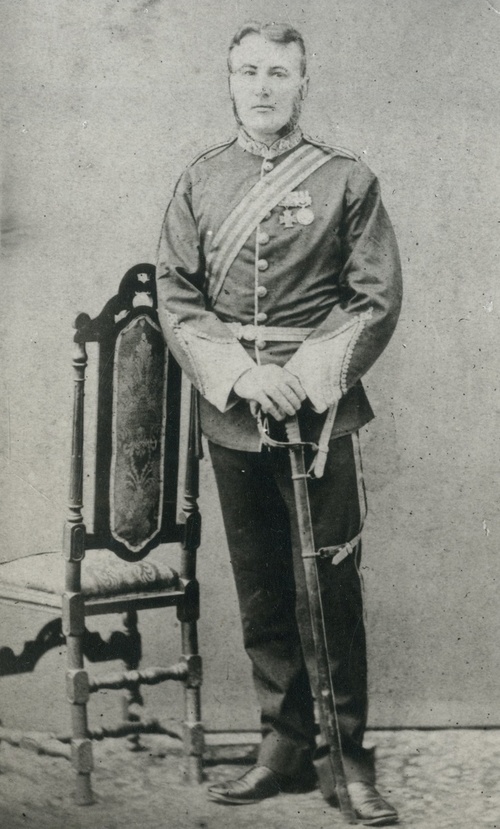
Wounded twice during the ensuing Siege of Lucknow, the last time severely, Cubitt returned to England in 1858 on sick certificate, sharing passage on the ship with one Mrs. Jenkins who recalled he as “modest and unassuming…He never talked of this deed as anything out of the common.” In the course of his VC recommendation, Colonel Aitken too would be asked about Cubitt; he steadfastly recounted that Cubitt even if he had not performed such a singular deed at Chinhat, “he richly deserved his reward for all his acts of self-denial in every way. In the time when rations were short, he would surreptitiously make over his share to someone who he thought required it more.” On the 15th of June Cubitt received his VC from Queen Victoria herself, at Windsor Castle.
By 1861, Cubitt had recovered enough to return to India and rejoin the 13th NI. What had remained of the 13th, 48th and 71st Regiments was formed into the “The Regiment of Lucknow” and the 13th was renumbered the 16th in 1861, and from 1864 carried the sub-title, “The Lucknow Regiment” in honour of their service during the siege. For Cubitt it was a time of tranquillity - he married Charlotte Isabelle Hills at St. Peter’s Church in Fort William, Calcutta, in 1863, thus gaining James Hills as his brother-in-law, the rather brash and daring officer who had won his VC at Delhi. His wife would eventually become the aunt of Brigadier Lewis Pugh Evans, another VC holder.
The marriage itself would produce 5 children.
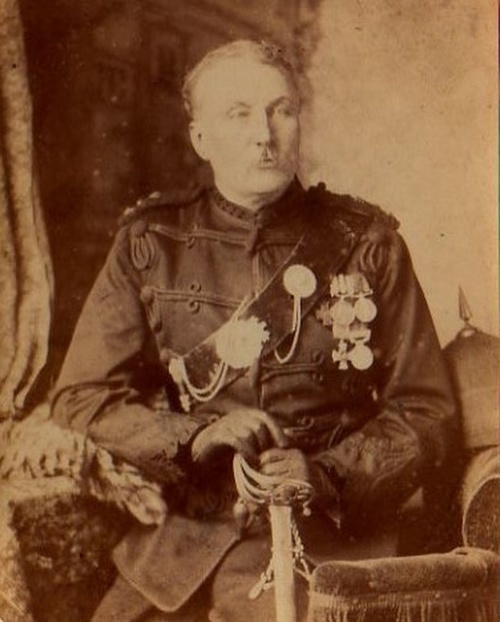
William served as adjutant to his regiment from 1863 to 1867, gaining his captaincy in 1865. He was promoted to Brigade Major in Benares in 1867, served as “wing-officer” in the 16th in 1872 and promoted to Major in 1873. His career continued – between 1873 and 1874 he served in Dacca as officiating station officer, took part in the expedition against Dufflas in the North-East Frontier and was finally promoted to Lieutenant-Colonel in 1879. Attached the Bengal Staff Corps from 1879, William served as second-in-command of the 16th (Lucknow) NI, as which he found himself commanding a fort at Ali Masjid in the Khyber Line Force during the Second Afghan War. The conflict nearly cost him his life for, when wounded, he nearly died of blood poisoning. He would not return to duty until 1881, when he was given command of the 43rd (Assam) NI, later known as the 43rd Goorkha Light Infantry – with whom he would serve until 1888. Promoted to colonel in 1883 he once again served on the North-Eastern Front then between 1883 and 1884 in operations against Akkas, where he would once again find himself mentioned in despatches.
War was never far behind William and between 1886 and 1888 he served during the Third Burmese War, becoming, as the result of his exceptional service, one of the first Companions of the new Distinguished Service Order, and more mentions in despatches. In 1889, William Cubitt retired and was placed on Unemployed Supernumerary in 1891. He died in 1903 and his wife would be buried beside him 13 years later upon her death in 1916. Cubitt’s medals, including his VC, are on display in the Lord Ashcroft Gallery at the Imperial War Museum in London.
 Mutiny Reflections