The Battle of Shamshabad, which had such terrible personal consequences for William Hodson, proved to be something of a boon for the troop sergeant major of the 9th Lancers – David Spence, the only Victoria Cross awarded for the battle.
His gallant deed on 27 January 1858 was for saving the life of Private Edward Kidd; yet long before he rode the field at Shamshabad, David Spence had had an adventurous life. Born in 1818 in Inverkeithing, Fife, Scotland, to Robert Spence, a mason by profession, and his wife Agnes (née Anderson), there did not appear to be any haste for David to join the army. In 1835, at the age of 17, a blacksmith by trade, he married young Elspet Mathison, who was only one year younger than himself. However, it appears that marriage hastened his decision after all, and in 1838, he joined the 42nd Regiment of Foot, then based in Aberdeen. The same year, at Belfast, he enlisted in the 9th Lancers.
In 1842, the Lancers were on their way to India and with them sailed not only Corporal David Spence, but his wife, Elspet. Their lives had been touched by some tragedy when two of their daughters died in infancy; it was deemed prudent, however, to leave their remaining son, Robert, in Scotland to be cared for by his grandmother. There would be another seven children born in India, but they would only bring home one, young Agnes, when the regiment left in 1859. Three of their daughters lie buried in Cawnpore, and except for baby Charles, the others were carried to their graves in Ambala.
As for David Spence, promoted to sergeant in January 1843, he would now see his first battles during the Gwalior campaign, serving at Punniar — a short break, and the Lancers were off, in 1845 to take their part in the Sutlej Campaign, where David was present at Sobraon. War was never far behind, and before the Lancers could settle into the humdrum nature of cantonment life, the Second Sikh War broke out. Once again, David would have bid his family goodbye and ridden off with his regiment. The war brought him two clasps on his Punjab Medal – Chillianwalla and Goojerat.
In 1850, David resigned his rank as Sergeant and a year later was promoted to Troop Sergeant Major. The regiment now did the tour of stations and cantonments, uprooted ever so often to trek across India to the next station. In 1856, they buried Isabella Ann, only 5 years old, at Ambala. A year later, Elspet would once again be left behind, now with their children, as David once again went to war – it would have been a sore trial for his wife, who had taken refuge with the other ladies in Kasauli, for she would bury her infant son Charles on the 10th of June, a few days after his first birthday.
Over the next months, there is only one mention of David Spence, and that is in the journal of Major Anson, who writes, while on the Ridge before Delhi:
“Saturday, July 18th, 1857, 7 a.m. — We passed a very quiet night. In consequence of Drysdale’s absence, I went round the picquets between 10 and 11. There was a good deal of thunder and lightning. I expected every moment it would rain, but it has not done so up to this, though the wind is easterly, and it is very cloudy. I am glad of the change, for we lost one man from apoplexy (Taylor of A Troop) yesterday, and the heat gave old Sergeant-Major Spence an attack of fever.”
If Sergeant-Major Spence returned to see his wife, it is unknown, but it is very unlikely. After Delhi, the campaign took him further and further away from her and his daughter, and just like Major Anson, he
would find himself before Lucknow in November 1857. The 9th Lancers would be the only regiment to have served in the three largest theatres of the Indian Mutiny – Delhi, the Relief of Lucknow in 1857, and the Capture of Lucknow in 1858. However, before we can place him in the Army of Oudh, we will now follow David Spence to Shamshabad.
The battle itself was fought against a column of no less than 10’000 insurgents, and both sides were equally determined to have the upper hand. Of the Lancer’s charge itself, Oliver Jones, that enthusiastic volunteer, had this to say:
“One squadron of the Lancers had to remain behind to protect the guns, but the other charged splendidly down the hill to the proper right of the camp, which was crowded with fugitives, and into the thick of the enemy, who did not stand the shock, but dispersed and fled in all directions; the rest of Hodson’s Horse came up in the rear and joined the engagement.”
Following the charge, it would appear that Spence became separated from his men, much to the good fortune of Private Edward Kidd, who had been injured and was now lying on the ground, pinned under his dying horse. His chances of getting out alive were rapidly diminishing as the insurgents closed in for the final kill. Without a second thought, upon hearing Kidd’s shouts for help, Spence put his spurs to his horse and charged. Wholly unassisted, he then cut and slashed his way through the men in his way until he reached Kidd. Dismounting, Spence managed to get the private out of his predicament, and then, with the next set of sepoys closing in, Spence, within an inch of his own life, managed to bring Kidd to safety. Kidd got out of the scrape, wounded, and Spence was unharmed. It was all in a day’s work for David Spence and very much in keeping with the style of the 9th Lancers.
It seems a little unfortunate that his gazette citation is dated incorrectly, for the battle itself would not take place for another 10 days:
For conspicuous gallantry on the 17th of January, 1858, at Shumsabad, in going to the assistance of Private Kidd, who had been wounded, and his horse disabled, and bringing him out from a large number of rebels. Despatch from Major-General Sir James Hope Grant, K.C.B., dated 8th April, 1858. (No. 22212, The London Gazette. 24 December 1858. p. 5512)
After 17 years and 122 days in India, David Spence, his long-suffering wife and their 5-year-old daughter, after five months on a ship, arrived off Spithead on the 4th of September 1859. He was promoted one month later to Regimental Sergeant Major and was presented the VC by the Queen herself in January 1860 at Windsor Castle. Two years later, David Spence received his discharge from the 9th Lancers, at his own request, and his papers read:
“Service up to this day, which he is entitled to reckon amounts to 24 YEARS 135 DAYS …. during which period he served abroad 16 and 8/12 years…5ft 10 and-a-half inches, with hazel eyes and a fresh complexion.”
He received an army pension for his services, to which he added his VC annuity of £10 per annum; his medals, too, were most impressive:
- Victoria Cross
- Gwalior Campaign Star ( 1843 )
- “Punniar Star”
- Sutlej Medal ( 1845-46 )
- Reverse: “Sobraon 1846”
- Punjab Medal ( 1848-49 )
- 2 clasps:
- “Chilianwala” – “Goojerat”
- Indian Mutiny Medal ( 1857-58 )
- 3 clasps:
- “Delhi” – “Relief of Lucknow” – “Lucknow”
- Army Long Service & Good Conduct Medal
Shortly after Spence left the Lancers, in 1862, he was appointed to Her Majesty’s Bodyguard as a Yeoman of the Guard where he is seen in his uniform in the only known picture of the man himself.
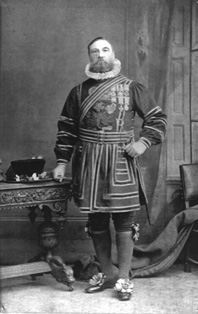
In the meantime, the family moved to Falmouth in Cornwall, where David would take up employment as a mounted coast guard and settle into civilian life. Unfortunately, Elspet died on the 14th of August, 1864, aged only 45, of pneumonia and typhoid fever; she left behind not just a grieving husband but her sorrowing children, Robert (aged 26), Agnes (12) three year three-year-old David (born 1861) and little Mary, who would have just seen her first birthday. It seemed sensible that the widower, with such young children, would remarry, and his choice fell on Mary Pascoe, an innkeeper’s daughter from Falmouth, who was already pregnant when they married in February 1865. Together, they would have another eight children, including twin girls. Their last child, born in 1876, was named, quite fittingly, Jane Delhi Spence. However, her life, like her father’s, ended in 1877. While the cause of his daughter’s death is unknown, David collapsed on a London street on the 17th of April and died of a heart attack. He was buried four days later, on the 21st, at Lambeth Cemetery in a grave that would remain unmarked until 2017.
As for his children, Robert died a year later in 1878, and little Agnes, who had been at her mother’s side throughout the mutiny, had predeceased her father, finding an early grave in 1869, just 17 years old. Six of his children from his second marriage attained adulthood, and his widow, Mary, lived on until 1937.
Sources:
Anson, O. H. St. G. With H.M. 9th Lancers During the Indian Mutiny. London: W. H. Allen & Co., Ltd., 1896.
Grant, Hope. Incidents in the Sepoy War 1857-58, Compiled from the Private Journals of General Sir Hope Grant, K.C.B.. Edited by Henry Knollys. Edinburgh & London: William Blackwood & Sons, 1873.
Jones, Oliver J. Recollections of a Winter’s Campaign in India in 1857-58. London: Saunders & Otley, 1859.
Ouvry, M. H. A Lady’s Diary Before and During the Indian Mutiny. Lymington: Printed by Chas. T. King, 1892.
Links:
Geneanet.org
https://www.thegazette.co.uk/all-notices/content/100390
https://www.victoriacross.org.uk/cc912lan.htm
https://vcgca.org/
https://www.victoriacross.org.uk/
https://theroyallancers.org/troop-sergeant-major-david-spence-vc-9th-queens-royal-lancers/
 Mutiny Reflections