In 1801, Abraham Roberts, the fourth son of Reverend John Roberts, began his career in the Waterford Militia. The Peace of Amiens saw the regiment disbanded, and Abraham applied for a commission in the Line, but with nothing forthcoming, he decided to go to sea. His voyage took him to Calcutta – his experiences in India must have been favourable, for he determined to return. When he returned home, he found he had been gazetted to H.M.’s 48th Regiment of Foot, and he set to work to obtain a cadetship with the EICo. In 1805, he landed once again in Calcutta and joined the 1st Bengal European Regiment. He would not leave again for 48 years.
His career began at a most volatile time in the history of John Company. Abraham served under Lord Lake in the 2nd Mahratta War, and as he crossed the Sutlej in pursuit of Holkar, he had his fair share of work in the Pindari Wars and the skirmishes in Bundelkhand, in Sirmur and the Nepal Campaign. Upon becoming seconded to the public works department, Roberts set about building cantonments, engaged in forestry and was one of the first people to build himself a house in Simla. At the outbreak of the 1st Afghan War, he commanded the 4th Brigade of the Army of the Indus and in 1839, commanded Shah Shuja’s contingent at the storming of Ghazni and was in Kabul preceding the disasters of 1842. Roberts was unhappy with the occupation of Afghanistan, and as Sir William Napier noted,
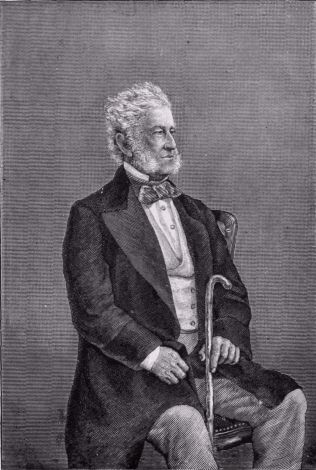
“There was a General Roberts who commanded Soojah’s Force; he knew his business, he remonstrated against the false security of the Political Agents…he was laughed at, then insulted…wrote one or two dispatches to Lord Auckland pointing out these mischievous proceedings, and declaring some great disaster would occur, demanded leave to return to India. He obtained it and left Cabul two months before the catastrophe, thus saving his honour and his life.” (Letters)
Roberts resigned his appointment in 1840 despite being made a Commander of the Bath and returned to India. His predictions of an impending disaster proved true, and he would only say, “I spoke the truth and was thought an alarmist. Our rulers have much to answer for.”
Once back in India, he commanded the 72nd Bengal Native Infantry, and shortly after the 15th BNI, then he went on leave to England in 1844 and did not return until 1851 when he took command of the Punjab Division – a year later when the division was split, Roberts assumed command of the Peshawar Division with his son, Robert, as his ADC. Illness forced him to finally leave India in 1853, and he returned to England a final time. He was promoted lieutenant general in 1857 and general in 1864. As Colonel of the 1st Bengal Fusiliers from 1859, Roberts received his KCB in 1865 and GCB in 1873. He died the same year, aged 89.
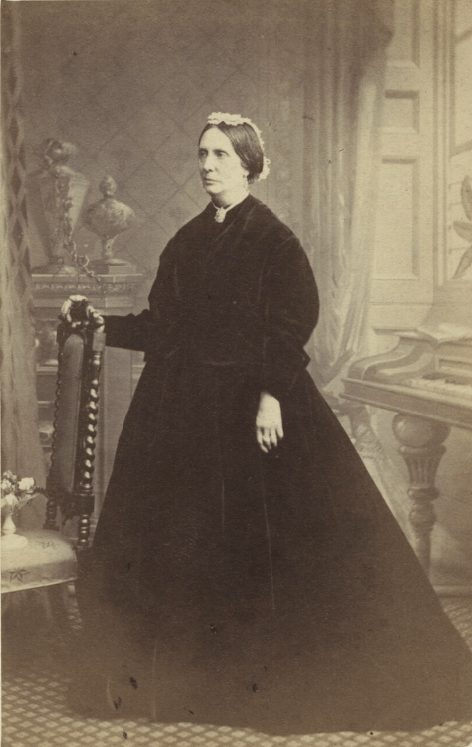
During his life, Abraham married twice; firstly to Frances Isabella Poyntz Ricketts (of the old East India Company family of Ricketts) in 1820. They had three children, Frances Eliza (who married Charles Grant, later General Grant of the Bengal Artillery), Maria Isabella (later the wife of William Maximilian George Maconochie-Welwood, whose baptism had been attended by Tsar Nicholas I; he also boasted Archduke Maximillian of Austria as his godfather) and George Ricketts. The connection with India remained strong and both daughters married in Meerut on the same day, 20 October 1842.
At Meerut, Charles Grant, Capt. Horse Art. son of the late Robert Grant, Esq. Bengal Civil Serv. to Frances-Eliza, dau. of Lieut.-Col. Roberts, C.B. and at the same time, Maxwell George Maconochie, Esq. 11th Light Cav. Son of Lord Meadowbank, to Maria-Isabella, dau. of Lt.-Col. Roberts, C.B. (FIBIS)
Unfortunately, Frances died aged 24, three months after her son’s birth in 1827. Abraham Roberts remarried Isabella Bunbury in 1830, the daughter of Major Abraham Bunbury, widow of Major Hamilton G. Maxwell and herself a mother of two children. Major Maxwell had transferred to the 43rd BNI in 1824, was invalided in 1829 and died in Chunar near Allahabad in 1829, commanding the 2nd Battalion, Native Invalids at the time of his death. He had likely crossed Abraham Roberts’ path in his career as both men had served in Bundelkhand and the Nepal campaign. With Roberts, she would have two more children, Frederick Sleigh, born in Cawnpore in 1832, and Harriet Mercer, born in 1834.
All three boys would follow Abraham to India – Hamilton and George would make their careers in the Bengal Staff Corps. Hamilton would marry Julia, the daughter of Brigadier General St.George Showers and die a colonel in 1889, while George Ricketts would gain the rank of Major-General before his death in 1915. He would curiously marry Harriet Roberts, the daughter of Captain Thomas Roberts of the Royal Navy, who happened to be Abraham’s brother. The youngest, Frederick, however, it would appear, was determined to outshine not just his siblings but his father.
In 1834, Abraham Roberts packed up his wife, his two step-children, Robert and his sister and settled them in England – (it can only be presumed the other three had been safely ensconced in England shortly after their mother’s death). When he returned to India, Isabella remained behind. The strain on his purse strings with seven children to feed, cloth and above all to educate the boys, must have been dire. His youngest son, Frederick, must have caused his parents some worry – he was by no means a strong child, and an attack of illness in India had left him blinded in one eye. He would never be a tall man and would stand 5’3″ in his socks, but what he lacked in stature, he made up for with personality. His sisters dubbed him “Sir Timothy Valiant, and he had a lively nature and was full of spirit. His father was determined however, that his education would not be wanting – he was first schooled in Clifton, and then given over, after six years to the hands of Mr Mills of Hampton who had been a master in the Navy and his pupil was “wont to declare that his system was an excellent one for the training of the mind and body and that the weekly option he gave misdemeanants of a long punishment task or a long flogging was inspired by a desire to develop character and a capacity for quick decision.” (Letters)
The question was what to do with the boy after Hampton; his mother wanted to send him to Eton, but the expense of it depended on whether his father would get command of a regiment. With promotion only by seniority and with 17 men ahead of him, Abraham quaintly mentioned to his wife, “I wish for no man’s death…” However, in 1845, at the age of 13, Frederick entered Eton in the 4th Form, where, in the estimation of his uncle, Captain Thomas Robert of the Royal Navy, he would meet, “…the sons of the first people of the Kingdom, which in after life is sometimes useful.” Although he only remained in Eton for one year, it marked one of the most pleasant in his childhood. Although Frederick was determined to join the army, his father was not so inclined, writing to his wife, “If Freddy is clever I hope he will not think of the Army…Freddy must be Lord Chancellor…” while his mother ardently hoped he would go either to Oxford or Cambridge and join either Church or law. However, it would appear his father had a change of heart – after failing to gain him a commission in the EICo, he sent his son to Sandhurst, where he came out second in the entrance examination. During his 18 months at the college, he gained a prize for German and advanced three steps of the six needed for a commission without purchase. In 1850, when a vacancy at Addiscombe became available, he was finally on his way to join the EICo’s army. In 1852, Frederick Roberts left England on the steamer Ripon bound for Cairo as second lieutenant in the Bengal Artillery. Poignantly, his father had promised him £100- and a gold watch if he passed into the Engineers, and £50- with the watch if he succeeded in getting into the artillery. His son did not disappoint and came out ninth in a class of 50 cadets – in Roberts’ year, only six men were appointed to the engineers.
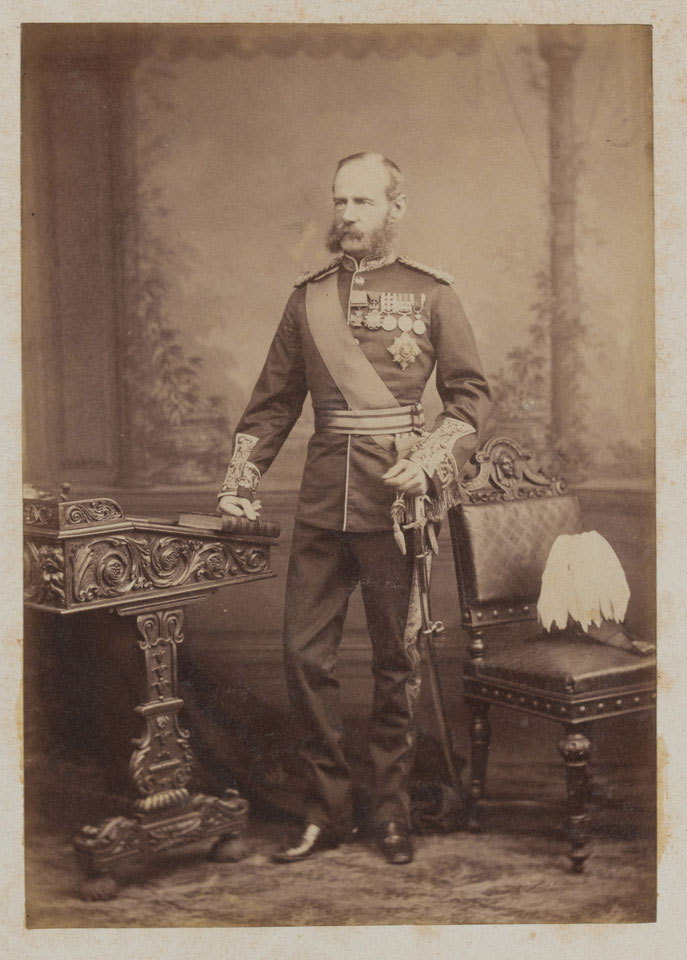
[Image number: 121580]
The good ship Oriental brought Roberts and his fellow cadets safely from the Suez to Calcutta, where all thoughts of war and honour were swiftly stamped out. Lord Dalhousie was governing India, and much of what the East India Company had set out to achieve had, for all intents, been done. Roberts found himself at Dum Dum with his regiment diligently executing peacetime garrison duties. Two months before Roberts had arrived in February, war had been declared with Burma; Roberts had written to his father begging him for an appointment in that quarter, but his father replied that he expected, as soon as he had command of the Peshawar Division, his son would join him in Punjab as his ADC. In August, Frederick left Calcutta behind – after nearly three months of travel, he finally arrived in Peshawar in November. Until the autumn of 1853, when his father returned to England, Frederick acted as his ADC and continued doing duty with the artillery. Having seen the Bengal Horse Artillery at Meerut,
“It certainly was a splendid service; the men were the pick of those recruited by the East India Company, they were of magnificent physique, and their uniform was singularly handsome. The jacket was much the same as that now worn by the Royal Horse Artillery, but instead of the busby, they had a brass helmet covered in front with leopard skin, surmounted by a long red plume, which drooped over the back like that of a French Cuirassier. This, with white buckskin breeches and long boots, completed a uniform which was one of the most picturesque and effective I have ever seen on a parade ground.”
The sight was so magnificent it left him with “a fixed resolve to leave no stone unturned in the endeavour to become a horse-gunner.” He transferred to the Bengal Horse Artillery in 1854 but remained on the frontier, serving as staff officer to General Reed, and Sir John Lawrence offered him an appointment in the Public Works Department – fortunately, Roberts declined the offer, and towards the end of April 1857, he reported to Cherat, where he first met John Nicholson,
“Nicholson,” Roberts writes, “impressed me more profoundly than any man I had ever met before, or have ever met since. 1 have never seen anyone like him. He was the beau ideal of a soldier and a gentleman. His appearance was distinguished and commanding, with a sense of power about him which, to my mind, was the result of his having passed so much of his life amongst the wild and lawless tribesmen, with whom his authority was supreme. Intercourse with this man amongst men made me more eager than ever to remain on the frontier, and I was seized with ambition to follow in his footsteps.”
However, events for everyone took a strange turn in 1857. Lieutenant Roberts would shortly leave Punjab and find himself embroiled in the Siege of Delhi, where he was slightly wounded.
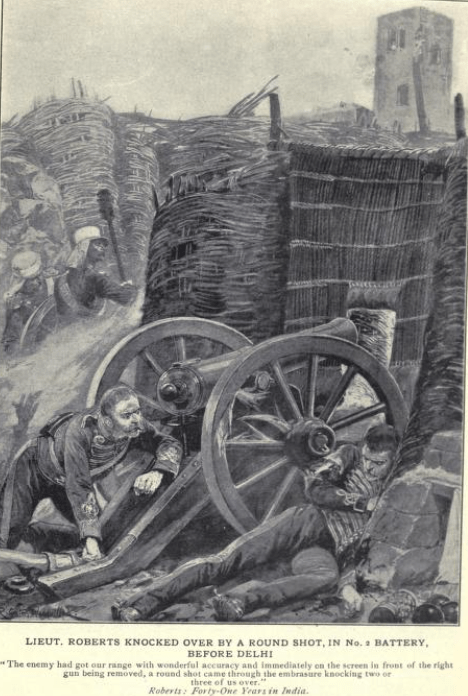
He would then join the Delhi Column on its ride to Cawnpore and their devil’s work to relieve the garrison at Lucknow. He was attached to the staff of Sir Colin Campbell as Deputy Assistant Quartermaster General for the Lucknow operations and would find himself still occupying the same position when Campbell finally left Cawnpore in January 1858 and made his way towards Fatehgarh.
 Mutiny Reflections