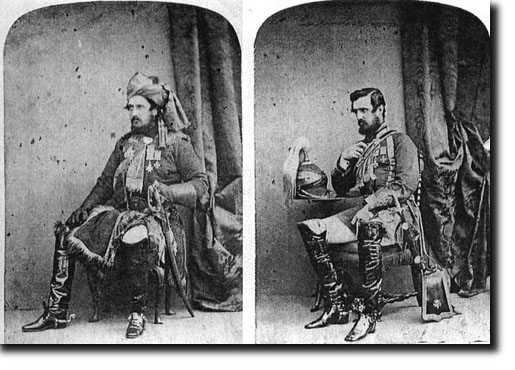
In 1826, Captain George Probyn, Captain of the Honourable East India Company’s Service and an Elder of Trinity House, married Alicia Macnaghten in St. Mary-le-Bone. The announcement was made in the Cambrian on 10 June 1826:
“On Thursday, at the New Church, St- Mary-le-bone, by the Rev. Dr. Coglan, Capt. Geo. Probyn, of the Hon. East India Company’s Service, son of the late Rev. Wm. Probyn, Rector of Pershore, Worcestershire, and Chancellor of St. David’s to Alicia daughter of Sir Francis Workman Macnaghten, of Roe Park, county Derry, and late one of his Majesty’s Judges of the Supreme Court in Calcutta.”
The bride was the daughter of the future Sir Francis Workman Macnaghten, 1st Baronet (having changed his name to Francis Workman-Macnaghten by Royal Licence in 1809). A practising barrister, he was appointed to the office of Judge of the Supreme Court in Madras between 1809 and 1815 and held the office of Judge of the Supreme Court of Calcutta between 1815 and 1825. He would be created 1st Baronet Macnaghten of Dundarave, co. Antrim on 16 July 1836. In 1841, his second son, Sir William Hay Macnaghten, adviser to Lord Auckland, was murdered on the Seeah Sung Plain on 23 December by Akbar Khan, son of Dost Mohammad.
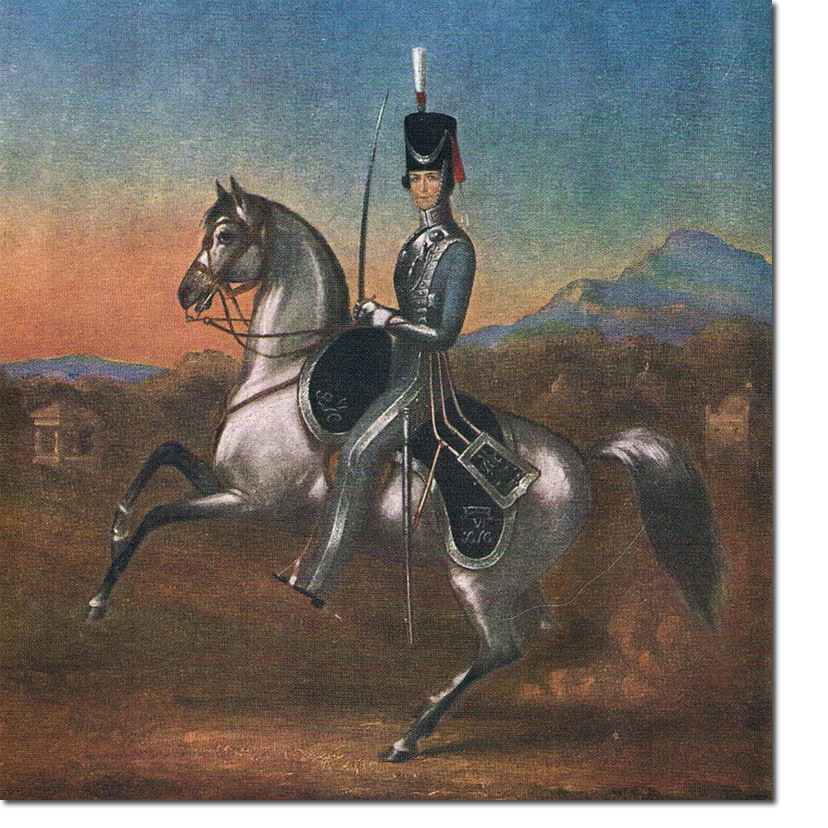
On 21 January 1833, a boy named Dighton Macnaghten Probyn was born, one of six sons of the captain and his wife. He was gazetted into the Bengal Army in 1849 and joined the 6th Bengal Light Cavalry on 14 March the following year as a cornet. The 6th had been raised in 1800 in Ghaziapur and had fought their way through Lake’s operations against Holkar, gained their Battle Honours in the 2nd and 3rd Maharatta wars – Leswaree (1803), Seetabuldee (1817), Bhurtpore (1826), and in the 2nd Sikh War – Punjab (1848-49), Chillianwallah (1849) and Goojerat (1849). However, a fine regiment, which undoubtedly the 6th was, did not hold the same attraction as the newly raised irregulars in Punjab. In 1852 Probyn transferred to the 2nd Punjab Irregular Cavalry, raised in 1849 in Lahore and commanded by Lieutenant Samuel James Browne. They were one of five cavalry regiments, nine infantry battalions and four mountain batteries (1’100 strong) of the Punjab Irregular Force to police the North-West Frontier. They were not part of the Bengal Army nor under the orders of the Commander-in-Chief but directly under the Lieutenant-Governor of Punjab. It was just as well for him – the 6th Bengal Light Cavalry would toss their loyalty to the wind and in 1857, they mutinied at Jalandhar.
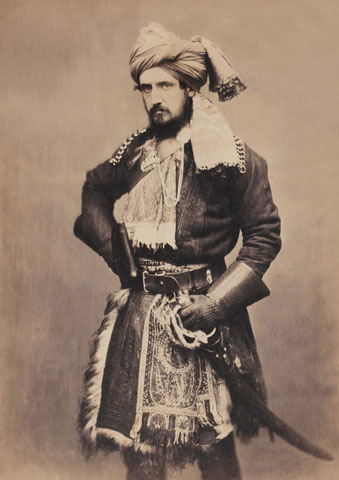
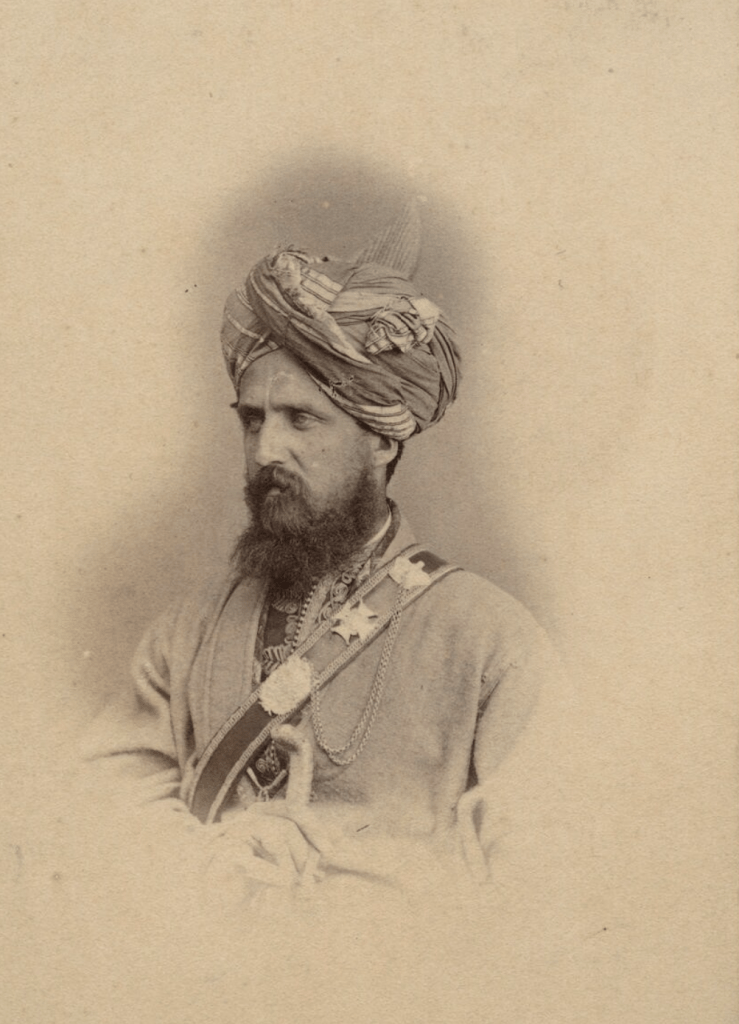
2nd Punjab Cavalry, in Indian dress,”
photographed in India, ca. 1857,
(from an album previously owned by
General Sir Sam Browne VC
Probyn was appointed adjutant in the 2nd Punjab Cavalry, and if it was active service he sought, he would soon have it in abundance. In March, he took part with his regiment in the punitive expedition against the predatory Bozdars, under Brigadier-General Sir Neville Chamberlain. The 2nd Punjab Cavalry was next ordered to Kohat with rumours of mutiny in the Bengal army already running rife. Samuel Browne then sent Probyn and several dismounted men to the North-West Provinces to procure horses and then return to Jalandhar. When the mutiny broke in Meerut, the station commander of Jalandhar, Brigadier Johnstone, was on leave and acting in his place was Commissioner Major Edward Lake. Lake immediately sent Probyn and a handful of men to seize the Phillour bridgehead over the Sutlej to prevent any mutineers from the Punjab crossing into Oudh; he then insisted, on Johnstone’s return, that the Bengal regiments at Jalandhar be disarmed. Johnstone refused to listen.
Following the mutiny at Ferozepore on 13 May, Browne was ordered to detach a squadron under his second-in-command, Charles Nicholson, to serve with the Moveable Column, which was being formed at Jhelum by Peshawar Commissioner Herbert Edwardes and Lieutenant-Colonel John Nicholson (the brother of Charles). Commanding the column would be Neville Chamberlain. However, the column would soon be reorganised, realising it was folly to remove all the Queen’s troops and Gurkhas from the Punjab; these were swiftly either returned to their stations or halted on the march. As such, Charles Nicholson’s squadron was diverted to Jalandhar, where on 7 June, the Bengal troops revolted. When Nicholson arrived the next morning, he found there had been no pursuit, and these had been allowed to leave the station with the equipment and arms. Although Johnstone was finally persuaded to set off after them, the chase was so half-hearted that most of them managed to cross the Sutlej and make their way to Delhi, neatly avoiding Probyn at the Phillour bridgehead.
Nicholson’s squadron, with H.M.’s 8th Regiment of Foot and the remaining loyal troops from Jalandhar, made haste to Phillour and were then ordered to proceed to Delhi. On 14 August, further troops from the Punjab under John Nicholson would be the last reinforcements to reach the Ridge, and one week later, Probyn was promoted to Captain, “in the room of Captain Willock, deceased,” of his now lost corps, the 6th Bengal Light Cavalry. Under John Nicholson, Probyn would fight at Najafghar on 26 August; at the taking of Delhi, Probyn would command the detachment of 2nd Punjab Cavalry, and Charles Nicholson the 1st Punjab Infantry.
Shortly before midnight on 13 September, Probyn and his men fell in with the Cavalry Brigade, under Brigadier James Hope Grant of the 9th Lancers. The four infantry columns began their assault on the breaches in the walls at dawn. Only three of these successfully entered the city; the fourth, under Major Charles Reid of the Sirmoor Gurkha Battalion, ran into severe opposition in the Kisanganj suburb as the rebels attempted to outflank the entire position on the Ridge.
With Delhi taken, a movable column was again formed to pursue the now-fleeing rebels. In command of the 2,500-strong column was Colonel Greathed, who would lead them as far as Agra. During the march, they fought the action at Bulandshahr and Aligarh. At the latter place, Greathed had expected a fierce resistance, but before him on the road to Aligarh was a ragged band of rebels with no stomach for a prolonged fight. The horse artillery pushed them into the town; the rebels fled through it and rushed into the open countryside on the other side. The 9th Lancers, Punjab Cavalry detachments and horse artillery were now divided into two parts and swept around Aligarh, with Probyn and his men going around to the right. On the other side of the town, the parties rejoined, and the cavalry charged on for another 5 miles in pursuit. ‘Probyn and his 2nd Punjab Cavalry,’ observed Lieutenant Arthur Moffatt Lang of the Bengal Engineers, ‘first returned from their gallop on our right, having killed some 50 of the enemy.’ The next day, the column took Akrabad with the Punjab Cavalry sent on in the advance to surround the village before daybreak. In the surprise attack, some 50 rebels and two of their leaders were killed.
The plan now was to make haste towards Cawnpore, but the persistent shouts for succour from Agra that had plagued Greathed since he left Delhi had now assumed a character of such urgency that he was forced to turn from his road and make, with all haste, towards the terrified fort.
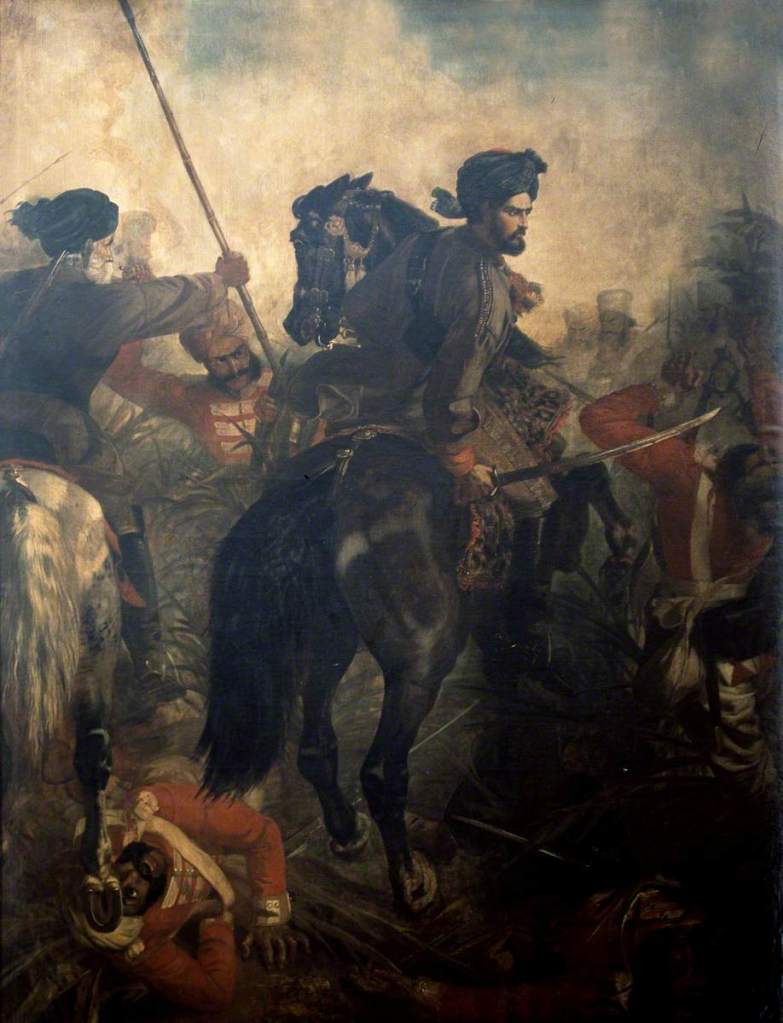
Louis William Desanges (1822–1906)
National Army Museum
Probyn’s VC citation is for distinguished gallantry and daring throughout the campaign, it was largely for his valour at The Battle of Agra.
“Has been distinguished for gallantry and daring throughout this campaign. At the battle of Agra, when his squadron charged the rebel infantry, he was some time separated from his men, and surrounded by five or six sepoys. He defended himself from the various cuts made at him, and before his own men had joined him had cut down two of his assailants. At another time, in single combat with a sepoy, he was wounded in the wrist, by the bayonet, and his horse also was slightly wounded; but, though the sepoy fought desperately, he cut him down. The same day he singled out a standard bearer, and, in the presence of a number of the enemy, killed him and captured the standard. These are only a few of the gallant deeds of this brave young officer. Despatch from Major-General James Hope Grant, K.C.B., dated 10 January 1858.” ( No. 22154. The London Gazette. 18 June 1858. p. 2960).
As Probyn ordered all his papers burnt upon his death and never wrote anything about himself (considering his employ in the last decades of his life, this was probably wise), we shall continue reconstructing his gallant exploits.
The Moveable Column left Agra four days later; on the way to Cawnpore, Greathed was relieved of his command by Sir James Hope Grant and the pursuit of the rebels continued. On 23 October they reached Miran-ki-Serai on the outskirts of the ruined Hindu city of Kanouj. Here, Roberts received intelligence that a party of mutineers were close by with four captured British guns. As such, he proceeded onwards and found them on the banks of the Kala Nadi, dragging the guns across the river. He reported back and Hope Grant ordered the horse artillery, Major Ouvry with some of the 9th Lancers, Probyn and Watson in the advance guard, to ‘look them up.’ A few rounds from the artillery sent the rebels into a panic; they abandoned the guns and fled across the river, pursued by the Punjabis. Once across the river, the two squadrons then charged them in parallel lines a mile apart across a grassy plain, pushing them towards the Ganges, some four miles away. Ahead as was his custom, Probyn arrived at the river first to watch the rebels struggling the river where many were swept away by the fierce current.
Three marches later, the force reached Cawnpore. They only remained for two days but during this short stay, Probyn, with Risaldar Punjab Singh, were involved in a singularly daring exploit. Shortly before sunrise one morning, Probyn and the risaldar set off to visit some outlying pickets, furnished by his squadron. They did not go far before they saw a small party of rebels, unaware of their approach. Risaldar Singh told Probyn to remain behind him at a short distance and stay quiet; he then rode up to the rebels to find out who they were. It turned out they were mutineers of the Gwalior Contingent who had lost their way and were desperately trying to get out of sight of the British lines. Singh told him he and a companion were in a similar fix; he called Probyn over, and they led them off in the direction of the nearest picket. When they were well on their way, Singh warned Probyn to gallop off and alert the picquet at his signal. Since the growing daylight would soon reveal to the rebels that Probyn was a British officer, Singh drew his tulwar and shouted to Probyn, who rode off as Singh cut into the rebels. Singh managed to cut down a few and then held his own until Probyn returned with the picket, and they dispatched what was left of the 16-man party.
by Bourne & Shepherd
albumen carte-de-visite, 1860s
NPG x12771
 Mutiny Reflections