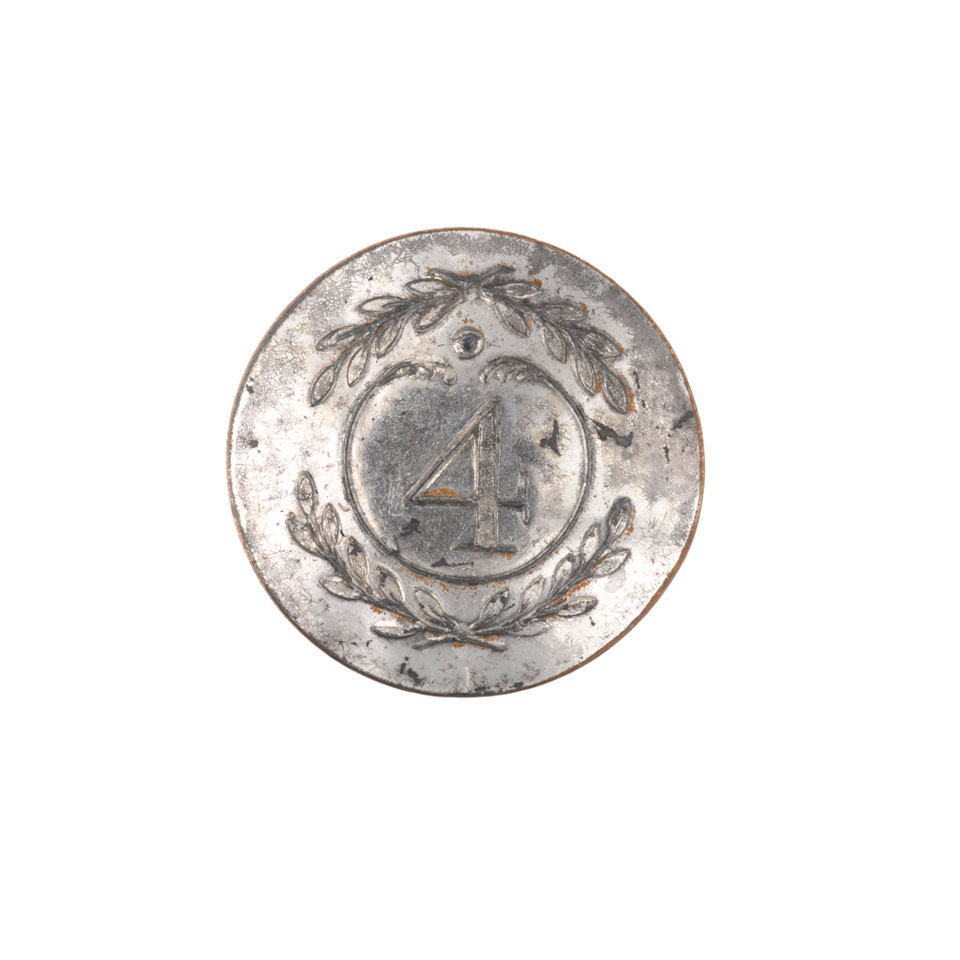
In 1845, the youngest son of George Robertson-Aikman was commissioned to the 4th Bengal Native Infantry, having entered the service shortly after his father died the year previously on 23 January 1844. Almost a year to the day, on the 18th of January 1845, Frederick joined his regiment.
The 4th Regiment, Bengal Native Infantry – Bailun-ki-Pultan, had been raised in 1763 as the 16th Battalion (although they are recorded as having existed already in 1759 in Midnapore, but their name is unknown) – after various changes in numeration, they were reorganised in 1824 as the 4th Regiment. They had been a steady one, and when Frederick joined their honours already included “Carnatic” and “Mysore.” The Colour, too, would have appealed to the young man, for it depicted a Royal Bengal tiger underneath a banyan tree. Even their uniforms were appealing – the red coat with yellow facings; gold lace replaced silver in 1831. Frederick arrived in time to take part in the Sutlej Campaign and would find himself at Sobraon, of which General Sir Hugh Gough would say,
“The awful slaughter, confusion and dismay were such as would have excited compassion in the hearts of their generous conquerors, if the Khalsa troops had not, in the early part of the action, sullied their gallantry by slaughtering and barbarously mangling every wounded soldier whom, in the vicissitudes of attack, the fortune of war left at their mercy.”

It was perhaps battles like these that allowed men like Aikman to cut their teeth in war, for in the 2nd Sikh War, Frederick was once again there, this time with General Hugh Wheeler’s Field Force. This was still years before Wheeler would have to face the horrors of his mistake at Cawnpore – for now, he was leading his forces from one victory to the next, capturing forts and earning the praise of Sir Hugh Gough, who twice mentioned him in despatches. Even the governor general was impressed and said,
“Brigadier-General Wheeler, C. B., has executed the several duties which have been committed to him with great skill and success, and the Governor-General has been happy in being able to convey to him his thanks thus publicly.” Wheeler received thanks in both the House of Commons and the House of Lords, and in 1850, was made a KCB. For now, he was the man of the hour.
The 4th BNI were given Punjab as a further Battle Honour on their Colours, and things should have gone smoothly if it had not been for a problem with batta in 1844. However, the regiment, despite this momentary lapse, had remained on the straight and narrow ever since. Unfortunately, the stain left on the regiment after the Sindh affair was never completely forgotten. Young Frederick Robertson-Aikman would most certainly have been told of the batta incident; in 1857, however, the actions of the regiment were, as in 1844, conflicting.
At the time of the mutiny, the 4th BNI was stationed in the Punjab, with the right wing at Nurpur and the left at Kangra under Major Patterson. It was considered imperative to secure Kangra Fort, and Robert Montgomery decided the left wing would have to be disarmed. On 16 July, a body of Punjab Police, known as the Sher Dils, was ordered to march into the fort, which they promptly did. They took up their quarters in the citadel and relieved the magazine guards. The left wing was caught completely by surprise and, without a word, laid down their arms. They would subsequently be marched off to Hoshiarpur. At the same time, at Nurpur, the right wing voluntarily gave their arms to their commandant, Major Wilkie. The left wing would eventually mutiny, albeit in part and very late – they saved their uprising for May 5, 1858, which resulted in 200 men being convicted and punished. However, the right wing remained quiet at Nurpur and eventually had their arms restored to them. They were eventually disbanded in 1861.
As it is, Lieutenant Robertson-Aikman did not wait around after he lost his regiment; he promptly joined Wilde’s Sikhs and rode off to Delhi, where the regiment arrived on 5 September. It was a spectacular march – leaving Nowshera on 31 July, they covered 567 miles in 31 days. With only one day’s rest, they were set to provide picquets and working parties for the batteries that were still under construction. On 14 September, as soon as the Kashmir Gate was taken, Wilde was instructed to take one company to occupy Skinner’s House, adjacent to St. John’s Church; however, since the rebels had decided to start taking potshots from their position at Delhi College, Wilde decided there was nothing for it but to storm the college. The action was successful, and the Rifles held it until 20 September, repulsing two attacks with no additional support. As Delhi was not yet taken, three companies were then detached to take part in the street fighting that was still going on. While Ensign McQueen was leading his men through the gates of the Red Fort, Lieutenant Aikman was up to something else altogether.
With a small party of Sikh infantry, he decided to take the Salimgarh Fort, which is attached, by means of a bridge to the main complex of the Red Fort.
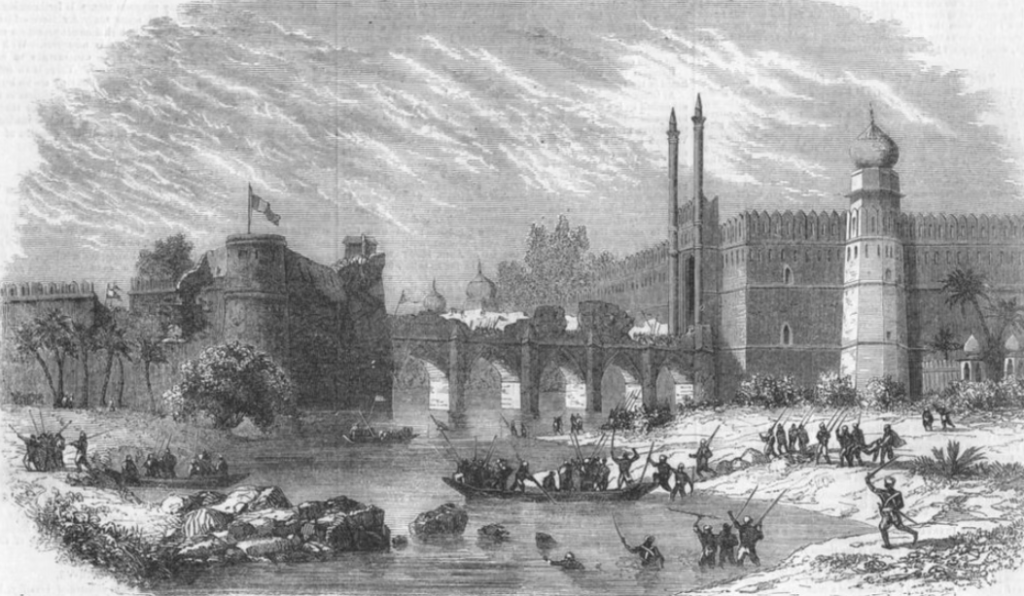
“Some short time before the assault on the palace gate, Lieutenant Aikman, with a small party of Wilde’s Sikhs, had been directed to feel his way to the left. Aikman, the most daring and intrepid Aikman of men, knew the ground thoroughly, and having received, as he imagined, permission to act on his own judgment, he resolved to effect an entrance into the Selimgarh from the rear, and hold the enemy as in a trap. Accordingly, he doubled round to the Calcutta gate, forced it open, and pushed on to the Selimgarh. The few men in that fort fled on his appearance and escaped across the river. Aikman’s attention was then turned to the gateway at the narrow passage from the Selimgarh into the rear of the palace. This passage connected the rear gate of the palace with an arched gate over the fort, over which was a parapet. Were he able to gain possession of this, he could stop the escape of multitudes till the storming party should reach them from the front. Thus thinking, he acted without hesitation, shot the sentry at the gate opening onto the drawbridge leading into the rear of the palace, and placed his men in the best position to defend it. He then, with the assistance of the Sergeant-Major of Renny’s troop or battery, set to work to spike the heavy guns directed against the Water bastion. He was in possession of the gate and drawbridge when the gates of the palace were blown in. The rush of the fugitives was not so great as had been anticipated, so extensive had been the flight on the two preceding days. But some at least were kept back. A more gallant or well-thought-out act was not performed even during that long siege.” (Official report of Major Wilde, commanding 4th Sikh
Infantry).
Aikman fought at Bulandshahr, but on the 3rd of October, his association with the Rifles ended as he was ordered to return to the Punjab. There, under the auspices of Deputy Commissioner Lake, he raised the Jalandhar Cavalry and became their first commander. Subsequently called the 3rd Sikh Irregular Cavalry, Aikman had chosen to follow the Guides’ principle of cavalry, one of those principles being,
“Lumsden sought out the men notorious for desperate deeds, leaders in forays, who kept the passes into the hills, and lived amid inaccessible rocks. He made Guides of them; tempted by regular pay and enterprise, many joined the Corps and became conspicuous for daring and fidelity.”
They also had to be spectacular horsemen, for, after Aikman was finished with equipping and drilling them, they were called upon to ride to Oudh and join the Jaunpore Field Force. After crossing the Sutlej, they rode with barely a halt and covered the last 40 miles in a day, arriving two full weeks earlier than expected. A delighted Brigadier Franks, who had just fought a trying battle at Sultanpore, exclaimed,
“I did not expect you for a fortnight,” exclaimed Franks as he welcomed Aikman. “Had I known you would have been here, I would at any cost have postponed the action.” Aikman’s arrival brought his cavalry up to 600 sabres, and there would be plenty of fighting for them to do. The force resumed its march, reaching Musafirkhana on the same day the 25 February (20 miles) and then 16 miles the next day to Jagdishpur. With his cattle exhausted and his men footsore, Franks called a halt. On the 28th, he reached Haidargarh, another 16 miles, and by the 1st of March, Selimpore, a mere 18 miles from Lucknow, as directed by Sir Colin Campbell, who was within one march of the city.
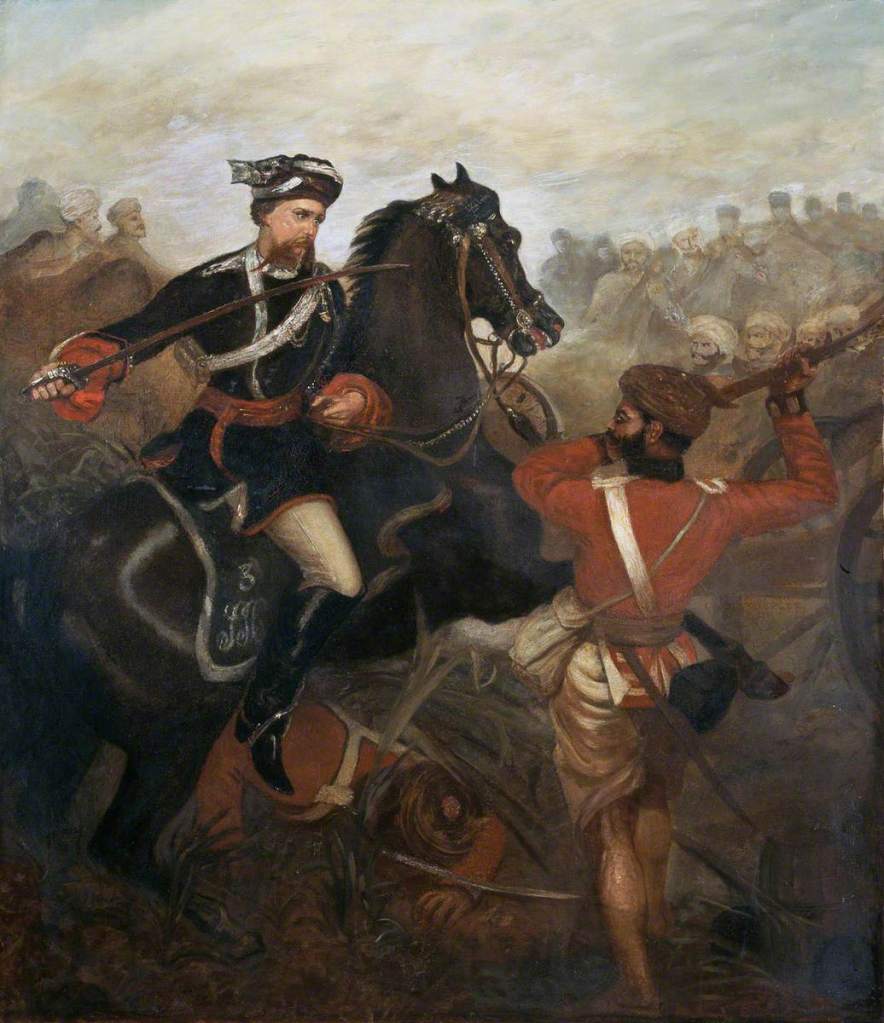
Early on the morning of the 1st of March, near Amati, Aikman, who had been posted three miles in advance of the camp with 100 of his sowars, learned that a formidable body of rebels, with 500 infantry, 200 cavalry and two guns under the rebel chieftain, Mansab Ali, were encamped on the banks of the Gumti only three miles off the high road. Aikman sent a cursory message back to Franks to bring up the cavalry and the guns as quickly as possible – he then gathered up his men and set off in Ali’s direction. Galloping through broken ground, Aikman found the rebels in the open, but some had taken cover under the walls of a small fort. Undeterred by their flanking fire, Aikman and his sowars charged.
In the ensuing scrimmage, Aikman would find himself, on more than one occasion, surrounded by several rebels at once, but his sowars came to his aid – ferocious hand-to-hand combat, another charge and the day was won. Aikman received a severe sabre cut to the face, but despite the odds, he and his men cut up 100 rebels, captured two guns and sent the rest of Mansab Ali’s force scrambling across the river. By the time Franks came up, it was all over. In Franks’ estimation, it was,
“.. one of the most dashing cavalry combats I have ever heard of….This feat was performed under every disadvantage of broken ground, and partially under the flanking fire of an adjoining fort. I regret to add that Lieutenant Aikman received a severe sabre cut in the face, which will not, I trust, long deprive me of the services of so enterprising an officer.” (Brigadier Franks, Report of the Operations of the Field Force, 9 March 1858)
The wound not only deprived Franks of an enterprising officer, but it also effectively ended Aikman’s career in India.
 Mutiny Reflections