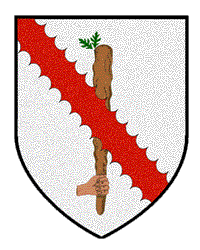
The story of Frederick Robertson-Aikman starts not with the Victoria Cross but with his father. It is unusual to explore a parent of the Victoria Cross recipient in much detail, but in this case, it is worth casting a glance over the career of George Robertson, one-time captain in the service of the East India Company.
Born in Scotland, he took to the sea as a boy of 13 when, in 1773, and sailed off on a ship chartered by the East India Company, presumably to make his fortune and perhaps see the world. By the age of 16, he boarded the ship Bute in Calcutta as a seaman and returned, for the first time in three years, to London. Until he retired in 1805, Robertson made ten voyages to India and China, working on private ships chartered by the East India Company. After each voyage, Robertson was ostensibly “let loose” to find his next means of employment. His pay, while it came from the East India Company, was deducted from the freight carried by the ship and thus came from the funds of the ship’s owners. So while Robertson did indeed sail for the East India Company, at the start of his career was not directly in their employ. Unfettered by the bureaucracy the EICo knew and loved, in time, as he raised his status with subsequent voyages, Robertson was allowed a certain tonnage to carry merchandise which he would then use in his own private trading endeavours, which he would take as far afield as South America, South and East Asia. In 1788, he was, however, promoted to First Officer and by 1795, was commanding a ship of his own, which he rented out to the EICo.
What makes our George Robertson so interesting is what is mostly overlooked – his contributions to cartography. In 1781, he was a mate on the Vansittart, which was looking for a new route to China through the East Indies and in 1782, it was Robertson’s chart which was published with the title, “Allass” followed by a “Short Account of a Passage From China Late in the Seasons with Charts and an Account of the Strait of Allass,” in 1788.
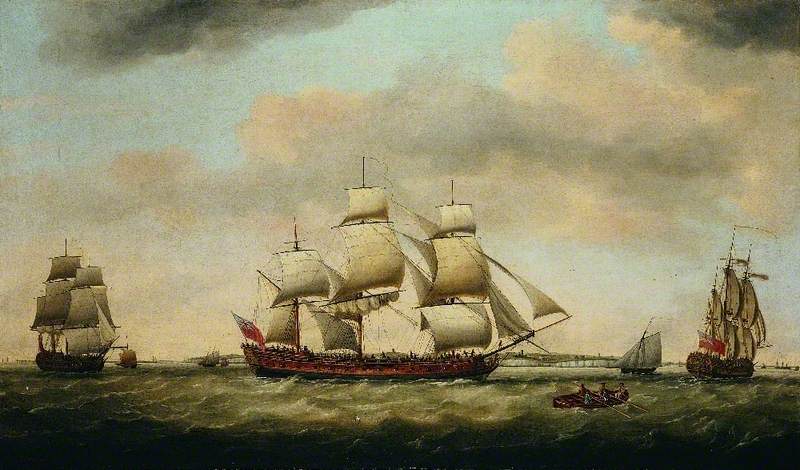
Between March 1788 and August 1789 he was onboard the East Indiaman, General Coote and back to cartography; in 1791 he made his name with “Memoir of a Chart of the China Sea, including Philippine, Molucca and Banda Islands with Part of the Coast of New Holland New Guinea” – a work which was still garnering praise in 1808 in Stevens’ Oriental Navigator. It was the same year he published “The East Coast of New Guinea and part of New Zealand (with) Captain Cook’s Track, 1770” that covered the whole east coast of New South Wales. While Robertson would still sail the seas himself, his recommendations for routes were taken with much interest by the others venturing out onto the waters, and some of his charts have withstood the passage of time so well, they are still in use today.
Once on land, however, George Robertson, with money in his pocket, was, when truth be told, a bit of a rake. Although he would always return to Scotland at the end of each voyage, London held a particular lure for the man, and while he inherited, in 1821, a sizeable estate in Scotland from his uncle John Forbes, the grandson of the Scottish artist William Aikman, George was a self-made man with the means to do as he pleased. His substantial fortune allowed him to put an end to seafaring in 1805, and he settled down, not in Scotland as the family would have liked, but in London. He gave his address as Ibbotson’s Hotel, where he had previously resided between voyages, but in reality, he was living in Baker Street with Mrs Wigglesworth. This in time changed, as George began to cultivate the finer things in life, one of his passions being the collection of art; he ran in fine circles at his newly purchased establishment of Auchingramont in Scotland, which he took before his inheritance came through. Here, he entertained the likes of the Duke of Hamilton. He also kept a farm in Whitehill. The life suited George Robinson, and he even took a position as JP and magistrate in the county of Lanark. However, his heart was still in London, and once out of the hands of Mrs. Wigglesworth, he turned his attentions to one Mrs. Ball, whom he generously gave a £ 100 per annum between 1804 and 1812 – and then he began a long dalliance with a young lady named Sara Cumby who lived on Margaret Street.
Where there is a mistress, there are bound to be problems, and when the mistress begins to bear your children, the problems will undoubtedly multiply. Realising his family in Scotland would look unkindly on his loose habits, in 1819, he took his four-year-old daughter for a holiday to show her off to his Scottish relations, who were less than impressed. Uncle John was so angry, he flatly refused to see George.
When he finally decided to marry Sara in 1820, they were the proud parents of three children, with a fourth one on the way. Upon their marriage, he sold off Auchingramont, storing the furniture for future use when the inheritance of the Ross finally came into his possession. He even insisted the marriage take place in Scotland as a last-ditch attempt to have his relatives recognise his illegitimate children. When this failed, he married Sara anyway in Glasgow, much to the intense irritation of Uncle John and his own sister. Uncle John died in 1821, unhappy to the last, but left George the mansion at the Ross; magnanimously, George allowed his widowed aunt to keep her own furniture, and as soon as she was gone, he took possession of the house. It is not clear how he handled his sister.
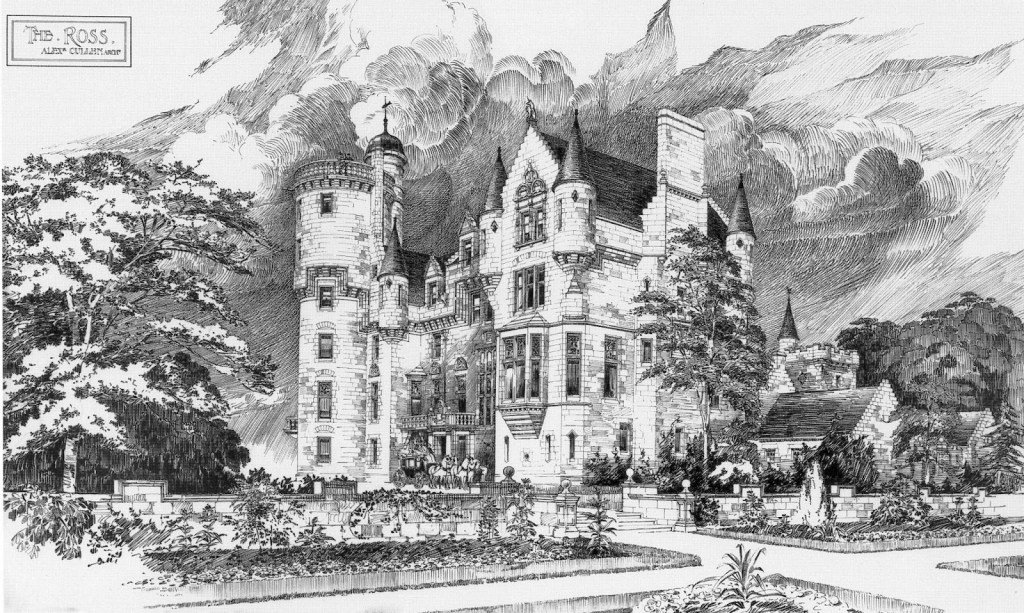
After certain improvements were made to the building, he moved his family in, and Captain Robertson, “having taken the name and arms of Aikman, was regularly installed as the Laird of the Ross.” He kept up his position on the commission of the peace, was decorated as Deputy Lieutenant, and sat on the assizes as a juryman for the county of Lanark. As for his children, they received their education from a private tutor, and things were going well. That is, of course, if the society of Lanarkshire had been willing to accept his wife, which they promptly refused. Her calls were left unattended, and to make matters worse, she received no invitations. No one would have anything to do with the Laird’s wife, who, in turn, was so miserable, she was demanding her husband pack in the whole thing and move back to London. While George would not give up Scotland altogether, he did appease his wife by buying a house in Great Portland Street, where they would reside during the London season. Why this was all so important will come out later in this post.
If things were not complicated enough, George Robertson also had a “natural son” by Mrs. Wigglesworth, named Edward – for him, Robertson secured a cadetship in the EICo and packed him off to India in 1825. His entry in Vol. III of the List of Bengal Officers of the Bengal Army 1758-1834 is very short and sad.
“ROBERTSON, Edward (1808-1827). Ensign, 52nd N.I, b. psh. of St. James’s, Middlesex, 24 Feb. 1808. Cadet 1825. Ensign 5 Nov. 1825.
d. Akyab, Burma, 22 June 1827, of Arakan fever.
Son of — Robertson, of Ross by Hamilton, Capt. E.I.C.S.
Services; Posted Ensign to 52nd N.I. in 1826. No record of active service.
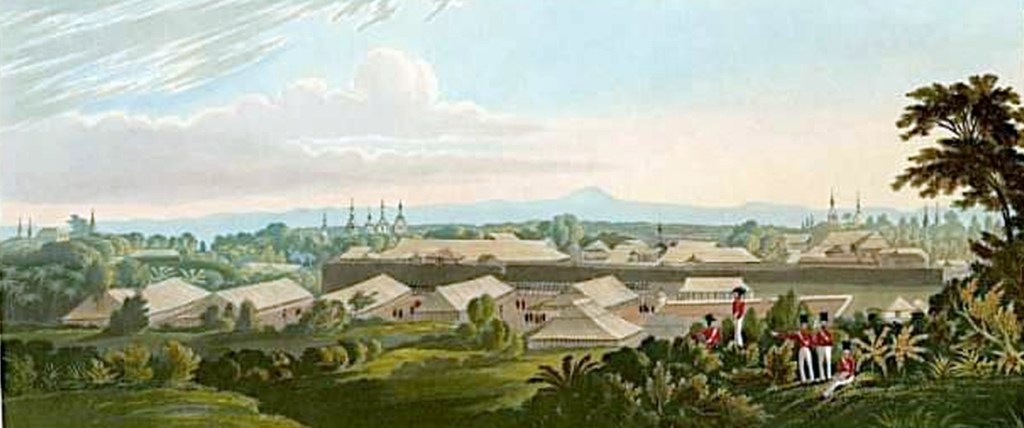
As it was, George finally gave up any idea of settling permanently in Scotland and in 1834, he let out the ancestral home and moved back to London for the final time. His family, in the meantime, had grown, as he and Sara had added another seven children to the four they already had. Their youngest son was Frederick. It seemed only logical that, after their education was completed, at least some of his sons would go to India in the service of the EICo. The first to leave was William, born in 1822, and then Charles, born in 1826.
Sadly, Charles’ life was a short one for he died at Agra of “paralysis” while trying the get back home in 1847, aged just 20. In his will, he left his widowed mother the sum of his entire estate, which came up to £20. As for William, he was the epitome of what the new soldiers of the East India Company were becoming – men of strong, and mostly zealous religious convictions; and although his ideas on the causes of the mutiny and his ideas on how to rebuild the army after it was all over did have some merit, Viscount Palmerston at whom a published letter titled, “The Bengal Mutiny: Popular Opinions Concerning the Origin of the Mutiny Refuted” (1858) was addressed, most likely choked when he read it. William was in London in September 1857, still a lieutenant, and he was “late of the Bengal Army.” It was just as well as the man openly believed,
“Our safety is in the word forward, and forward we must go at the point of the bayonets, if needs be, of the
whole British Line. Either give up the land altogether, or rule it with a Christian yoke. And if it be said,
“Yes, rule it with a Christian and merciful yoke,” then I answer-agreed; therefore, extirpate all power and the semblance of power which is contrary to the Christian yoke; and by this means, provide due security in future for the gallant men, their faithful wives, and innocent children, who in carrying out this purpose of ruling India with a Christian and merciful yoke, are necessarily domiciled in the land.” – and this is not the worst of it.
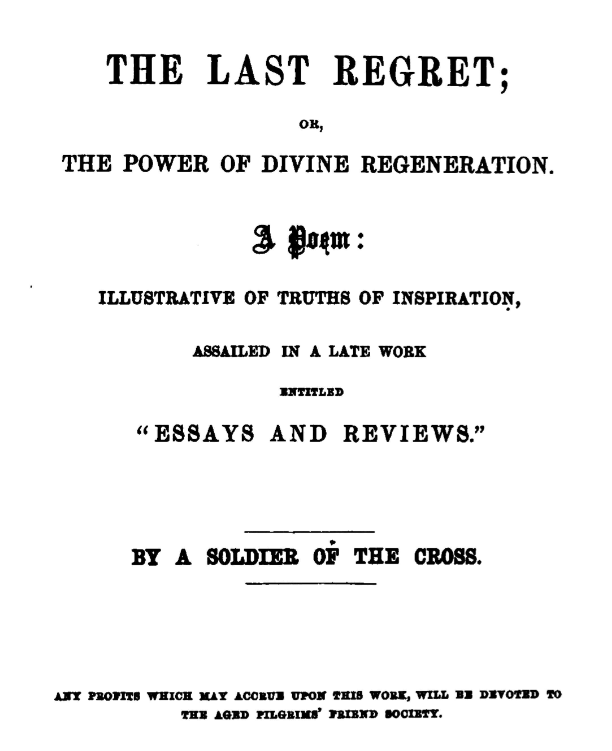
Perhaps William’s religious convictions were always a part of him; the stories of his father’s philandering, the fact that his mother had been for many years a mistress and not a wife, the rejection his mother had faced in Scotland, had led the young man to search for divine meaning. If Viscount Palmerston thought he had been given a good slapping, William would continue on this path for the rest of his life, taking up his arguments with everyone else. He published four books, mostly of religious poetry. The first book, “The Last Regret”, was published in 1861 and is today, most unreadable. The others, “Inscribed To The Crudite Mahommedans Of Hindostan” (1868) , “Sulastul tul Kutuub – A Treatise” (1868 and also a translation of a work written originally in Hindustani which William did himself – he might have had some difficult religious ideas, but he had taken his lessons in language seriously) and “Judgment of the Judges of Jehovah: or, the Rationalism of Ultra-Calvinism Repudiated” (1875) are equally not for the faint-hearted.
Perhaps it was all the better that by this time, George Robertson, captain, cartographer, merchant, Laird and man-about-town was dead. He had a good run of things and had given up the ghost at the age of 84 in 1844, dying of a heart attack on a London street. While he slumbered on in the family mausoleum in Kensal Green Cemetery, his eldest son, also named George, took up the reins at the Ross. Meanwhile, his youngest, Frederick, would begin making waves in India.
Sources:
Geneanet. Genealogical database. https://en.geneanet.org/.
Hodson, V. C. P. List of the Officers of the Bengal Army 1758-1834, Part III. London: Phillimore & Co., Ltd., 1946.
Kingsley, Nick. “(60) Robertson-Aikman of Ross House.” Landed Families of Britain and Ireland (blog). August 3, 2013. https://landedfamilies.blogspot.com/2013/08/60-robertson-aikman-of-ross-house.html.
Richards, Rhys. “The Easternmost Route to China and the Robertson Aikman Charts.” The Great Circle 8, no. 1 (1986): 54–67. http://www.jstor.org/stable/41562716.
vLex United Kingdom. Aikman v. Aikman lawsuit/judgment portal. https://vlex.co.uk.
 Mutiny Reflections