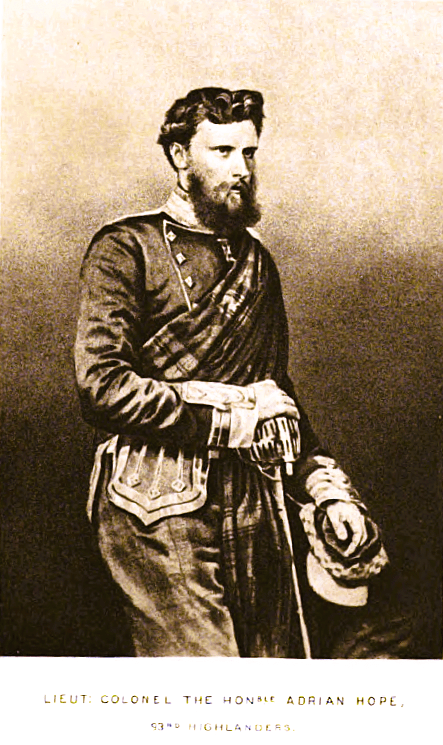
Suddenly, on 25 January, Hodson was recalled to Fatehgarh. It can only be imagined what he thought when he was ordered, with no warning, to join Adrian Hope’s brigade. At 10 pm the next night, the brigade was ordered, as silently as possible, to fall in and leave their tents standing. The men followed the order to the letter, and hardly anyone realised in camp that they were gone. For one officer, Captain Jones, the happy Royal Navy volunteer, it was a thrill.
“On Tuesday night, while at mess, (Major) English told me that the 42nd were going a night expedition to catch some rebels who were encamped near a village called Mow, some eighteen miles north-west of Furrukabad; so I went to Colonel Cameron to ask his leave to accompany them. On returning, I found the camp in the bustle of preparation, and to my joy heard that the dear old 53rd were going too.”
Consisting of two squadrons of 9th Lancers, two hundred of Hodson’s Horse, HM’s 42nd Highlanders, HM’s 53rd Foot, the 4th Punjab Rifles, Remmington and Blunt’s troops of Bengal Horse Artillery, and Bengal Field Battery (four guns) – 2’500 men in total they were to march through the night a surprise the rebels who were now only 12 miles short of Fatehgarh.
A thick winter fog descended on the marching men, making visibility difficult and reconnoitring impossible. Close to five in the morning, after having stumbled along for nearly three hours, Brigadier Hope called a halt to wait for daylight. The first rays of the sun were showing weakly through the fog when Hope called for the march to continue, with caution, towards the village of Shamshabad, but it was 9 o’clock before the column closed up. The rebels had, the day previously, decided on their position; Hope found them, three-quarters of a mile beyond the village, occupying a “commanding knoll on the edge of the plateau overlooking the plain, which stretches towards the river some six miles distant. On the knoll was a brick building, the shrine of a Muslim saint, and the place was surrounded with the remains of an old entrenchment, upon which they had raised a sandbag battery. Their front was defended by a ravine, impassable for cavalry or guns, which runs at right angles across the road to Mhow, along which we moved, to the right of which their position was.”
With the fog slowly lifting, Hope realised his own position was hardly a wise one. He moved off the road to the right and, with his staff and accompanied by Hodson and Lieutenant McDowell, he rode to a solitary tree that stood nearby. From here, he wanted to examine more carefully the rebel position, but on this occasion, the rebels were quicker. They had already seen Hope – without warning, their guns opened fire from the high ground, and the very first shot plumped into the middle of the group, striking poor McDowell just under the right knee, smashing his leg and passing through his horse. We saw his horse rear up and fall back, McDowell crying out, ‘Doctor, doctor!’, as he fell.
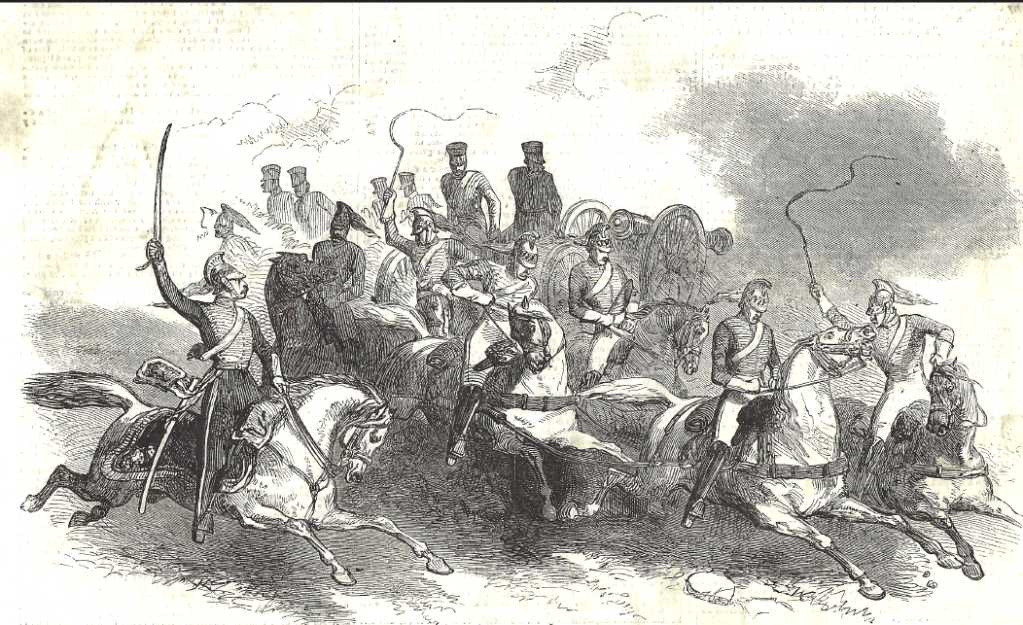
Without waiting for any further invitation, the Horse Artillery battery, which Hope had just moved up, immediately galloped forward, crossed the ravine to Hope’s front over a stone bridge and took up their position just beyond the ravine. At barely 700 yards from the rebel battery on the mound, they opened fire. Remmington had taken up a position to the left and front with his guns, with Captain Jones tagging along after him, to see if he could be of any use. The rebel cavalry was now observed leaving their camp and moving to the left, as if to outflank Hodson, who, in his current position, could not see them. Jones was sent off to warn Hodson.
“He asked me, ‘Where are the Lancers?’ who were on the other side of the bridge, and said, ‘Do go and get them.’ I galloped off, as fast as my little Arab could lay legs to the ground, to the Brigadier, who was bringing up the infantry, told him of Hodson’s request, and he instantly sent his aide-de-camp to order them up, and away they went, and I with them.”
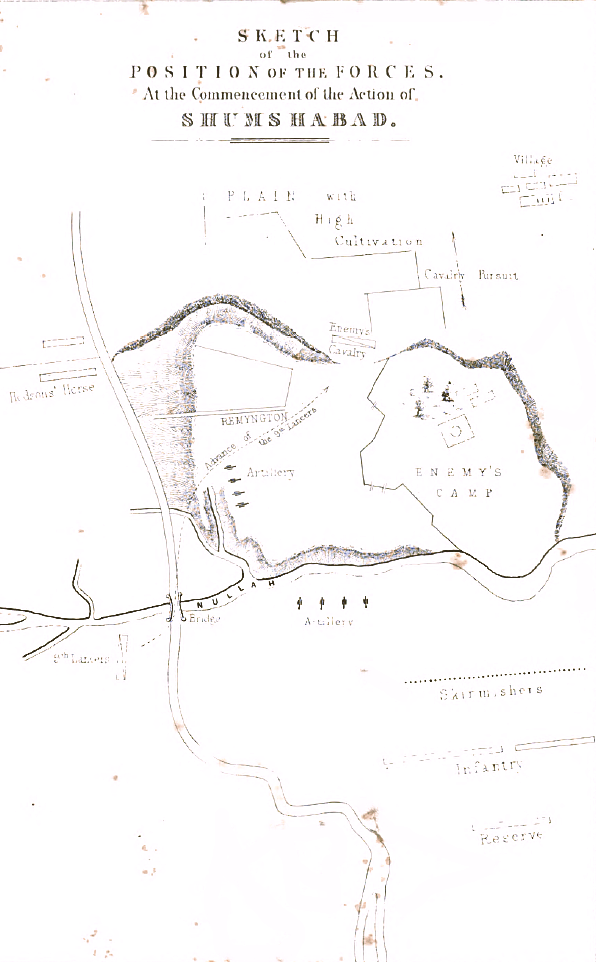
Hodson immediately led his regiment of three officers and 180 sowars through the dust kicked up by the Horse Artillery, over the stone bridge, and formed up on the left flank of the battery. Soon to be in the thick of it, with Hodson’s Horse, was Lieutenant Charles Gough.
“The ground here was undulating; the guns were placed on the crest of a ridge, whilst we were slightly sheltered by the rising ground. The roar of the round shot and shell flying just over our heads was terrific.”
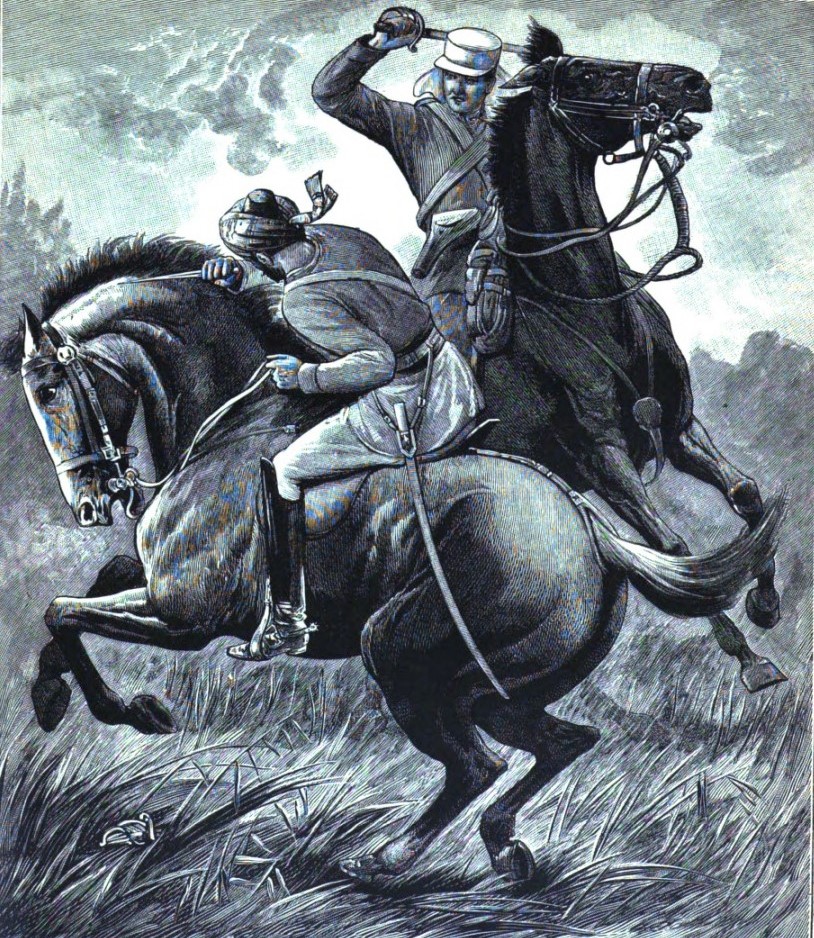
Taking the challenge seriously, a body of rebel cavalry was suddenly seen flying over the high ground to Hodson’s left – Hodson ordered the left squadron to “wheel to the left” and called out to Gough to remain in support and protect the guns, but suddenly shouting out, ‘Come on, Gough!’ I ordered the right squadron (I think the ressaldar was a stout old Sikh named Bal Singh ) also to wheel to the left, and led on upon the enemy on our proper left. The officers with the regiment were Hodson, Wise, and myself.
As we advanced at a gallop, I saw another body. When we got on the rising ground to our then right
(proper front) , who came down upon us, their leader carrying a carbine and challenging us. We turned
our horses to the right to meet this. For my own part, being on the right, I now got the lead, and rode straight at the enemy’s leader, thinking to run him through the body before he could swing his carbine round on me. The point of my sword struck him full in the breast, but to my surprise, the next moment I found myself unarmed, and looking round saw my sword sticking fast in the man’s body, he still on his horse; but in the midst of the enemy, there was no time to look after him. I drew my revolver and rode down to where I saw Hodson and Wise and some of our men hotly engaged with the enemy.“
Gough shot the man attacking Wise, but at the next moment, a spear struck Gough on the left side. Throwing his body around in his saddle to defend himself, he saw Hodson’s sword crashing down on his assailant’s head with such force that the man fell half over Gough before tumbling to the ground. “My throwing myself round like this had, it so happened, exposed me to some fellows I had had my eye on just before-three of them side by side, shouting Allah! Allah! One of them, seeing me turn, rode up quite close and fired. I felt a tremendous bang on my right shoulder, and for a moment was not quite sure what had happened. For a few minutes, it was a very sharp scrimmage, but then the survivors of the enemy turned.“
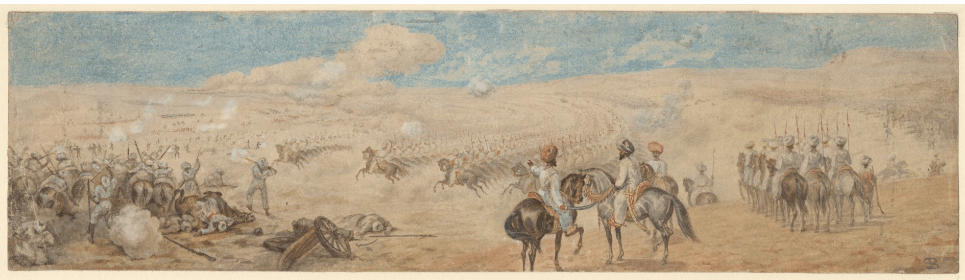
From Hodson’s point of view, things were rather worse than Gough surmised.
“They were very superior in numbers and individually, so as horsemen and swordsmen, but we managed to ‘whop’ them all the same and drive. them clear off the field; not, however, until they had made two very pretty dashes at us, which cost us some trouble and very hard fighting. It was the hardest thing of the kind in which I was ever engaged. I got a cut which laid open my thumb from a fellow after my sword was through him, and about half an hour later this caused me to get a second severe cut which divided the muscles of the right arm, and put me hors de combat, for my grip on my sword handle was weakened, and a demon on foot succeeded in striking down my guard or rather his tulwar glanced off my guard on to my arm.”
Not that Hodson was alone. Captain Steele and the 9th Lancers had rushed up in his support. The Lancers were not known for half measures – they swiftly rode at the rebels’ cavalry, forcing them back and over a steep bank, straight into an open plain below, the Lancers never giving an inch, sabres drawn, Steele ever in front, leading his regiment, and though wounded in the melée that followed, kept his saddle. At close quarters, a sowar managed to slash Steele over the shoulder, while another, on foot, hit him in the thigh with his tulwar. As Steele’s horse wildly spun around, the point of a sword passed over his face, fortunately without drawing blood. Grimly, Steele held his ground, but another slash went through his reins. As he was fumbling for the chain rein, a fourth slash came down over his right wrist, forcing him to drop his sword, and he withdrew to the rear. The squadrons of the Lancers (under Willis and Goldie) remained on the field, putting the final touches on their bloody work until finally the rebel sowars flew in disorder over the plain. For Jones, it was something of a mixed show – as the Lancers came up to the rebels, he put his hand down to grab his sword and found, to his intense surprise, the scabbard was empty. In galloping, it had “jumped out” of its sling belt (“the sword bangs about, sometimes
turning right over, and falling out, as mine did.”) As such, he was left, on horseback with two pistols, and they did the fair share of the fight.
Unfortunately, Lieutenant Hugh Gough and his men, who had been ordered in a moment’s notice to return to Fatehgarh, arrived, to their intense disappointment, too late to take part in any of the fighting.
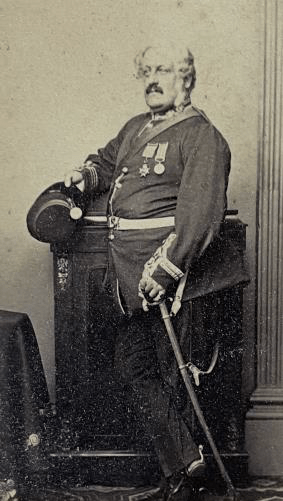
On the other part of the field, Captain Blunt, with the quick thinking that so defined this officer, chose, at a moment’s notice, an excellent position on the right bank of the ravine; Hope formed the infantry line on the right. Wylde’s 4th Punjab Rifles and Cameron’s 42nd Royal Highlanders were on the extreme right, with Major English and the 53rd forming the second line. The guns opened up a relentless fire, causing the rebels to think twice, for the first shot went straight into the mouth of their largest gun, gagging it up; another hit their magazine, and the third blew their treasure chest to smithereens. They returned fire, but none of their shots now met their mark, falling either too short or flying harmlessly over the heads of the infantry. Seeing he had managed to rattle them out of their convictions, Hope ordered the infantry to advance, screened as they were by a hollow in the ground. Wylde’s men were first on the rebels, who by this time had little interest in holding their ground – the fifth discharge of Blunt’s guns had so disconcerted their efforts, they were no longer in the mood to meet the infantry. Those who stood to fight held on as grimly as they could, but to little avail. Hope’s infantry was soon amongst, bayonets at fore and determined there would be little mercy. When the infantry was finished for the day, the rebels were in full flight in any and every direction, and 200 of their compatriots lay dead on the field.
It might have been a better victory if the 53rd had held themselves in control; instead, in their eagerness, they took to firing at anything and everything they felt might be a hiding place, including a haystack which unfortunately did not contain any rebels but a sizeable amount of powder, which blew up sky high. In another incident, they managed to fire into a tumbril, injuring seven of their number so badly that they died shortly after. They were not alone in this dangerous behaviour.
Several men of the Punjab infantry were injured by the bursting of a tumbril, which, for some reason, they thought they could move out of the way by shooting at it.
“On our approach, the enemy’s guns opened upon us, but were soon silenced by ours. My regiment was sent forward and captured four guns, tumbrils, etc. As I followed the Regiment, through a narrow winding lane, I suddenly came upon a group of our men round a tumbril blocking the way and just as I appeared on the scene, one of them fired his rifle into it. A tremendous explosion followed, and for a moment, I did not know whether I was in the air or where, but I made a rush for the first glimpse of light through the smoke, and was only then able to find out what had happened to me…Among the men who were near the tumbril, several were killed or died afterwards from their injuries.” (Assistant Surgeon James Fairweather, 4th Punjab Infantry)
Meanwhile, Remmington and his artillery had galloped up to the brink of the hillock where the rebels had positioned their guns and then opened fire with grapeshot and round shot on the fugitives scrambling in the plain below while Blunt advanced the right of their entrenchment and raked into the base of the hillock with utmost effect. They then descended into the plain, but the rebels were too quick on their feet, and the artillery had no chance of pursuit over what was broken ground and sand.
At the tomb on the summit of the mound, no more than a dozen rebels, part of the once infamous Bareilly brigade, made their last stand. Hope’s infantry made short work of their final moments on this earth by setting fire to the structure; then, as each man rushed out, attempting to escape the flames, they were shot down. The very last man horrified the waiting soldiers – with his uniform on fire, he rushed out and threw himself at their muskets, despairing in his last moments to be shot.
“The cutting and hacking lasted some time, and three hundred rebels strewed the plain, when the recall was sounded, and, looking back, we saw the hill and camp crested with the living wall of infantry advancing with their skirmishers in front.”
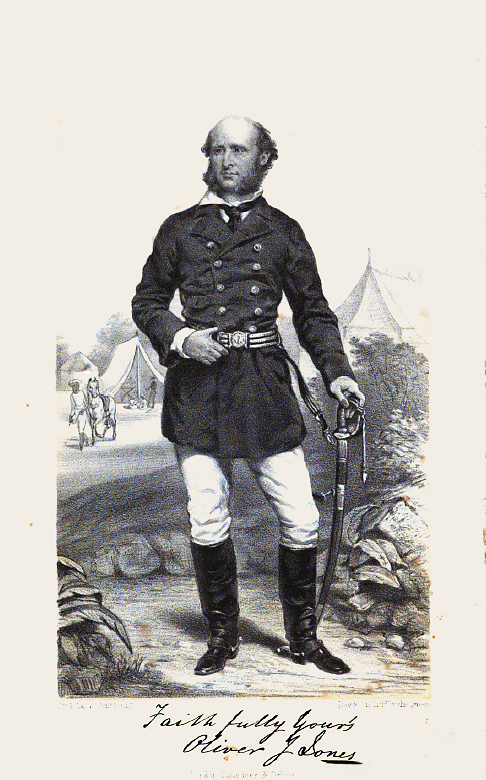
Jones, who had managed to get out of the cavalry fight without any injury, was now riding along with Brigadier Hope when suddenly the brigadier’s orderly came up, a sword in hand with a gilt hilt. He presented it, with a great flourish, to Hope, who now saw the look on Jones’s face. Embarrassed, he told Hope it was his – it had belonged to his father, who had used it on the retreat from Corunna. The orderly was not convinced.
“I valued it much, and promised the man gave twenty rupees for finding it, which, when he was convinced that the hilt was not gold, and that it had not belonged to some swell khan or nawab, he was as glad to get as I was to regain my father’s sword.”
Brigadier Hope ordered a squadron of 9th Lancers under Captain Johnstone and two guns to pursue the fleeing rebels to a ghat, supposed to be no more than 8 miles distant. It proved to be much further and with instructions to return before nightfall, Johnstone reluctantly turned around and retraced his steps. They had not come across any of the rebels but had seen them in the distance skirting the fields, trying to show themselves as little as possible while keeping a good distance between themselves and Johnstone.
As it was too late to proceed back to Fatehgarh, the brigade remained the night on the sloping ground in front of the rebel entrenchment. While there were no tents to speak of and it would be a night without much comfort, the mess carts were not wanting, and a plentiful supply of grog and ale was at hand. The ten hospital doolies, under Dr. Dalziel, were all full. In one of them lay Lieutenant McDowell with a frightful wound, for his leg was gone up to the knee. What with the shock and loss of blood, the doctors deemed it impossible, in his condition, to amputate what was left of his mangled limb. With Hodson by his side and the rest of Hodson’s Horse surrounding him, twenty-eight-year-old McDowell died during the night. His body would be taken back to Fatehgarh for burial.
“Short of losing their leader himself, no blow could have fallen so heavily on men and officers as the death
of their second-in-command. Not only had he been with the corps ever since the first troops under Man Singh had reached the Delhi ridge from the Punjab, but he had also gained in no common degree the love and admiration of all who had served with him. ‘He was,’ says Sir Charles Gough, ‘a most delightful companion, always bright and gay, full of life, and with very considerable ability, a good writer and a brave soldier.’ And Hodson wrote: What grieves me most is the loss of poor Mac: he was invaluable to me as a brilliant soldier, true friend, and thorough gentleman-I mourn him as for a brother.”
Hodson felt that at Shamsabad, his luck had deserted him. The loss of McDowell would continue to haunt him, and he was never quite the same Hodson everyone had come to know.
Back to Fatehgarh
With the rebels out of sight, pursuing their own destinies well away from Hope and out of reach of Fatehgarh, it was decided, with nothing left to do, to return to headquarters. As a slow march on a hot day did not interest Captain Jones, who was, truth told, attached to no one now the battle was over, he decided to canter back to Fatehgarh well ahead of the rest of the force. “When the country was open, and I could see around, I took it easy; but when the road passed through topes of trees, or any cover where a lurking foe might send, unseen, a bullet at one’s head, I went by at a rattling canter. I met Forster, one of the Chief’s aides-de-camp, about halfway, going, with an escort of Irregular Horse, to get news of Adrian Hope’s doings. When I got to Farrukhabad, where no doubt they had heard of the defeat and dispersion of the mutineers, everyone was on their knees as I passed through the street; I never saw so much salaaming in my life. No doubt, had we been unsuccessful, they would all have spat in my face. I went to the Chief’s tent, and told him what had occurred, and he was very glad at Adrian Hope’s success.”
The distance which had taken Jones two and a half hours riding took Adrian Hope until 8 pm to complete. The wounded were taken to the hospital, and the dead prepared for burial; McDowell’s funeral would take place the next day on 29 January.
Reverend Mackay busied himself on the day of the funeral, calling on the wounded of Shamshabad and taking particular care to visit Hodson and Brigadier Seaton, whom he found together in Seaton’s tent. Seaton received the news of McDowell’s death with sadness; the whole endeavour seemed to be blighted from the beginning to wherever the end might be. His own ambitions, now that he had been raised to brigadier and posted to the 3rd Brigade, were, with cruel swiftness, dashed to pieces. On 22 January, Sir Colin Campbell had called Seaton to his tent – the interview was short and very much to the point.
“…he had determined to form a district to be called the Futtygurh District. It was to comprise Futtygurh, Mynpooree, Etawah and Meerunka-Serai on the Grand Trunk Road; and as I was the only brigadier he had who could speak the language and manage the natives, he was obliged to appoint me to the command, &c.”
There was little point in explaining to Sir Colin that his idea of a district was, on the face of it, absurd and expecting Seaton to hold this imaginary area, which was larger than four English counties put together, was nothing short of dooming Seaton to failure. With a weak force of two English regiments, the 9th Punjabis, a field battery of nine pieces and a levy of 350 horsemen who were nothing but raw recruits who also happened to be in Mainpuri, the whole idea was ridiculous. Campbell allowed Seaton to retain his usual escort of six sowars of Hodson’s Horse, but the Chief felt the local body of civilians, currently being trained as horsemen, would adequately supply Seaton’s lack of cavalry. Despondent at being left behind while Sir Colin planned his return to Lucknow, a fact which was hardly a secret in the camp anymore, Seaton was scarcely in the mood to listen to Mackay as he tried, in his best reverendship, to impart comfort to the sorrowing friends.
The funeral procession for Lieutenant Charles Theophilus Metcalfe McDowell, 2nd in Command, Hodson’s Horse, came up shortly before sunset.
“At the funeral,” writes Mackay,” the band of the 82nd played the ‘Dead March,’ very grandly and solemnly, as the coffin, covered with military trappings, was borne on men’s shoulders along the crest of the ridge overhanging the Ganges. Far across the plain of Oudh, the sun was sinking beneath the horizon, on our right, as we slowly approached the gate of the burial ground. Many officers followed McDowell’s coffin, with their caps in their hands….It was one of those scenes that photograph themselves upon the memory, leaving a clear and true impression of details.”
So moved was Mackay by McDowell’s funeral, he was too late to attend the next one for a man of the 53rd. By the time he reached their hospital, the funeral party had already left. Mackay hastened to the mission burying ground, but there was no one there. The 53rd had decided to bury their own, quietly under a tope of trees, in a grave they had dug themselves.
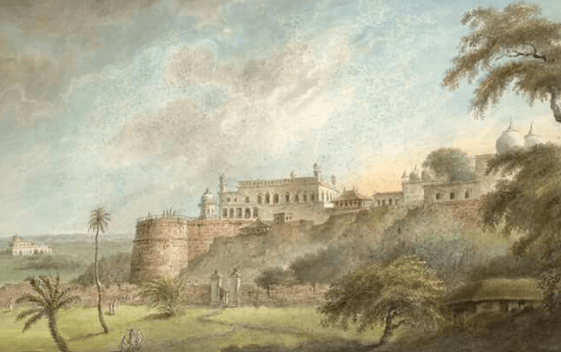
It was clear now that Sir Colin Campbell was finally ready to fulfil Lord Canning’s orders and recapture Lucknow. The siege train from Agra was well on its way and with nothing left to do but leave the station in Seaton’s capable hands, he imparted some impossible advice:
“On talking over the command with Sir Colin, he said, in reference to the large body of troops at Alagunge, that he should, ‘do something about them,’ but, for some reason best known to himself, he did nothing at all, though he could have driven them to the four winds in two hours. The day before he marched, Sir Colin said to me—’ You’ll be mobbed, my dear friend, as soon as I leave, but you must hold out till I come back. You must push on the repairs of the fort, and the defensive measures that are in progress outside, and indent at once on Agra for ammunition for your guns.‘” (Seaton)
With that, on 1 February 1858, Sir Colin Campbell turned his back on Fatehgarh and began his retrograde march to Cawnpore.
Sources:
Anson, O. H. St. G. With H.M. 9th Lancers During the Indian Mutiny. London: W. H. Allen & Co., Ltd., 1896.
Cardew, F. G. Hodson’s Horse 1857–1922. Edinburgh: William Blackwood & Sons Ltd., 1928.
Forrest, G. W. A History of the Indian Mutiny. Vol. 2. Edinburgh: William Blackwood & Sons Ltd., 1904.
Gough, Hugh. Old Memories. Edinburgh: William Blackwood & Sons Ltd., 1897.
Jones, Oliver J. Recollections of a Winter’s Campaign in India in 1857-58. London: Saunders & Otley, 1859.
Kaye, John William, and G. B. Malleson. Kaye’s and Malleson’s History of the Indian Mutiny of 1857–58. Edited by G. B. Malleson. Vol. 4. London: W. H. Allen & Co., Ltd., 1889.
Mackay, James. From London to Lucknow. Vol. 2. London: James Nisbet & Co., 1860.
Roberts, Fred. Letters Written During the Indian Mutiny. London: Macmillan & Co., 1924.
Seaton, Thomas. From Cadet to Colonel. Vol. 2. London: Hurst & Blackett, 1866.
 Mutiny Reflections