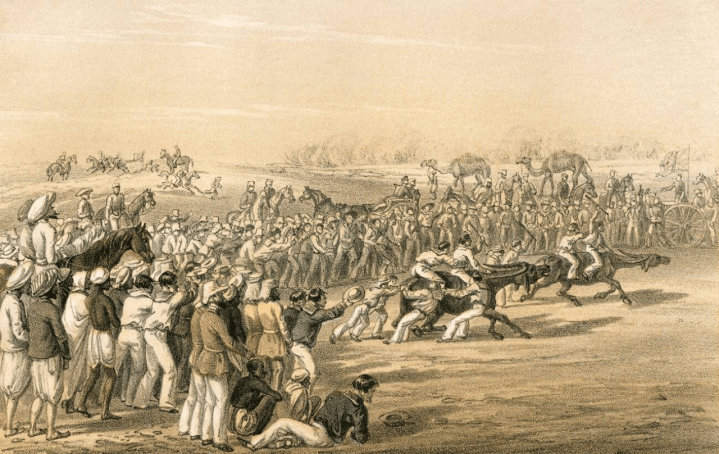
“Felt very Mondayish today; so I took a holiday, and went to some pony races, got up by the officers outside the camp. Among those present was Sir Colin, Brigadier Barker, Brigadier Little and most of the staff, and I supposed every officer in Futtehgurh. There was an immense gathering, and a vast deal of unobjectionable merriment. At home, racing leads to much immorality of various kinds; but I suppose there never was a more harmless affair of the sort than that which came off today; and thousands of men in a standing camp, doing nothing, require some amusement to keep them in health. I saw one man drunk, but he was not a soldier.” (Rev. Mackay, January 25, Fatehgarh)
“I went to the races for about an hour, and used the spy-glass. Officers were racing their ponies and horses, and the fun, I thought, was rather stupid. Sir Colin was there, and his horse was almost too fresh for him.” (Anson, January 27, Fatehgarh)
We left Sir Colin Campbell and his force at Fatehgarh. The Commander-in-Chief was keeping his plans close to his chest, divulging nothing and as such, the camp was left wondering what would happen next.
Fatehgarh was proving to be tiresome – the dry, dust-laden winds were adding a special misery to the already miserable camps, and the cold nights were disagreeable. Occasionally, troops were sent out on harassing field trips to subdue a village or harangue a local chieftain, but on the whole, besides the near-daily court-martials of captured sepoys, there was very little to actually do in Fatehgarh. The Nawab’s palace had been nearly picked clean, and no sign was found of his fabled jewels. However, unbeknownst to the officers and their men, discussions had been going on between Lord Canning and Sir Colin Campbell long before the force had even set foot in Fatehgarh.
Lord Canning and Sir Colin Campbell Discuss
” So long as Oudh is not dealt with, there will be no real quiet on this side of India. Every sepoy who has not already mutinied or deserted will have a standing temptation to do so, and every native chief will grow to think less and less of our power. I am, therefore, as things now stand, strongly in favour of taking Oudh in hand after Futtehghur, Mynpooree, & c., and the Grand Trunk Road communications are made safe. What do you think of this? There may be reasons against it in favour of some other course, which are not known to me but obvious to you. I am sure you will write to me unreservedly all you have to say upon it.”* (Lord Canning to Sir Colin Campbell, December 20 1857).
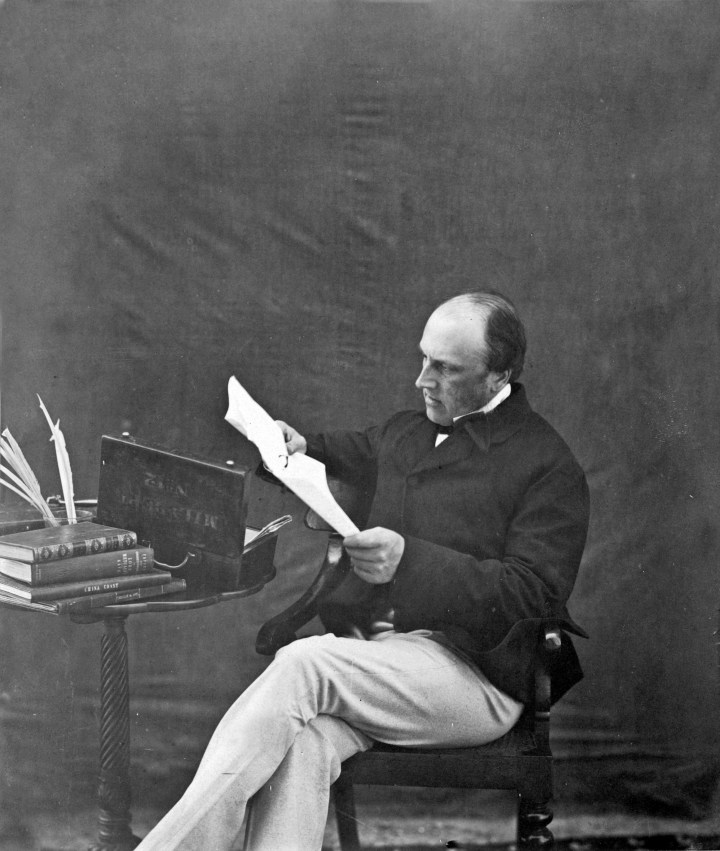
The general feeling in Calcutta by January was that Sir Colin was wasting time in Fatehgarh; he should, they believed, be making great strides to recapture the lost citadel of Lucknow. By doing so, he would regain the prestige he had so wantonly squandered by leaving Lucknow in rebel hands, and he would strike a blow at the very heart of the mutiny. Campbell, however, did not agree. He felt he needed time to plan the campaign Calcutta so eagerly required, and besides that, while he held Fatehgarh, he was only half-safe for Rohilkhand was teeming with mutineers. His plan, therefore, was to ignore Lucknow for now and begin his Rohilkhand campaign while the cool weather held. He would rid himself of the threat to his rear and take Lucknow at his leisure. His reasoning was sound, but hardly likely to please the government. In a memorandum to Lord Canning, which Sir Colin had hashed out after much “careful deliberation” with one of the lesser military minds on his staff – General Mansfield – concluded that, owing to the stubborn nature of the people of Oudh, the “reduction of the province could not be attempted with less than 30’000 men.” He then swiftly threw the ball back at Lord Canning.
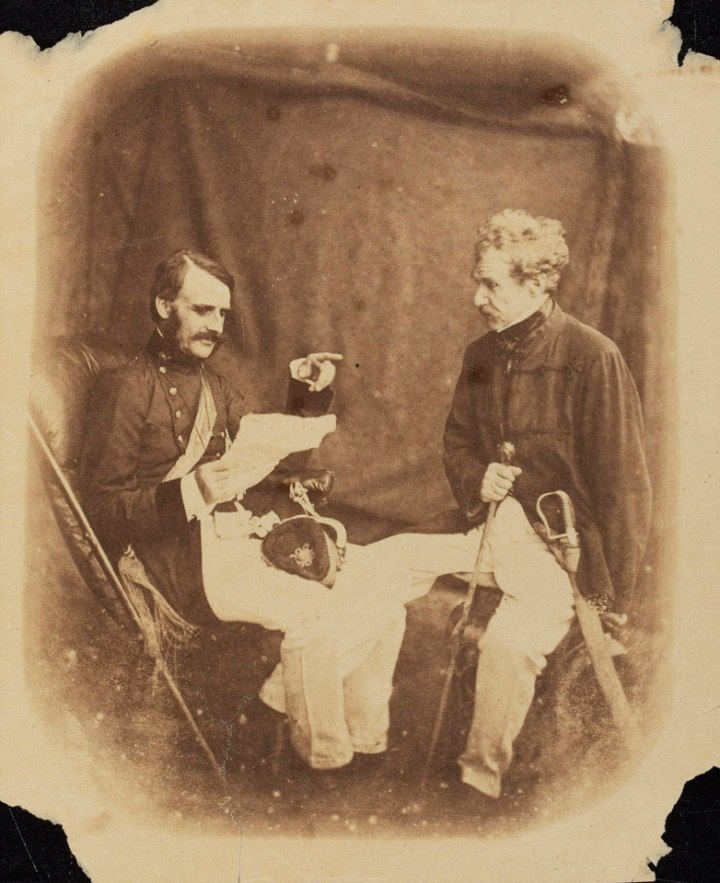
“Commander Napier, of the Bengal Engineers, has given the deliberate opinion, in which I coincide, as regards numbers, that 20,000 men are necessary for the first operation of subduing the city. That having been performed, it will be necessary to leave a garrison in occupation, consisting of at least 10,000 men—viz., 6000 in the city, and 4000 in a chain of posts to the Cawnpore Road—until the whole province shall have been conquered and the rebels driven out of their last stronghold.” It was, “…for the Government to decide whether it be possible, with regard to the circumstances of the Presidency, to effect the necessary concentration of troops for this purpose.” Campbell then went on to point out that exposure to the hot weather could very well debilitate a third of the British force in India, and this was a most conservative estimate. He concluded with such losses, there would be no chance of refreshing them with troops from England, and he strongly urged economising the troops already at hand.
Calcutta, and most importantly, Lord Canning, disagreed. The government did not want, at this point, the “reduction of the province” all they wanted was Lucknow. Oudh itself could wait.
“That it should not be considered as a necessary consequence of our entering Oudh that the whole province should be subjugated. If it were possible to collect a force equal to taking Lucknow and holding it without attempting more for the present, it should be done. Paradoxical as it may appear, I think it of more importance to re-establish our power in the centre and capital of Oudh, which has scarcely been in our possession for two years, than to recover our older possessions. Every eye in India is upon Oudh, as it was upon Delhi. Oudh is not only the rallying-place of the sepoys,—the place to which they all look, and by the doings in which their own hopes and prospects rise or fall,—but it represents a dynasty: there is a King of Oudh seeking his own. Oudh, and our dealings with it, have been in every native’s mind for the last two years. The attention of all native chiefs is drawn to whether or not we can retain hold of what we have taken.”
Campbell was not a man who appreciated being told what to do, nor having to conclude he might be wrong. Instead, he pushed again for a campaign in Rohilkhand, citing the importance of keeping the roads safe. This could only be achieved, he argued, if the insurgent leaders in the province could be brought to task. “It seems to me that if we halt in this course to direct the only force at our command in
these parts to another object, we run no slight risk of seeing the results of our late labours wasted, and
of an autumn, perhaps a summer, campaign on the same ground, to rescue the garrisons which would
have to be left in Futtehghur and Mynpooree. Our late experience of the siege of Cawnpore might in
such case be disagreeably repeated. The very fact of the retreat of the insurgents without a good beating renders this contingency so much the more probable, if they be not followed up with a will throughout the province of Rohilcund, where they are falling back on the rebel forces reported to be massed at Shahjehanpore and Bareilly.” Campbell further stated he did not see any point in entering Oudh until the autumn of 1858, by which time every province bordering it would have been subjugated. Then, and only then, would he deal with Oudh.
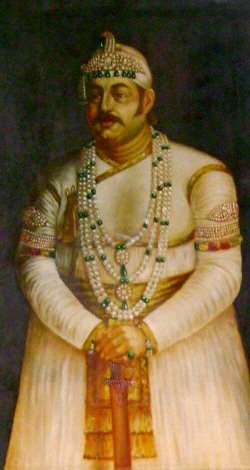
Clearly, in Canning’s opinion, Sir Colin Campbell was missing the bigger picture. He swiftly reminded the Commander-in-Chief that a force of 3000 Nepalese Gurkhas were swiftly moving, with Rowcroft and Franks, towards Lucknow; on 21 December, Jung Bahadur himself had crossed the border with fourteen regiments of infantry and four batteries of artillery – in all, 10’000 men – they too, would be placed Sir Colin’s disposal for the taking of Lucknow. He was, of course, obliged to Sir Colin for his sound advice, but Canning concluded political considerations would now have to be at the forefront. Canning quickly pointed out that the Nana Sahib was intriguing with the Mahrattas of Western India; the Burmese were anxiously watching to see what the British would do with Lucknow – depending on the outcome, there was no doubt they too were planning a donnybrook of their own at Ava and Pegu. Hyderabad, although held in control by the powerful Nizam, would most likely fall as his people were openly sympathising with the rebels in Lucknow. If Campbell insisted on going to Rohilkhand, then he should withdraw Outram from his impossible situation at the Alambagh, (whose position Campbell was hardly taking with any seriousness) as he could not hold out until the autumn, and Canning would halt a part of Brigadier Whitlock’s Madras Column at Secunderabad, to guard against all “contingencies in the Nizam’s dominions.” Besides this, Canning was loath to ask the Madras Presidency for yet another loan of troops. It should also have been obvious to Campbell that Calcutta was sitting on a wasps’ nest of intrigue – the one-time king of Oudh, though carefully guarded at his Garden Reach residence, was not without his mischief-making friends.
This most gentlemanly of exchanges had reached its conclusion. Sir Colin Campbell would do as he was told.
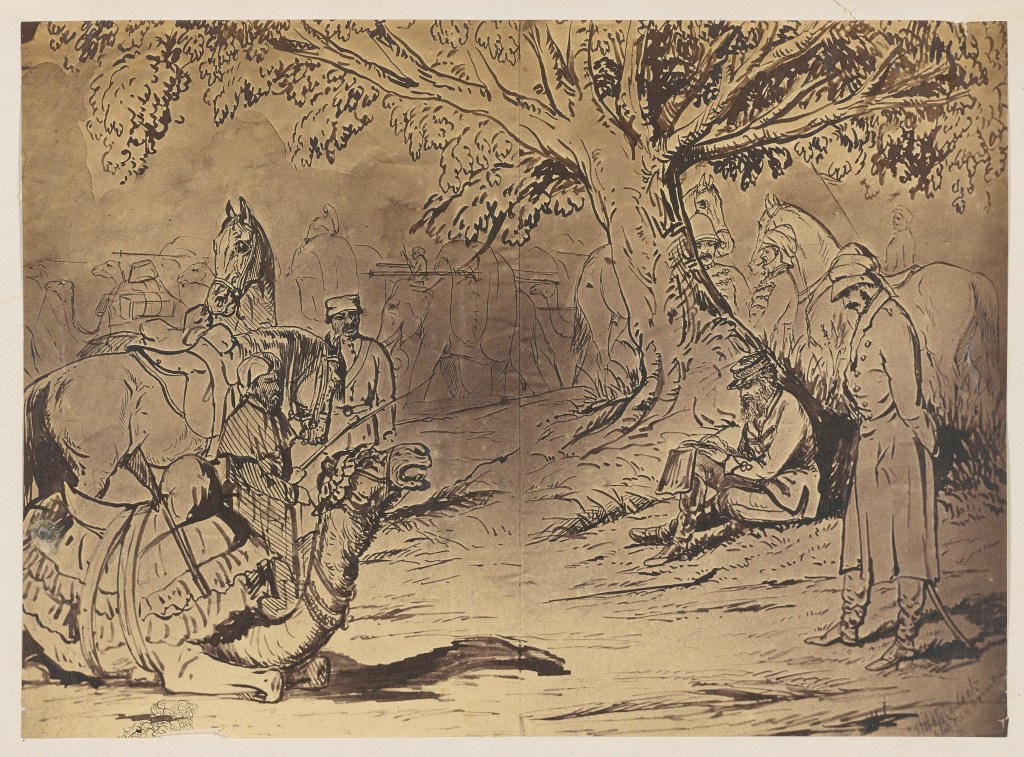
Deception
The taking of Lucknow, in Sir Colin’s opinion, was a delicate and difficult task – as such, he kept his intentions secret from everyone except those in his inner circle. This, however, did not go down very well with his men. One officer, who wisely chose to remain anonymous, wrote a scathing letter to the Times (well after the fact, for the letter was published in May 1858) criticising Sir Colin Campbell’s conduct,
“Did the Chief now act? No, not a bit of it, not he; foolish people should not hurry an Army. Day after day, and week after week, and still that long road of white tents stood motionless, or made but very pretty and partial moves, while the sun got warmer and warmer, till at last February also was actually gone, and still nothing was done. By this time, in truth, those whose faith in Sir Colin was not very strong could stand it no longer and began audibly to swear. The cold weather was gone, and the heat was upon us, yet the campaign not really commenced.”
Those who had begun to swear most probably had commenced their cursing in January when one of Campbell’s “pretty and partial moves” ended in the death of a well-liked young officer of Hodson’s Horse and the serious injuring of another of the 9th Lancers. While none of this can be placed squarely on Campbell’s head, by not telling anyone what he was up to, these forays into the wilderness were starting to appear pointless and only caused more resentment of the Commander-in-Chief; the men were now starting to call him “Sir Crawling Camel.” However, Campbell continued to develop his plans indifferent of the abuse now poured on him. He was determined that if no one in his camp knew his goal was Lucknow, then most likely the rebels would not either.
His continued delay at Fatehgarh had a very good reason – 170 miles distant, at Agra, a formidable siege train that included two 68-pounders (which would first need to be collected at Allahabad), and every conceivable manner of provisions, carriages and munitions of war were slowly snaking their way towards Cawnpore. Fatehgarh was the best strategic centre for the protection of the siege train; he could also dispatch troops at a moment’s notice to any quarter threatened by rebels from Oudh, Rohilkhand or the trans-Jumna territories. With Bareilly only 77 miles distant and on the direct high road to Lucknow, Sir Colin Campbell was able to keep the rebels guessing what he was going to do, and he decided to put up a show for their benefit, which would lead them to believe his objective was Rohilkhand.
Shortly after occupying Fatehgarh, Adrian Hope’s brigade, accompanied by Hodson’s Horse, had been sent out into the countryside to scout out the movements of the rebels and returned to report that a force of 15’000 men had gathered at Allahganj on the banks of the Ramganga, eight miles from Fatehgarh. As it was necessary to keep a close eye on the rebels, Lieutenant Hugh Gough and a detachment of cavalry left Fatehgarh with “sealed orders” which were not to be opened until they had ridden a considerable distance from the camp. When finally opened, it was revealed they were to ride to Miran-ki-Serai on the Cawnpore Road, to watch the roads and fords of the Ganges, which approached Oudh from the northwest.
At Miran-ki-Serai, they found a regiment of Punjab infantry under Major “Jack” Stafford, who had himself been sent to this outpost a few days previously. Stafford, a big, jovial man who Gough soon found was full of fun, had decided to make the best of a strange situation and established a “capital mess”, making Gough and the other officers honorary members. The countryside around abounded with game; pig-sticking was a firm entertainment while the Sikh sowars vied with their British officers at the game of tent-pegging.
Yet their business was still a serious one. Sir Colin Campbell had received intelligence that the Nana Sahib would attempt a crossing either at Miran-ki-Serai or a mad dash up the Grand Trunk Road, so it would be up to Gough and Stafford to make sure the wily Maratha was kept in order. However, as the days passed, there was no sign of the Nana.
The next day, 13 January, Sir Colin sent out Walpole and his brigade, with strict orders not to engage with the rebels across the river, but to make as much of a display as possible. With a contingent of sappers, guns and cavalry, Walpole set off. He swiftly set the sappers to work, conscientiously repairing a bridge across the river the rebels had but recently destroyed, to lend credence to the rumour now that Rohilkhand was the objective. In Walpole’s brigade was Hodson, and from the first day, he was not particularly impressed.
“Hodson was ordered to pitch his camp on a spot which was about 800 yards from a position occupied by the enemy on the other bank of the Ramganga. Hodson pointed this out to the D.A.Q.M.G., but he took no heed of it, and so the camp was pitched. The enemy left us alone the first day, but on the next Hodson ordered the regiment to parade for inspection in the centre street of the camp. The opportunity was too tempting for the enemy’s gunners, and they opened fire. The very first shot struck immediately behind the line and passed through it, carrying off the leg of one of the men. Their other shots were not so good, but they dropped all about the camp. Of course, the camp was then moved.”
Sir Colin and his staff rode out to inspect the progress, making as big a show as his personage allowed, as he cantered about with this staff in tow, reconnoitring, inspecting, deliberating. For the next 12 days, the rebels watched these strange proceedings and remained on the banks of the river, ready to oppose any advance into Rohilkhand.
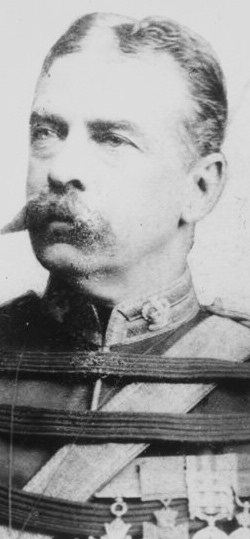
As for Gough, at his dusty outpost of Miran-ki-Serai, things suddenly looked a little more interesting. A frantic note from the tehsildar of Nana Mhow Ghat, a landing place and ford on the river. He was begging for immediate succour, for the Nana Sahib was crossing the river under his very nose. Gough and Lieutenant Anderson, excited by the prospect of being the men to capture the Nana, wasted no time in assembling 90 sowars and, at a round trot, crossed the 20 miles to the ghat. The Nana would be quite a feather in their cap, the young officers decided, and they were picturing themselves bringing him trussed up back to the government he had so basely betrayed.
At the village, however, what they did find was a very worried tehsildar. The rebels were about to cross, he insisted, and the Nana was amongst them. Gough and Anderson did indeed see a few boatloads of sepoys crossing the river, but their spies had already thrown a spanner into the works. Informed of Gough’s movements, they precipitously changed their minds and their boats, when Gough saw them, were all turned around and heading back to their own side of the river. With hope dwindling of catching the Nana, Gough and Anderson determined to not let the ride go to waste – they remained overnight on the banks of the river, on the off chance the rebels would use the cover of darkness to cross the river.

Not to be left out of the fun, John Watson arrived. Having heard what Gough and Anderson were up to, he quickly put together a detachment, and they sped off after the two officers. “The arrival of
companions in our disappointment was curiously soothing to our feelings. We returned to our camp next day, where we had but little to do: everything was perfectly quiet, and with the exception of people travelling up and down country, we saw no one.” Amongst those people was a convoy of ladies and officers on their way home, including a rather disappointed Brigadier Greathed. He stopped a moment to talk to Gough – there was no work left for him in Oudh, and he was ordered to join his appointment in Bombay.
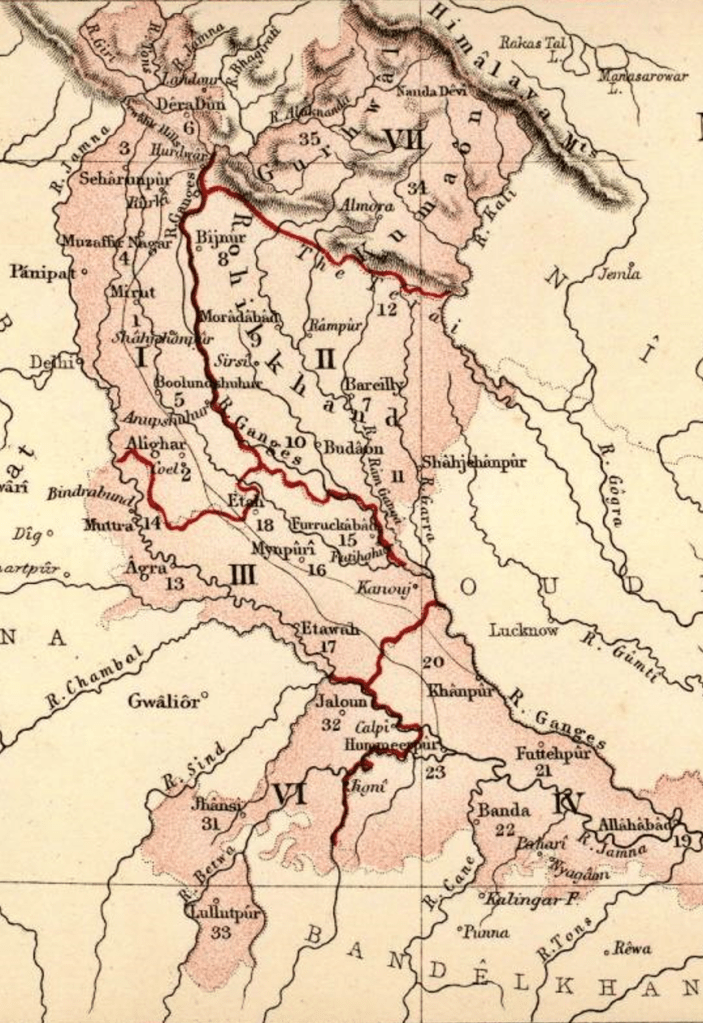
However, Sir Colin Campbell had neglected to consider that the rebels were not so easily deceived. A detached body of 5000 men crossed the Ramganga at a point above that watched by Walpole and well out of sight of Gough. With no one to oppose them, they marched unnoticed to a ferry at Suraj Ghat on the Ganges, some 12 miles from Fatehgarh, crossed the river and settled themselves in a half mile from the village of Shamshabad.
Sources:
Anson, O. H. St. G. With H.M. 9th Lancers During the Indian Mutiny. London: W. H. Allen & Co., Ltd., 1896.
Cardew, F. G. Hodson’s Horse 1857–1922. Edinburgh: William Blackwood & Sons Ltd., 1928.
Forrest, G. W. A History of the Indian Mutiny. Vol. 2. Edinburgh: William Blackwood & Sons Ltd., 1904.
Kaye, John William, and G. B. Malleson. Kaye’s and Malleson’s History of the Indian Mutiny of 1857–58. Edited by G. B. Malleson. Vol. 4. London: W. H. Allen & Co., Ltd., 1889.
Mackay, James. From London to Lucknow. Vol. 2. London: James Nisbet & Co., 1860.
Roberts, Fred. Letters Written During the Indian Mutiny. London: Macmillan & Co., 1924.
 Mutiny Reflections