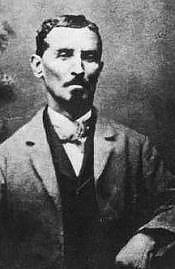
Born at Athlone, in Ireland, on the 22nd of December 1839, Thomas Flynn was the son of Patrick Flynn, a military pensioner and his wife, Ellen (or Eleanor) née Kenny, the eldest of four children and the only boy. In 1854, at 14, Thomas joined the 64th Regiment, the Second Battalion of the Staffordshire Regiment. He was attested as a private in the boys’ section, and on the 11th of August, he was added, nominally, to the Adjutant’s Roll and formally joined the regiment. On the 9th of September 1854, Thomas Flynn sailed for India. The 64th had been in India since 1848 and would remain there for the next 13 years. They would serve in the Persian War and the Indian Mutiny.
Although we do not have any accounts of Flynn’s life with the 64th, we do have the rather interesting book by Captain Mackenzie, who had arrived in India with the 64th in 1848 and joined the band and served as a field bugler. In 1851, he was appointed drill corporal and in 1854, drill sergeant. Just nine years Flynn’s senior, Mackenzie had joined the 64th, fourth company, in 1841, “and immediately began to acquire a soldier’s duty, as well as to learn how to play the flute, beat the drum, and blow the bugle; and by the time the regiment arrived home from Halifax, in October 1843, I was considered to be perfect and able to take my place in the fife and drum band of the regiment.” Promoted to full drummer next to his duty as field bugler, in 1844, his duty was to give “corporal punishment when a soldier is sentenced to such punishment by court-martial.” Although Mackenzie makes but little mention of Flynn in his book, it is more than likely he knew the young drummer.
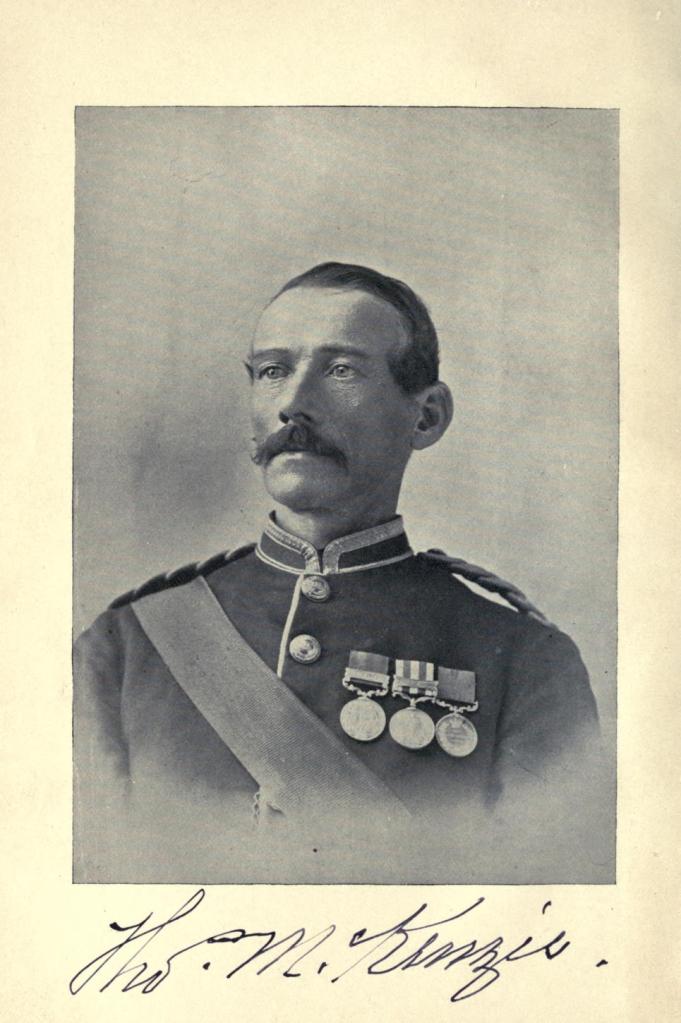
Field Bugler to the Generals Commanding in the Persian Campaign & Indian Mutiny
During their time in India, coffee rooms were not as yet established in regiments, something which Mackenzie rues, and perhaps, considering the life of Thomas Flynn, might have been a boon to his soul. The common practice was, “…the men could only get into the canteen after 12 noon for one pint of ale or porter, and no more until 7 p.m. when a dram of either arrack or rum would be allowed them. After 8 p.m., they could again get one pint of ale or porter.” Mackenzie and others of the 64th, instead, attended the Temperance Club.
The daily issue of alcohol to troops was considered a necessity to help the men withstand the rigours of the climate, and although a rule was in place against Indians selling alcohol to soldiers, it was by far not difficult for them to procure arrack or other country spirits. Officers tried to find other ways to keep their men from drinking, be it active sports like cricket or even the rather interesting occupation of gardening. Teetotallers were encouraged to hold tea parties, while other officers openly advocated religion as a way to keep their men sober. Temperance associations had started to gain some hold in the 1840s, with men receiving awards for abstinence. The earliest of these was established in 1823 in Burma by none other than Lieutenant (later General Sir) Henry Havelock. Dubbed “Havelock’s Saints,” they would have to face a measure of ridicule, not so much for their abstinence but for their somewhat zealous following of Havelock’s preaching. As adjutant, Havelock would form the first regimental temperance society for the 13th in 1839 and by 1850 there would be over 50.
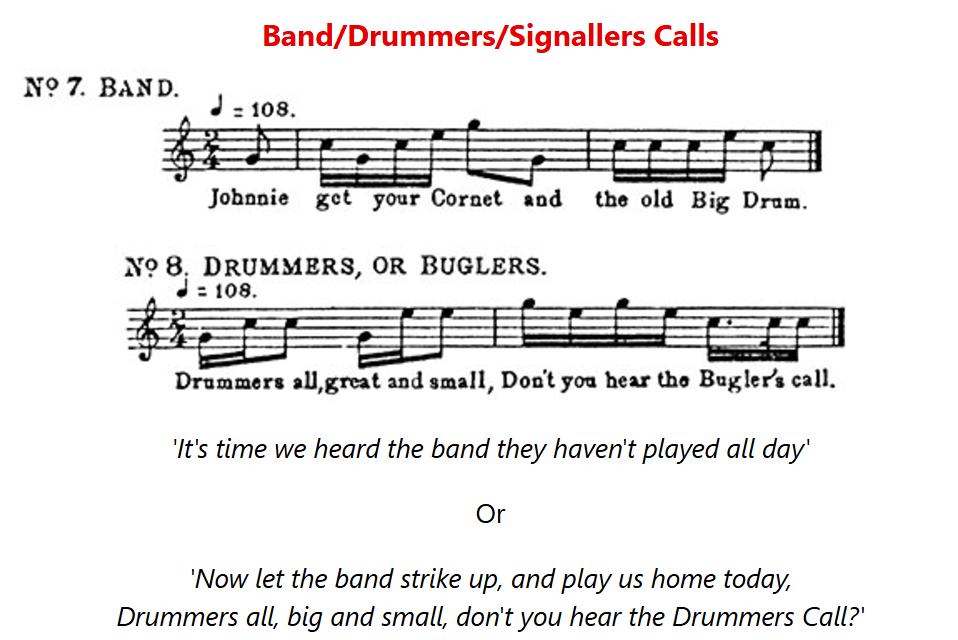
The 64th arrived in Bombay on the 4th of June 1857, fresh from the Persian War. They were immediately ordered to Calcutta, so it was back to sea. When they arrived, their regiment was divided into several detachments with other corps and sent up the Ganges to disarm various regiments that had not as yet mutinied and then to stop at Allahabad. Eight companies would subsequently wait for Major-General Havelock (the remainder of the 64th would make an appearance not only in Bihar but at the Battle of Khajwa).
On the 3rd of July, Havelock’s Column was formed, among them the 64th. They would then constitute part of the First Infantry Brigade, under Brigadier-General Neill, on the advance to the relief of Lucknow in September, however, the headquarters of the 64th remained behind under Colonel Wilson to defend Cawnpore. As for Mackenzie, he advanced with Havelock, but he was stopped short at the Alambagh. The importance of this incident would remain with Mackenzie for the rest of his life.
“As the force advanced, a number of the rebels who came by our rear were about to attack the small baggage which Havelock thought he could have brought into the residency, but this proved impossible. The aides-de-camp being away delivering orders to other parts of the force, I was sent to the rear to tell the baggage guard to move into the Alam-Bagh, and if I could get back to join him, I was to do so; if not, to remain with the guard and go with them. I delivered the order, but my horse was shot under me, and we had scarcely time to get into the enclosure. But the escort or party already there, acting with the small party just entered, caused the rebels to move off quicker than they came.”
Windham would succeed Wilson in November before Campbell’s departure to Lucknow. Wilson was described as the “…type of the soldier now passed away. Well-bred, comely in appearance, of active and regular habits, a great stickler for all the traditions of the Service, a disbeliever in modern ideas of warfare, an opposer of reforms…withal a man of kindly disposition, and with much of the courtesy of an elderly chivalry about him.” He would lead the 64th for a final time on the 28th of November, and with him would fight Drummer Thomas Flynn.
On the 28th of November, the fight for Cawnpore was in full swing, and the rebels were winning. Brigadier Carthew of the 34th was desperately holding his position through a series of running fights, while the 64th were held idle, holding the entrenchment. The plan, as devised by Windham, read as such:
To Colonel Walpole—commanding five companies of the Rifle Brigade under Lieutenant-Colonel Woodford, two companies of the 82nd Regiment under Lieutenant-Colonel Watson, and four guns—two 9-pounders manned by Madras gunners, and two 24-pounder howitzers manned by Sikhs, under Lieutenant Green, R.A. he confided the defence of the advanced portion of the town on the left bank of the canal, that is, the portion in the left rear of the brick-kilns separated from them and from the rest of the town by the canal; to Brigadier Carthew—having under him the 34th commanded by Lieutenant Colonel Kelly, the flank companies of the 82nd, and the four Madras 6-pounders under Lieutenant Chamier—the defence of the Bithoor road, in a position more advanced than, and a little to the right of, that occupied the previous day. The intrenchment was entrusted to the care of the 64th under Brigadier N. Wilson, who was also to guard against a turning movement on the right by establishing a post at the Baptist Chapel; whilst Windham himself, having under him the 88th Regiment commanded by Lieutenant-Colonel Maxwell, should defend the portion of the town nearest the Ganges, on the left bank of the canal.
On the left, Walpole had fought back an attack by the rebels. They came on in force but not in resolution, reserving the main brunt of it for Carthew. However, Windham’s left advanced position was so well-manned that they could defeat a successive attack even without the support that was sent up from the rear, and Walpole “achieved that result without them.” Seeing that Walpole was actually holding his own, it should have been in Windham’s interest to support Carthew, who was risking life and limb to protect what was left of Windham’s stores. He left the 88th, 300 men in all, in reserve. Instead, he sent McCrea, again, to tell Carthew to advance up the road, “promising him that the 64th Regiment under Brigadier N. Wilson would make a parallel advance on the right.” It was, however, deemed necessary to relieve Carthew of 40 men of the 82nd to strengthen the 64th.
Captain McCrea, with the 40 men of the 82nd, directed Wilson, as ordered by Windham, to move the 64th parallel to Carthew’s front. The problem was Wilson missed the road as it ran in line some little way with the river and then forked. Instead of proceeding along the one nearer to the river, where he could have come up with ease on the rebel guns, peppered the gunners and saved his men any undue harassment, he took the other, which descended abruptly and then towards the top, became mercilessly steep.
“His skirmishers climbed up the steep part, and got possession of the guns, but these could not be retained. Major Stirling, waving his sword, jumped across one of the guns, and shouted encouragement to the men embarrassed with the ascent. He was cut down by troopers coming up. The enemy rallied to the spot, six of the officers of the 64th were killed, and the endeavour to carry the height failed.”
The two companies were harassed by the fire of six guns directly to their front, but they managed, when within 100 yards of these guns, not only to charge them but for a few minutes to hold them. Unfortunately, the remainder of the Wilson’s force was still too far behind, and the rebels, quickly recovering from the initial surprise, came on in such numbers that hardly any of the skirmishers survived the attack. Major Stirling fell in front of the battery, fighting hand to hand until the end; Captain Morphy was shot through the heart and “seemed to bound from his saddle, falling heavily on his head.” Captain McCrea was shot dead, while Captain Saunders, seeing Stirling fall, quickly took his place and dashed forward, boldly followed by Lieutenant Parsons and O’Grady. Parson was shot through his sword arm for his pain. “O’Grady cheered the men on, waving his cap in the air, until he reached one of the guns, and he laid his hand on it as a token of its capture. In a second, he and Saunders were engaged in hand-to-hand combat with a host of the enemy.” The men, answering the cheer, ran forward to their aid. Meanwhile, old Brigadier Wilson was still pushing his wounded horse onwards towards the front, shouting, “Now boys, you have them!” The words were scarcely said when a bullet passed through his left lung, and Wilson fell. Some men ran forward and carried him to the rear, still alive. Mortally wounded and close to death, Wilson continued to urge his men to “maintain the honour of the corps.” Somewhere in the confusion, Flynn, already wounded, rushed the guns and engaged in hand-to-hand combat with two rebel artillerymen. As it was, the 64th could not hold the guns, much less their position, and were forced to retire back to the entrenchment.
“Often and often since have I walked over the road he took. It ran in a line with the river for some
little way and then forked. One branch wound gently down below an old burial place, the other descended more abruptly beneath the rising ground, which, at the top, became quite steep. If the Colonel had known the difference of the roads and had taken the one nearer the river, to his right, and, skirting the graveyard, he would have come to a place whence he could have peppered the rebels at the guns they had pushed forward, without exposing his own men. It was, of course, not the least his fault; but he took the wrong turn…” (Sherer)
The 64th lost more men in that engagement than they had until then in their other actions in 1857 – it was a sore loss which ultimately achieved very little. Carthew did not receive his reinforcements, and Windham would finally be left with a well-deserved whigging from Sir Colin Campbell. The 64th, despite the hopelessness of their position, had charged against insurmountable odds, unsupported, and were, in their moment of valour, cut down for their pains. The regiment would rise and fight again over the next year until the end of the mutiny, but Flynn’s would be the only Victoria Cross. His citation appeared in the London Gazette on the 12th of April 1859 and reads,
“For conspicuous gallantry, in the charge on the Enemy’s guns on the 28th November 1857, when, being himself wounded, he engaged in a hand-to-hand encounter with two of the Rebel Artillerymen.”
(No. 22248. The London Gazette. 12 April 1859. p. 1483)
Interestingly, Mackenzie makes a slightly more detailed story than the citation or, indeed, history.
“…a bugler of ours, named Flynn, was mentioned in despatches for his bravery in killing the artilleryman in the act of firing the gun. This same bugler saved Major Sterling’s life afterwards at Cawnpore by interposing his bugle to receive the cut of a rebel cavalryman. For these two acts, he received the Victoria Cross.” Mackenzie, who was not there, must have heard the tale from his compatriots or perhaps from Flynn himself. The citation, as it turned out, made no mention of the valorous second act. As events sadly showed, Major Sterling did not survive the 28th of November 1857.
Considering Flynn’s age (22nd December 1839) at the time which was 17 and just shy of 18, rather than the commonly cited 15, Midshipman Mayo, born (on the 18th of May, 1840) five months after Flynn and 2 months after Private George Monger of the 23rd Regiment, (born on the 3rd of March 1840), remains the youngest Victoria Cross recipient for the mutiny.
The citations, however, are all spectacularly close:
Monger – 18th of November 1857, for action at Sikandarbagh
Mayo – 22nd of November, for action at Dacca
Flynn – 28th of November, for action at Cawnpore
After the Mutiny
Following the mutiny, the 64th left Belgaum and took up their new quarters in Karachi. In 1860, at a parade, Flynn was invested with the VC by Brigadier General John Hall (division commander at Hyderabad). Unfortunately, there was no Temperance Club, religious sermon or any amount of busy work that could help Thomas Flynn. Just shy of his 18th birthday, Flynn started exhibiting erratic behaviour just two days after the disastrous action at Cawnpore when he was imprisoned for the first time for drunkenness. Ultimately, he would be imprisoned 14 times in all, totalling a staggering 586 days. Although he left India with the regiment in 1861, this had no sobering effect on what could be termed a terrible state of affairs. He was imprisoned for one month between December 1861 and January 1862, then for three months in 1863; to make matters worse, in 1865, he was a guest at different prisons – Manchester & Carlisle, Chatham and the Curragh. He managed, albeit briefly, to show some promise of reformation and received his one and only Good Conduct Pay in March 1867. This apparently did not go to his head as it should have done.
When his regiment was stationed on the Isle of Wight in 1868, Flynn found himself serving time again, this time at Templemore and Parkhurst. In February 1868, he was reduced to private, and in December 1869, he was discharged from the service. He received £1 2s 6d for his passage to Athlone. Nor does his sad story end. In 1882, when the 64th was stationed at Athlone, we find Flynn before the magistrate, this time charged with the theft of Major Denison’s boots, which he subsequently pawned. This earned him a stay at Mullingar Prison for 30 days. It would appear even his marriage to Mary Hardimann in 1880 did not have a sobering effect on Thomas Flynn, and it was hardly a happy union. They frequently found themselves in the Workhouse, only discharging themselves with Thomas’s VC pension of £10 that was paid out. When the money was gone, it was back to the workhouse. Exasperated, the Board of Guardians finally confiscated his pension, but not before his case had been brought up in Parliament.
HC Deb 01 April 1892 vol 3 c466
MR. D. SULLIVAN (Westmeath, S.)
I beg to ask the Financial Secretary to the War Office whether he is aware that Thomas Flinn, formerly of the 64th Regiment, is now a pauper inmate of the Athlone Workhouse; that he holds the Victoria Cross for valour, and wears also the medals for Persia and India, having been present at Cawnpore and Lucknow, where he was severely wounded in attacking some guns, one of which he brought off himself; whether he is aware that Flinn was awarded a pension of £10 a year for his valorous conduct, which sum the Guardians of the Athlone Union appropriate towards his maintenance; and whether some small increase could be made, so as to enable him in his old age to end his days more comfortably than in a workhouse?
THE FINANCIAL SECRETARY WAR DEPARTMENT (Mr. BRODRICK, Surrey, Guildford)
This case is well known at the War Office. Flynn did very gallant service and was awarded the Victoria Cross, but I regret to say that he was discharged with a very bad character, he having been entered in the defaulter-book 47 times and tried by Court Martial 15 times. The poor man is a victim to drink to such an extent that when he had the control of his money, he only left the workhouse for the purpose of drinking up his annuity as soon as received. It would consequently be useless to consider his case for an increase.
Thomas Flynn died four months after this debate about his future, on the 10th of August 1892 at Athlone Workhouse. His wife died three months later. The whereabouts of his Victoria Cross remains unknown. It is too harsh and undeniably unfair to judge a man by what his life became, and fortunately, the citizens of Athlone see it the same way, as should we all.
https://www.westmeathindependent.ie/2023/12/14/refurbished-monument-to-athlone-victoria-cross-holder-unveiled/
Sergeant Mackenzie – the VC That Wasn’t
Conversely, there could have been another Victoria Cross for the 64th and it would, had things gone better, have been awarded to Mackenzie. According to him,
“Sir James told me that I would be recommended for the Victoria Cross, for that my action on the 25th September alone, when ordered to proceed to the baggage guard by General Havelock with orders as an aide-de-camp, to which he was an eye-witness, would entitle me to receive it, and that he had told Major Bingham, then there at Dilkoosha, about it.” Unfortunately, Sir James Outram never sent in the commendation, but he did not forget. While on a visit to Dover, Outram visited the 64th and requested to see Mackenzie about the VC, but Mackenzie was away on furlough. Outram promised to “call again.”
As for Mackenzie, Colonel Shute told him, had he not been on furlough, he would undoubtedly have received the VC – so convinced was Mackenzie of his own case, he asked Shute to recommend him. As Mackenzie was due to leave shortly for service in Canada, Shute promised he would approach Outram should the occasion arise – it never did.
“About eight months afterwards, I wrote Colonel Shute regarding the Victoria Cross and received a reply to my letter four months after from him, stating that Sir James had not since called at Dover and that he had not forgotten the matter. I waited for a few months longer, then wrote directly to Sir James. Lady Outram returned the letter to me, with the sad news of Sir James’s death, he having died a few days before the date of my writing to him. Thus, I missed the soldier’s most coveted decoration. My only satisfaction is that, in the opinion of my general, I had won it.“
Sources:
Bulletins and Other State Intelligence for the Year 1858. Part 1. London: Harrison and Sons, 1859.
Mackenzie, Thomas. My Life as a Soldier. London: [Privately Printed], 1898.
Sherer, J. W. Daily Life During the Indian Mutiny: Personal Experiences of 1857. London: S. Sonnenschein & Co., 1910.
Wickes, H. L. Regiments of Foot: A Historical Record of All the Foot Regiments of the British Army. London: Osprey Publishing, 1974.
Links:
https://www.queensroyalsurreys.org.uk/regimental-music/bugle-horns-music.html
https://vcgca.org/news-and-events/38/Thomas-Flynn-VC-a-life-revealed
https://vcgca.org/our-people/profile/1105/Thomas-FLYNN
https://www.westmeathindependent.ie/2023/12/14/refurbished-monument-to-athlone-victoria-cross-holder-unveiled/
https://api.parliament.uk/historic-hansard/commons/1892/apr/01/thomas-flinn-vc
https://www.westmeathindependent.ie/2024/11/18/four-wreaths-placed-on-drummers-grave-for-armistice-day/
 Mutiny Reflections