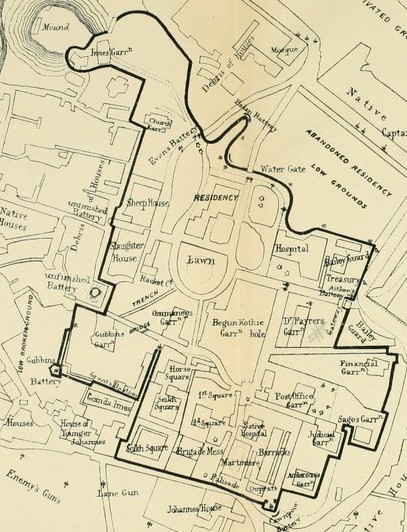
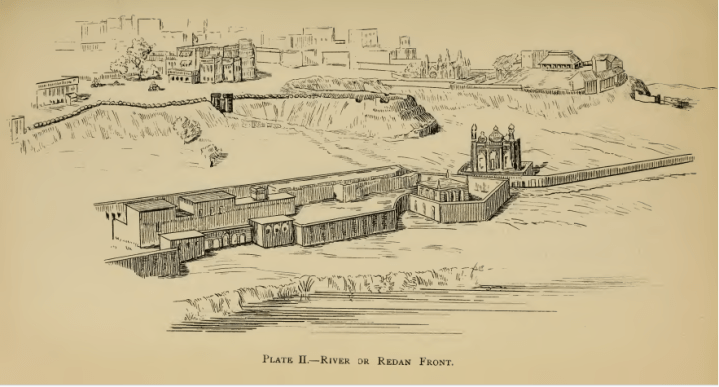
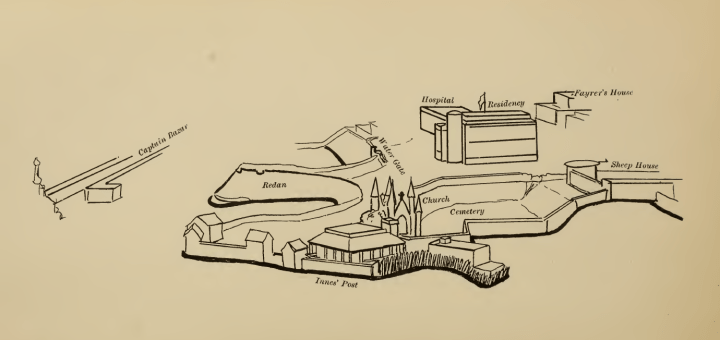
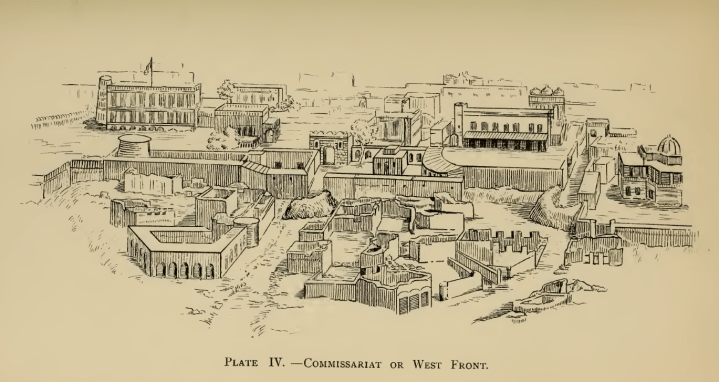
The position chosen by Sir Henry Lawrence as his defence proved to have both its advantages and pitfalls. Situated on a slight elevation, which also happens to be the highest hill in Lucknow, it encompassed an area of some 33 acres and had, besides ample outbuildings, 28 main buildings, all of which would serve as accommodation for all those who sought refuge here. The compound also boasted of an ample water supply, with each post having its own well, and the drainage system, when maintained, was efficient. Next to the church, there was also enough empty ground to establish a cemetery that was well enough away from the main buildings to remain somewhat inoffensive.
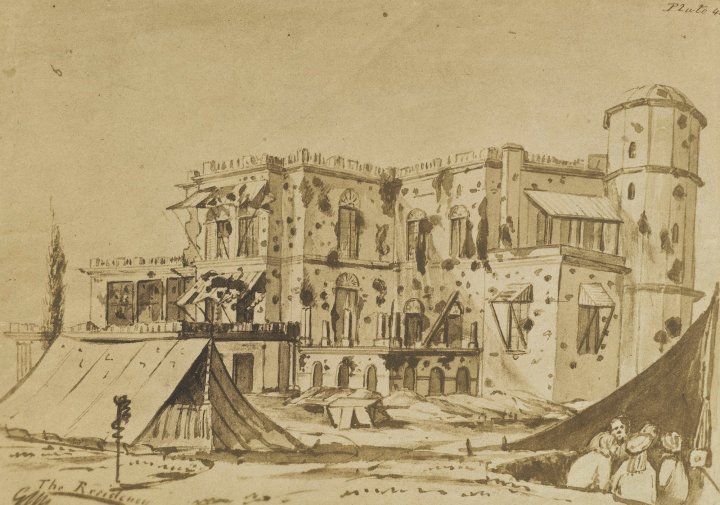
However, none of the buildings was intended for defence as they were intended, above all, as accommodation. Some were indeed very large and could accommodate a fairly large population, but would prove fairly useless as protection against cannonballs. As such, the damage to the walls was so extensive that in no time at all, the engineers were forced to declare not only the main Residency building but Innes’ House and the church as uninhabitable. Saunders’ Post, Germon’s Post and Anderson’s Post would not be recognisable as houses by the end of the siege; Captain Anderson himself would state he was defending a pile of bricks. However, we are getting ahead of ourselves, and the history of the Residency predates the Siege by some years.
In 1774, the third nawab of Oudh, Asaf-Ud-Daula, allowed for a permanent British Resident (a high commissioner, we would say today, but controller would serve as a better definition) to be stationed in Oudh. A year later, he moved his capital from Fyzabad to Lucknow, taking the Resident with him. The site of the Residency at the time belonged to the Shiekhzadas and to General Claude Martin, a Frenchman of considerable influence who served in the Oudh court. Considering it to be an ideal site for a Residency, the Nawab ordered the construction of the first building in 1780 on the northern slope of the plot. The compound itself spanned an impressive 33 acres, bounded to the north by the Gomti River, to the south and west by the main city and to the east by the Bailey Guard (as the compound was initially known). Over the next 20 years, with the church being the last building completed in 1810, a further 18 buildings would be built, and eventually, not just the Resident but his staff would have their houses in the same compound. The mosque, imambara, and the Begum Kothi (Ladies House) predate Residency itself.
The site itself is quite straightforward, but we must imagine that before Sir Henry Lawrence began making the necessary changes to make it a defensible position, it was just a collection of houses, each set in its own compound, surrounded by a low wall. Within the walls would have been pretty gardens, wells and magnificent trees. As it was, none of the occupants thought it necessary, even as late as May to start fortifying their houses; only Martin Gubbins thought differently, and he was subsequently laughed at by his colleagues for being a worrier. However, Sir Henry Lawrence shared Gubbins’ opinion for he believed quite earnestly that there was no chance Lucknow would escape the mutiny, it could be, perhaps, delayed but inevitably, it would come.
For Sir Henry, this of course presented a problem. Like Sir Hugh, he did not want to alarm the troops but on the other hand, he was experienced enough to know that no matter what he did could be construed as alarming. Initially, he wanted to keep three defensible positions in Lucknow – the Martiniere College, the Macchi Bawan (the Magazine) and the Residency. However, he was quick to realise he hardly had the manpower to fortify and defend all three; the Martiniere was abandoned for being too far away, and the magazine for simply being too old, too close to the city, leaving him with only the Residency as the final option. Here, the problems were quite clear. The buildings would not withstand any heavy bombardment, and the compound was too sprawling. Its walls were also bordered by several high-roofed houses, which Sir Henry steadfastly refused to blow up, firstly for the untold loss it would be to the occupants, but this would have shown the sepoys he was not only afraid, but undoubtedly up to something. Only a few were eventually cleared away, much to the distress of the garrison.
“About the middle of June, the fortifications of the Residency began in earnest; defences capable of resisting the assault of Artillery were now being rapidly thrown up. At the time when the blockade was commenced, only two of our Batteries were completed; parts of the defences were yet in an unfinished condition; and the buildings in the immediate vicinity, which gave cover to the enemy, were only very partially cleared away. The greatest annoyance we received was from the native buildings which, in close proximity, surrounded us on all sides, and which, as soon as the siege began, were filled with the enemy’s sharpshooters, from whose ceaseless fire the Garrison suffered more than from any other cause.” (Hilton)
The gunpowder that was brought from the magazine to the Residency was initially buried in the lower Residency grounds, and although it would eventually be moved, a rumour was started that these low grounds were in fact mined and anyone venturing there would undoubtedly be blown to high heaven. This was not the case at all, but as it was, the lower grounds were considered an uneasy sort of no-man’s- land during the siege.
As the Siege of Lucknow is a monumental event and covered in several books contemporary to the times, I have chosen to confine my writings to a description of each post as it served its purpose during the siege.
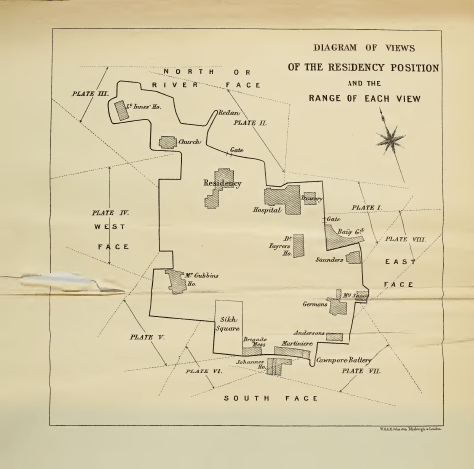
For reference, we shall be relying on “Lucknow and Oudh in the Mutiny- a Narrative and a Study” – Lieutenant-General McLeod Innes, R.E., V.C. (London: A.D. Innes & Co., 1895).
All other works shall be separately cited.
For the names of those who were at the Residency, these can be found in
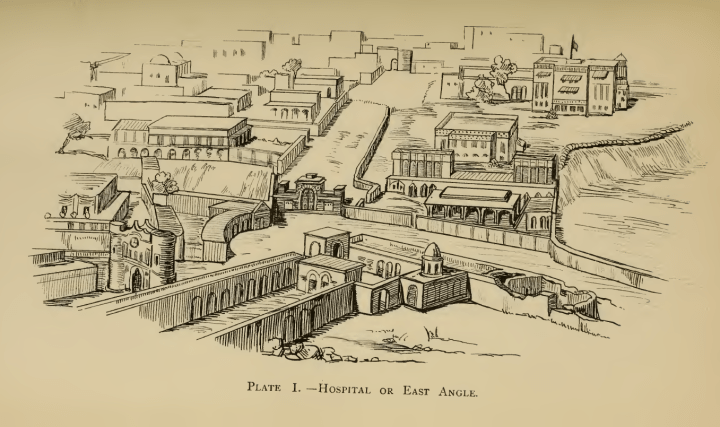
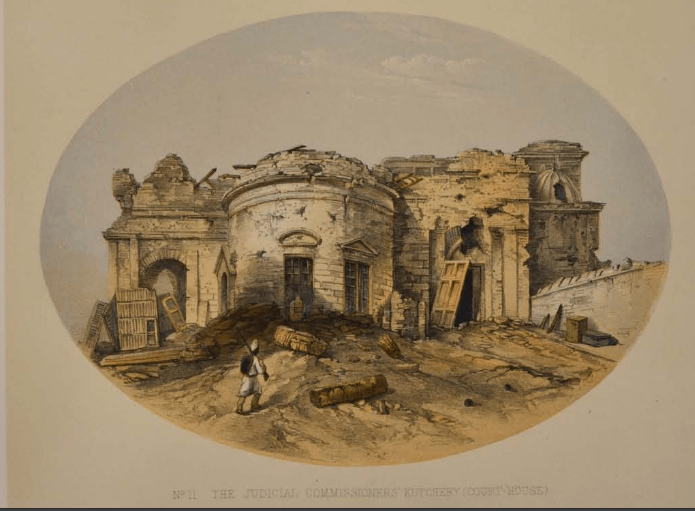
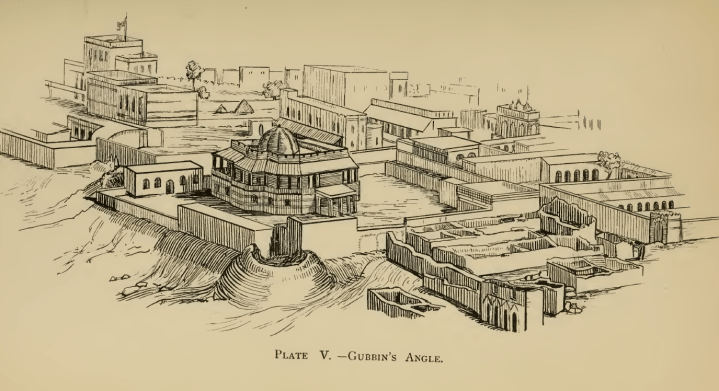
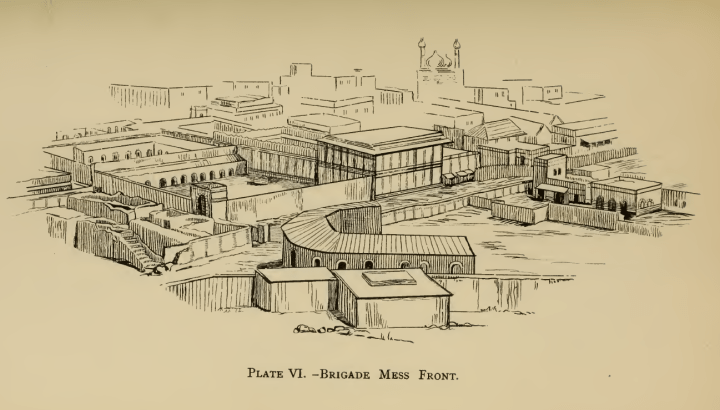
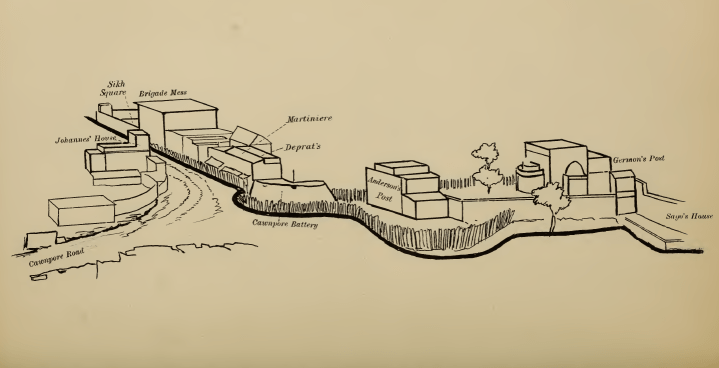
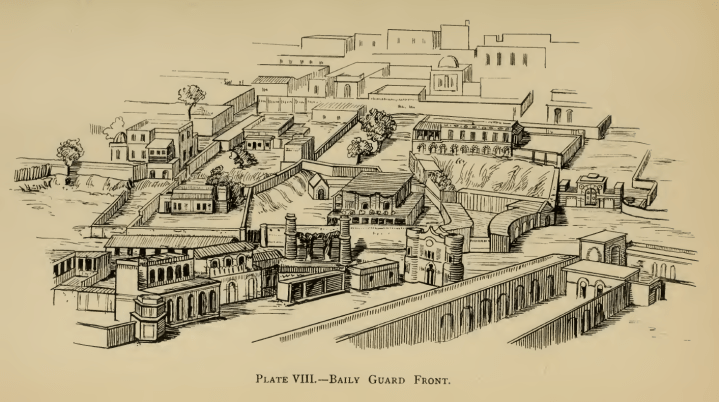
Of course, things have changed considerably at the Residency since 1857. The site is open to visitors; however, it remains woefully underappreciated by the history-loving public. Instead, the ruins are now the scene of many an assignation between young couples searching for privacy.
I have been visiting Lucknow and the Residency for just over 25 years – my tenth visit was in 2023; the very first time was puzzling as I had expected to find a museum and instead found a pile of ruins, weeds and above all wasps. Getting to the cemetery was nearly impossible, and finding the posts, such as Germon’s or Anderson was impossible due to the lack of signage. Considering the jungle-like environment I was faced with, it is not surprising I half tumbled over the ruins, which were conveniently hidden in bushes and behind trees. Since then, I have seen many changes, and sadly, not all have been for the better. However, the Residency will remain on my “must visit” list, if only see what has happened in the intervening years.
 Mutiny Reflections