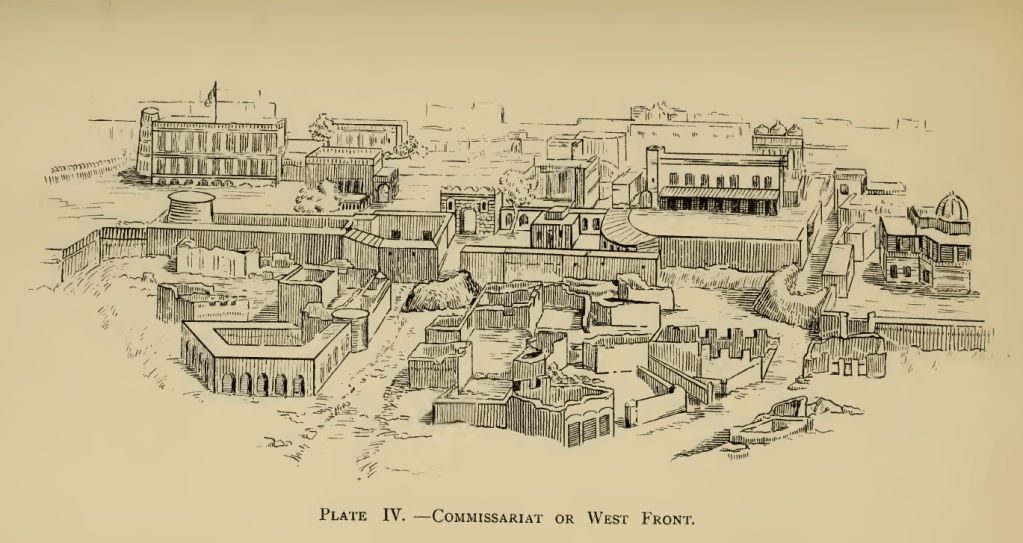
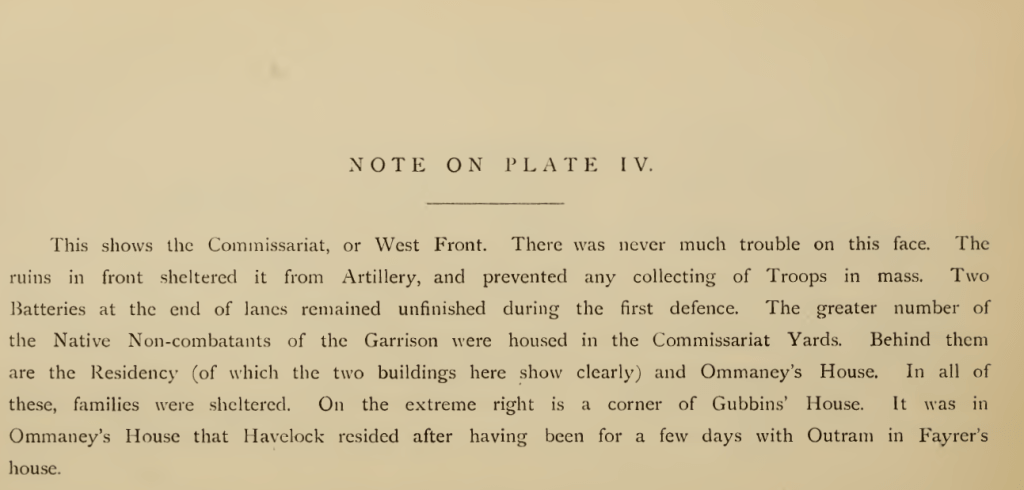
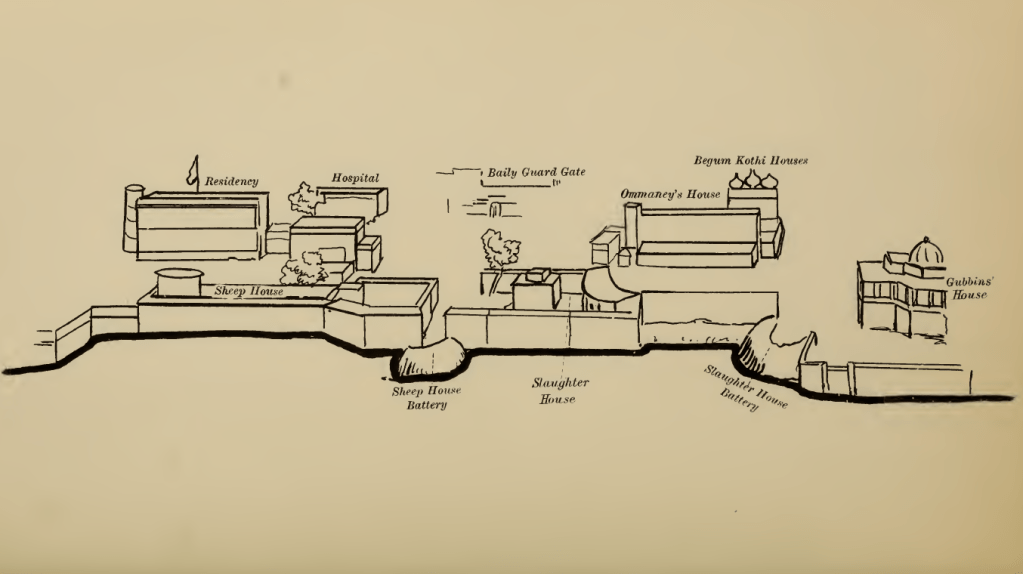
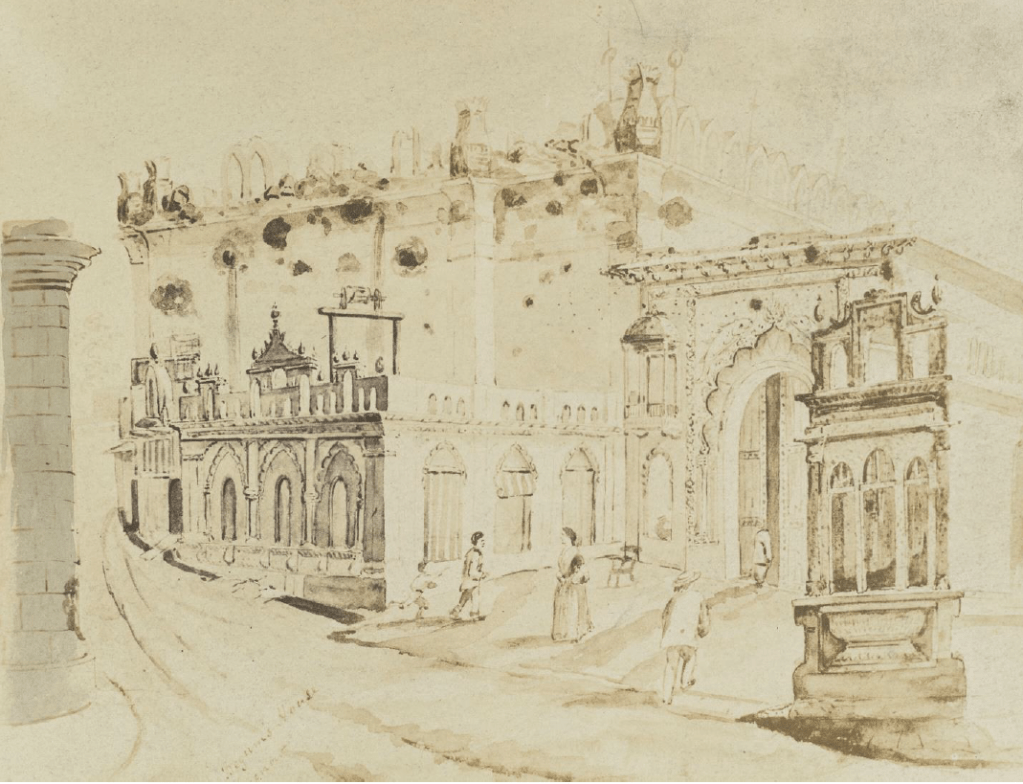
The Begum Kothi (Lady’s Quarters) was a large, imposing building with a lofty gateway and a double range of outer buildings which formed a square within a square, one side of which was the Imambara. An upper room of the Begum Kothi served as the Commissariat store-room, while the house with its adjoining stables was utilised as a canteen and as a liquor store room. As the house and the main guard house behind it were connected to the Begum Kothi by a passageway, they were considered a part of the complex.
From its position and from the mass of its masonry, the Begum Kothi was one of the safest places to be. Despite this, Mrs Bartrum, who spent the entire siege in this building, was less than thrilled. She describes the Begum Kothi as being both uninviting and dirty, with no punkahs to fend off the heat and the flies, and without any furniture. Initially, she shared one room with 15 other women and their children, sleeping on the floor on mats, though later they did get some charpoys to sleep on, three chairs and a table. Mrs Bartrum was a fugitive from Gonda (along with Mrs Clark and Mrs Hale, who shared her room at the Begum Kothi) and had arrived at the Residency with nothing but the clothes on her back and her infant son – her husband, Robert, had remained behind in Gonda. As a lady without any particular rank and lacking influential friends in the Residency, Mrs Bartrum was one of the many women left to fend for themselves. Her food did not come out of private stores; she drew her rations from the commissariat stores, and when the last servants fled the chaos of the siege, she took it upon herself to keep the room clean -some of the other women were mentally and physically too ill to care. Determined as she was to “add to the comfort of others,” she adds rather sardonically, “even if I afford them amusement by giving them occasion to call me servant-of-all-work.”
For a time, while she was still strong and her child was healthy, and she was receiving occasional news from her husband, Mrs Batrum was able to take on the work in a grim but nevertheless determined fashion. But as the months work on, her health started to give way, and with her son suffering repeatedly from dysentery, she writes, “I am not inclined to look on the bright side of anything now, all looks so dark, and there is no sweet hope…” With no very influential friends, Mrs. Bartrum had to rely on the help of strangers – a soldier who cut some firewood for her when her own dinner knife proved to be too blunt, a little milk for her child which she received every day from Mrs. Ousely, and the kind Dr. Darby who did what he could for the young widow, bringing arrowroot and suji to supplement her infant’s diet and lancing the boils that erupted on Mrs. Bartrum’s fingers. It was the kindness of a fellow sufferer – he had left his wife and baby behind at Kanpur. Mrs Bartrum did all her cooking on the veranda; her stove was a cooking pot placed upon two bricks, with a small fire underneath. She washed clothes (without soap) and tried to nurse her ailing friends when they became ill and, in consequence, comforted their orphaned children. While the firing and discomfort were bad enough during the day, she could keep herself occupied, but at night, without a reliable punkah, the room became terribly hot, the incessant noise of musketry and shelling keeping her alert, the flies twice as bothersome, and rats crawling over the restless children; it is no surprise Mrs Bartrum’s diary makes for very bleak reading. With very little news from the outside, even from the other posts, she does not speak of the siege in terms of battles and victories. Her husband Robert, who was part of Havelock’s force, was killed on the approach to the Residency, and he died without ever seeing his family again. His body was never recovered. Kate’s son survived the siege but died in November, the day before they were due to leave Calcutta for England. Mrs Bartrum sailed home alone. For her, there was to be no happy ending.
The Slaughter House, Sheep House and the Racquet Court
Several structures stood on this front, which served as cook rooms and stables, initially in the service of the main Residency building. During the siege, these outhouses were repurposed as cattle pens and slaughterhouses to serve the commissariat department. The fodder for the live animals was kept in the walled racquet court, which for a time was called the Bhoosa (Fodder) Garrison.
As can be imagined, keeping animals in siege conditions was extremely difficult. Initially, many of the cattle roaming through the compound, falling prey to roundshot and described rather vividly by Wilson as “tumbling down wells”. Until the commissariat department was able to organise itself, herd the cattle into the pens and appoint men to look after them, much valuable livestock was wasted. Without any way to preserve the meat and refrigeration unheard of, the dead animals which could not be consumed were buried at night in pits by fatigue parties made up of civilians and officers alike. The horses fared worse. Terrified by the noise of the shelling around them, they ran wildly through the grounds, dying of exhaustion or bullet wounds, while others died of fright and some of neglect in their stables. It was noted that, due to hunger, some of the horses had begun to eat the hair of each other’s manes and tails.
Lacking the time and the manpower to care for so many animals, it was thought kinder to turn the horses out of the Residency altogether, and they were driven off into the city. Only fifty, which were considered valuable, were kept in the horse square and looked after by a few retainers. Sir Henry Lawrence particularly kept his horse, which he bequeathed in his will to his nephew. Dr Fayrer had kept a trained elephant before the siege; what became of the animal, however, is not mentioned. All dogs were ordered to be destroyed as feeding and caring for them was thought to be impossible; however, a few did survive the siege as their owners simply neglected to follow orders.
The Sheep House, next to the Slaughter House Post, was a row of low houses used as pens to keep the sheep in before their slaughter for food. In the same area, a group of Indian Christians and their families also found shelter. Both areas were actively defended by Captain Boileau of the 7th Light Cavalry and by civilians of the Uncovenanted Services. At the end of the lane between the sheep yard and the slaughterhouse, a battery was started to flank and protect that front, but the work was only partly completed, and the battery was never used. It was considered a singularly disgusting place to defend. The entrails and offal of the slaughtered animals were more often than not simply flung over the outer wall where they rotted in unseemly heaps, leaving the place crawling with flies and awash with horrid smells.
 Mutiny Reflections