In Pursuit of Kunwar Singh – I

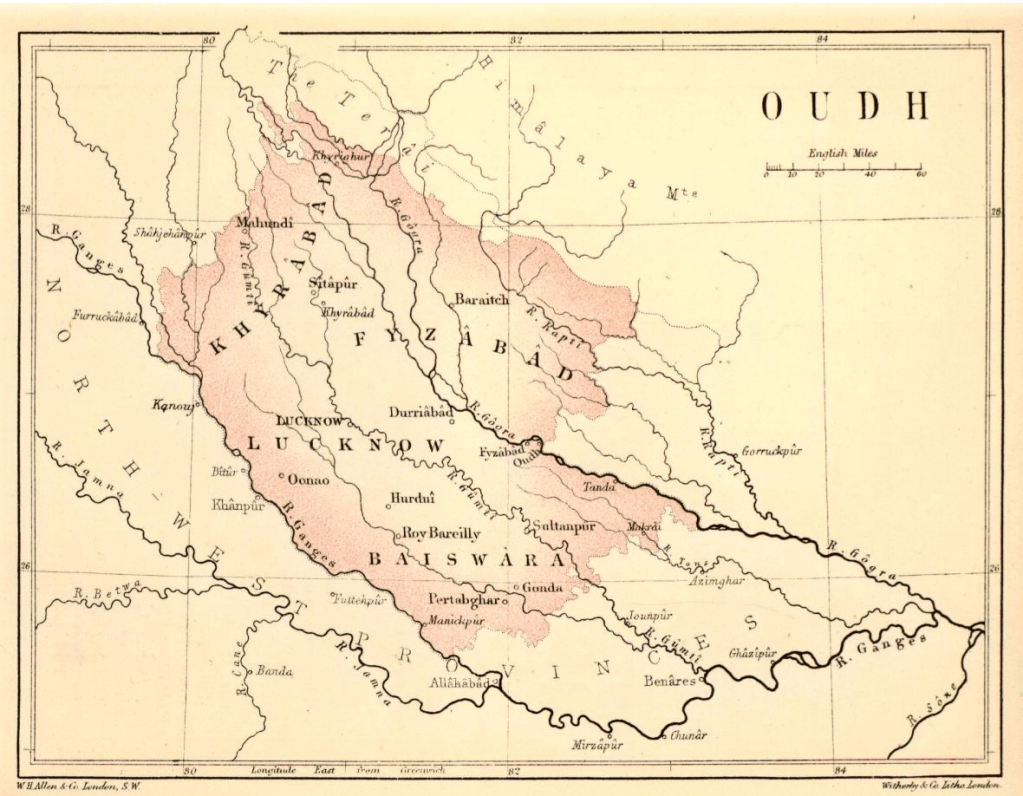
One of the dispatches sent by Colonel Milman from Azamgarh reached its destination of Lucknow on 28 March. That Azamgarh was besieged was not news Sir Colin Campbell, on the cusp of the opening of his Rohilkhand Campaign, needed. There was nothing for it – a column would need to be sent for his relief.
The Articles of War say ‘ Obedience is the first duty of a soldier, ‘ so we cannot grumble whatever comes .” (Diary Entry, Pte. Malcolm, 10th Regt, 29 March 1858)

HM’s 10th Regiment of Foot had seen all they had wanted to see of India. Ever since 1842, they had been guests on her shores, had lived in her cantonments, and had fought in their Queen’s battles in both Sikh Wars; at Sobraon, the Relief of Multan, and the Battle of Gujrat. Then came seven years of comparative rest, with a long halt at Ferozepore that Private Malcolm called “the worst station in India”, where heat, apoplexy and cholera played the devil in their ranks; then it was off to Wazirabad to replace the 29th Regiment that had been decimated by sickness. If nothing else, Wazirabad was certainly a worse station than Ferozepore, for to their horror, on their arrival, their barracks had not been built, and their accommodation consisted of tents over which a shed had been built. The heat was terrific, with temperatures in the tents rising to 110°F during the day, but the torrential monsoon rains turned their camp into a swamp. At Wazirabad, they received the disheartening news that their regiment, which had expected to go home after two years in India, would now remain for another seven. By the time their barracks were built and the 10th had fairly settled into life in Wazirabad, the order came for them to don their packs and march to Dinapore— it was 1856, and there was perhaps some possibility of going home at last, had it not been for that scuffle in Crimea.

“This is the Gravesend of India; it is the last place regiments are stationed in before going home. But I am afraid that in consequence of the continuance of the Russian war, there is no likelihood of any Queen’s regiment being withdrawn from India for a long time, at least, until the war is over; still it is certain that our regiment will return first. The regiment we relieved in Lahore in 1854 left this station last year for England. They are now in England — the 96th regiment.” (Malcolm)

Before mutiny was even a topic, the 10th was also faced with the prospect of being sent either to the Persian Gulf or, worse still, China. What was certain was that they would go home “next spring,” – but it did not happen. Spring 1857 saw the 10th still at Dinapore, and by the time the mutiny rolled about, it was clear they were not going home. Instead, they would witness the mutiny at their station and subsequently be on the receiving end of Dunbar’s fatal attempt to relieve Arrah in July. Those who made it back from Dunbar’s expedition had grisly stories to tell, but when Major Eyre called on the 10th Regiment, they not only relieved Arrah but chased Kunwar Singh from his jungle stronghold of Jagdishpore. Malcolm wrote to his relatives at home in November 1857:

“I don’t think the 10th will leave the Behar district, as we are the only Europeans in it. We have five companies in Dinapore, and five companies here in a jungle, about one hundred miles from Dinapore, waiting to move whenever the rebels rise. “We can get scarcely anything to eat, but we have our health… We certainly shall be very often engaged with the rebels, as the district is very large. You must not be surprised if I don’t write to you so often, for it is only in certain places that we can write.”


The next time he wrote home, it was February 1858 – in the time intervening, the 10th had joined Brigadier Franks’ and his field force; and they would then fight their way through the final capture of Lucknow. Malcolm was still optimistic that the 10th was going home, “We expect in a day or two to be sent to our several stations, and there is talk of our going home. this year.” It came sooner than expected. On 26 March, after 17 years in India, the 10th was ordered to march to Calcutta – they were going home. Two days later, they turned their backs on Lucknow and, with joy, set their faces homewards. The very next day, they were recalled – Colonel Milman was holed up in Azamgarh, writing frantic letters for relief to all quarters, including Lucknow, and it was decided that the 10th were going to meet Kunwar Singh again. So, with the Article of War in mind, the 10th stoically, and undoubtedly with muttered curses, returned to Lucknow. Azamgarh was 15 marches away.

Brigadier Lugard’s Column
Cavalry

Military Train
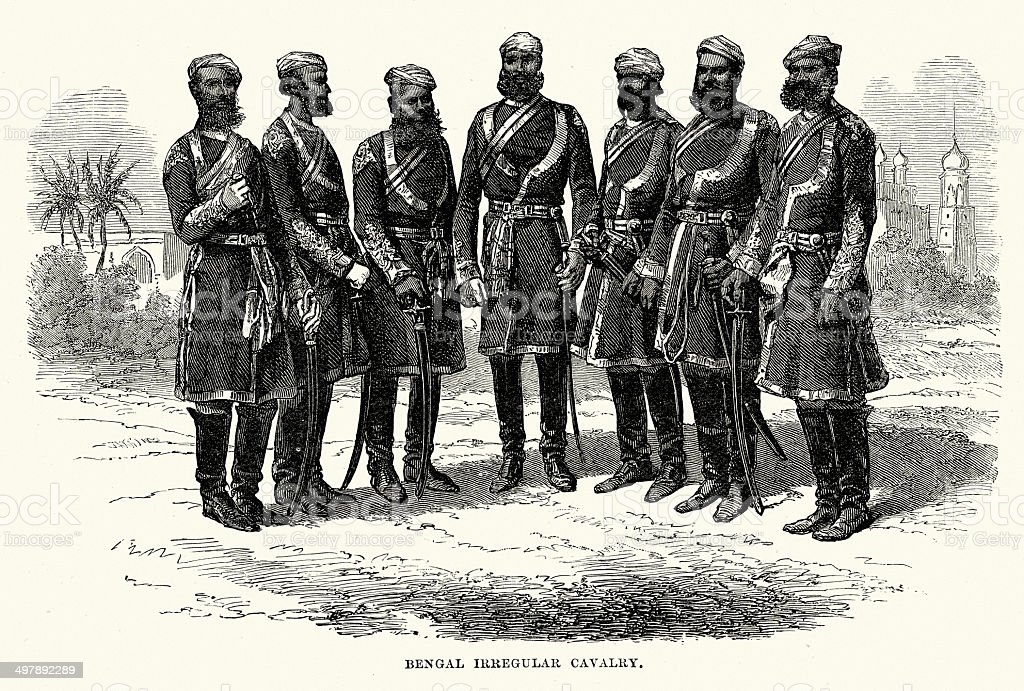
3rd Sikh Cavalry
12th Bengal Irregulars (1 squadron)

Infantry

HM’s 10th Foot
HM’s 34th Foot
HM’s 84th Foot
Detachment Royal Engineers
Punjabi Pioneers

Artillery:
1/2 E Troop, Royal Horse Artillery (2nd Captain & Brevet Major J.E. Mitchell)
A/3 Madras Artillery (Captain G.S. Cotter)
Heavy Battery:
8/2 Royal Artillery (Captain J. Thring)
Detachment 5/13 Royal Artillery (Lieutenant W.H. Fitz Maurice)

O.C.A. Lieutenant Colonel C.J.B. Riddell, R.A.
S.O. Brevet-Major N.O.S. Taylor, R. A

The following civilians accompanied the force: from Lucknow, Mr Forbes, C.S., acting for the intelligence department, Mr Jenkinson, C.S., and Mr P Carnegy (Deputy Commissioner) joined the force at Jaunpore.

60 men of the 10th Regiment were mounted, just as they had been in Brigadier Franks’ force, to act not only as scouts but as impromptu cavalry, to follow up retreating rebels and keep them busy until the remainder of the troops came up for an organised attack; the work was not new to the 10th, and their services would prove invaluable. One of the men was Lieutenant Montague Battye, whose brother Quinten had been killed at Delhi leading the charge of the Guides. Another brother, Charles, was riding with the 3rd Sikh Cavalry. Only four days earlier, they had bid farewell to their younger brother, Wynyard, who was off with Jung Bahadur’s army. For Montague in particular, this return of Kunwar Singh must have been beset with apprehension – he had survived Dunbar’s folly with a crack on the head and had nearly lost his life to a river crocodile (mugger) during the retreat; the mugger had dined on a fellow officer instead, leaving Montague to face the fortunes and fights of the HM’s 10th for many months to come.

Once again, that very intrepid volunteer, Mr Edward Henry Venables, who had, at first opportunity, disentangled himself from Azamgarh, and with fortune on his side, met up with Brigadier Lugard at Sultanpore. He had something of a score to settle with the rebels — after all, they had but lately placed a bounty on his head. Little did he know, his own days were numbered.

The March Begins – the Battle of Munnihar/Tigra, Oudh, April 11, 1858

On 29 March 1858, Lugard’s force left Lucknow. No one seemed particularly interested in their departure; the Times correspondent, William Russell, merely notes he went to see them forming up. The weather was becoming fearsome; blistering days, sweltering under tents, gave way to stuffy and very dusty night marches, and for the next six days, there wasn’t a rebel in sight. Lugard had planned to march directly to Azamgarh, but this was not to be.

Sultanpore Cantonments, April 5th 1858
Be so good as to tell His Excellency that I arrived here this morning all right, but owing to the bridge having been destroyed by fire, and there being no boats, I could not effect a crossing under a week; I therefore proceeded down the right bank towards Jaunpore.”
(signed) Brig. E. Lugard

If the heat and the bad roads were not enough, there would also be a fight at hand. A chakladar (feudal chief) named Ghulam Hussain had come to the conclusion that the small force of Gurkhas, who had been left to garrison Jaunpore were quite a trifling matter – he had his personal army of some 3000 men, and they were wreaking havoc through the countryside, having plundered and burnt a village just a day before Lugard arrived at Tigra, some 8 miles distant from Jaunpore. Hussain, however, had some very odd notions of how the mutiny was proceeding. He had proclaimed to the people, whose livelihoods he was busy plundering, that Lugard was all that was left of the British army, which, according to him, had been destroyed before Lucknow. They were now running for their lives, seeking safety in the Lower Provinces. All this destruction, thought Hussain, would serve a purpose by ensuring there would be no provisions for Lugard’s army, but plenty for his. It did nothing to improve the already miserable plight of the people who fell along Hussain’s road, who by now must have been heartily fed up with one errant raider after another; in this time of lawlessness, one army barely differed from the other.

At Tigra, Lugard found the insurgents had moved six miles further back and had taken the day to burn and destroy the village of Selaidapore. There was little Lugard could do to prevent it – his men were tired, having just marched 16 miles in the blazing sun over bad roads; even the cattle that he had taken along had begun dying along the way, and Lugard decided the best he could do was call a halt. However, with the insurgents so close, he sent out scouts to reconnoitre their position. Towards evening, he received intelligence that the insurgents were planning to move, very much as if they were setting off on their next march. “This was about 4 p.m., and fearing they would make off, I at once ordered out all the cavalry off duty, consisting of 293 sabres, with three Horse Artillery guns and proceeded with them in pursuit, requesting Brigadier Douglas to bring up a portion of the infantry in support.” Riding with Lugard were both Battye brothers, Mr Venables and 24-year-old Lieutenant Charles Wemyss Havelock, the nephew of the late Sir Henry. Although a lieutenant in the 66th Gurkhas, he was doing duty with the 12th Bengal Irregular Cavalry when they mutinied at Sagauli. The detachment of the 12th at Gorakhpur was disarmed by Mr Wynyard, but a few had made a rush, retook their arms and dashed off. In all, only 83 men had remained loyal; with them, young Havelock had attached himself to his uncle’s army and had spent nine months in his employ. Attached to a Gurkha regiment for the taking of Lucknow, he was on the move again with the 12th Irregulars and Brigadier Lugard.

Lugard had been given to understand that the insurgents were encamped in a grove of trees just on the other side of Munnihar village, and numbered in all 3000, of which 800 were mutinied sepoys and cavalry of the 37th BNI and the 12th Irregulars. They also had two guns. He quickly came up to their cavalry picquets, who had moved up to three miles from Lugard’s camp; however, these thought better of it and rode off as Lugard advanced on them. As for the insurgent army, they were indeed in full retreat. With no time to lose and seeing his opportunity to punish Hussain slipping away, Lugard sent the 3rd Sikhs under Captain Pearse and a party of the 12th Irregulars under Lieutenant Havelock, supported by a squadron of the Military Train under Major Robertson. Major Michell of the Royal Artillery hurried on after them, but in the fast approaching dusk, there would be very little for them to do. There must have been something appalling in the sight of Lugard’s cavalry, sabres at the ready, charging in fury down upon the insurgents. A great many of them ran but those who did stand to fight did so with considerable determination, taking the brunt of the onslaught of the cavalry, while others ran for cover into huts.

Charge of the Sikhs

Charging through the village was Lieutenant Havelock, very much in front, but unfortunately in the line of fire of a man who, hidden in one of the huts, took aim, hitting Havelock full in the face. His men rallied around him, and a doolie was quickly organised, but he died before he reached the camp. Meanwhile, the pursuit thundered on for another three miles. When they were done, 80 of Hussain’s men lay dead on the field, and his two guns of local manufacture — a very large iron 8-pounder and a 2 3/4ths-pounder (of small bore) — were dragged into Lugard’s camp. While his force managed to return before most of the night was over, the guns did not appear until 4 am. The effort was somewhat wasted. The artillery declared both guns useless for Lugard’s purposes, and he ordered them to be burst. Their massive carriages were dismantled, and any materials deemed useful for the force were salvaged.

“The cavalry could not certainly have marched yesterday less than thirty-two miles, and the infantry twenty-eight miles. The exertion in such weather was very great, but I considered the object required it; for had Golam Hussain’s force gone away unpunished and with their guns there would have been no limit to their falsehoods and boastings. As it is, the fact of their flight, punishment, and loss of their guns must become patent to the district.” (Brig. E. Lugard, dispatch, Camp Tigra, April 12 1858)

On 12 April, Lugard rested his men. The next day, they marched 13 miles to Didarganj, where he would learn what Kunwar Singh had in store for him at Azamgarh. The chase, as they say, was now on.


Returns of the 11th of April 1858

3rd Sikh Cavalry
3 troop horses killed
5 rank and file, and 7 troop horses, wounded

12th Irregular Cavalry
1 native officer, 1 rank and file wounded, 1 troop horse missing

Lieutenant Charles W. Havelock — born in Cawnpore in 1834. Aged 24. He was the only man killed that day.

“Lieutenant Havelock was shot through the head gallantly leading his men, and he expired before returning to camp. He was an intelligent, brave and gallant soldier, well worthy of the name he bore…” – Dispatch, Brig. E. Lugard, Camp Tigra, April 12.

Son of Maj.-Gen. Charles Frederick Havelock (formerly 16th Lancers) and Mary Wemyss. Major General Havelock had fought and was wounded at the Battle of Ferozeshah; subsequently, he fought at Mudki, at Gujrat and Sobraon and was present at the Capture of Ghaznee. He gained the rank of Lieutenant-Colonel in October 1854 in the Osmanli Irregular Cavalry and the rank of Major-General in August 1856 in the Ottoman Army. Charles was his eldest child and his only son. His daughter, Mary, had married John Bensley Thornhill and spent the mutiny in the Lucknow Residency. Her husband was mortally wounded when he went out to save young Harry Havelock during the first relief.

Major General Charles Frederick Havelock

In the Jaunpore Cemetery, near the old Police Lines (north-east of the mauza Bharsara), is the tomb of Lieutenant Charles Wemyss Havelock; should it still be there, it bears the following inscription:

Sacred to the memory of Charles Wemyss Havelock, Lieutenant 66th Gurkhas, and Second-in-Command, 12th Irregular Cavalry, the beloved and only son of Lieutenant-Colonel Charles Frederick Havelock and of Mary his wife, aged 24 years. He was killed in the action at Tighra with Sir E. Lugard’s force, whilst gallantly leading his men of the 12th Irregular Cavalry in a charge against the rebels. Born February 16th, 1834, died 11th April 1858.


Lieutenant Havelock’s Helmet

In his autobiography, “Old Memories”, Hugh Gough relates a peculiar tale of a particularly smart helmet that had once belong the Captain Charles James Salmond, once adjutant in the Gwalior Contingent Cavalry, later serving as ADC to Sir Hope Grant. Grant narrated that Salmond’s death occurred during the Battle for Cawnpore on 6 December 1857. He “…had loitered a little behind, was found with his throat cut, and a terrible gash across his chin. The poor young fellow must have met with some of the enemy who had been lying hid till the force passed, and had murdered him in this shocking manner.” The helmet in question was brought back with Salmond’s body and subsequently auctioned.
The helmet “excited my envy and admiration,” so much so that Gough asked a friend to purchase it at the auction on his behalf. However, Lieutenant George Austen Patterson Younghusband of the 5th Punjab Cavalry outbid him, and Gough was left empty-handed. However, the helmet would shortly come up for auction again. In January 1858, Sir Colin Campbell marched on Fatehgarh and in the ensuing skirmish, Lieutenant Younghusband was mortally wounded, shot through the lungs. Following his death, his effects were up for auction. Still determined that the helmet should grace his head, Hugh Gough once again bid on it and was again “…outbid, and the helmet fell to the nod of Lieutenant Havelock, a nephew of the General. He, too, was killed wearing it; and rumour subsequently said a fourth officer had bought it and had been killed. It was a strange coincidence, and as these deaths occurred quickly one after the other, I ceased to wish I had been its possessor.”

Gwalior Contingent Cavalry
Officer’s Helmet, 1st Gwalior Contingent Cavalry, ca 1848

Sources:

Ball, Charles – The History of the Indian Mutiny, Vol II (The London Printing & Publishing Company, Ltd.)
Battye, Evelyn Désirée – The Fighting Ten (London: BACSA, 1984)
Behan, T.L. – Bulletins & Other State Intelligence for the Year 1858, Part III (London: Harrison & Sons, 1860)
Caine, Rec. Caesar – Barracks & Battlefields or the Experiences of a Soldier of the 10th Foot in the Sikh Wars and Sepoy Mutiny (London: C.H. Kelly, 1891)
Dodd, George – The History of the Indian Revolt and the Expedition of Persia, China & Japan (London: W.&R. Chambers, 1859)

Forrest, G.W. – A History of the Indian Mutiny, Vol III (Edinburgh & London: William Blackwood & Sons, 1902)
Führer, Rev. A – List of Christian Tombs and Monuments of Archaeological or Historical Interest & Their Inscriptions in the North-Western Provinces & Oudh (Allahabad, Government Press, 1896)

Gough, General Sir Hugh – Old Memories (London: William Blackwood & Sons, 1897)
Jocelyn, Col. Julian R.J. – The History of the Royal & Indian Artillery in the Mutiny of 1857 (London: John Murray, 1915)
Malleson, Col. G.B. – History of the Indian Mutiny 1857-1858, Vol II (London: William H. Allen & Co., 1879)
The Sepoy War of 1857-58, Compiled from the Private Journals of General Sir Hope Grant (London: William Blackwood & Sons, 1873)