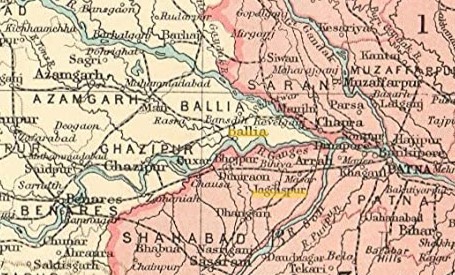
Kunwar Singh’s strategy of evacuating Azamgarh before becoming entangled in an all-out battle with Brigadier Lugard had given the British a moment’s pause. It was mystifying as to why, with his superior army, he had not taken either the entrenchment or attacked Lugard with vigour. It was not the only surprise he had in store for the British.
Brigadier Lugard realised that his only option at this juncture was to divide his force. Having taken complete command of the Azamgarh Field Force, he now had a sufficient number of men of all arms to mount not just a pursuit of Kunwar Singh, but to continue operations in the district.
After the fight on the 15th, Kunwar Singh had halted at the village of Naghai, not 15 miles from Nathupur. Here, he occupied a small but well-defended fort, in the belief that the British would pursue him. He planned to strike them such a crippling blow that they would be forced to not only retreat but be dissuaded from keeping up the pursuit, so he could cross the Ganges in peace. Before Douglas arrived, Kunwar Singh had put his forces in order. His position was well-shielded by a grove of trees and breastworks, while his guns were so positioned to greet Douglas with considerable destruction. If things worked out, Douglas was walking into a trap.
Brigadier Douglas set out from Azamgarh on the 15th of April with:
Three guns, E Troop Royal Horse Artillery
Four guns, Major Cotter’s Battery, Madras Artillery
Two 5-inch mortars
Detachment of Punjab Sappers
One Squadron Military Train
Two Squadrons 3rd Sikh Cavalry
One Wing HM’s 37th Regiment
HM’s 84th Regiment
One company, Madras Rifles
Naghai – 17 April
It would not be until the 17th, however, that Douglas was ready to march. At 3 in the morning, the force set off from Nuthupur and, as expected, found Kunwar Singh at Naghai. He sent the cavalry and horse artillery of the advanced guard through the village along the road, with the infantry cutting across the fields and as soon as practicable, opened with artillery. While the barrage was swift and should have been lethal, the insurgents’ breastworks were holding, and they were able to stand their ground. Coming up to the edge of the trees, it became clear to Douglas that Singh had posted a considerable number of men in the grove; now, as if to repay the compliment, Singh’s artillery opened fire. Any attempt to charge Singh’s guns at this juncture failed; however, for their part, the insurgents were unable to capture Douglas’ guns either, although it was not for lack of trying. Douglas threw part of the 37th, 84th and the Madras Rifles into skirmishing order with supports and under a very heavy fire, they rushed Singh’s positions, driving them off at the point of the bayonet. For their part, the rebels retired “in good order from tope to tope, followed by the infantry, a number were bayoneted in their trenches, and a colour was taken by the 37th”.
While the infantry was clearing the front, Kunwar Singh sent a “considerable force” to Douglas’ left. Hence, he kept them at bay with the Horse Artillery and Cotter’s Battery while the Sikh Cavalry charged. It would take “several charges” before the insurgents finally fell back.
“I followed the enemy for some distance, and a number were cut up; they were very determined, and evidently trained soldiers: in their retreat they divided into two bodies, and I halted for some time, till I could ascertain which was the main body; I then started in pursuit along the lower Ghoosee road, passing through Chuprah and Etawah, at which latter place the enemy seemed to have united; our force bivouacked at Ghoosee, within four miles of the enemy, after a march of twenty miles; from information afterwards received, the enemy, on our arrival, moved six miles further on.“
What Kunwar Singh had managed to do was secure two lines of retreat for his main columns, which he had divided, and although the loss of life in the retreat was considerable, his men maintained their discipline throughout. As soon as Douglas had called off the pursuit, the two columns reunited and halted for the night. It must have been an interesting night indeed – the two armies were bivouacked within 6 miles of each other across a vast and silent plain.
18-19 April Nagra to Manohar
The next morning, Douglas was up early but Kunwar Singh was quicker. By the time Douglas had resumed the march, Singh managed to reach Nagra, 18 miles distant, without any molestation from the British. For the remainder of the day, they were followed by the Sikh Cavalry and the horse artillery, but the exhausted infantry could not keep up the pace and did not come up in time to engage Singh’s men. After a march of 24 miles, Douglas was within 3 miles of Nagra. In the early evening, Douglas received information that Singh had, in fact, left the town upon his approach, but the spies had no idea which road he had supposedly taken. Singh’s spies were quicker on the uptake. They had been watching Douglas’ every move, and as soon as he called a halt, Singh broke up his camp and marched to Sikandarpur, crossed the Gogra and pushed onto Manohar in the Ghazipur District. Douglas’ spies did not provide him with any reliable information until after midnight, and it was 2 in the morning before Douglas resumed the chase. He quickly picked up Singh’s track, picking up stragglers from his army on the way, from whom he heard, “…the enemy were in much distress by the rapid pursuit, not having had time during the last two days either to cook or sleep.” When Douglas finally called a halt, he was within 4 miles of Singh’s camp. The rest, much to the chagrin of his men, would not be a long one, for Douglas turned out his men well before daylight to catch Singh, if at all possible, while his men were still asleep. Since leaving Azamgarh, both armies had marched 120 miles in dreadful conditions. “The heat was oppressive, and when the sun rose the rifles became hot and a heavy burden; but the troops trudged on over the roads deep in dust…”
20 April Manohar

This time, Douglas had the upper hand. Singh’s position was not as secure as it had been at Naghai, and while he had taken a position in some very thick woods to the right of the village, he had not taken the appropriate measures to secure his position and was most likely not expecting Douglas to fall on him just as dawn was breaking.
Douglas ordered a few rounds of grapeshot to be fired directly at Singh’s position and then advanced a part of the 27th, the 84th and the Madras Rifles in skirmishing order through the woods, with the cavalry, and both the Madras and Horse Artillery moving quickly around by the right. It was little surprise then that after a determined but very brief resistance, Singh’s men broke, the cavalry and horse artillery hard on their heels. A part of the insurgents managed to reach the Gogra, six miles distant, where they piled into boats and crossed the river, all the while under a heavy fire from the Horse Artillery and two of Cotter’s guns, supported by a portion of the Military Train. Meanwhile, two of Cotter’s guns, with a smaller portion of the Military Train and the Sikh Cavalry, had continued the pursuit on the right chasing some 1500 of Singh’s men – the ground however, was so broken and treacherous that one of Cotter’s gun carriages broke, obliging its withdrawal but the Sikhs carried on for several more miles, “cutting up a great number and dispersing the remainder.”
Singh’s army had retreated in such a rush that they had left behind not only one 9-pounder gun — “a brass 9-pounder gun belonging to the Honorable East India Company’s service, complete in horses and ammunition” — a quantity of limbers and wagons, along with an “immense quantity of ammunition and a large quantity of treasure.” Several bullocks, hackery carts and four elephants completed the Singh’s losses, but the prize was undoubtedly the regimental colours of the 28th Regiment, found wound around the dead body of a subedar. Their mutiny in Shahjahanpur had been one of particular brutality and had not been forgotten.
Although routed from Manohar, Singh had managed to keep his senses about him. Instead of proceeding in one column, he had once again split up his army, and now several columns took different routes. According to a preconceived plan, they were to be reunited again “at a given hour of the night at some settled spot,” but Douglas was in the dark as to where and when that was to be. Accordingly, Douglas gathered up his force and proceeded towards Bansdeh to the point where the roads diverged, one towards Ballia and the other towards Bayreah. Here, he called a halt until he could figure out where, on India’s vast plain, Kunwar Singh had gone.
“Koor Sing was reported first to have gone to a village named Rajogaon, and afterwards to Taintwar, where the dispersed rebels had their rendezvous. I proceeded in that direction, and found several bodies of the enemy on my left, and I also understood that they were holding the village; it being nearly dark, and the country thickly wooded, I did not consider it advisable to advance further, and bivouacked within two miles of Taintwar. During this night, no spies came in; we were under arms at 2 a.m.; on the 21st; but at this time a spy came in, saying that the enemy had collected all their forces in a dry tank close to the village, and our reconnoitring party made the same statement, which prevented my moving off till daylight.”
21st – 22nd April
Douglas called the advance, but he found that once again, Singh had thwarted him. He had indeed been there, but by the time Douglas arrived, his army was gone. Douglas pushed on the cavalry and Horse Artillery with some haste towards Seopar Ghat, seven miles below Ballia, where it was reported Singh was intending to cross the Ganges. Colonel Cumberlege, who was still patrolling the roads out of Ghazipur with the Madras Cavalry, missed Singh in the dark, and Douglas’ information was woefully inaccurate. While Singh’s agents collected enough boats to cross the Ganges, he had circulated a story that he not only had no boats but would be forced to cross the river on elephants. This is what Douglas was led to believe, and when his cavalry and artillery arrived on the riverbank, expecting a slow-moving column of pachyderms, they found practically all of Singh’s army was already on the other side of the river. In a last act, the Sikhs and the artillery “cut up about 200 and sank one of the last boats that crossed.”
All Douglas could do was call it a day. His men were tired, and he had no means of crossing the river unless he planned to swim. So Kunwar Singh completed crossing the Ganges and made his way to Jagdispur while Douglas wrote his reports and waited for orders. These would come sooner than he expected, as a singular disaster was about to occur, that would throw everything into disarray.

Numerical Return of Casualties in a portion of the Azimgurh Field, Force, detached under Command of Brigadier J. Douglas, C.B., in the pursuit of the Rebels from Azimgurh, in the Engagements at Azimgurh on the 17th, at Munnihur on the 20th, and at Sheopore Chat on the 21st of April, 1858.
E. Troop Royal Horse Artillery—1 rank and file wounded.
2nd Battalion Military Train —1 troop horse killed.
Her Majesty’s 37th Regiment—1 rank and file, killed; 1 subaltern, 7 rank and file, wounded.
Her Majesty’s 84th Regiment—8 rank and file, wounded.
3rd Seikh Cavalry—1 troop horse killed; 1 havildar, 4 rank and file, and 3 troop horses, wounded.
Total—1 rank and file, 2 troop horses, killed; 1 subaltern, 1 havildar, 20 rank and file, and 3 troop horses, wounded.
Total Casualties.
1 man killed, 22 wounded.
1 follower wounded.
2 horses killed, 3 wounded.
Sources:
Ball, Charles – The History of the Indian Mutiny, Vol II (The London Printing & Publishing Company, Ltd.)
Behan, T.L. – Bulletins & Other State Intelligence for the Year 1858, Part III (London: Harrison & Sons, 1860)
Dodd, George – The History of the Indian Revolt and the Expedition of Persia, China & Japan (London: W.&R. Chambers, 1859)
Forrest, G.W. – A History of the Indian Mutiny, Vol III (Edinburgh & London: William Blackwood & Sons, 1902)
Kaye’s & Malleson’s History of the Indian Mutiny of 1857-8 – edited by Col. Malleson, Vol IV (London: W.H. Allen, 1889)
Malleson, Col. G.B. – History of the Indian Mutiny 1857-1858, Vol II (London: William H. Allen & Co., 1879)