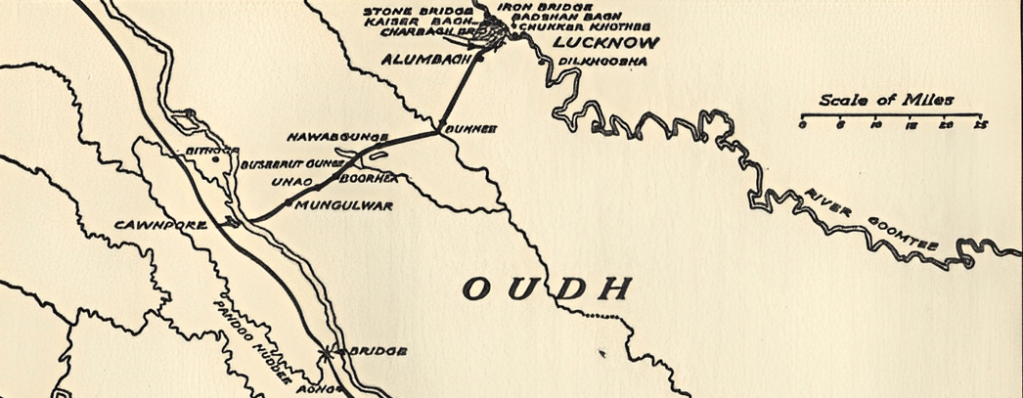
Tuesday, April 13th — A night of great pain. Clifford came in to see men, and pronounced that I had an attack of dysentery. This is pleasant, considering the Head-Quarters march tonight and I must go with them. Clifford says there is no alternative but to take a dooly, as I am quite unfit to travel on horseback. Such a way to begin a campaign ! But, please God, let me able to get into the saddle ere the fighting begins.
At a quarter past two in the morning, on April 14, 1858, William Howard Russell, that intrepid reporter for The Times, who had covered the war in Crimea and had for some weeks now been doggedly following every step Sir Colin Campbell made, found himself sick, tired and above all, too ill to ride. The weeks at Lucknow, with the pestilential air of decomposing bodies, the dirt, dust, foul water and increasing heat had taken their toll on Mr Russell. Now, he would march to Bareilly, albeit in a doolie. His trusty servant, Simon, ever by his side, provided him with every comfort possible for a sick man, filling up his flasks with congee water (water in which rice has been boiled, an effective drink for cases of dysentery) and placing, as an added precaution his sword and pistols, sharpened and loaded at his side, for, according to Simon, there are plenty of badmashes in the little streets of Lucknow. With extra bearers – eight instead of the customary six, as Mr Russell was not exactly the lightest man to carry – and torches to light his way, Mr Russell bid goodbye to Lucknow.
“We have only a handful of men as escort, and the members of our mess have started just as they pleased, some on elephants, some on horseback, some in buggies, and the sick in doolys. I was too much fagged to observe more than the picturesque effect of the torchlights moving in the distance. Soon we were in the deserted lanes of the huge city, and frequently we came upon families returning to their homes, who had selected night for a secret return, and were surprised by the torchlights. Ay de mi, Lucknow. I am quite convinced it was the dust which made me ill. We went out of the city by the Charbagh, passing the Alambagh on our way to Cawnpore. This is a melancholy mode of progression — so sad and solitary; no one to speak to; smothered, if you open the purdahs, by dust, and by heat if you keep them shut.“
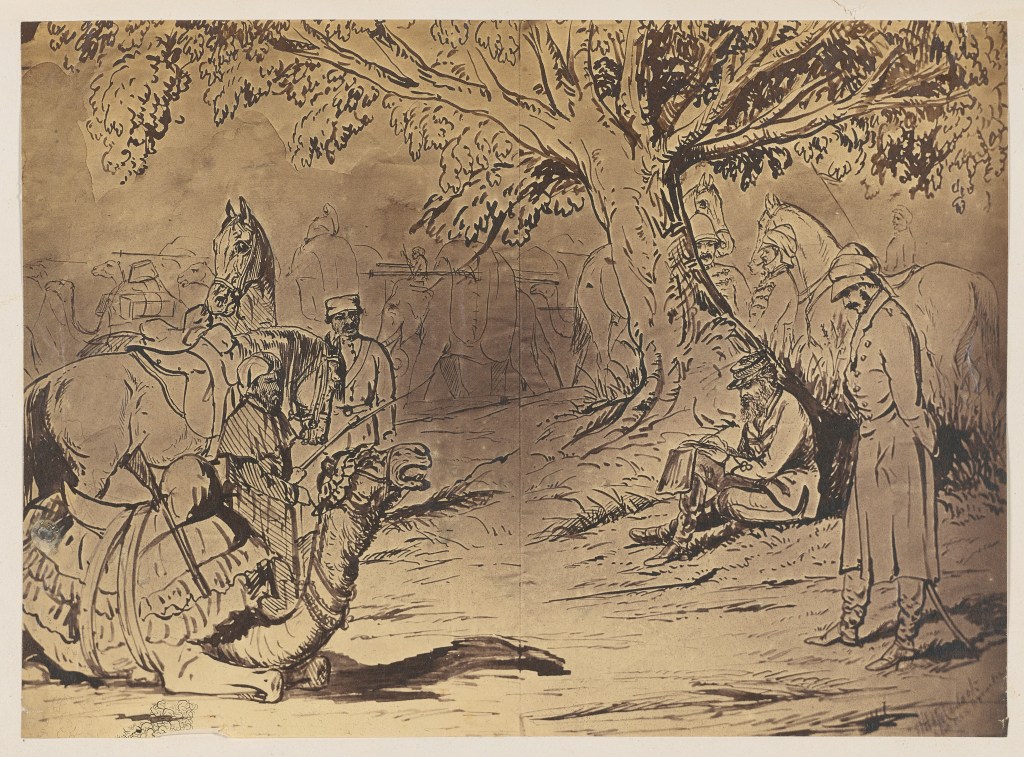
The first halt came a few hours later at Banthera. Awakened by his doolie being placed on the ground, Russell realised he was not alone – the doolie next to him contained an exalted, but very doomed man; Captain William Peel.
A thin hand is stretched out and draws the curtains. A pale face rises languidly from the pillow.
“What, Russell! You in a dooly? Why, I thought nothing would upset you. What’s the matter ?”
“Why, my dear Sir William, if a man lives over graves, drinks bad water, and breathes powdered pandies, he must give in at last.”
Russell could not know they would not have many more conversations. While waiting for their tents to be set up, the two men spoke of France, of her navy and politics. At seven in the morning, they repaired to their respective tents to wait for the next march to begin.
April 15th — Buntheerah to Nuwubgunj. Nuwabgunj.—At 2 this morning, marched from Buntheerah, and arrived at Nuwabgunj, and encamped at the usual hour. Our wits sharpened all night by reports that the enemy are hovering on our flanks as we march. We see nothing of them, but Simon announced that one of my camels had suddenly bolted off in the dark with my chairs, and the best part of my camp outfit on his back, and says, “Budmash sowars will catch mastar’s chairs.” There is a brave old custom of always encamping on the same ground, which secures you the reversion of the smells of your predecessors, and something more.
And the march continued. At three in the morning, Russell was once again packed into his doolie and carried by torchlight towards Oonao. During the night, he had been kept awake by the picket close to his tent. By now, everyone had developed their own theories of warfare, the pickets included.
An Irish corporal was instructing his hearers in the art of war. “ It all dipinds,” said he, “ on where you hit yer inimy. Suppose I offered to hit you, Hollman, on the head, ye’d have yer two hands ready for me, and I wouldn’t hurt you a bit; but suppose I gev you a sthroke in the stomach; bedad, I ’d do for you. That’s what we calls a vinerable part, and that’s the whole art of war to find it out, and do it clane and cliver. It’s Sir Colin finds out the vinerable part; it’s their flanks or their sides he comes down on, and thin they turn their backs in a minit, for they’re ‘cute enough to know whin they’re bate, anyhow; and sometimes they discovers it afore it happens, the poor craytures.”
They would find out, in the weeks to come, if Sir Colin was right.
The next night’s march brought Russell to Cawnpore. Instead of a tent, he was brought to the house of John Sherer, one-time magistrate of Fatehpur, who had followed Sir Henry Havelock and remained behind at Cawnpore, picking up the pieces of a destroyed civil service, and trying to find remedies for a terrified population who by now trusted no one, in what was once the gayest station in the district. The British civilians themselves were, as Russell found out at dinner, less than impressed with Sir Colin Campbell. He might have won back Lucknow, but the countryside was now swarming with badmashes, criminality was on the rise, and those sepoys he had failed to manage during the final days at Lucknow only added to the overwhelming lawlessness. He should have done better, was the consensus, even if it meant killing all 20’000 of the rebels who had opposed him. Even Sir Colin’s war machine baulked at such wholesale slaughter; Russell had seen enough at Lucknow to know the civilians, running off their mouths over dinner, had no idea just what horror Campbell had inflicted in the city.
Cawnpore, of course, had its fair share of curiosities to keep Mr Russell occupied. He met the European kotwal, a man named Edward Chandler and a woman he wisely introduced as his wife, the infamous Amelia “Bonny” Byrne. Bonny’s first love had been the Nawab of Fatehgarh ( a match organised by her mother but quashed by the Europeans at Fatehgarh, who sent Amelia to Calcutta to teach her some manners), but her husband had been Reginald Byrne of the 10th BNI. He had valiantly aided in the defence of Fatehgarh Fort while his wife and her mother were safely hidden away in the zenana of the Nawab. Reginald was killed in Cawnpore, not far from where Russell now kept house with Sherer and Bonny, whom Mr Power had once threatened to hang in Fatehgarh for treason, was once again betrothed. After Russell left Cawnpore, Bonny married Edward Chandler, by special licence, on 24 July 1858. She gave birth to a son, whom she poignantly named Byrne, and a little less than a year after Russell met her, on 5 Feb 1859, aged just 20, Bonny died. She lies buried in the Kacheri Cemetery in Cawnpore; Reginald’s name is listed on one of the many plaques in the Memorial Church. Her husband and son disappeared into obscurity.
Russell tried to recover his health; good dinners of curry followed up with enough claret to sink a normal man, he toured Cawnpore, noting that most of the trees had been felled to widen the roads, many of the bungalows had been partially repaired, but the old church was still a burned-out, hollow ruin. The railway was progressing towards Cawnpore, and eventually, although Russell would never see it, the station and cantonment of Cawnpore would be rebuilt, once the dust had settled, over the bones of the dead.
On 18 April, the awful news that Walpole, whom Campbell had sent on towards Fatehgarh ahead of the main column, had been badly beaten at Ruiya. Brigadier Adrian Hope was dead.
“A gentler, braver spirit never breathed—a true soldier, a kind, courteous, noble gentleman in word and deed; devoted to his profession, beloved by his men, adored by his friends—this is indeed a loss to the British army! A sad fate for such a one as Adrian Hope, who would have shone in the grandest battle-fields, or have done himself honour in the greatest of European campaigns by the exhibition of courage and of skill, to be shot down in a ditch by an ambushed ruffian in an obscure Oude jungle fort.”
While Russell remained with Sherer for one more day, the camp was moved to the Subedar’s Tank, just outside Cawnpore and on April 19, well before dawn, Russell rejoined for the march to Chowbeypore. He was out of the doolie and back in the saddle, fit enough to ride but hardly ready for what Sir Colin Campbell had in store for him. Russell leaves little room for the imagination, but he really had very little to complain about.
April 20th. —Chowbeypore to Poorwah.—Oh, Sir Colin, this is very severe! At 2.15 this morning, we were on our way to Poorwah, thirteen miles. The fatigue and monotony of these slow, long marches in the dark are indescribable. You can see nothing. Unrefreshed by sleep,’ only half-awake, every moment you catch yourself just going over the horse’s shoulder. You must look out lest you ride over soldiers or camp followers who throng the road, mingled with flocks of goats, sheep, tats or ponies, camels, bullocks, begum carts, all shrouded in dust and darkness. At last dawn comes, very slowly, no glory in it, no clouds — on the horizon there is a dim fog of dust, a haze which hides the sun. There is no colour, no atmosphere.
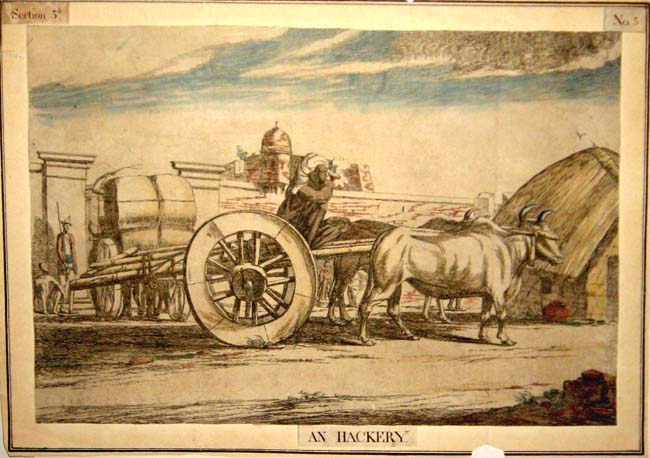
The moment the sun shows above the haze, he burns you like fire. As you pass through the villages, ghostlike figures clad in white rise from their charpoys, which are laid out in the street, stare at you for a moment, and sink to sleep again. Early marches, how I hate you ! and yet you must be, for the men must be got under cover ere the sun is long out. It is joy indeed to come up to the camping ground, and to find the mess-dooly already established in full play under some fine tree, to join the group which is lying on the ground among the ants and dried leaves—alas, there is no grass—and to get the first gulp of refreshing tea. I have hired two bullock-hackeries, which come along very nicely with my effects, and Sherer gave me two splendid black jenny-goats on starting from Cawnpore, which set me up every morning with an abundance of delicious milk.
The next march from Poorah to Urrowl commenced at the accustomed hour of 2 in the morning; this time, Russell managed to find himself a place in the front with the Quartermasters-General, Allgood and Johnson, out of the dust for another 13 miles of tramping in the dark.
In India, the Government camping-ground is reserved at certain stages all along the road, and is marked off by stone pillars. The great object is to get the men under the shade of the trees, the Commander-in-Chief of course, getting the best place. Whilst Allgood and Johnson gallop to and fro with the camp, the kotwal and colour men were laying down the cords for the streets of tents. I fasten up my horse if the syce is not up, and take a sleep with one eye open for the mess camels. One by one, the staff come in. Sir Colin and the chief of the staff are generally some time behind us. Then comes their escort, a handful of cavalry; next the interminable line of tent-camels and elephants, then the cavalry in the centre of a cloud of dust, and at last, “ rub-a-dub-dub, rub-a-dub-dub,” and the infantry, hot and fagged, and white as bakers, trudge up; then more baggage; then the rear-guard, and three miles of stragglers, and bazaar people. We have the 80th with us, fine soldierly-looking fellows, with a cruelly bad band.
All of this would have to be done over and over again, for on April 22, they broke camp at 3 in the morning to march 10 miles to Miran-ki-Serai; Russell, suitably impressed, the marches were improving in both “time and distance,” dined that evening with Sir Colin Campbell. After a pleasant dinner, the intrepid reporter promptly lost his way back to his own tent
For the life of me, I could not find it. I wandered about among the trees in the dark, and at last was forced to shout out “ Simon ” at the top of my voice, no doubt receiving kind wishes from the inmates of the tents. There were plenty of fellows sleeping out in the air on their charpoys, as it was cooler than in the tents. No Simon answered. At last, quite savage, I made over to a charpoy, and shaking the sleeper, said, “ Who’s here? Can you tell me where my tent is?” It was Sir Colin himself who, wide awake in a minute, gazed at me with some wonder. I apologised and told him my story; he laughed, and said, “Well, take a fresh departure from this point now, and you must come upon your tent down that street.” He then stumbled on General Mansfield, who was still sitting up, reading, but was still none the wiser. Russell continued blundering through the camp, shouting for Simon and receiving in reply only curses from the officers who were trying to get some sleep. When he finally found his tent, it was nowhere near where he had last seen it. Colonel Herbert Perry had ordered it moved to make way for his own and his staff.
 Mutiny Reflections