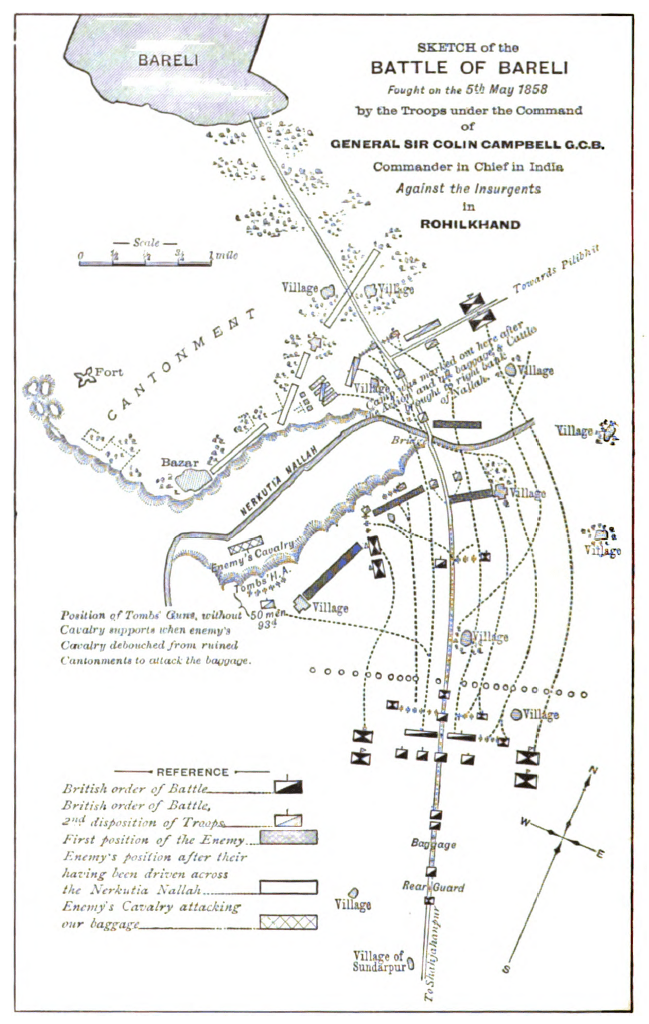
“It is curious how little information we can get about Bareilly. It is said that all the way from Fareedpore till within a mile of the ruined cantonments, the country is as level and smooth as a bowling green. The result is, that the road is raised above the ground, in order that it may not be flooded in the rains. Outside the cantonments, there is a small stream flowing deviously in a deep bed, and the ground is intersected by nullahs, so as to be unfavourable for the movements of regular troops, in various places.” (Russell)
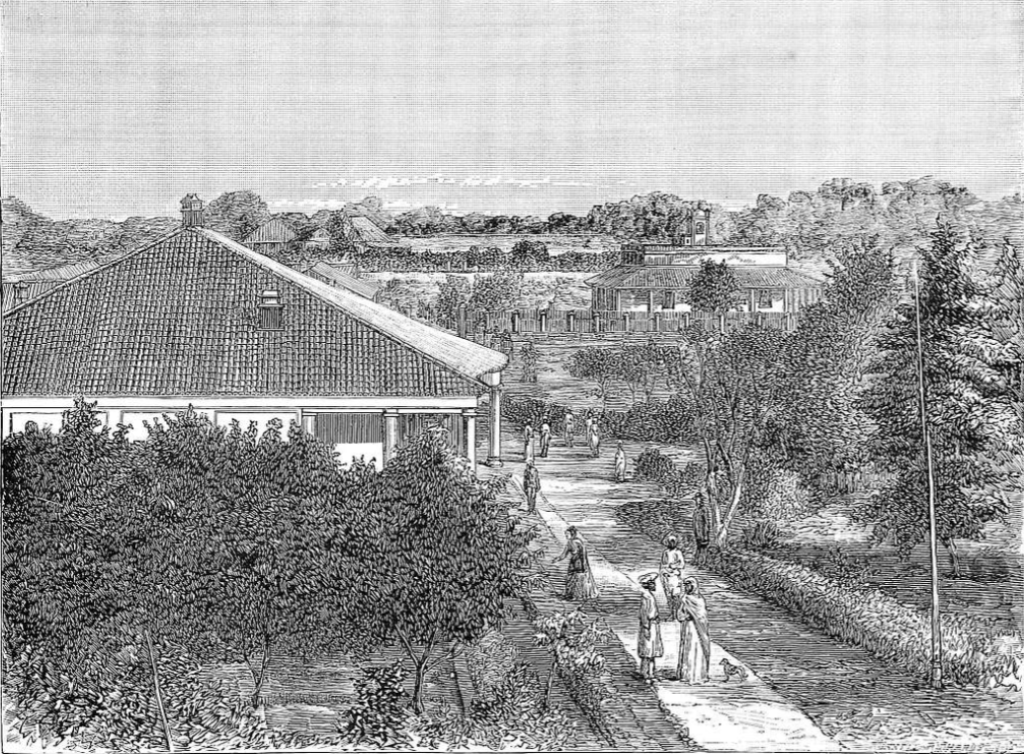
Bareilly itself did not offer itself to a strong defence. There was no fort, no walls or ditches encircling it. The town had one main street, approximately two miles in length, with lanes branching off to its sides. Beyond these streets came the suburbs. Large detached bungalows lined the roads, each in its own walled compound, and once, before the mutiny visited Bareilly, the gardens had boasted of trimmed lawns and an abundance of flowers. Everything had fallen into disrepair now, and what houses had escaped the ravages of plunder a year earlier sat now as crestfallen relics to better days. Beyond the town came the wide open plains, intersected with ravines and small streams. Only the Nattia Nadi, which covered Bareilly on the south side, could be seen as a potential obstacle, with its steep banks providing a natural defensive position against any oncoming army. However, none of the bridges crossing the river had been destroyed. Likely realising the defects of Bareilly as a defensive position, Khan Bahadur Khan decided he would take the fight out into the open plain instead.
4 May, 1858
“Do not attempt to meet the regular columns of the infidels, because they are superior to you in discipline and have more guns; but watch their movements; guard all the ghats on the rivers; intercept their communications; stop their supplies; cut up their piquets and daks; keep constantly hanging about their camps; give them no rest!” (Proclamation of Khan Bahadur Khan, circulated in Rohilkhand, 1858)
Obviously aware that Sir Colin Campbell was indeed on his doorstep and Brigadier Jones was advancing from Moradabad, Khan Bahadur Khan had two choices: in the first instant, he could pack up his army and flee towards Pilibhit, the road to which was still open, or he could give Sir Colin a roughing up before he left. If he wanted to keep face in front of his followers, among whom he now counted hundreds of wild Ghazis, leaving without a fight would never do, and he needed to strike a blow against the British if he intended to keep his name alive in Rohilkhand.
Towards dusk on May 4, he moved his army out of Bareilly and over the Nattia Nadi. His position was chosen with some care; he had the high ground of the river banks on which to place his guns, and he commanded the line by which the British would have to advance. This he covered first by his infantry and guarded both his flanks with cavalry. His second line was placed in the old cantonments closer to Bareilly itself and still kept the Philibit road under his control. He further held a force of infantry in reserve on the Bareilly side of the river, near the bridge. If the spies were correct, Khan Bahadur Khan had a force of no less than 55’000 men of all arms, a number that should have been able to stagger Sir Colin Campbell. That is, if Khan Bahadur Khan actually had 55’000 men.
Sir Colin Campbell had opened his Rohilkhand Campaign prepared. Gone were the days of badgering Calcutta for reinforcements, of watching weary men collapse after miserable marches in their heavy, unsuitable clothes, of raw recruits and inexperienced commanders. The men Sir Colin Campbell had taken with him from Lucknow and ordered from beyond knew their work, some of them all too well, and they knew the Commander in Chief.
Without counting the siege train, the numerical strength of the force was 7’637 men and 19 guns.
Artillery – Lieutenant Colonel James Brind, C.B. (Bengal Artillery), commanding
Captain A. Bunny – Staff Officer of Artillery
Lt. W. Tod Brown – Commissary of Ordnance
Lt. J.R. Pearson – Deputy Commissary of Ordnance
Captain C. Cookworthy -Commanding Bengal Artillery attached to the Siege Train
2/1 Bengal Horse Artillery – Lt. Col. H. Tombs, C.B.
3/3 Bengal Horse Artillery – Lt. Col. F. F. Remmington
4/1 Bengal Artillery – Capt. H. Francis – two 18-pounders, two 8-inch howitzers, two 8-inch mortars
No. 14 Field Battery 3/3 Bengal Artillery – Capt. H. Hammond – 4 guns
Siege Train – twelve 8-inch mortars, eight 5 1/2 -inch mortars
3/14 Royal Artillery – 2nd Capt.& Brev. Major W.G. Le Mesurier
Detachment 4/6 Bengal Artillery – Capt. C. Cookworthy
Engineers – Colonel H. D. Harness, R.E. (Chief Engineer to the Force) – commanding
Capt. F.E. Cox – Staff Officer of Engineers
Detachment Royal Engineers (Major W.O. Lennox)
Bengal Sappers and Miners (Lt. F.R. Maunsell)
24th Punjab Infantry – Pioneers (Lt. J.St.J. Hovenden)
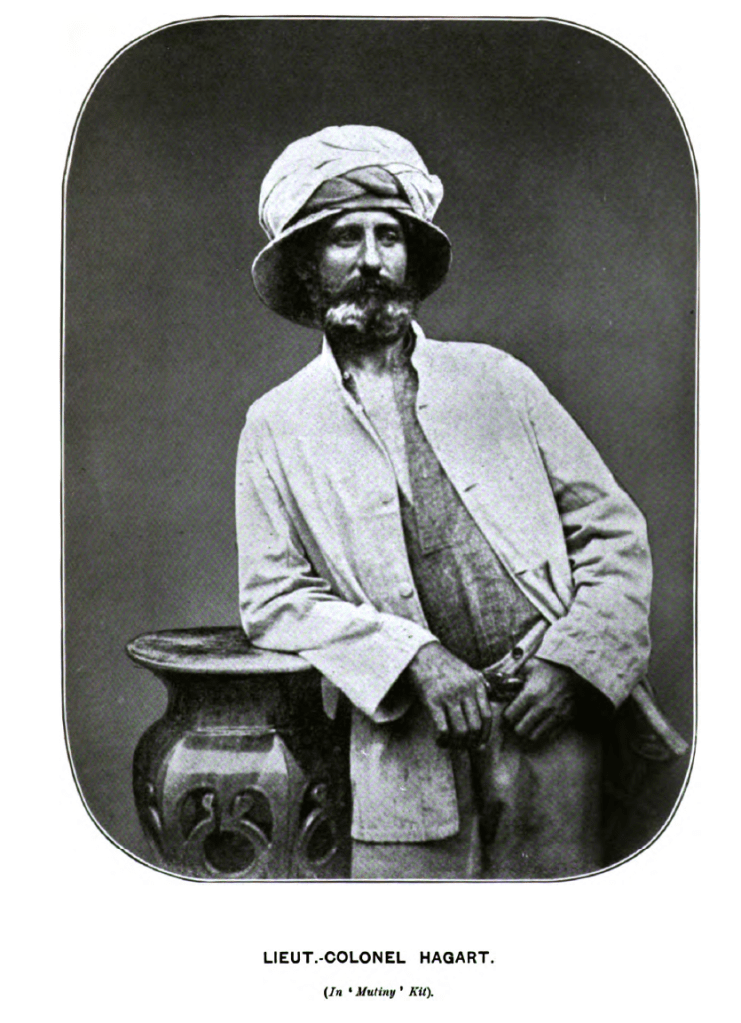
First Cavalry Brigade – Brigadier C. Hagart (7th Hussars)
Major H.A. Sarel – Major of Brigade
Lt. A.F.W. Gore – Orderly Officer
9th Lancers (Capt. J.R.J. Coles)
2nd Punjab Cavalry – one squadron (Major S. Browne)
Detachments of:
Lahore Light Horse (Capt. J.H. Balmain)
1st Punjab Cavalry – one squadron (Lt. A.K.J.C. Mackenzie)
2nd Punjab Cavalry ( Capt. S. Browne)
5th Punjab Cavalry – one squadron ( Lt. W.F.
17th Irregular Cavalry – one squadron (Lt. G.C. Thomson)
Second Brigade – Brigadier R. Jones (6th Dragoons)
Major C.H. Nicoletts – Major of Brigade
6th Dragoon Guards – Headquarters & two squadrons (Capt. Bickerstaff)
Lind’s Multani Horse (Lt. J.B. Lind)
1st Infantry Brigade – Lieutenant Colonel A.S.L. Leith Hay, C.B. (93rd Highlanders), commanding
Major J.H. Cox – Major of Brigade
42nd Highlanders (Lt. Col. A. Cameron)
79th Highlanders (Lt. Col. R.C.H. Taylor)
93rd Highlanders (Lt. Col. R. L. Ross)
4th Punjab Rifles (Lt. J. W. McQueen)
Belooch Battalion – one wing (Lt. H. Beville)
Brigadier Sisted’s Brigade – Brigadier H.W. Sisted, C.B. (78th Regt) commanding
Lt. A. Cassidy – Major of Brigade
Seven companies, 64th Foot (Lt. Col. G.W. P. Brigham, C.B.)
78th Highlanders (Col. H. Hamilton, C.B.)
Four companies, 82nd Foot Col. the Hon. P. E. Herbert, C.B.)
2nd Punjab Infantry (Lt. Col. G.W.G. Green)
22nd Punjab Infantry (Capt. W.J.F. Stafford)
General Staff
Major-General Sir W.R. Mansfield K.C.B. – Chief of Staff
Colonel the Honourable W.L. Packenham, C.B. – Acting Adjutant-General H.M.’s Forces in India
Major H.W. Norman – Deputy Adjutant-General of the Army
Major D.M. Stuart – 2nd Assistant Adjutant-General of the Army
Lieutenant-Colonel J.D. Macpherson – Acting Quartermaster-General of the Army
Captain G. Allgood – Officiating Assistant Quartermaster-General of the Army
Personal Staff of the Commander-in-Chief
Colonel A.C. Sterling, C.B. – Military Secretary
Major Sir F.D. Baird, Bart. – Aide-de Camp
Lieutenant F.M. Alison – Aide-de-Camp
Major J. Metcalfe – Interpreter
Assistant Surgeon W. A. Mackinnon, Surgeon
Divisional Staff
Brigadier-General R. Walpole, C.B. – commanding Field Force
Major C. A. Barwell, – Deputy Assistant Adjutant- General
Major T. A. Carey – Deputy Assistant Quartermaster-General
Captain A. C. Warner – Aide-de-Camp
Lieutenant W. H. Eccles – Extra Aide-de-Camp
Captain W. H Earle – Deputy Judge-Advocate- General
Captain R. G. Simeon – Deputy Assistant Adjutant General, Meerut Division
Major F. J. Harriott, Deputy Judge Advocate- General – Meerut Division
Captain R. Ouseley, – Officiating Deputy Assistant Quartermaster-General – Meerut Division
Lieutenant J. Morland – Baggage Master
1st Class Staff-Surgeon J. C. G. Tice, M.D., Superintending Surgeon
 Mutiny Reflections