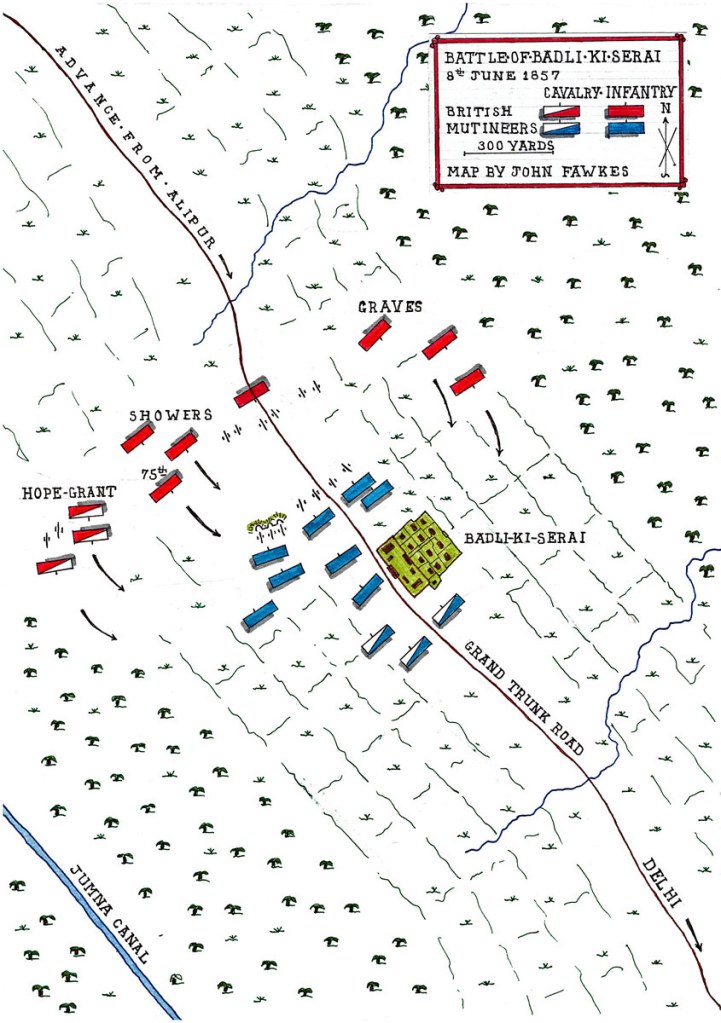
“The mutineers had selected an admirable position on both sides of the main road. To their right was a serai and a walled village capable of holding large numbers of Infantry, and protected by an impassable swamp. To their left, on some rising ground, a sandbag battery for four heavy guns and an 8-inch mortar had been constructed. On both sides, the ground was swampy and intersected by water-cuts, and about a mile to the enemy’s left, and nearly parallel to the road, ran the Western Jumna Canal.”
At midnight, Brigadier Hope Grant set off with the first advance column consisting of artillery and cavalry –
3rd Troop of the Horse Artillery under Major Frank Turner
four guns of the 2nd Troop of 1st Brigade under Major Tombs
three squadrons of H.M.’s 9th Lancers.
They were guided by Lieutenant Hodson with some Native Horse. First, the column crossed the bridge and then followed a bullock track with took them through the empty countryside back over the canal. They moved along the bank to come upon the flank of the enemy while Colonel Showers would attack with the main column from the front. Their progress was much hindered by the poor state of the roads, full of ruts and watercourses – by the time they achieved their position, the discharges of cannon told them the battle had already commenced.
At one o’clock in the morning of the 8th of June, the camp at Alipur was stuck, preparatory to an advance on the enemy’s position. Within an hour, they were ready to march. The plan was to attack the enemy at sunrise.
Second Column, Colonel Graves
6th Dragoon Guards (Carabineers)
four heavy guns were placed in position on the road
a party of Sappers commanded by Lieutenant Chesney
four guns of Major Scott’s Battery
H.M.’s 75th Foot
1st European Bengal Fusiliers
Third Column – Brigadier Grant
1st Battalion of 60th Royal Rifles
2nd European Bengal Fusiliers
the Sirmur Battalion
a party of Sappers under Lieutenant Salkeld of the Engineers,
2nd Troop of the 3rd Brigade under Captain Money
1 squadron of H.M.’s 9th Lancers
The rear guard was commanded by Major Cobbe of the 87th Royal Irish Fusiliers and consisted of one squadron of 6th Dragoon Guards, one company of 2nd European Bengal Fusiliers and two guns of Major Scot’s Battery. They were assembled in front of the siege train. Impressive though it may sound, none of the regiments named were present at their full strength.
“The advance column took a road to the right, so as to come upon the left flank of the enemy; other two columns, the first of which was commanded by Brigadier Showers and the second by Brigadier Graves, moved fully half an hour after the advance column.“
The mutineers had indeed chosen their position carefully, and their numbers were considerable, consisting of nothing less than seven entire regiments, two detachments of infantry and two regiments of cavalry. Their ranks were further strengthened by deserters and fugitives from Ferozepore, Meerut and Ambala, by soldiers on furlough, by policemen and chaprassies of all kinds, as well as innumerable volunteers from Delhi and the ever-present Gujurs from the countryside. Their guns were ably manned by the men of the 3rd Company, 7th Native Battalion of Artillery, by the gun lascars of the Delhi Magazine and retired Golundazes who lived in the city.
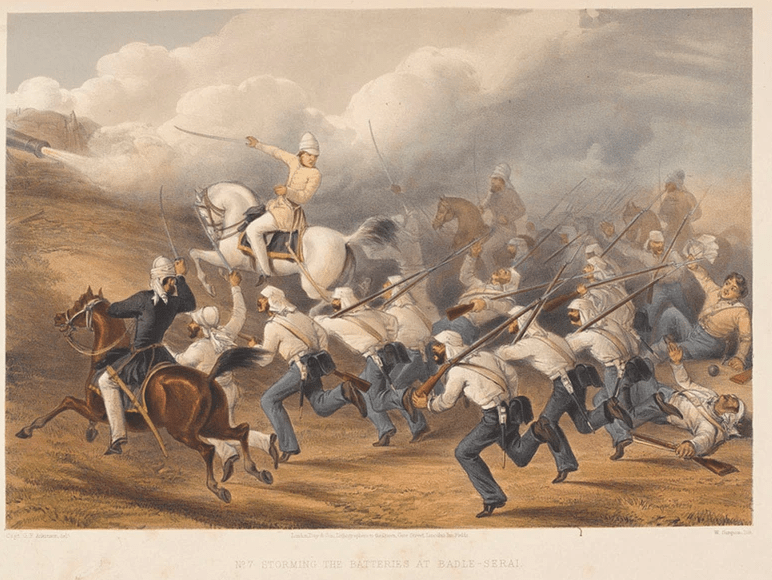
“At half-past four in the morning, the main body came up to the village of Badli-ki-Serai. The sepoys immediately opened fire from the battery in front of the serai. Then were heard the deep shouts of the Europeans and the yells of the sepoys. With deadlier hatred, two foes had never met…”
The Artillery advanced quickly and fired; the infantry deployed on each side of the road. “Their cannon told on our ranks; one of our waggons was blown up, and the bullock drivers of our heavy guns ran away. Captain Money’s troop of horse artillery galloped up, unlimbered and fired with great judgement and precision; but it was evident that the enemy’s guns in their strong and sheltered position could not be silenced.” As the British casualties mounted under the regular and sustained firing of the mutineer sepoys, it was quickly ascertained that the 2nd Column had fallen behind and was not yet in sight. “One round shot carried off the leg of Captain Money’s trumpeter and mortally wounded Colonel Chester, the Adjutant General. Captain Russell, another of the staff, was killed, and several horses fell; Sir Henry Barnard said he had never witnessed such a concentrated fire, even before Sebastopol. The 75th, who had been lying down in line and the 1st Fusiliers, were ordered to charge upon the heavy battery.”
First ordered to form a square to meet the attack of some cavalry, the men scrambled to their feet, only to be quickly formed again in a line when it was ascertained what had been taken for enemy cavalry was, in fact, their own men. “The ground was broken and covered with water…The enemy’s guns were pointed at the advancing line as it struggled through the mud…Seventy men were killed and wounded in a few minutes. Captain Harrison was shot through the head, and seven officers were wounded.”
The 75th “neither flinched nor stayed” and rushed the guns, driving before them at the point of the bayonet the Golundaze gunners and their protection detail of infantry. The 1st Fusiliers carried an enclosure and several houses, setting them on fire; then supported by the 75th, they rushed the serai, broke open the gates and bayonetted the defenders. The 2nd Brigade under Colonel Graves now appeared on the enemy’s right while Brigadier Grant with the Lancers took them in the rear on the left as the guns came up “one by one”. The Lancers wasted no time in falling upon the enemy and captured three guns as Colonel Yule cut down three men singlehandedly. This might have gone badly for Grant – the ground was broken and marshy, and the guns were slow in coming up. In their eagerness to charge, the Lancers dashed ahead, leaving the guns behind. Fortunately, the sepoys had not noticed and failed to capture the guns in the brief moment they were left unprotected.
As it was, progress was the order of the day. Besides driving the rebels back, the British had captured twelve guns, all of the ammunition and their stores. With Badli-ki-Serai cleared of rebels, the whole force continued their advance until they reached a high, open plain on the Karnal side of the canal. Here, a halt was called.
It was thereupon determined to advance across the canal through cantonments and take the heights above them. The Royal Rifles moved to the left and broke into skirmishing order, advancing onwards to the canal, which was, at this season of the year, fordable. Crossing the canal and advancing up the rocky face of the hill, round shot and grape came pouring in very thickly. On crowning the heights and descending the other side, the Rifles advanced a short way, when the colonel of the regiment caused his bugles to sound
” Left shoulders forward;” this was one of the most effective movements of the day, as it completely outflanked the enemy on the heights. At the same time, Captain Money’s troop guns opened fire from the road crowning the heights, on the left side of the Flag Staff Tower. The guns on the heights were now captured at the charge…After the general engagement of the day, the enemy made a contemptible effort to retake the guns on the heights, but our men very soon repulsed the attack.” And so the Delhi Ridge was taken; the next post will take us through what happened next.
After the Battle
Badli-ki-Serai had exposed the rebel weaknesses, the most damaging of which was their lack of competent leaders. Their officers, though able soldiers, were not gifted generals; they had not deployed any forces to protect against outflanking manoeuvres and had failed to keep men in reserve. They had plenty of cavalry at their disposal, and yet they never used it. They neglected to destroy a bridge on the western Jumna Canal about 800 yards to their left, a fatal mistake. While their left was protected by the Jamuna Canal, and their right was protected by a jheel (lake): from this point to the river there was an open space of some five miles, which the sepoys neglected to protect with their cavalry. Had they done so, Colonel Graves could not have outflanked them from the east.
The sepoys numbered roughly 4000 to 6000 men and were holding a position, approximately 600 yards wide, at Badli-ki Serai. Their left and right flanks were turned as they had not guarded them with cavalry and had not taken the British plan of attack into consideration until it was too late.
The British forces implemented a three-pronged attack – a frontal attack by Sowers and the first column, Colonel Grant turned their left flank, and Colonel Graves turned their right. As a sage historian pointed out, “At Leuthen, the Prussians, with 35,000 men, defeated 60,000 Austrians because they turned their flank. Once an army is outflanked, its numerical superiority is nullified since only part of its manpower is facing the enemy.” Besides this, the British simply fought better than the mutineers. They were well-led and had the fire of the fight in them. Their enemy, though numerically superior, was led by old men, none younger than 50, who had never held an independent command or led anything larger than a company in their lives, no matter how long they had served with the ECIo’s army. The sepoys, although they had taken up a strong position and fought with bravery, showed no inclination to manoeuvre in the field. They had allowed themselves to be outflanked and enfiladed by the British horse artillery. Ultimately, the sepoys lost the battle and the Ridge and retreated in disorder. The Delhi Field Force had won their first decisive victory against the mutineers – what commenced now would be called the Siege of Delhi; however, who was besieging whom would soon become painfully clear. The British had reached the city, but by no means was it captured.
Sources:
The Siege of Delhi: Mutiny Memories of an Old Officer – Richard Barter, (The Folio Society, 1984)
Memoirs of My Indian Career – Sir George Campbell, 1893
Twelve Years of a Soldier’s Life in India, being extracts from the letters of the Major W.S.R. Hodson, B.A., edited by his brother, the Rev. George H. Hodson, M.A., 1859
41 Years in India from Subaltern to Commander-in Chief – Field Marshal Lord Roberts, 1897
The Chaplain’s Narrative of the Siege of Delhi, from the Outbreak at Meerut to the Capture of Delhi – John Edward Wharton Rotton, M.A., 1858
Casualty Roll for the Indian Mutiny 1857-1857, compiled by I.T. Tavender, 1983
Military Surgery – George Williamson (1863) – the descriptions of the injuries in italics are attributed to this source
History of the Siege of Delhi by an Officer Who Served There – William Wotherspoon Ireland, M.D. 1861
Delhi- 1857, the Siege, Assault and Capture and given in the Diary and Correspondence of the Late Colonel Keith Young, C.B., Judge-Advocate General, Bengal. Edited by General Sir Henry Wylie Norman and Mrs. Keith Young, 1902
Online Sources:
https://www.britishbattles.com/indian-mutiny/siege-of-delhi/
 Mutiny Reflections