In “The March Begins“ we left the troops hurrying towards Delhi in disarray – General Anson lay dead in Karnal, his successor, General Barnard, a competent officer of Crimea fame, was barely known to the men he was now to command, and he was to join forces with a man who had proved himself somewhat sketchy at best at Meerut, Archdale Wilson.
Before his death, Anson had sketched a plan of operations. Dated the 23rd of May, Anson sent off messages to the brigadiers who were more immediately at his disposal. Choosing to leave Barnard at Ambala, Anson proposed to lead the siege army himself. It would consist of three brigades: 2 from Ambala under Brigadier Halifax and Brigadier Jones, and the third from Meerut under Brigadier Archdale Wilson. Anson’s plan was to send two brigades from Ambala on different days so that all the corps would meet in Karnal, fifty miles from Delhi, by the 30th of May. Then, leaving Karnal on the 1st of June, Anson expected them to reach Bhagput by the 5th with the whole Ambala force except the siege train, which should arrive a day later. It was left up to General Hewitt to organise the Meerut brigade and send it on the Bhagput to meet the Ambala force. On his way, Wilson was to leave a small force at Ghaziudinnagar to secure the road to the Upper Doab while he advanced with the rest of his force to Bhagput. If all went to plan and Wilson left Meerut no later than the 2nd of June, he could be in Bhagput by the 5th.
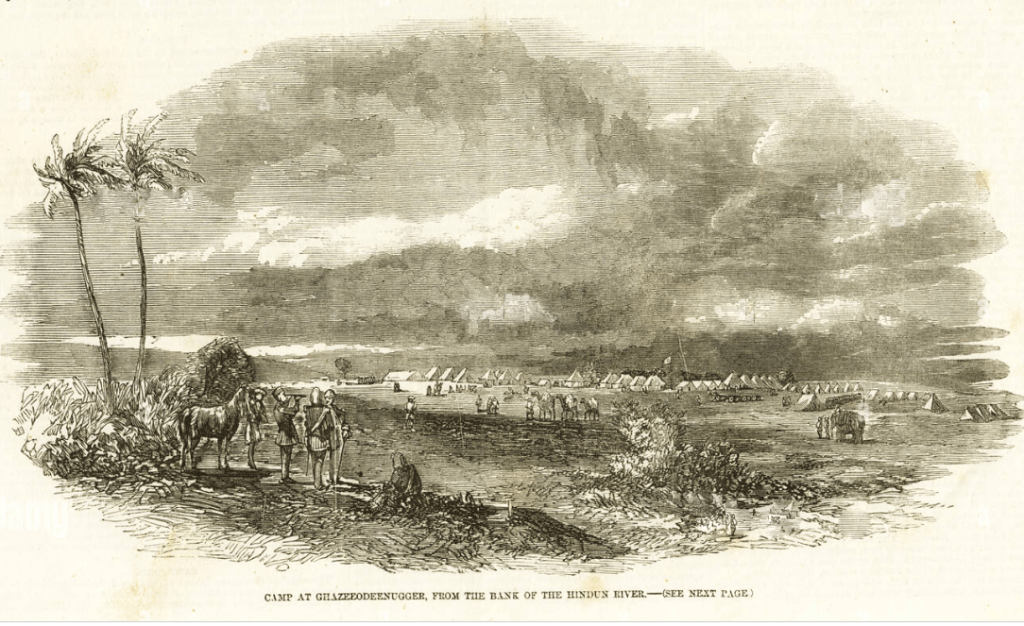
Major-General Hewitt wasted no time assembling a force for Wilson to lead while he himself elected to remain in Meerut. His priority was to keep Meerut secure and protect it from attacks from other quarters; as such, he put together an exceedingly small force: less than 500 of the 60th Rifles, 200 of the Carabiniers, one battery and a troop of artillery. Instead of waiting for the 1st of June, the force marched out of Meerut on the evening of the 27th of May. By the 30th, they were encamped in Ghaziudinnagar on the left bank of the Hindon River, eighteen miles east of Delhi. Although the village itself presented no particular interest, the suspension bridge over the river needed to be secured at all costs.
The Affairs on the Hindon River and Ghaziudinnagar
The mutineers were as aware of the bridge as Wilson. Wasting no time, a sizeable force left Delhi for the single purpose of stopping the Meerut mutineers. On the 30th of May, as Wilson settled into Ghaziudinnagar, the mutineers appeared on the opposite side of the river and, without delay, unveiled their five guns. Wilson immediately sent a body of Rifles to command the suspension bridge while a few Carabiniers were dispatched to find a place along the river they could ford.
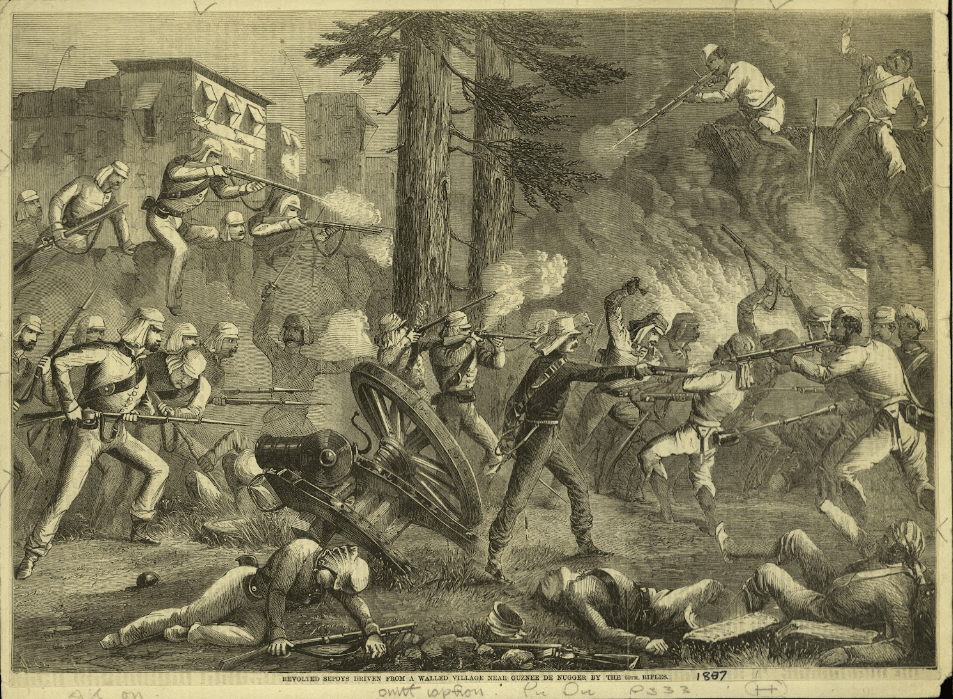
“The insurgents opened fire with their 5 heavy guns, whereupon the brigadier sent off to the attacked points all his force except sufficient to guard his camp, and the contest became very brisk. The Rifles, under Colonel Jones, were ordered to charge the enemy’s guns; they rushed forward, disregarding grape and canister shot and advanced towards the guns. When they saw a shell about to burst, they threw themselves down on their faces to avoid the danger, then jumped up and off again. They reached the guns, drove away the gunners, and effected a capture. The enemy, beaten away from the defences of the bridge, retreated to a large walled village, where they had courage to stand a hand-to-hand contest for a time….”
By evening, the mutineers were in full flight back to Delhi, hotly pursued by Colonel Coustance and his Carabiniers, but they returned to camp before dark fell on Ghaziudinnagar.
This affair at Hindon River cost Wilson 11 dead and 21 dead or missing. Of these were Captain Andrews and four of his riflemen. While capturing two heavy guns on the causeway close to the bridge toll-house, they were blown to bits by the explosion of an ammunition wagon that had been fired by one of the sepoy gunners.
If Wilson thought he had put the mutineers in their place, he was seriously mistaken. Within hours, parties of their cavalry were seen reconnoitring the British position – by the afternoon of the 31st, no less than 5000 mutineers had taken up a position, nearly a mile long, on a ridge on the opposite side of the Hindon, within a mile of Wilson’s advanced picket. The Horse Artillery, with two guns, were sent forward to answer the fire of the mutineers supported by a part of Carabiniers; while another party of Rifles and Carabiniers were hastily dispatched to support the picket positioned at the bridge. For nearly two hours,“the contest was of artillery alone; the British guns repeatedly and vainly charged by the enemy’s cavalry; the enemy’s fire then slackening, and the Rifles having cleared a village on the left of the toll-bar, the brigadier ordered a general advance.”
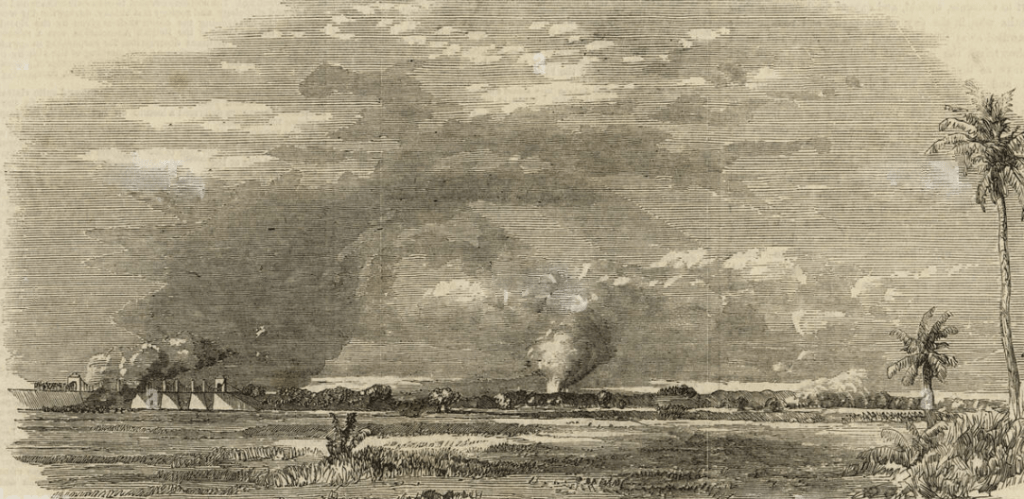
Again, the mutineers were driven off and forced to retreat, but the result was less decisive than the day before. Wilson refused to allow his men to pursue the mutineers for any distance, and the enemy was able to carry off all their guns, two heavy and five light.
The result was another 24 killed and wounded for the British force, with 10 alone struck down by the sun. Lieutenant Perkins was killed, while Captain Johnson and Ensign Napier were wounded.
The mutineers, for their part, left off attacking Wilson at Ghaziudinnagar, who could now sit and wait for reinforcements without being forced to expend any more of his men in skirmishes. On the morning of the 3rd of June, he was joined by 100 men of the 60th Rifles from Meerut and the Gurkha Sirmur Batallion from Dehra Dun. He then wasted no time in marching the Bhagput to rendezvous with the Ambala Force. However, instead of taking a direct route to Bhagput, Wilson found it prudent to take a very circuitous road which proved not only to be hilly, it was a rough, rugged road – as a result, he would not reach Bhagput until the 6th of June.
The Advance
Meanwhile, in Karnal, Sir Henry Barnard too delayed his advance; he was waiting for the heavy guns to arrive from the Punjab. The ones in his possession he felt were too small – all 6-pounders – and Barnard wanted the 9-pounder battery promised to him. It arrived on the 31st of May and Barnard called his force to advance that very evening.
What he wasn’t expecting however was what Wilson had done.
“Sir Henry expected to have met Brigadier Wilson at Raee, where there was a bridge of boats over the Jumna; but through some misconstruction or countermanding of orders, Wilson had taken a much more circuitous route by Ghazieeoodeen Nuggur, and could not join the Umballa brigade at the place or on the day expected. Barnard, after a brief sojourn and a slight change of plan, sent out elephants to aid in bringing forward the Meerut Brigade and advanced with the greater portion of his own force to Alipore where he arrived on the morning of the 5th of June. Then chief artillery force being with the Meerut brigade, Sir Henry waited for Wilson...”
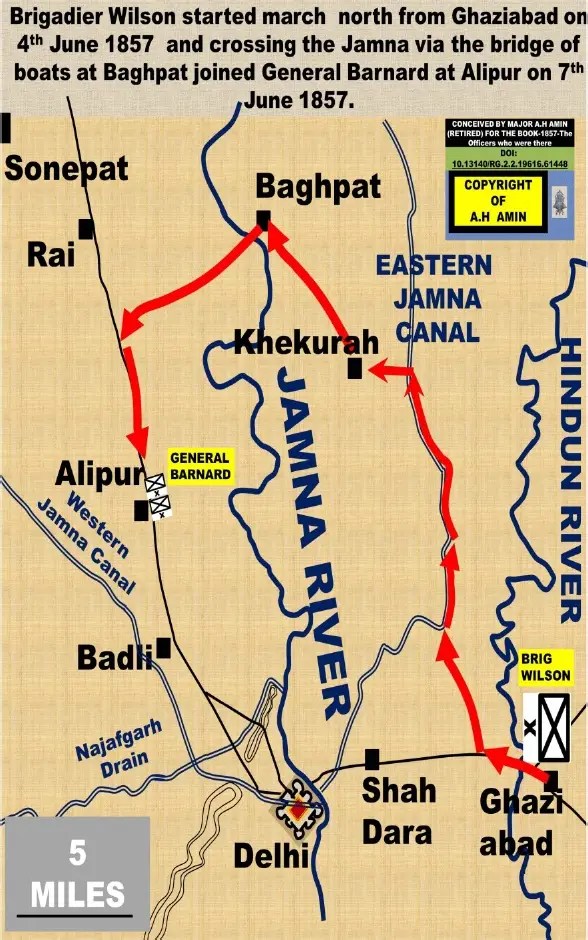
On the 7th of June, Wilson’s brigade finally crossed the Jumna at Baghput and arrived later than expected in Alipore, a full day after the slow and lumbering siege train. Barnard did not have the time for any more irritations; he had his force and was now finally ready to march on Delhi.
The force consisted of 600 Cavalry and 2400 Infantry with 22 field guns. 150 European Artillerymen, chiefly recruits, had accompanied the siege train, itself comprising 18-pounders, four 8-inch and twelve 5-inch mortars. George Campbell, in his “Memoirs of My Indian Career,” described it thus when he saw it passing through Karnal: ‘I could not help thinking that it looked a very trumpery affair with which to bombard and take a great fortified city.’ Though not quite obsolete, many of the guns were well past their prime and thoroughly unsuitable for the work expected at Delhi.
Barnard, while preparing for the final march to Delhi, was apprised of the information that the mutineers planned to oppose his march at all costs: intelligence was needed to ascertain their exact position, and he chose Lieutenant Hodson to reconnoitre. His famous ride of 250 miles in two days had not gone unnoticed, and it was to him that Barnard now turned to find out what the enemy was doing. Hodson did not disappoint.
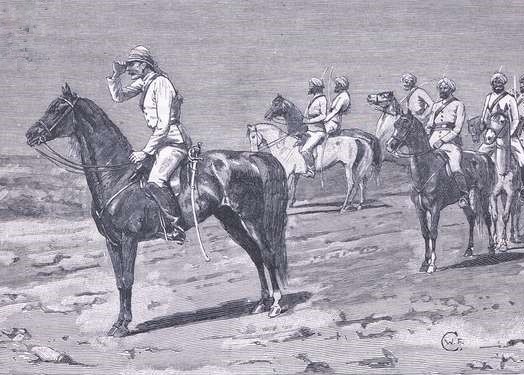
Hodson found the mutineers in a well-entrenched position halfway between Alipur and Delhi, called Badli ki Serai.
Returns of the Killed and Wounded
30th of May Action at Ghaziudinnagar
1st Brigade Bengal Horse Artillery
First Lieutenant Henry George Perkins, killed in action. Aged 27. Memorial at Meerut – “In memory of 1st Lieutenant Henry George Perkins ….. of the 2nd Troop, 1st Brigade, Bengal Horse Artillery who fell in action with the mutineers at the Hindan river on the 31st May 1857, nobly doing their duty. This monument is erected by their Commanding Officer Colonel H. Tombs in token of esteem and regret.“
1st Brigade Bengal Horse Artillery, 2nd Troop
Sergeant Colin McLennan, wounded
Bombardier John McCabe, slightly wounded
Gunners
Donoghue, Cornelius, slightly wounded
Gilmore, John, severely wounded
McAteer, John, severely wounded, right leg amputated
Mahoney, severely wounded
1/60th Foot -1st Kings Royal Rifle Corps
Captain Francis Andrews – killed in action. Memorial at Meerut – “Erected by the 60th Rifles in memory of Captain F. Andrews …. who were killed near this spot in action with the mutineers of the Bengal Army on the 30th and 31st May 1857.”
Ensign William Henry Napier – wounded. Died of wounds at Meerut, 4th June. Aged 21. Son of Major-General Johnstone Napier (Madras Army). Born in Paris. Joined the army in 1855.
6th Dragoon Guards
Troop Sergeant Major John Mackenzie, wounded
Privates
Kelly, Pearse, killed in action
Mason, George, wounded
Nesbitt, Thomas, wounded
Wilkins, Josep, killed in action
31st May Action at Hindon River
Bengal Field Artillery
Rough Rider Patrick O’Neil, killed in action
6th Dragoon Guards
Surgeon Stewart Moore, killed in action
Private John MacCormick, severely wounded
Sources:
Memoirs of My Indian Career – Sir George Campbell, 1893
Twelve Years of a Soldier’s Life in India, being extracts from the letters of the Major W.S.R. Hodson, B.A., edited by his brother, the Rev. George H. Hodson, M.A., 1859
41 Years in India from Subaltern to Commander-in Chief – Field Marshal Lord Roberts, 1897
The Chaplains Narrative of the Siege of Delhi, from the Outbreak at Meerut to the Capture of Delhi – John Edward Wharton Rotton, M.A., 1858
Casualty Roll for the Indian Mutiny 1857-1857, compiled by I.T. Tavender, 1983
Military Surgery – George Williamson (1863) – the descriptions of the injuries in italics are attributed to this source
History of the Siege of Delhi by an Officer Who Served There – William Wotherspoon Ireland, M.D. 1861
Delhi- 1857, the Siege, Assault and Capture and given in the Diary and Correspondence of the Late Colonel Keith Young, C.B., Judge-Advocate General, Bengal. Edited by General Sir Henry Wylie Norman and Mrs. Keith Young, 1902
Battles are still being fought at Ghaziabad and Badli-ki-Serai, however they are those of a modern kind:
https://timesofindia.indiatimes.com/city/delhi/land-sharks-eat-into-1857-war-memorial-in-delhi/articleshow/47135456.cms
https://www.cityspidey.com/news/4247/this-1857-memorial-stands-wedged-amid-scrap-yards-in-ghaziabad-come-take-a-look
 Mutiny Reflections