“Perfect courage means doing unwitnessed what we would be capable of with the world looking on.”
– François de La Rochefoucauld
The nature of the fighting at Badli-ki-Serai of a numerically superior but disorganised force of mutineers against a smaller yet disciplined army meant danger was manifest. The mutineers, especially those who had killed their officers at Meerut and Delhi, knew they would receive no quarter from the British, so surrender was not an option. The British were fighting with much anger. The European community in India was small, and most were to some degree related to each other – more than one man at Badli-ki-Serai had relatives or friends who had either been killed or otherwise abused at the two stations.
Amid the battle, in the chaos of pounding guns, the screams of the wounded, the dust and the burning heat, three very different men distinguished themselves with valour to win the Victoria Cross.
Colour Sergeant Cornelius Coughlan, 75th Regiment of Foot – Dates of Acts of Bravery, June 8th and July 18th. The Honourable VC
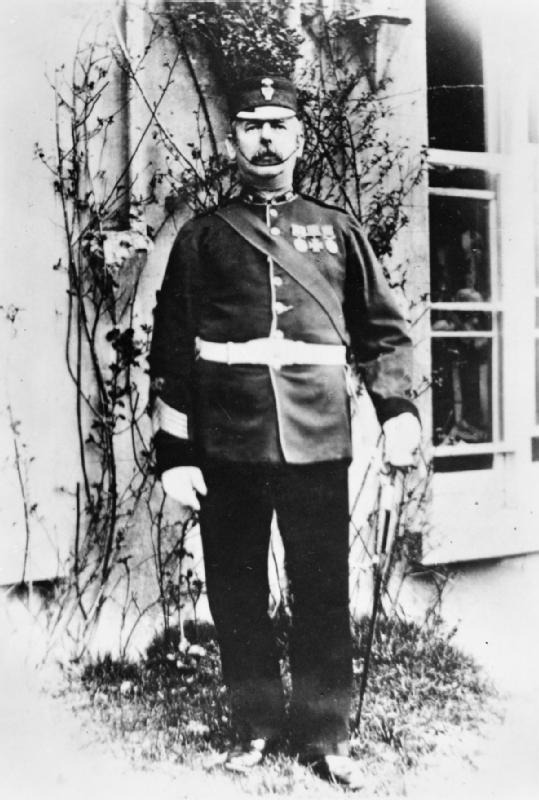
28-year-old Colour-Sergeant Coughlan serving with the 75th Regiment of Foot would have been one of the men who was ordered to take the guns at Badli-ki-Serai, not by firepower but by bayonet. 74 men of the 75th lay wounded, many dying and others killed outright in the first few minutes of the charge. Yet they stormed the guns, always pushing forward until the guns were reached and the serai was open to a relentless attack.
Here, in the horror of battle, came the valiant Sergeant Coughlan, pushing his way with three others into a serai to rescue Private Michael Corbett, who lay on the ground, severely wounded. Despite Coughlan’s best efforts, Corbett died.
“For gallantly venturing, under a heavy fire, with three others, into a Serai occupied by the Enemy in great numbers, and removing Private Corbett, 75th Regiment, who lay severely wounded...”
Coughlan would step up again on the 18th of July during the Siege of Delhi.
“…Also for cheering and encouraging a party which hesitated to charge down a lane in Subzee Mundee, at Delhi, lined on each side with huts, and raked by a cross fire; then entering with the said party into an enclosure filled with the Enemy, and destroying every man. For having also, on the same occasion, returned under a cross fire to collect dhoolies, and carry off the wounded; a service which was successfully performed, and for which this man obtained great praise from the Officers of his Regiment.” (The London Gazette, November 11th, 1862, pp 5346)
The London Gazette, however, omits the more astonishing detail of the charge on Sabzi Mandi.
When the 75th charged the enemy, their commanding officer was shot dead. Undaunted, Coughlan encouraged the wavering men not just by word but by example, rushing forward to continue the attack. His action was followed by victory – the Kabul Gate was stormed and taken, and besides that, the men captured several guns. The achievement did not escape attention and led to a memorial tablet and monument being erected over the Kabul Gate – and it was Coughlan’s name inscribed on the tablet.
Perhaps his most notable feat of valour was during the siege of Delhi. When his regiment charged the enemy, the commanding officer was shot dead, but Sergeant-Major Coughlan, undismayed, encouraged the wavering men by word and example and returned to the attack. The engagement was followed by victory, and the Kabul Gate was stormed and taken, in addition to the capture of several pieces of cannon. This achievement was so noteworthy that a memorial tablet and monument were erected over the Kabul Gate, and inscribed on the tablet was the name of Sergeant-Major Coughlan. Queen Victoria wrote a personal letter complimenting him on his bravery and expressing regret that she was unable to pin the Victoria Cross on his breast herself. He served for thirteen years in India as a Gordon Highlander and for a further 21 years back in Ireland in the 3rd Battalion, Connaught Rangers. He died in 1915 at the age of 87.
District Orders, Devonport, 4th January 1863
The Major General commanding the Western District, having had the honour, in compliance with Her Majestry’s command transmitted through the Right Hon. the Secretary of State for War, to present this day on a General parade, the most honourable decoration of the Victoria Cross to a most deserving N.C.O., Colour Sergt. Cornelius Coughlan of the 75th Regiment; desires to record the fact in District Orders. This is the first occasion during the three years he has commanded the District, that the honour of presenting the V.C. has devolved on him. He used the word “honour” advisedly, for our beloved Sovereign has been graciously pleased to express her deep regret that she is unable to decorate Colour Sergt. C. Coughlan herself. The Major General acts therefore as her representative, and he takes the opportunity of impressing on the Soldiers under his command, that the acts of bravery, for which Colour Sergt. Coughlan obtained the prize anxiously sought for by all ranks of Her Majesty’s Naval and Military Service, and which are recorded by the subjoined extract from the London Gazette of the 11th November 1862, were not mere instances of reckless daring, but exhibitions of cool courage productive of much benefit to the Service. It is by such deeds the V.C. is to be won, and not uselessly risking valuable life. The Major General feels it incumbent on him to record the high character borne by Colour Sergt. Coughlan in his Regt.; Lt. Col. Radcliff considers him a pattern N.C.O., and states, since he entered the Regiment he has never even been reprimanded.
Coughlan would further receive an Indian Mutiny Medal with 2 clasps.

He would serve 13 more years in India with the 75th, after which he returned to Ireland and transferred to the 3rd Battalion (reserve) of the Connaught Rangers, settling down in Westport, County Mayo. Later in life, he served in the South Mayo Rifles. He was also a family man, having married Margaret in 1856, and together they had four children. At the time of his death, four of his grandsons were serving in the army.
Sergeant-Major Coughlan would live in Westport until his death on the 14th of February, 1915, at the age of 87. Although his funeral was fitting for a hero and comprised of a firing party of the Royal Field Artillery, the Fife, Drum and Bugle Band of the 10th Hants Regiment, politics determined he would not receive a headstone until 2004. For nearly a century, Sergeant-Major Coughlan would lie in an unmarked grave. Following the 1916 Easter Uprising, it was determined that Irish soldiers who had worn the British uniform were persona non grata, and Coughlan, although he had been dead a year, never received the honour of a headstone. It would take a change not just in attitude but in politics to allow a nation to honour their heroes.
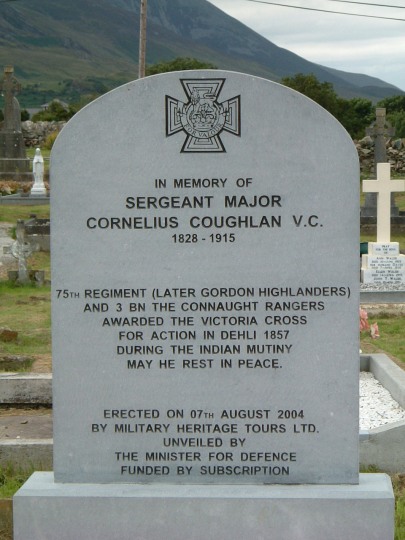
His medals are held by the National War Museum of Scotland, Edinburgh Castle.
The 9th (Queen’s Royal) Lancers
As two of the VCs awarded at Badli-ki-Serai were to men of the 9th (Queen’s Royal Lancers, we shall depart from the narrative for a moment and take a brief look at this illustrious regiment.

Called by all “the beau ideal of all that British Cavalry ought to be in Oriental countries”, the 9th Lancers formed in 1715 by Major-General Owen Wynne as Owen Wynnes’ Regiment of Dragoons to serve as a response in part to the Jacobite Uprising. Renamed the 9th Regiment of Dragoons in 1751, and after becoming a light dragoon unit in 1783, they would, five years later, help oppose the Irish Revolt in 1798. The years 1806-07 would find them far from home, fighting in South America during the failed attempt to capture the Spanish colonies of Buenos Aires and Montevideo. They returned home in 1807 only to be thrust into the Walcheren Expedition in Holland a mere 2 years later, followed by the Peninsular Wars, which lasted from 1811 to 1813. Following this campaign, the dragoons returned home and remained on home service for the next 3 decades. Converted to Lancers in 1816, they took on the title “9th (Queen’s Royal) Lancers upon the accession of King William IV in 1830, in honour of his consort, Queen Adelaide. After their peaceful time in home service, life for the Lancers would suddenly change.
From 1841 to 1880, the 9th Lancers would find themselves dispatched to nearly every major war fought on the Indian Subcontinent- their first sojourn in India would last 18 years.
1842- Gwalior Campaign, including the Battle of Punniar, 1843
1845-49 – 1st and 2nd Sikh War with action at Sobraon (1846), Chillianwallah (1849) and Gujerat (1849)
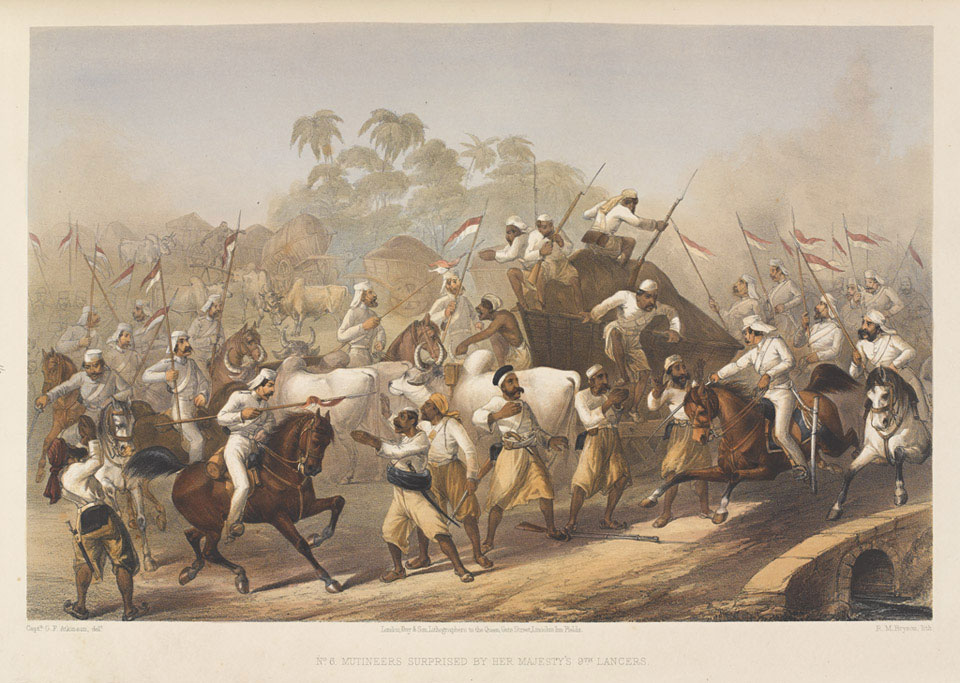
1857 – Besides Badli-ki-Serai, the 9th Lancers took part in the siege and capture of Delhi, the Relief of Lucknow, and the Capture of Lucknow. They earned the nickname “the Delhi Spearmen”, a name given to them by the mutineers for their battle prowess.
The regimental motto “Vestigia nulla retrorsum” (We do not retreat) seems to have been taken to heart by the men of the 9th Lancers – they would receive a total of 12 VCs in the Indian Mutiny.
Patrick Donohoe, Private – 28 September 1857
John Freeman, Private – 10 October 1857
William Goat, Lance Corporal – 6 March 1858
Thomas Hancock, Private – 19 June 1857
Henry Hartigan, Pensioned Sergeant – 8 June 1857, 10 October 1857
Alfred Stowell Jones, Lieutenant – 8 June 1857
Robert Kells, Lance Corporal – 28 September 1857
Robert Newell, Private – 19 March 1858
John Purcell, Private – 19 June 1857
James Reynolds Roberts, Private – 28 September 1857
David Rushe, Troop Sergeant Major – 19 March 1858
David Spence, Troop Sergeant Major – 17 January 1858
When the 9th Lancers finally left India in May 1859, they received the unique honour of a 21-gun salute upon their departure.
Lieutenant Alfred Stowell Jones, 9th Lancers, Dates of Acts of Bravery, June 8th –
A VC for an Ambitious Man
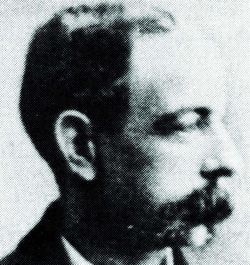
On the creation of the Victoria Cross by Royal Warrant, an ambitious 24-year-old officer was heard to remark he was determined to do all he could to be awarded the medal. That young man was Lieutenant Alfred Stowell Jones.
The army had been home to the Jones family for nearly a century before Alfred joined the 9th Lancers. His grandfather had enlisted in a cavalry regiment in 1758 and held a commission as a cornet in the Royal Irish Light Dragoons. After the regiment mutinied and was unceremoniously disbanded, the loyal Cornet Jones transferred to the 12th Regiment of Light Dragoons. All his four sons held commissions in the army, including Alfred’s father.
The eldest son, Alfred’s uncle, Colonel Rice Jones, served with distinction in the Peninsular War, leading a storming party over a breach at Ciudad Rodrigo. Another uncle was killed in a duel while a lieutenant with the 22nd Light Dragoons. The dispute was with an Irishman of the 6th Irish Dragoons. Alfred’s third uncle, Captain Ebenezer Jones, served with the Royal Artillery. His own father was gazetted a cornet in the 21st Light Dragoons in 1807, but having found religion, he resigned his commission and joined the church instead.
Born in 1832, the son of now Archdeacon John Jones and his wife Hannah, Alfred was educated first at Liverpool College and then at Sandhurst. He joined the 9th Lancers on the 9th of July 1852, as a cornet by purchase. He became a Lieutenant on the 21st of September 1855.
One of Alfred Jones’s best friends was none other than Captain Nolan of the 15th Hussars, whom he met while spending a year at the cavalry depot at Maidstone. Nolan would carry out the fatal order which led to the destruction of the Light Brigade at Balaclava during the Crimean War. Alfred would later state that Nolan “as a red-headed Irishman, was accused of making the mistake which Lord Cardigan was really responsible for.” He went on to say Nolan was well-read in both English and foreign military tactics and quite incapable of making such a terrible mistake.
In 1853, Jones set sail for India.
Until 1857, his life would have been very much the same as any other officer in the Lancers in peacetime and at the start of the mutiny, he was to be found on a private expedition to Tibet. Hearing of the mutiny, Jones rushed to join his regiment at Ambala, only to find they were already gone. Undeterred, he managed to overtake them halfway to Delhi, meeting them on the 7th of June in Alipore. He had made it in time for Badli-ki- Serai.
” The Cavalry charged the rebels and rode through them. Lieutenant Jones, of the 9th Lancers, with his
squadron, captured one of their guns, killing the drivers, and, with Lieutenant-Colonel Yule’s assistance, turned it upon a village occupied by the rebels, who were quickly dislodged. This was a well-conceived act, gallantly executed.” (Despatch from Major-General James Hope, dated 10th January 1858, London Gazette, June 18th, 1858, pp 2960).
Leading the right troop, 4th Squadron, Jones and his men found themselves galloping after a “cloud of dust” which had been pointed out to them by a staff officer as belonging to enemy guns. Jones saw a 9-pounder with six horses and drivers on the left flank of his squadron, galloping with all speed to the left front. He pulled up short, waited to be clear of the ranks and then started after the gun on his horse while the rest of the squadron continued following the dust.
Jones caught up to the 9-pounder, coming alongside the off-wheeler, and cut the rider over the shoulders, causing the man to fall between the wheel horses, and then Jones, grabbing the bridle, stopped the whole team. Regimental Sergeant Thonger arrived and proceeded to attack the drivers of the four lead gun horses, killing all of them. Jones, meanwhile, was able to ride off with the gun. To his astonishment, it turned out to be not just any gun but one belonging to Captain de Tessier’s Field Battery, which had mutinied at Delhi the previous month.
Jones himself realised his VC, though well-earned, was reckless. Upon hearing of his gazette, he remarked, “It is questionable if the VC does not interfere with discipline, which might have demanded a trial by court-martial if I had been riding a slower horse, and so had failed to reach my prey.” He had, after all, removed himself from his squadron and had pursued his line of attack – without Regimental Sergeant Thonger, things might have looked grim for young Lieutenant Jones. During the ensuing Siege of Delhi, Jones would find himself embroiled in no less than nine battles around the Ridge, including the attacks on the Lahore and Kabul Gates, where Jones would hold the position for 24 hours before receiving any reinforcements. His conduct did not go unnoticed, and Jones was appointed Deputy Assistant Quartermaster-General to the Cavalry, with Fred Roberts, the future Lord Roberts of Kandahar fame, receiving the same position but in the artillery. Interestingly enough, it was during the siege that Jones first started working as a sanitary officer – and his experience would serve him well later in life.
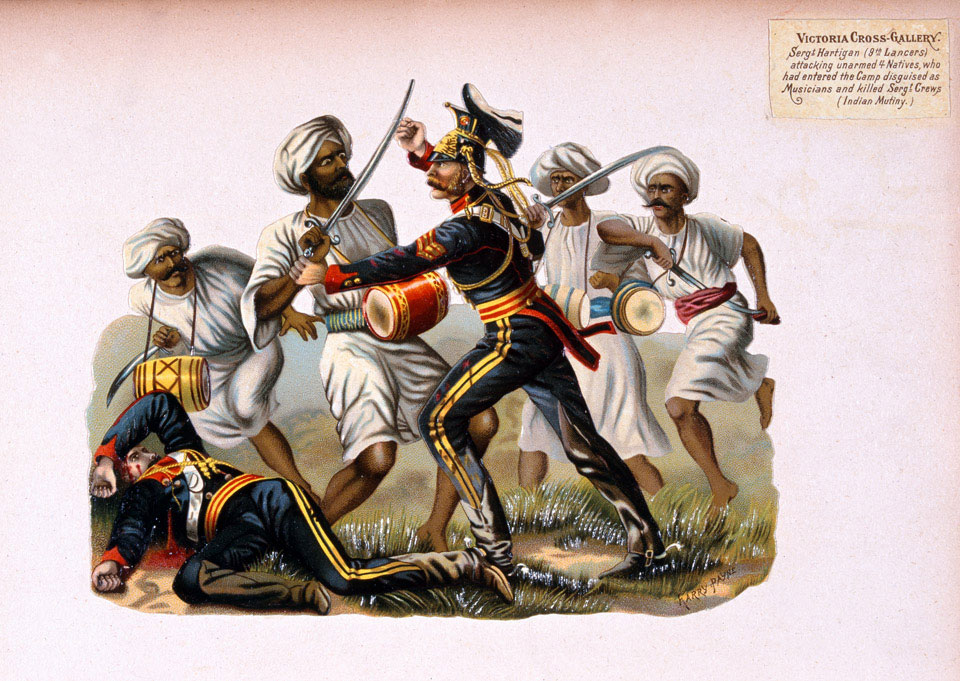
Following the fall of Delhi on the 20th of September, Jones proceeded with a substantial force towards Agra to thwart an attack by the Gwalior Contingent. This proved to be for nought, but the Battle of Agra on the 10th of October nearly proved to be the end of Lieutenant Jones as for the next man, Sergeant Henry Hartigan. Following a desperate fight, he was left for dead on the battlefield, sustaining a bullet wound through the bridle arm, 22 sabre cuts and the loss of an eye. He was found, however, and nursed back to health in Agra Fort.
Jones sailed for home in January 1858. Upon reaching England, he transferred to the 18th Hussars, gaining a promotion to Captain and Brevet-Major. He received his VC from Queen Victoria at Southsea Common, Portsmouth, on the 2nd of August, 1858. He retired from active service as a lieutenant colonel in 1872 and proceeded to invest his energy in civil engineering, specialising in sanitation and hygiene, winning a prize from the Royal Agricultural Society for the best-managed sewage farm. Following his retirement in 1912, Jones settled in Finchampstead, where he remained until his death on the 29th of May, 1920. Of his five sons, two would die in India – one in a polo accident in 1895, the other in action in 1896 while a third son, Captain Percy Jones, was killed in action at Samara, Mesopotamia, in 1917, while serving with the 13th Lancers.
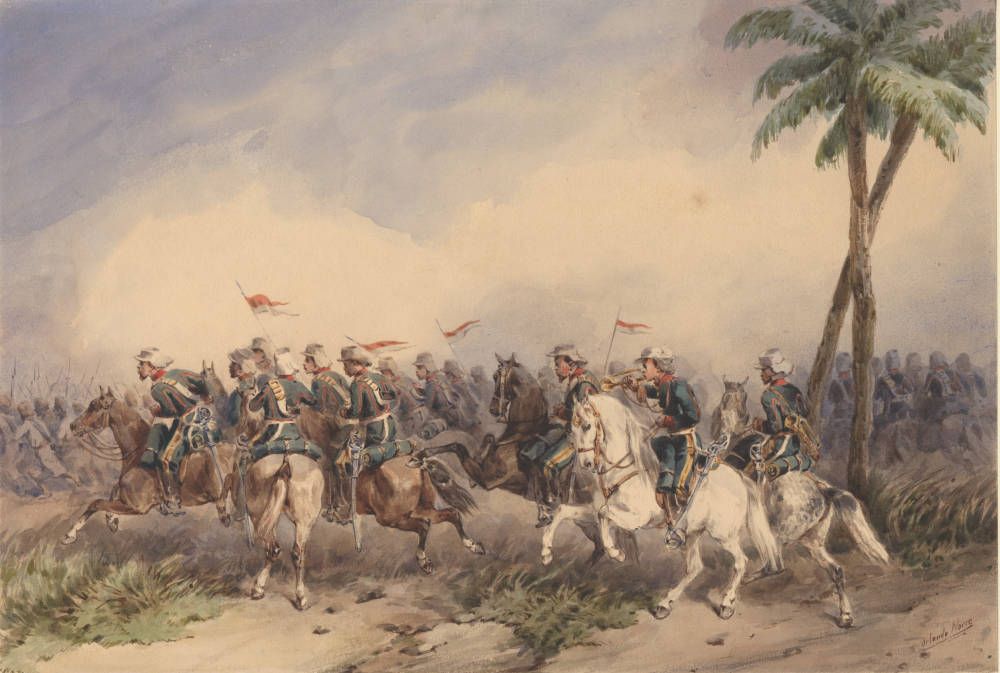
Sergeant Henry Hartigan, 9th Lancers, Dates of Acts of Bravery, June 8th and 10th October – A VC for Daring-Do
What befell the 9th Lancers at Badli-ki-Serai is described in some detail by one man who was in the thick of the fighting:
“There were more casualties in my squadron than any other. We had 12 men killed , among the poor Sergeant Lindsay. I got hit by a spent ball on my left side behind, and it seem to me perfectly wonderful I how I escaped.
What a providential mercy it was my having the general’s horse! He carried me nobly through a hard day’s work. I should have been left been left behind and cut had I been on the old Cape. Upton had his chestnut killed under him by round shot, and both the doctors lost their horses. Poor Colonel Chester and a Mr. Russell were killed early in the fight by the same round shot. Delamain also lost his life. Jones with his small party captured one of the enemy’s guns and it was fired four times against them with success. The enemy fired all day from Delhi and their shot command the hill. Soon after we arrived a shot of theirs blew up one of our tumbrils and grievously wounded by the explosion was young Davis. Another shot disabled one of Light’s guns and killed four of his men, and another shot carried off 2 Carabineers. Light got wounded in the head, and was covered in blood. Hope’s flank move was not quite so successful as he wished owing to the very difficult country poor Turner had to drag his guns through. At one time they were left unprotected and were in great danger of falling into the enemy’s hands, our squadrons being too eager and impetuous for the charge to stand patiently by and protect them…”
In the middle of this chaos, we find Pension Sergeant Henry Hartigan.
Born in 1826 in Drumlea, County Fermanagh, Ireland, Henry Hartigan enlisted in the 9th Lancers. Like many of his contemporaries, he found life in the army with the promise of pay and a meal, favourable to an uncertain future and the limited prospects of poverty. We do not know anything about Hartigan’s background, and his later life is shrouded in mystery. However, his enlistment sent him away from his home to a new life in India. The 9th Lancers were first sent to India in 1842 and almost immediately found themselves on active service in the Gwalior Campaign of 1843. This was swiftly followed by active service in the 1st (1845-46) and 2nd Anglo-Sikh Wars (1848-49). As for Henry Hartigan, he arrived in India in 1848 in time for the second campaign, and his Punjab service medal bears not only the Goojerat but the Chillianwallah clasp.
1857 finds Henry Hartigan still in India. He is now 31 years old and based with his regiment in Ambala. He would receive his VC for not just Badli-ki-Serai but for a most astonishing action at Agra in October of the same year.
“For daring and distinguished gallantry in the following instances:—
At the battle of Budle-ke Serai, near Delhi, on the 8th June 1857, in going to the assistance of Serjeant H. Helstone, who was wounded, dismounted, and surrounded by the enemy, and at the risk of his own life, carrying him to the rear.
On the 10th October, 1857, at Agra, in having run unarmed to the assistance of Serjeant Crews, who
was attacked by four rebels. Hartigan caught a tulwar from one of them with his. right hand, and with the other hit him on the mouth, disarmed him, and then defended himself against the other three, killing one and wounding two, when he was himself disabled from further service and dangerous wounds.” (War-Office, 19th June, 1860, London Gazette, pp2316)
The London Gazette, however, only paints some of the picture.
At Badli-ki-Serai, Sergeant Helstone, injured and having fallen off his horse, found himself on the ground and attacked now on all sides by the enemy. Hartigan, with the fortune of the brave, dismounted his horse and amid a cavalry melee, rushed to Helstone’s aid, picked up the unfortunate sergeant and put him on his horse, before remounting and taking the injured man to the rear. Hartigan then returned to the battle. His quick thinking saved Helstone’s life: his injuries proved to be slight, and he was soon fit to fight again. His next feat at Agra shows what a man of Hartigan’s mettle could do.
Sources:
Links:
http://www.vconline.org.uk
http://www.victoriacross.org.uk/
https://www.arnsby.org/samuel/edmund/ned/ned/coughlan.html
https://www.irishexaminer.com/news/arid-30160603.html
https://www.indianculture.gov.in/rarebooks/stray-leaves-military-mans-note-book-containing-descriptions-men-things-regimental-home-0
https://vcgca.org/our-people/profile/989/Alfred-Stowell-JONES
https://www.finchampsteadsociety.org/coloneljones.html
Books:
Accounts and Papers of the House of Commons, Volume 44, Part 3 (1857)
With H.M.’s 9th Lancers During the Indian Mutiny – The Letters of Brevet-Major O.H.S.G Anson, edited by his son, Harcourt S. Anson (1896)
General Sir Richard Meade and the Feudatory States of Central and South India -A Record of 43 Years Service as Soldier, Political Officer and Administrator – Thomas Henry Thornton, C.S.I, D.C.L (1898)
The Hearseys, Five Generations of an Anglo-Indian Family – Colonel Hugh Pearse, D.S.O. (1905)
The Indian Mutiny 1857, A Sketch of the Principal Military Events – Captain F.R. Sedgwick (Royal Field Artillery) (1919)
A Matter of Honour, an Account of the Indian Army, it’s Officers and Men – Philip Mason (1976)
The Life of a Lancer in the Wars of the Punjaub – James Giling (originally published in 1855, new edition, 2014)
 Mutiny Reflections