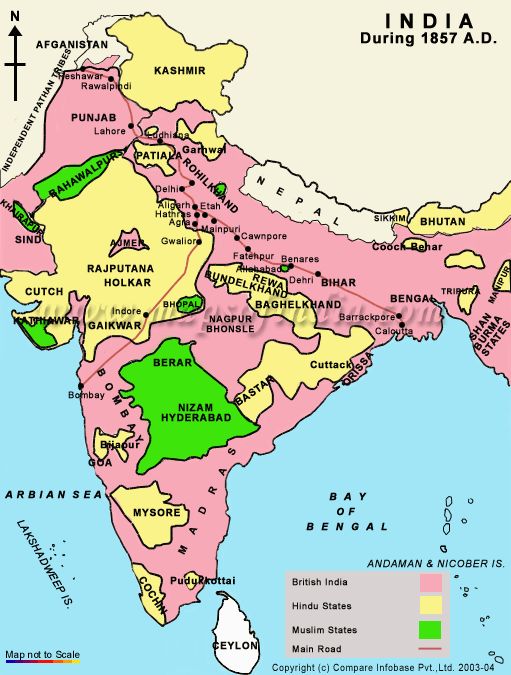
The army in India was divided into three separate entities – Bengal, Bombay and Madras. They differed in all aspects, from organization to their very size. Although in 1857, the Bombay Army did show some disaffection, there was none in Madras, and the uprising in Bombay was brief and quickly quelled.
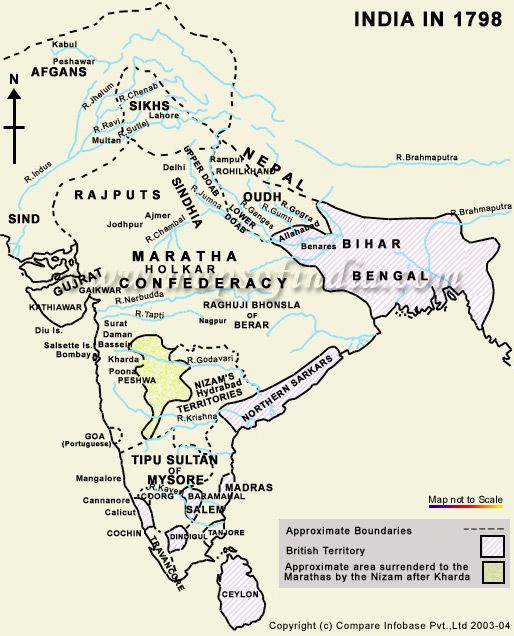

Organisation of the Bengal Army
The Commander-in-Chief of the Bengal Army and Commander-in-Chief of India in 1857 was General Anson, who was in Simla at the time of the outbreak. He had seen active service during his career as an Ensign in the 3rd (Scots Fusiliers) Guards in the Napoleonic Wars and had fought at the Battle of Waterloo.
The army, of which General Anson was in charge, was divided into seven divisions spread out over a vast area through the entire Bengal Presidency up to the Khyber Pass.
- Presidency Division, Calcutta. Commanded by Major General Sir John Bennet Hearsay
- Dinapore Division. Commanded by Major General Sir G.W.A. Lloyd
- Cawnpore Division. Commanded by Major General Sir Hugh Wheeler
- Meerut Division. Commanded by Major General S.H. Hewitt
- Sirhind Division. Commanded by Major General Sir Henry Barnard
- Lahore Division. Commanded by Major General G.E. Gowan
- Peshawar Divison. Commanded by Major General T. Reed.
Regular Native Troops in the Bengal Army
10 regiments of Bengal Light Cavalry
74 regiments of Bengal Native Infantry
18 companies of Bengal Foot Artillery, with 8 field batteries attached
12 companies of Bengal Sappers and Miners
18 regiments of Irregular Cavalry
The mEn who served john’s company in bengal
In 1857, the Bengal Army consisted of 151,361 men of all ranks – 128,663 were Indians, the bulk of which were sepoys, serving in 74 infantry regiments and 10 of cavalry. The majority of the irregular cavalry was made up of Muslims, the light cavalry and the infantry regiments were traditionally Hindus – the light cavalry regiments were almost exclusively of a high caste – – by 1857 the infantry regiments were composed of “Mahommedans, Brahmins—Rajputs, Gwallahs, Kaits, Aheers, Jats and some low caste men.” They came from Oudh, North and South Bihar, the Doab of the Ganges and the Jamuna, Rohilkhand, some from Bundelkhand and a few from the Punjab. Two-fifths of the Bengal Artillery were Muslims, while the remaining 57 per cent were Hindus of different castes.
The incentive to join the army was often a result of tradition, with the son following his father into the same regiment, or in the case of Sitaram in 1812, he was recruited by his uncle. Although recruiting parties would be sent out to find willing young men to join up, the preferred method was to let relatives bring in the boys themselves and thus guarantee by way of family ties not only their loyalty but their respectability.
It had been the policy of the EICo (East India Company) initially to recruit mainly high caste Hindus – Rajputs who were the traditional warrior caste in Northern India, Bhumimars (the military arm of the priest caste), and Brahmins themselves, the idea being that besides being physically fitter than men from the labourer classes, the Company felt they would not only prove to be the most loyal but somehow give the new rulers of India a stamp of legitimacy. If your army consists of the best men society has to offer, then how can the EICo, in its turn, be wrong? This was not perhaps the soundest judgment, but for some time, as the army grew and gained accolades in various campaigns, it appeared to at least be a functioning theory.
The first Governor-General of India, Lord William Bentinck, saw a danger in this kind of recruitment as it put an emphasis on religion and creed over duty and could potentially be a future threat to discipline. His worries were not unfounded, and by the 1840s, the army was actively recruiting from a broader segment of the population. It is interesting to note, however, that although caste always played an important part in all of the armies, be it Bengal, Bombay, or Madras, it was only in Bengal and briefly in Bombay that it became an issue. This, however, had more to do with the organization of the army of Bengal itself or the lack of it.
ORGANISATION OF A BENGAL REGIMENT
An infantry regiment of the Bengal Establishment was, in 1857, composed of 1000 privates, 120 non-commissioned officers, and 20 Indian commissioned officers. It was further divided into ten companies; each company contained 100 privates, 2 Indian commissioned officers, and 12 Indian non-commissioned officers.
Regiments did not live in barracks but in lines, which is where the thatched houses in which the men lived were built. The houses were organized in ten rows, one behind the other. Each company had its own lines. At every new station, the sepoys and non-commissioned officers had to either buy or build their huts- these were generally ten feet long, eight feet wide and seven feet high, made of mud and roofed by thatch, which leaked in the monsoons and were often situated on land that lacked adequate drainage. Commissioned officers had three huts in a small compound that was encircled by a low mud wall. In front of each row was a small round building where the weapons and accessories were stored when the men were off duty. The key was kept by the duty sergeant, or to give him his Indian name, the havildar.
Rising in the ranks was virtually impossible under the system in place in 1857 as it was strictly based on seniority. A man could join as a boy of 16 and find he has only attained the rank of naik (corporal) by the age of 36. The average age of a havildar (sergeant) was 45, a jemadar (lieutenant) at 54, and a subedar (captain) at the ripe old age of 60. The system was brutally unfair, and the commanding officer of a regiment had no power to pass over any man for promotion without the approval of the Commander-in-Chief.
| Indian Infantry | Indian Cavalry | British Infantry Rank |
|---|---|---|
| Sepoy | Sowar | Private |
| Lance Naik | Acting Lance Duffadar | Lance Corporal |
| Naik | Lance Duffadar | Corporal |
| Havildar | Duffadar | Sergeant |
| Havildar Major | Kot Duffadar | Sergeant Major |
| Jemadar | Jemadar | Lieutenant |
| Subedar | Risaldar | Captain |
| Subedar Major | Risaldar Major | Major |
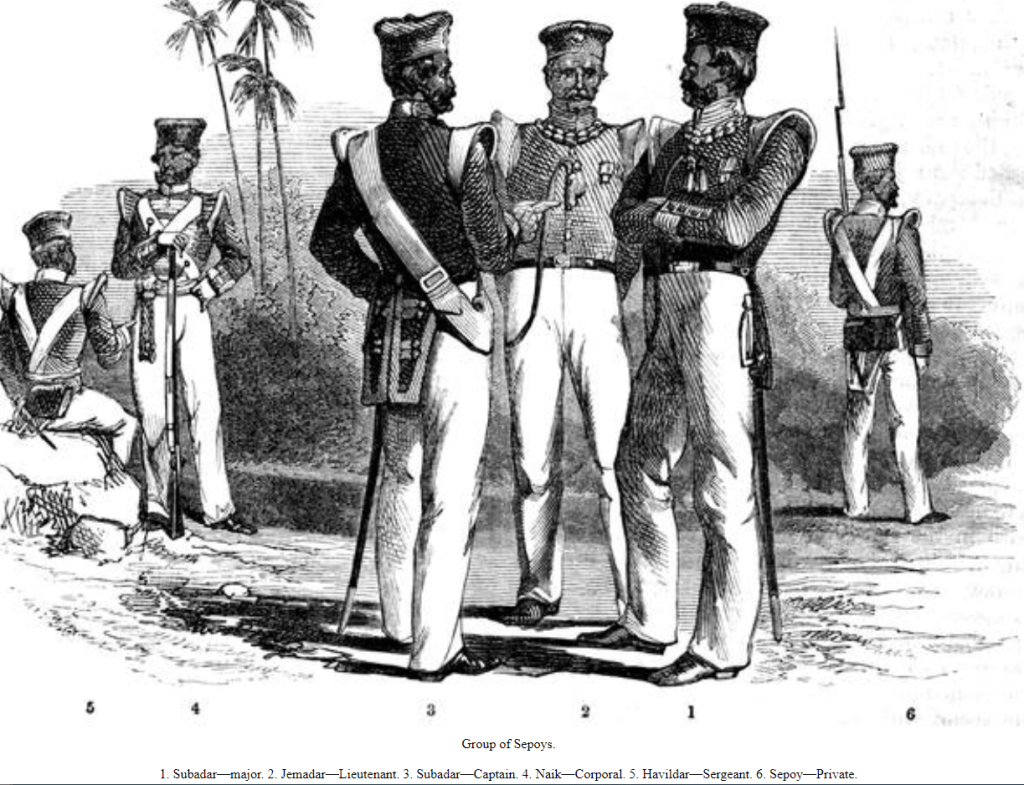
Needless to say, all Indian personnel were subordinate to even the most junior of European officers. The highest rank an Indian soldier could obtain was Subedar-Major, which in the East India Company army (HEICo) was in all actuality no more than a senior subaltern rank. Indian officers did not command, nor were they taught to – although some did prove themselves to be capable commanders during the mutiny, they had not been actively encouraged to take on leadership roles.
DUTIES AND THE LACK THEREOF
Peacetime duty was neither strenuous nor engaging. A sepoy was required to attend the morning parade for the cleaning of his weapon and accoutrements, and then while away the time until the evening parade for orders and guard duties. The monotony of this relentless routine was broken up by a brigade exercise once a week and regimental exercises four times a week. They were also increasingly used as an impromptu police force, detailed to escort treasure and guard prisoners.
As the chances of war decreased, so did the sepoys’ chance of bettering their finances. The pay was notoriously poor, and in 1857, it was the same as it had been at the turn of the century, a paltry 7 rupees or 14 shillings a month. The cost of living, however, had nearly doubled during the same time, and the introduction of long service pay helped matters only slightly as it was dependent solely on good conduct. It increased their pay by one rupee after 16 years of service and two after 20. Rank was not taken into consideration, nor was outstanding duty. In 1837, a new pension scheme came into effect, which entitled a sepoy to four rupees a month after 15 years and seven rupees for those who had served for 40 years. Disabled sepoys were entitled to the same amount, and their families received the pensions if a sepoy was killed in action. Where rank was concerned, a subedar or subedar major would retire on 25 rupees after 15 years and 40 after 40 years. But to qualify for a pension in the first place, a man had to be declared unfit for duty by a board of surgeons. This rarely happened, and as long as the sepoy could walk, he was expected to serve.
Sepoys were furthermore expected to feed and clothe themselves from their meagre salaries, although, after the reforms of 1828, they were provided with a jacket and a pair of trousers once every two years and the amount they had to pay for the other items of uniform was set to not cost more than five rupees a year which was unrealistic at best. Regardless of what the intent was, many sepoys inevitably fell into debt and subsisted on a hand-to-mouth existence. In the cavalry regiments, including the irregular ones, although better paid, they were expected to buy their horse and all the trappings, thus setting them further into debt than their infantry counterparts. The system was crying out for reform, but it would not be until 1895 that the sepoys saw any rise in their pay.
A successful campaign brought with it the reward of plunder, which the EICo stamped with the moniker “prize money,” thus legitimizing the long-standing practice of looting and pillaging. It was one way a soldier – sepoy and European alike – had to line their coffers, but by 1850, most of India had been conquered, and minor campaigns against troublesome tribes did not bring big rewards.
AS FOR THE EUROPEANS

The European officers were organized the same as those in an English regiment and their duties did not differ as such, nor the structure. The commander, usually of the rank of Lieutenant-Colonel, was at the head of the regiment, the Adjutant superintended drill and would make daily reports to the commanding officer, the Quarter-Master attend to the men’s uniforms and he was often also the Interpreter whose sole job was to translate all orders given. Each company had its own officer – and it was up to him to keep his men content, listen to their grievances, and anything he could not settle himself, he was duty-bound to report it to his commanding officer.
In peacetime, an officer’s day could hardly be said to be busy – after the morning parade, they were generally left to shift for themselves, occupying their time with reading, writing, sleeping, and socializing when possible, and except for occasional guard duty or perhaps the odd parade or two, a regimental officer effectively had nothing to do. Whereas previously, men in these positions had shown interest in their men and had even spoken their language in the decades preceding 1857, this new breed of officer was neither well-bred nor well-read for that matter – they had joined the service simply for the security it offered and for the prospect of improving one’s social standing. Their training at the military college of Addiscombe was poor – consisting mostly of mathematics and a touch of science, while a brief sojourn in a subject such as fortification was based on the teachings of a 17th-century engineer who had never set foot in India. Military Drawing was theoretical at best, and the language skills taught were, at worst, the most basic. Many of these young men came to India with the sole purpose of bettering themselves; they had little or no interest in sepoys or, for that matter, soldiering. As the century rolled towards 1857, disrespect for Indian soldiers by junior European officers who by rules were ranked higher than the oldest serving sepoy had become the norm rather than the exception. In 1857, there was a sizeable portion of officers who had been born in India and some had familial ties to the regiment in which they served. They had a better understanding of the men and the region in which they served, and above all, many of them could speak the language fluently. Unfortunately, due to the lack of prospects within the army, they were also more likely to choose duty elsewhere to advance their careers.
In regular cavalry regiments, there would be a colonel – a position that was rarely more than honorary. Below him were two lieutenant colonels. Below them, the Regiment was divided into two “Wings”. Each wing had a major, 6 or 7 captains, and as many as a dozen lieutenants. The lowest rank was that of cornet. A lieutenant would be chosen as an Adjutant and additionally as an interpreter and Quarter-Master. In addition, the regiment would have attached to it one or two surgeons, a veterinary surgeon and a riding master, who was also the warrant officer.
Ideally, twenty-six European officers made up the full complement of an Indian infantry regiment, but it was very rare that all of them were present at any given time. Usually, no more than 15 and sometimes as few as 7 were actually there. Life for an officer in the army of the Honorable East India Company could be stultifying to any young man who possessed talent. Lucrative positions or detached service in the Irregular Corps and the civil service provided not just better pay but generous prospects for advancement and certainly a more exciting existence than regular army service. By 1857, it was more common to view the army as a stepping stone to a better career – 1000 British officers ( the majority of these were field officers – majors and above, and captains) were pursuing such a course, and those that remained with their regiments were not always the best and brightest. Often, only in India, because of connections in England who had secured them their positions, they were too readily disinterested in their men, unambitious to the point of apathy, and they despised India. The junior officers, more often than not, outright hated the sepoys, and married officers simply retreated into domestic life. They would have been better off paying heed to the words of Captain Albert Hervey of the Madras Army:
“Treat the sepoys well; attend to their wants and complaints, be patient and, at the same time, determined with them; never lose sight of your rank as an officer, be the same with them in every situation; show you have confidence in them; lead them well and prove to them that you look upon them as brave men and faithful soldiers, and they will die for you. But adopt a different line of conduct – abuse them, ill-treat them, neglect them, place no confidence in them, show indifference to their wants or comforts – and they are very devils!”
Unfortunately, for the Bengal Army, they hardly had anyone who thought like Captain Hervey.
What they did have in 1857 were officers who lived separately in bungalows – near the lines but still too far to have any meaningful contact with the men they were supposed to command. During the heat of the day, the Europeans would be sweltering in their shuttered bungalows, and for 8 months of the year, they would barely stir out of doors, except for their morning and evening rides. Supervision in the lines was given over to the two sergeants as permitted to serve each corps. They were the only Europeans who actually lived among the men in the Lines. They were responsible for presenting a daily report to the Adjutant as to what the men were actually up to.
Not that it had always been this way.
The Army Reforms

Sitaram, who had been recruited into the Bengal Army in 1812 and served until 1857 remembered.
“When I was a sepoy, the Captain of my company would have some of the men at his house all day long, and he talked with them…” The officers took an active part in their lives, arranging amusements for their men such as nautches (erotically charged dance exhibitions), taking them hunting, competing with them in sports – and when not actively participating, were always present at their games, and treated them with as high a regard as if they had been equals. The army was led by men who genuinely loved India and had no intention of leaving it. Their Indian wives and mistresses helped the officers bridge the gap – these were men who understood the language and, above all, their men.
At the time when Sitaram was recruited, and indeed for the first 30 years of the 19th century, commanding officers wielded actual power over men. They could promote and demote, punish without recourse to a court-martial, they could dismiss unruly men, impose corporal punishment (flogging with cane) in cases of severe breaches to discipline, refuse leave and even implement extra drill and duties. Although this may all sound fearsome, the men knew who their leader was, for better or for worse – as Sitaram wrote, “we liked the sahib who always treated us if we were his children.” But these were officers of a completely different breed – a breed that was rapidly dying out, not just through old age but through the reforms being forced upon the army. Unfortunately, the sepoy himself was not averse to taking advantage of their powerless commanders and from being petted children, they were rapidly becoming undisciplined, spoiled ones.
By 1835, Lord William Bentinck did away with corporal punishment throughout the native army. He believed it belittled a man, and where a good man might be induced to join up, he would inevitably refuse due to the fear of the whip. Although the abolition was short-lived and reintroduced by Governor-General Lord Harding in 1845, it barely served as a deterrent to anything at all. Officers were advised to
“inflict corporal punishment as seldom as possible, commuting it for other punishment in all cases where it can be done with safety to the discipline of the army.”
In other words, punish but be gentle about it. Flogging could only be used in cases of mutiny, insubordination, and drunkenness on duty; however, for other offences, such as stealing and unruliness, it was no longer tolerated. In fact, flogging was so sparingly used in Bengal that an Indian officer remarked to his colonel, “As long as the lash was hanging over the bad man’s head, he was all right, but now they do not care for the commanding officer or anyone else.”
With flogging no longer in his power, the commanding officer could resort to a court-martial, but the sepoys had found a way to go around even this form of punishment. A court-martial, under the new reform, had to be sanctioned by the Commander-in-Chief and was no longer solely in the power of the commanding officer. Then, if the sepoys were dissatisfied with the resulting punishment, which they inevitably were, they would simply petition the C-in-C to overturn their sentence. Although protocol dictated that the sepoy could only send such a petition through his commanding officer, they sent it directly without him ever being privy to it. More often than not, the appeals were upheld and the sentences revoked. Even men who had been deemed unfit for service could thus be reinstated to their regiment, and the commanding officer was powerless to do anything.
To add insult to injury, the government also felt that the old men who commanded the army were, for lack of a better term, judgmentally deficient. Although this was very much the case in some instances, it was not necessarily true of everyone. Meerut is an example of a station run by men who should long have been pensioned off, and William Hodson remembered a man who “was not able to mount a horse without the assistance of two men. A brigadier of the infantry… could not see his regiment when I led his horse by the bridle until its nose touched their bayonets and even then he said faintly,” Pray, which way are the men facing, Mr. Hodson?” This brigadier, it will be noted, served during the Mutiny.
The problem was the practice of promotion by seniority. The system left younger men who would have been excellent senior officers, simply chomping at the bit, waiting for their turn, but by the time it came, they were often too old to be of any use. The system was prevalent among Indian officers as well – but there had been a time when a commanding officer had the power to promote a man on merit. The government now put an end to that – instead of abolishing the seniority clause altogether, it simply prevented the commanding officer from having any meaningful use for his men. In their eyes, he had lost his prestige. While this system could be irksome to an English officer, it was positively loathsome to an Indian one – he would spend his life in practical servitude, his rank no matter how high would still be worth less than that of an English subaltern, he would have to take orders from increasingly disdainful officers who no longer cared for their regiments, and be subjected by rules imposed by a government that was not his own.
With the young men either on detached duty or disinterested in their men, and the old ones no longer held in esteem and the constant government meddling, it is no wonder that by January 1857, Lieutenant-Colonel Doughter of the 60th Bengal Native Infantry upon – returning to his regiment after a three-year absence wrote,
“I saw a great laxity in ranks, worse even than when I got command of the regiment in 1849. The authority of the commanding officer had become less than mine was as a subaltern, as regards punishment drill to non-commissioned officers, owing to army standing orders being set aside by circulars, and by station orders issued by officers perfectly ignorant of the proper method of keeping sepoys in subjection, and thereby interfering with the commanding officer’s authority, and rendering him a mere cypher in the eyes of his men.”
By 1857, a commanding officer was mostly powerless – he was unable to make promotions, he could not give immediate recognition for loyal service, and at the worst end of things, could not refuse the court-martial of any sepoy under his command -this was the result of thoughtless army reforms by men who had no idea that the army needed to be led by men who could exude absolute control over their men.
In other words, by 1857, the army had ceased to respect their commanding officers.
Until 1842, when the Britsh endured a singularly catastrophic defeat in Afghanistan, the men of the Bengal army still held the officers in some awe. They had been victorious in practically all of their ventures, and plunder had been rich, but Afghanistan was a kick in the face of prestige. The army had seen their officers run, and not a few had behaved horrifyingly poorly, to the point of abandoning their own men. The retreat from Afghanistan was not just a loss in terms of war – it proved this invader was not invincible.
Although the Sikh Wars did go some way to restore some of the army’s reputation, these wars were problematic. The sepoys soon realized that with a defeated Sikh nation, their own existence was at stake. A conquered Punjab meant there would effectively be no war left to fight in India, leaving the sepoy with nothing to do but to be at the whim of a war-happy government that could now send them overseas to fight in other nations. This could be anywhere over the dreaded black water – overseas to China or Burma – a notion abhorrent to a high-caste Hindu. While this was something that had been avoided until now (overseas duty was voluntary, and the Bengal regiments did what they could to not have to go), leave it to Lord Canning to make it a reality.
ENTER LORD CANNING, GOVERNOR-GENERAL

Following in the footsteps of that overzealous Lord Dalhousie, who we remember for his infamous and abhorrent use of the Doctrine of Lapse to steal vast swathes of land for the EICo, came Charles Canning, whose greatest misfortune was to be the son “of an illustrious man.” He had proven himself to be a hard worker who appears to have taken to administration quite readily. However, he was not his father. His abilities were described unkindly as “mediocre” and his personality “weak, ” a man easily swayed by the opinions of others and given over to relying on his advisors rather than judging a situation for himself. As Governor-General of a country at peace, he might have struggled somewhat, but faced with one in mutiny, Canning was frankly overwhelmed. Cautioned by Henry Lawrence to introduce any reform to the army as slowly as possible, Canning allowed himself to ignore sage advice and introduced the much dreaded General Service Enlistment Order to the Bengal Army within the first year of his term in India, in 1856.
It basically required that all new recruits must take an oath to serve where ever they were required to. Henry Lawrence was so appalled by the order he wrote to Canning in May 1857, ” The General Service Enlistment Order is most distasteful…it keeps many out of service and frightens the old sepoys who imagine that the oaths of the young recruits affect the whole regiment.”
The Supreme Council of India was composed of experienced men who should have been able to advise Lord Canning in a crisis such as the Mutiny. Although they did advise him in abundance, they did not do it very well. Each had their own talents; none of them was particularly good at anything besides an inordinate amount of squabbling. I will describe this terrifying group in another chapter but suffice to say, Mr. Dorin had barely left Calcutta in 33 years of service, Mr. J.P. Grant had no knowledge of sepoys and disliked military men with a passion, General Low, though a man who had actual service under his belt was by 1857 too old and was unable to get his point across, and then, of course, we have the flamboyantly named Mr. Peacock, who as the Law Member of Council with absolutely no experience with soldiers and incapable of recognizing what a threat the mutiny actually was. His intentions might have been pure, but his thinking was flawed. We are then left with Colonel Birch – Secretary to the Government of India for the Military Department, a sycophant, and a man who had spent so many years behind a desk he knew nothing of the Bengal Army, nor had he spoken to sepoy in living memory. History has been kinder to Colonel Birch than his contemporaries ever were.
The Annexation of Oudh in 1856 had not only rankled men like Henry Lawrence, but it was also the worst single catastrophe for the sepoys of Bengal. Not only was it achieved under false pretences – citing misrule by the Nawab, an accusation that was never fully explained nor could be justified- but it had also been done in such a way as to humiliate the ruler. He was sent packing with a pension off to Calcutta, but the vast amount of people under his employ, including his personal army, was left penniless and above all, jobless. Until annexation, Oudh had been the Company’s main recruiting ground, but how could the sepoys trust a government which took over their homeland by lies? Although the question regarding the annexation deserves a lengthier answer, suffice it to say that this blatant act of Company greed was deliberate. There was no misunderstanding, and it was not a mistake.
Changes in Domestic Affairs
Until 1813, missionaries had been banned by the HEICo, who saw them as disturbers of the peace, but in that year, the Evangelical element of the British parliament forced them, against their better judgment, to repeal the ban. In their wake came a flood of mission schools, reform societies, and the usual bevvy of street preachers and men who had no understanding at all of the Indian culture nor an interest in preserving it. It is no wonder then that the army, when faced with a commanding officer who actively preached the Gospel at them – and many did – could not help wondering if the British weren’t there to convert them all to Christianity after all.
By the 1830s, keeping Indian mistresses or having an Indian wife had fallen out of societal favour, and the era of the memsahib began. It is unfair to say that these women were the cause of the breakdown of relations between officers and their men, but their advent came at an already troublesome time. However, an officer with an English wife who offered him the comforts of an English home, albeit in a warmer climate, was less likely to spend his time with his men. The women themselves would have very little exposure to India itself and much less to the men their husbands commanded. There are always exceptions – Harriet Tytler, a true daughter of the regiment, Elizabeth Wagentreiber who could fall on her family legacy, but for the most part, women were often constrained by their Victorian upbringing which had been undoubtedly stunted by the conventions of the time, and India was a vastly strange world which provided them with no end of shocks. Although they would have been aware of the sepoys, they would not have been able to keep their society, nor would it have been accepted if they had tried. Victorian women were kept on a pedestal, supported by supposed virtues and endless prejudices – especially in Bengal, where society was far stricter than in Bombay or Madras. English women were practically the most isolated people in India. They might have added another component to the already disintegrating nature of relations in the Bengal army, but they were not the sole cause.

By 1857, a general disaffection had invaded the army of Bengal. The causes had been creeping in for years, and as grievances, both real and imaginary, continued to be ignored and hardly addressed, it took only the mere idea of a greased cartridge to set the fire alight. This and other causes will be addressed in the following chapter as we delve deeper into the events leading up to May 1857. For this, we will need to go back to February 1857 and the often-neglected mutiny at Berhampore.
The Regiments
Nearly three-fourths of the Bengal Army was involved in the uprising. The following list can give the reader an idea of the scale of the event and how it led to the demise of some of the finest regiments the army had.

The 74 Regiments of Native Infantry
Full Regimental Title 1857 and After
The Cavalry REgiments

| 1st Bengal Light Cavalry | Mutinied at Mhow. Disbanded in 1858, transferred to the 1st Bengal European Light Cavalry | |
| 2nd Bengal Light Cavalry | Mutinied at Cawnpore, 4th of June | |
| 3rd Bengal Light Cavalry | Mutined at Meerut, 10th of May | |
| 4th Bengal Light Cavalry | Disbanded in 1857 | |
| 5th Bengal Light Cavalry | Disarmed at Peshawar and later disbanded | |
| 6th Bengal Light Cavalry | Mutinied at Jalandar, 7th of June | |
| 7th Bengal Light Cavalry | Mutined at Lucknow, 30th of May | |
| 8th Bengal Light Cavalry | Mutinied at Meean Meer 15th of May | |
| 9th Bengal Light Cavalry | The left-wing was disarmed at Amritsar on the 10th of July and was later disbanded. The Right-wing were destroyed at Trimmoo Ghat by the Punjab Movable Column. | |
| 10th Bengal Light Cavalry | Mutinied at Ferozepore after being disarmed. |
These lists only give an outline of the magnitude of the calamity the HEICo was facing in 1857 and do not include the irregular regiments or the artillery. However, it should be clear that although this did turn into a wider uprising involving a tumultuous civilian population, 1857 started as a military revolt.

Sources and Links:
For the maps: https://www.mtholyoke.edu/courses/rschwart/hist151/India/maps.htm
For Regimental Information: https://wiki.fibis.org/
The Indian Mutiny of 1857 – Colonel G.B. Malleson C.S.I,1891
The Memsahibs – Pat Barr, 1976
The Indian Mutiny – Saul David, 2003
The Indian Mutiny – Julian Spislbury, 2007