To understand the full scale of the military aspect of the events of 1857, we must now delve a little further into the grievances of the army and take into consideration the other units involved, namely, the Irregular Cavalry, the Artillery, and the Sappers and Miners.
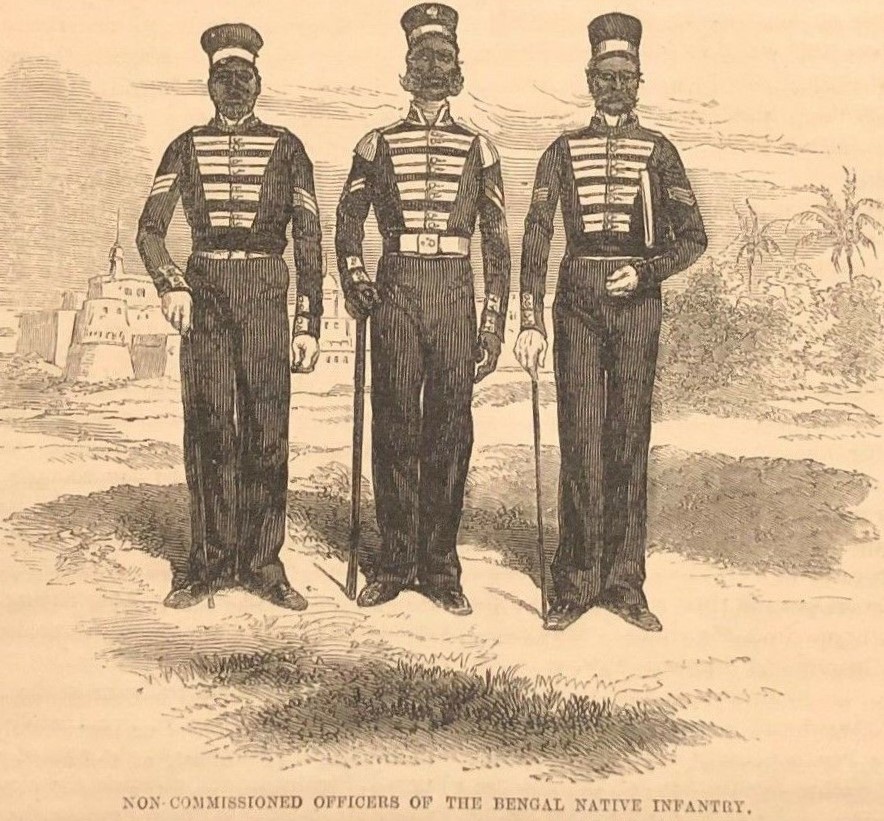
Dressing an Army
“A sepoy of the line, dressed in a tight coat; trousers in which he can scarcely walk, and cannot stoop at all, bound to an immense and totally useless knapsack, so that he can hardly breath; strapped and belted and pipeclayed within an hair’s breadth of his life; with a rigid basket-chako on his head, which requires the skill of juggler to balance there, and which cuts deep into his brow if worn for an hour; and with a leather stock around his neck, to complete his absurd costume – when compared with the same sepoy, clothed, armed and accourted solely with regard to his comfort and efficiency, forms the most perfect example of what is madly called the ‘regular’ system.” (Brigadier-General John Jacob, commandant of the Sind Irregular Horse, 1854).
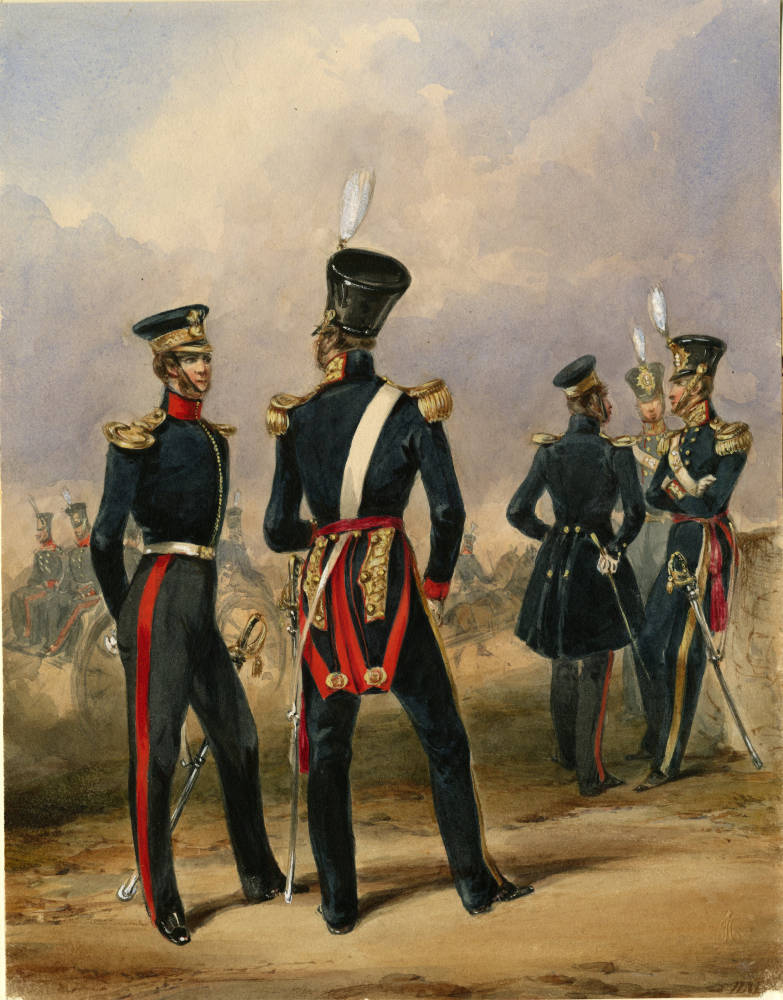
One of the problems any army in India faced – and not just in 1857 – was the uniforms. Hot, uncomfortable, tightly cut and topped with heavy headwear, not a single troop was satisfied with their clothes. Although it was not a reason to mutiny, it added to the general sense of dissatisfaction. Major-General Birch would recommend in 1858 that one of the reforms to be considered was the cumbersome uniform. He felt they would be better wearing “a loose dress or tunic, loose trousers, and turbans.” During the mutiny itself, one of the first things to be tossed aside was the knapsack, followed by the shako, and although many of them chose to keep their red coats, the trousers were replaced by loose-fitting dhotis.
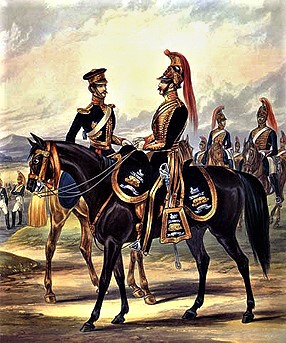
Nor was the artillery saved from impractical uniforms. They, too, were lumbered by shakos, and their horse counterparts would have been at home in another century altogether, resplendent in a Roman-style helmet, complete with a mane of red or black horsehair.
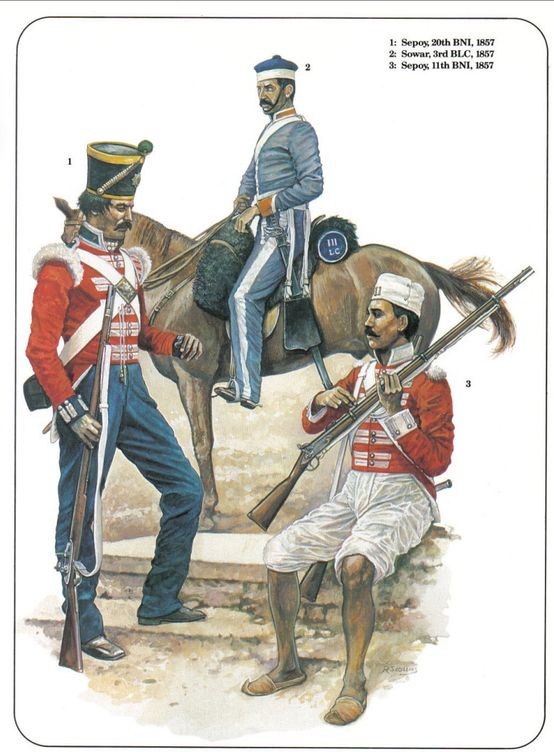
The regular light cavalry did not fare any better. Styled on the uniform worn by the British Army, the men wore very tight, short-waisted quilted tunics, a shako topped with a horsehair plume, a leather stock, cumbersome jackboots and breaches made either of leather or cloth, with instep straps. Their discomfort was furthered by the European saddle, its design forced the rider above the horse thus demanding an extremely good sense of balance and of course, the heavy dragoon sword (1821 pattern).
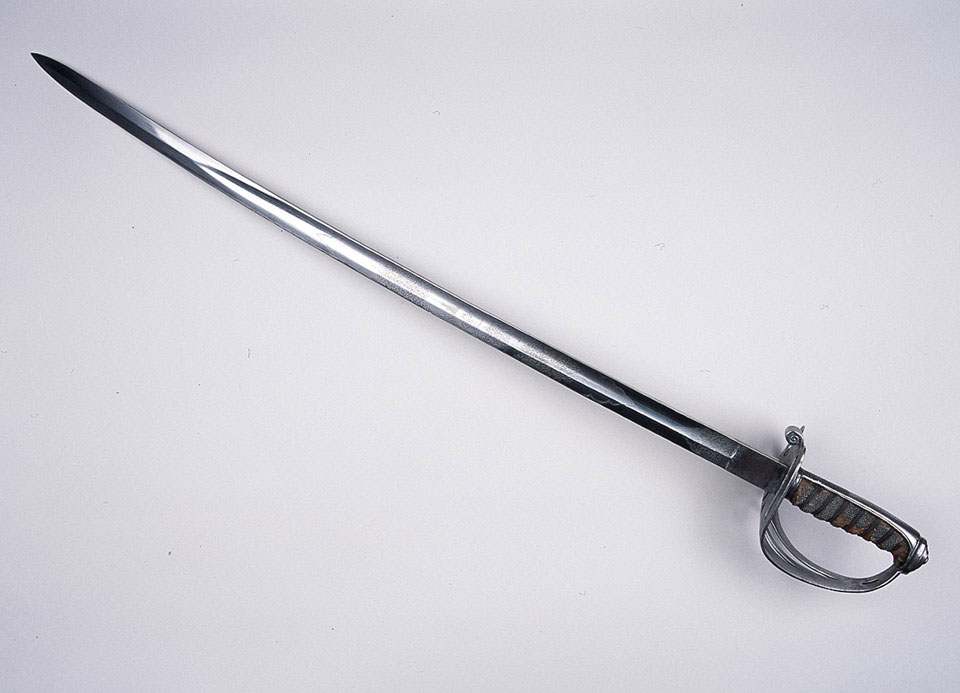
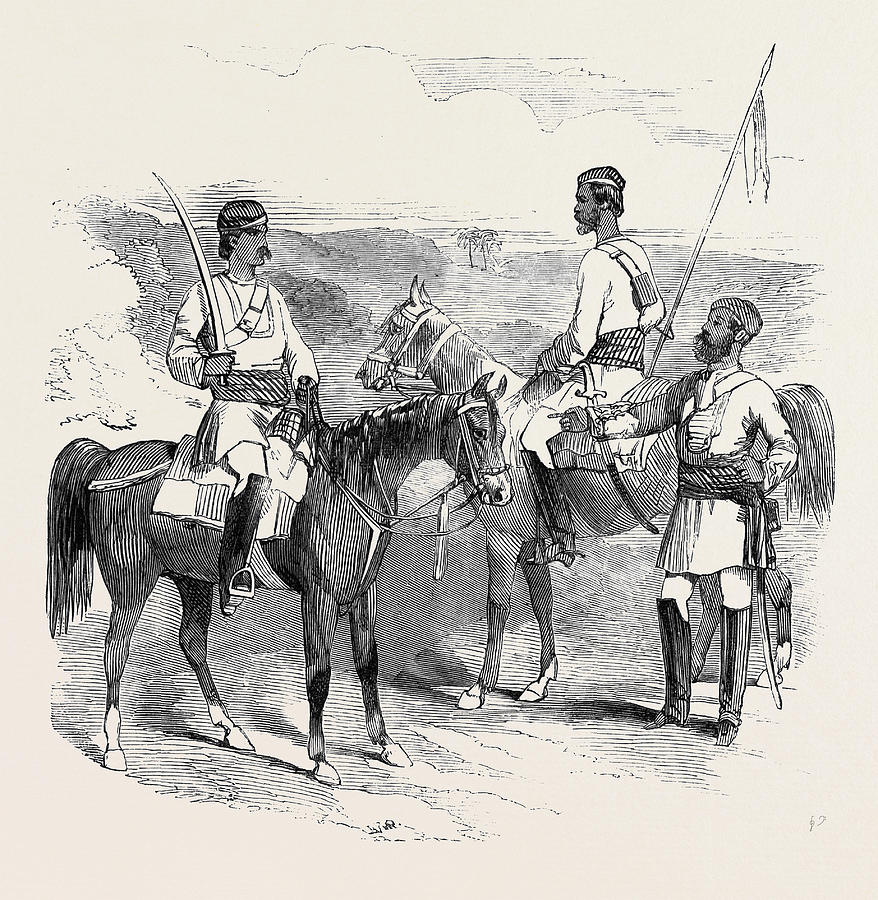
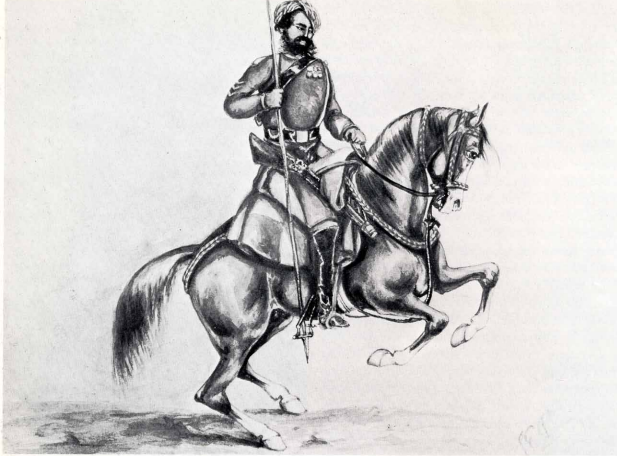
Although elegant to look at, the sword could neither cut nor thrust to any real effect and encumbered by its weight, the rider was unable to defend himself with any sense of purpose. Again, reforms had been proposed for the light cavalry as far back as 1847, and interestingly enough, the recommended changes came from Lieutenant-Colonel Charles Carmichael Smyth. He wanted to clothe the cavalry in “a broadcloth Ulkalluck, or long native dress, a pair of loose trousers, a turban and cummerbund with Hindoostanee saddles and bridles, “ thus aligning them in dress to the irregular cavalry who were not only more comfortably dressed but better equipped, forgoing the light cavalry sword for the much more efficient tulwars and shamshirs.
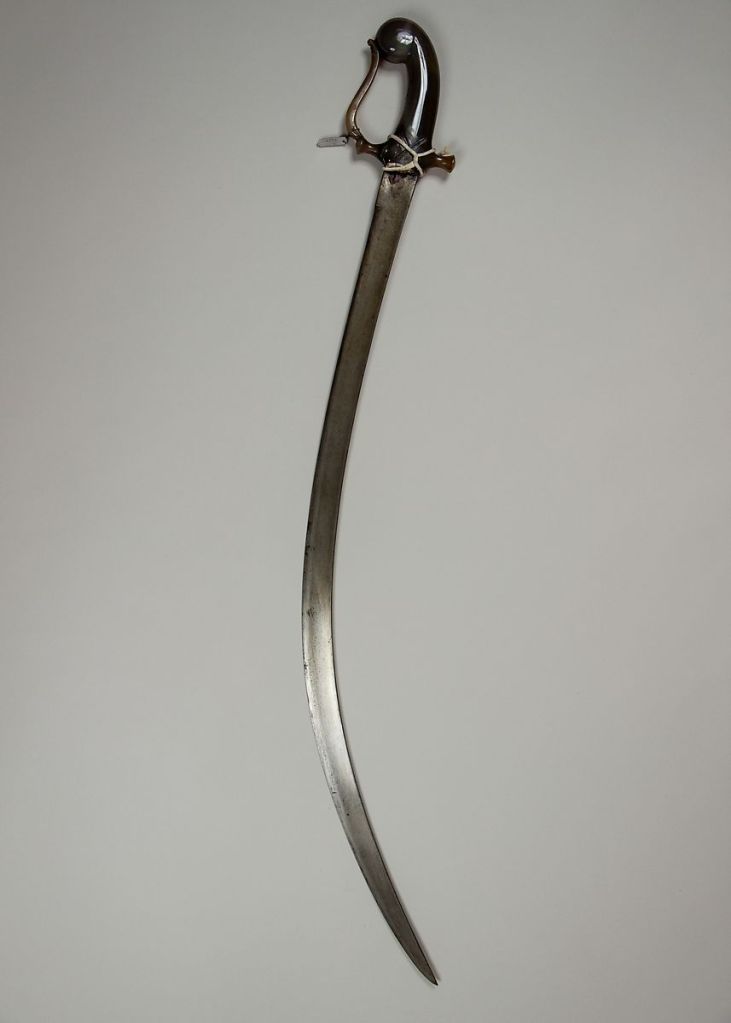
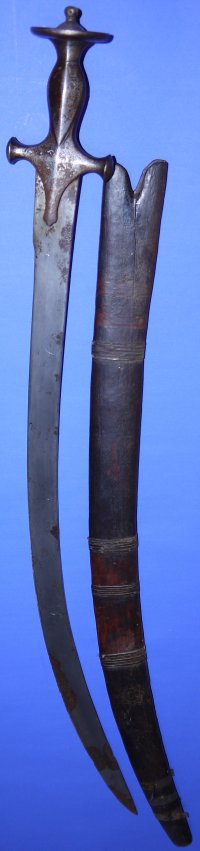
Henry Lawrence believed that cavalrymen should further be allowed to carry a carbine and a pistol and like Carmichael-Smyth, found the irregular pattern of uniform a far better fit. However, none of these changes were implemented in time.
The Irregular Cavalry in Debt
As for the Bengal Irregular Cavalry itself, things could have been far better. Although their commanders could promote their men according to merit and not merely by seniority, the men themselves were often crippled by debt. On joining the service, they had to purchase their horse and equipment and pay “one hundred and fifty rupees to the estate or family of the man whose decease or invaliding caused the vacancy. Such donation, of course, throws the recruit at once into the moneylender’s hands.” On a base pay of 20 rupees for a recruit (rising to 150 for a rissaldar major), it was impossible to stay out of debt. The situation was so dire in one regiment that the commandant himself borrowed money to pay off his men’s debts. Again, ideas were floated and ignored; a demand to increase cavalry pay was made already in 1853, but nothing was done. It is little wonder then in 1857, the irregular cavalry had a pressing financial motive to mutiny.
| 1st Irregular Cavalry (Skinner’s Horse) | Brevet Major Crawford Chamberlain | 1803 raised by James Skinner as Captain Skinner’s Corps of Irregular Horse 1823 became 1st Regiment of Local Horse 1840 became 1st Bengal Irregular Cavalry 1857 remained loyal and retained their arms |
| 2nd Irregular Cavalry (Gardner’s Horse) | Brevet Major George Jackson | 1809 raised at Farrukhabad and Mainpuri by William Linnaeus Gardner as Gardner’s Horse 1823 became 2nd (Gardner’s) Local Horse 1840 became 2nd Irregular Cavalry 1857 remained loyal and retained their arms |
| 3rd Irregular Cavalry | Brevet Major Sydney Hire | 1815 raised as the 1st Rohilla Cavalry 1857 partially mutinied at Saugor |
| 4th Irregular Cavalry | Brevet Major Anthony Marin | 1814 raised by James Skinner as 2nd Regiment of Skinner’s Horse 1857 partially mutinied; were reinstated after 1857 into the reformed Bengal Army |
| 5th Irregular Cavalry | Brevet Major John Macdonald | 1823 raised as the 5th Bengal Irregular Cavalry 1857 mutinied at Hansi. A portion remained loyal and was later disbanded. |
| 6th Irregular Cavalry | Captain James Curtis | 1838 raised as Oudh Auxiliary Force Cavalry for service with the King of Oudh 1857 remained loyal and retained their arms |
| 7th Irregular Cavalry | Brevet Lt.Col. William Mulcaster | 1846 raised by Capt Liptrott as the 16th Irregular Cavalry 1857 disarmed in Peshawar were reinstated after 1857 into the reformed Bengal Army |
| 8th Irregular Cavalry | Lt. Alexander Mackenzie | 1842 raised by Lieut Ryves as 8th Irregular Cavalry 1857 partially mutinied, were reinstated after 1857 into the reformed Bengal Army |
| 9th Irregular Cavalry | Brevet Lt.Col. James Fraser-Tytler | 1842 raised as 9th Irregular Cavalry 1857 partially mutined; disbanded in 1861 |
| 10th Irregular Cavalry | Brevet Major James Verner | 1838 raised as 10th Irregular Cavalry 1857 disarmed at Nowshera and Peshawar |
| 11th Irregular Cavalry | Captain Willam Alexander | 1846 raised as 11th Irregular Cavalry 1857 disarmed in Berhampore and mutinied |
| 12th Irregular Cavalry | Brevet Major James Holmes | 1846 raised as 12th Irregular Cavalry 1857 partially mutined at Segowli, the remainder disbanded in 1861 |
| 13th Irregular Cavalry | Captain Henry Guise | 1846 raised as 13th Irregular Cavalry 1857 mutinied at Benares 4 June |
| 14th Irregular Cavalry | Lt James Campbell | 1846 raised as 14th Irregular Cavalry 1857 mutinied at Jhansi and Nowgong |
| 15th Irregular Cavalry | Lt. Col. S. Fisher | 1847 raised as 15th Irregular Cavalry 1857 mutinied at Sultanpore |
| 16th Irregular Cavalry | Brevet Major Wright Davison | 1847 raised as 16th Irregular Cavalry 1861 disarmed at Rawalpindi |
| 17th Irregular Cavalry | Major John Liptrott | 1846 raised by Capt Liptrott as the 16th Irregular Cavalry 1847 became the 17th Irregular Cavalry 1861 became 7th Regiment of Bengal Cavalry 1857 disarmed; reinstated after 1857 into the reformed Bengal Army |
| 18th Irregular Cavalry | Brevet Major William Ryves | 1846 raised as the 17th Irregular Cavalry 1847 became the 18th Irregular Cavalry 1857 disarmed; reinstated after 1857 into the reformed Bengal Army |
Ten out of the eighteen Irregular Cavalry regiments were either fully or partially mutinied in 1857. Only three kept their weapons and fought for the British, and a further eight were later considered to have been loyal enough to be incorporated into the post-Mutiny army.
It is interesting to note that in the irregular cavalry, its commanders were chosen by appointment and not by seniority. However, where they had previously been allowed to discipline their men according to their discretion, the interferences of the government extended even to these regiments, and their commanders were effectively gagged and forced to follow the same rules that applied in the rest of the army. Whereas the government felt that the same rules should apply to everyone in every regiment, they did not take into consideration that an irregular cavalry, especially illustrious regiments like that of Skinner and Gardner, were held together by discipline and honour. They needed a strong and resolute commander – someone the men would follow with pride. Who would willingly follow a weak leader? By 1857, the irregular cavalry was anything but irregular save for its name and dress.
The Artillery and the Sappers and Miners
The Bengal Foot Artillery was composed of six European battalions of four companies and three native battalions of six companies. The Bengal Horse Artillery, considered the elite corps of the army, was composed of three brigades of European troops and one Indian troop. The 1st Brigade had a fifth Indian troop. Although artillery was usually dominated by Muslims before the EICo times, Brahmin and Rajput recruits, both high and low caste, had gradually begun taking their place in the artillery regiments as well. Only nine companies of foot artillery and two troops of horse artillery mutinied or deserted; of these, the 6th Company, 8th Battalion of Bareilly appears to have taken an active part in actually plotting to mutiny. The rest were most likely coerced by their infantry brethren; none of them murdered their officers (though the murder of a European staff sergeant’s wife and three children in Nimuch was attributed to men of the 4th Troop, 1st Brigade, Bengal Horse Artillery)- and many helped them to escape. However, only the 5th /1st Bengal Horse Artillery fought alongside the British in 1857. 1071 native officers of the Bengal Horse and Foot did not mutiny and were never disbanded.
The smallest arm of the Bengal Army was the Sappers and Miners. Raised in 1803 as the Pioneer Corps, in 1857, they comprised 12 companies, each with two native officers, fourteen non-commissioned officers, two buglers, and 100 sepoys. The corps was commanded by four European officers – commandant, adjutant, quarter-master, and interpreter – with each company headed by a junior European officer and a European non-commissioned officer to assist him. Although this should logically have been corps that would not have attracted high-caste Hindus, it did, something which was confirmed by Colonel Felix (former military secretary to Lord Dalhousie) who said they were generally recruited from one district and all belonged to one caste, something denied by Lord Clyde, Commander-in-Chief (1857-1860) who would claim they were of mixed ethnicity and from the North-West Provinces. Colonel Leslie of the Bombay Artillery concurred with Colonel Felix, stating that the men he had met in Afghanistan during the first war were all high caste and thoroughly disinterested in their work. In 1857, six of the twelve companies of the Sappers and Miners mutinied – four alone in Meerut on 16 May, where they murdered their commandant and their havildar-major. The rest were disarmed.
Subedar Sitaram Pandy noted the following after 1857:
“The Articles of War are often read out to regiments, but the language is seldom understood, being nearly all Persian and Arabic… [A] sepoy does not require a lot of rules and regulations to be read out to him. They only fill his head with doubts and fears. He should look upon his Commander as his father and mother, his protector, his god, and as such be taught to obey him. We do not understand divided power; absolute power is what we worship. Power is much divided among the English… The Commanding Officer has to ask half a dozen officers: before he can punish a sepoy and the permission takes months before it is received. By the time the punishment is inflicted, half the men will have forgotten all about the case and the effect of the punishment entirely lost. “
From Sepoy To Subedar
In the words of T. Rice Holmes,
“The relaxation of discipline had encouraged [the Bengal sepoys] to twist into a grievance anything that startled their imaginations, or offended their caprices: they were from various causes far less attached to their British officers than they had once been: it was in the nature of things impossible that, without such attachment, they should feel active loyalty towards the British Government; and they had become so powerful and were so conscious of their power that, from purely selfish causes, they were ripe for mutiny.”
What the rule makers in Calcutta and the commanders themselves did not realize as 1857 began, just how close mutiny was and how gravely outnumbered the Europeans were. Of the 159,003 men in all of the regiments combined, only 21,432 were Europeans. And as we have seen, not all of these Europeans were fighting fit or indeed had ever been.
In the next post, we will look further into the Bengal Army and take on the contentious subject of caste.
Sources:
David, Julian Saul Markham. “The Bengal Army and the Outbreak of the Indian Mutiny.” PhD thesis, University of Glasgow, 2001. gla.ac.uk.
David, Saul. The Indian Mutiny: 1857. London: Viking, 2003.
Holmes, Thomas Rice Edward. A History of the Indian Mutiny. 4th ed. London: W.H. Allen & Co., 1891
Jacob, John [A Bombay Officer]. A Few Remarks on the Bengal Army and Furlough Regulations, with a View to Their Improvement. Repr., with Corrections. Bombay: Smith, Taylor & Co., 1857Jacob, John. The Views and Opinions of Brigadier-General John Jacob. Collected and edited by Lewis Pelly. Bombay: Smith, Taylor and Co., 1858.
[Malleson, G. B.] The Mutiny of the Bengal Army: An Historical Narrative. By One Who Has Served under Sir Charles Napier. London: Bosworth and Harrison, 1858.
Sita Ram [Pandey]. From Sepoy to Subedar: Being the Life and Adventures of Subedar Sita Ram, a Native Officer of the Bengal Army, Written and Related by Himself. Translated by James Thomas Norgate. Edited by Douglas Craven Phillott. Calcutta: Baptist Mission Press, 1911
Spilsbury, Julian. The Indian Mutiny. London: Weidenfeld & Nicolson, 2007.07
https://wiki.fibis.org/w/Indian_Mutiny
 Mutiny Reflections