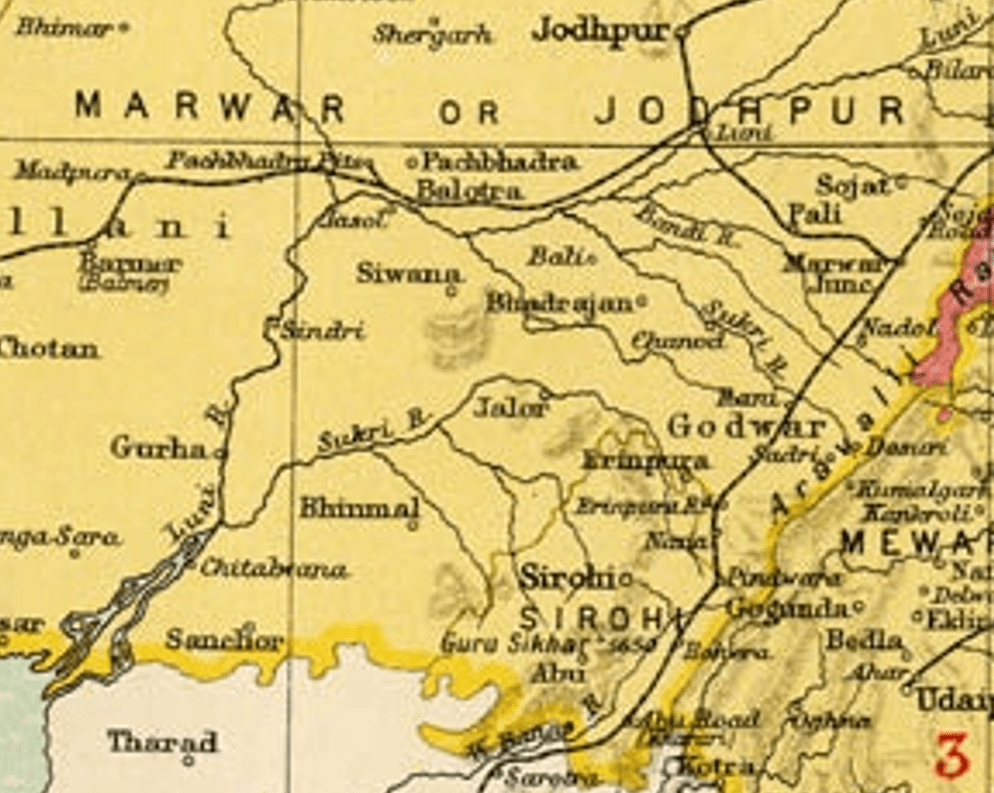
The Jodhpur Legion was by no means concentrated at their headquarters – two parties of infantry were guarding the summer station of Mount Abu; a company of the infantry had been deputed to Nasirabad after the mutiny at that station. There was no reason to doubt the Jodhpur Legion – the sowars, back in June, had been among the first to submit a written petition to Captain Hall, in which they hoped they would be allowed to “evince and prove their zeal in the service of the state, by being led against any mutinous troops or other enemies that might be causing the British Government any trouble.” Considering the distance from their disaffected brethren and their alleged loyalty to the Jodhpur State, there was, in all estimation, no cause for concern. They were carrying out their duties diligently and without a murmur of dissent – but the Legion was very good at keeping their secrets.
On the 18th of August 1857, a company of the infantry branch of the Legion, which had formed a part of the forces sent to Nasirabad after the outbreak, were on their way back to Erinpura. They made their halt at Anadra, two miles from the foot of the pass leading to Mount Abu. The company had been sent to hold in check a rebelliously disposed Thakur who had been kicking up a row in the area while a troop of cavalry had arrived a few days previously and had been distributed in small parties to different villages to protect the road from Disa to Abu. All was going well. The following afternoon, on the 19th of August, Captain Hall left the cool confines of Abu and rode down to Anadra.
The sepoys and their baggage had been soaked by the heavy rains, but Hall found the native officers, Ram Prashad Subedar and Ram Bux Jemadar, together with all the men – everyone appeared to be in good spirits; there were no outward signs of mischief, much less mutiny. Hall gave orders for their further proceedings and returned, contented, to Mount Abu. On his way, he met Havildar Gozan Singh, belonging to the Abu detachment, who explained he was riding to Anadra to see some of his friends in the detachment.
“This was true so far as it went, but the havildar deemed it unnecessary to add—what nevertheless was proved from subsequent inquiry to be the fact—that ‘he had been deputed to manage the attack which was to come off the following morning.’
Captain Hall had left behind him a determined den of rebels. It would subsequently be found that the havildar, with the full concurrance of Subedar Mehrban Singh and Jemadar Adju Dev, commanding the Abu guards, had developed a plan of action in complete secrecy – they had been following closely the events in the Bengal Presidency and “extremely perturbed” had decided their loyalties lay not with the Jodhpur State but with the mutineers now waging war against the British. The havildar was going to see some friends for sure – the 50 men from Anadra who would attack Mount Abu. It was by no means the entire legion, but the actions that followed would seal its fate.
 Mutiny Reflections