Erinpura
The only Europeans at Erinpura were the adjutant of the Jodhpur Legion, Lieutenant Conolly, two sergeants and their families. While the mutineers were still on the road, a letter from their ranks reached Erinpura on the 22nd and fell into the hands of the adjutant, brought to him by his orderly, Makdun Bakhsh, after it had done the rounds of the lines. It was short and to the point – addressed to all the men at headquarters, it gave out they should immediately prepare to revolt and join their comrades, “who had been to Abu, fought the Europeans and taken all precautions.” It was 4 o’clock in the morning when Conolly read the highly exaggerated claims of the mutineers but for all he knew, right now, he was the only officer left alive of the Jodhpur Legion. Whether they had murdered everyone at Mount Abu or not was currently not Conolly’s main problem – the letter further stated the guns should be seized, and the legion should be ready to march off to Delhi. Without losing a moment, Conolly sent a message to Monck Mason at Jodhpur, requesting assistance – knowing full well this might be long coming, as soon as it was light, Conolly rode down to the parade ground.
The lines occupied by the sepoy infantry faced south, with the main guard in front of centre, flanked by the bell of arms. The Erinpura bazaar was off to the right and a little to the front of the lines; to the left were two small houses, occupied respectively by the quartermaster sergeant and the gun sergeant. To the left of these stood the magazine and the two nine-pounders; just beyond them, the house of the sergeant-major. In front and at right angles to the lines were the cavalry and again in front of these, the lines of the Bhils. The hospital stood behind the sergeant major’s house, beyond which were the officers’ houses with the rear guard behind them. Further behind lay a dry watercourse, intersected only by the road to Pali, running north. Determined, Conolly intended to stem the outbreak.
As soon as he arrived at the parade ground, however, he found the troops in disorder – the gunners were running to their guns, shouting at Conolly to keep off; realising he was powerless without some help, he rode to the lines of the Bhils. However, to reach them, he had to pass through the lines of the cavalry. “Here, he was disgusted at seeing the sowars, who were considered more stanch than the infantry, galloping about in a disorderly and irregular manner. He called to the woordee major (non-commissioned staff officer) and told him to get the men under arms, but not to move, but orders were no longer attended to.”
No one regarded Conolly – they were too busy with their own arrangements. He arrived without any harm coming to him in the lines of the Bhils. To his relief, he found them turned out and ready to obey his orders, but they were too few in number and “even with the best intentions in the world” did not stand a chance against the rest of the Jodhpur Legion. Seeing that sending them forward would spell their deaths, Conolly ordered the Bhils to remain in their present position and decided to try his luck with the infantry. He found them “mad with excitement” and refusing to listen to anything he had to say. So he decided, as a last resort, to try the gunners.
“But, as he then neared the guns, the men shouted to him to keep off; as he persisted in advancing, they wheeled their guns round and pointed the muzzles at him, holding the portfires ready. Conolly then turned his horse’s head and, changing his direction, rode again at the guns, taking them in flank. Upon this, several troopers rode at him, between him and the guns, and pointing their carbines at him, exclaimed, “Go back, or we will fire.”
Powerless to stop them, Conolly watched as the sepoys began plundering the officers’ houses. He
shouted above the din, “What are you all at! Are there none on my side?” A few sowars – Nasirudeen and Elahu Bux – rode up and took their positions between Conolly and the guns. Seeing there was nothing more he could do, Conolly rode with the few faithful sowars to the cavalry lines and sent for the sergeants and their families. They had fled their houses – two men, two women and five children – as the sepoys approached. When Conolly’s message reached them, they were “seeking refuge in vain flight.” Events were about to become a little strange and certainly worse. Surrounded by men maddened on plunder, digging their way further and further to the point of no return, there seemed little hope they would spare Conolly or indeed any of the Europeans, and it was not long before they were baying for their heads.
Two Risaldars, Abbas Ali and Abdul Ali, suddenly came forward. Together, they laid their turbans at the feet of the mutineers, declaring solemnly that their blood would be shed before that of the Europeans. Their gesture had an interesting effect – another 45 men followed suit, including Conolly’s orderly, who had hardly left the officer’s side the whole morning. The men offered Conolly his life – they would die defending him, but he would have to leave the sergeants and their families behind. Horrified by their proposal, Conolly refused to leave, hoping that if he stayed, he might gain the sergeants at least a brief stay of execution. The sowars then offered to save the children but said they could not save the parents.
“After a few hours had been spent in this way, the artillery brought their guns down upon the cavalry lines and threatened to open fire upon the little party of fugitives and their defenders if all the horses in the lines were not immediately brought out and picketed under the guns. There was no help for it; indeed, the men did not seem inclined to resist, so they took all the horses away and picketed them on the parade ground, close to the artillery, as desired.”
For the captives, which is what Conolly and the others now were, a small tent was pitched out on the parade ground, and still surrounded by their faithful guardians, spent a cheerless and sleepless night.
The next morning saw the advent of the mutineers who had so triumphantly put an end to Mount Abu. As they related their tales of supposed murder and destruction, they gathered in small groups around the tent to stare at Connoly and the others. The sowars shooed them back and would not allow anyone to mistreat the prisoners – but they could not prevent Subadar Mihrwan Singh from giving vent to his feelings and “…in a most undignified manner, walking about and shouting at Conolly that Captain Hall was a liar, and so was he.” By evening, however, the sepoys consented that the sergeants could leave on the condition that Conolly stay. They demanded that he should be given up to them, but Conolly’s guard once again refused – in their fury, the sepoys “consoled themselves by setting fire to all the houses in the place and completing the plunder and ruin of the once favourite little station.” The sergeants were again prevented from leaving – and they sat through the night outside the tent watching all they owned go up in flames.
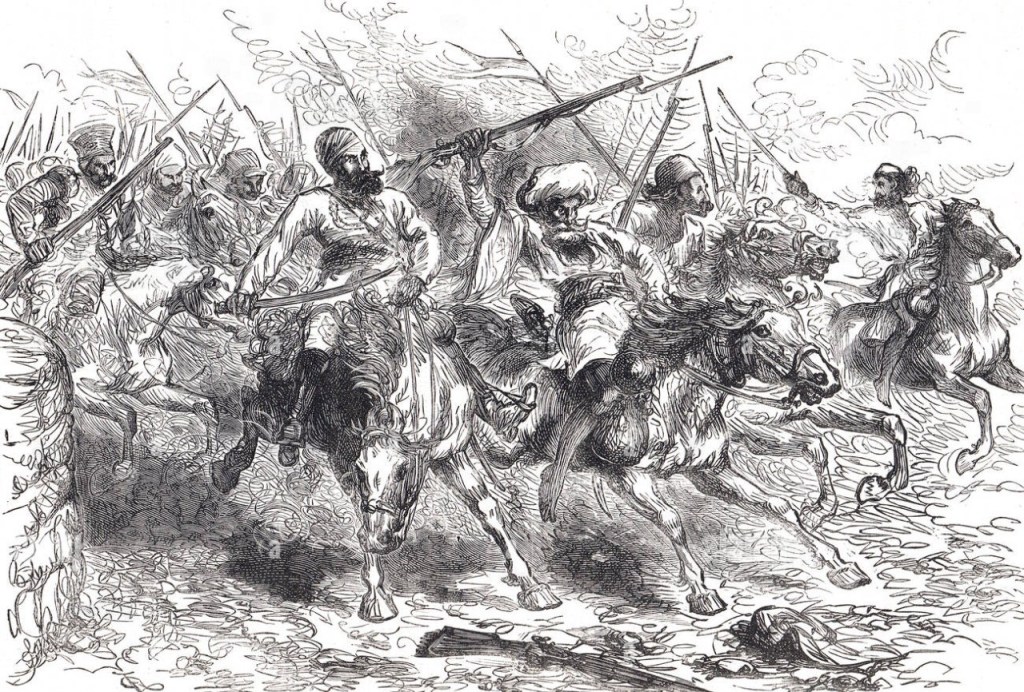
The next morning, the sepoys were in a better humour and let the sergeants leave, and Mihrwarn Singh had been promoted by some curious council to general, ordered the Legion was to march. Conolly was mounted on his horse and closely guarded by his still faithful guard, rode along with them. He was their prisoner and, for all he knew, soon a dead one.
 Mutiny Reflections