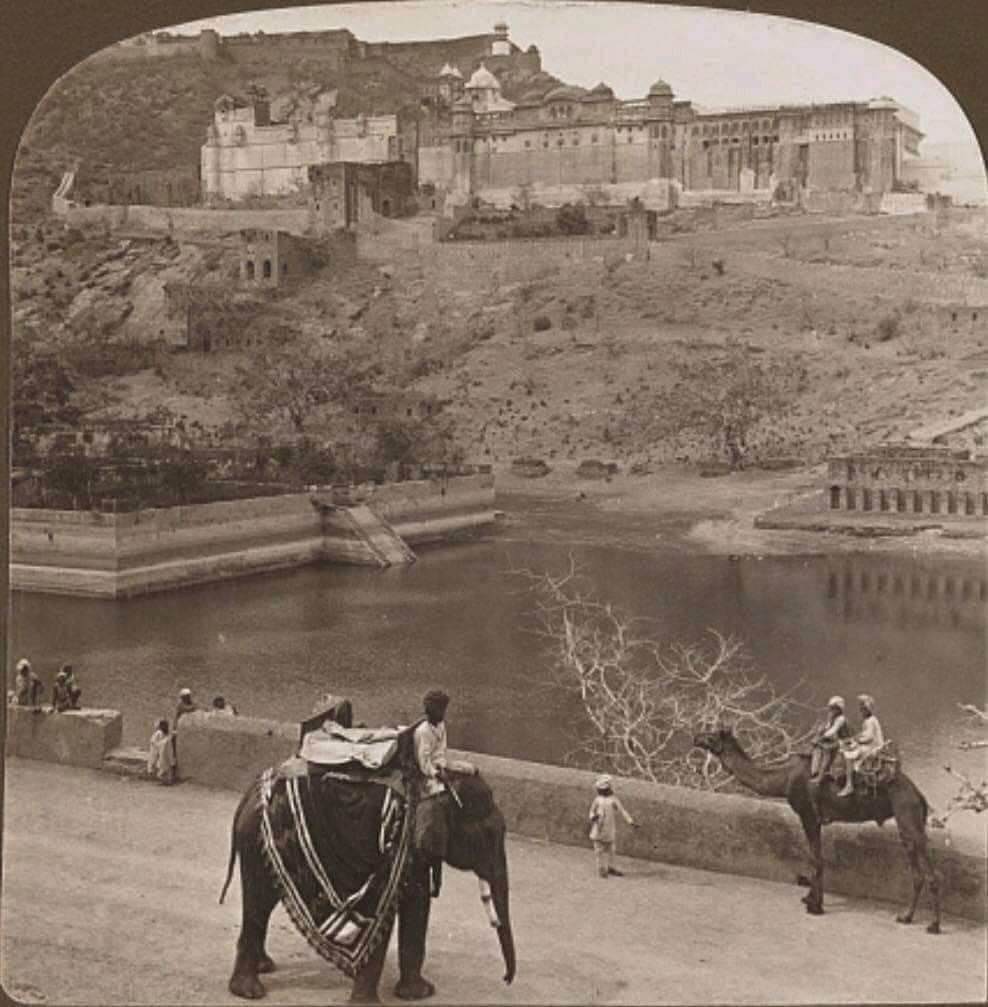
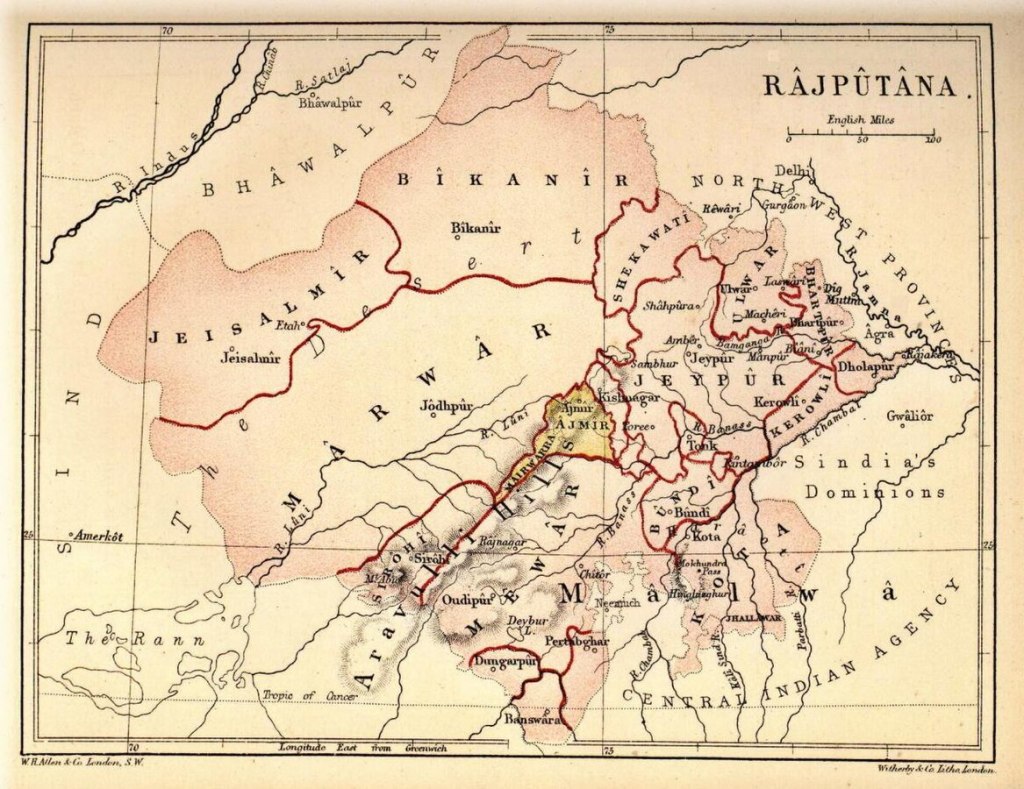
Undoubtedly, the erstwhile rulers of the numerous princely states of Rajputana proved their staunch fidelity to the “Paramount Power”, i.e. the EICo, during the turbulent times of 1857. Maharana Swaroop Singh of Udaipur “exerted his great influence as the acknowledged Head of all Rajput princes on the side of the British, advising all, who applied to him by letter or by accredited ministers specially deputed for counsel at the crisis, to stand firm in their allegiance to the British Government.” The Maharaja of Karowli sent his levies to support the British and even drove the Gwalior troops out of his territory and sent 800 troops to aid the Maharao of Kotah, who was being held prisoner by the rebels in his state. At Jaipur, while dissension raged in his ranks, Maharaja Ram Singh remained a loyal supporter; at Tonk, after his troops revolted, the Nawab continued to aid the British, although he incurred “considerable personal risk and pecuniary loss.” The Jodhpur Maharaja, Takht Singh, unable to directly support the British due to the very refractory nature of his chiefs, continued at least to beat the drum for their cause. Only at Bundi did the ruler remain aloof to all sides, leaving himself open to criticism for his lukewarm attempts to capture rebels, and at Kota, where things were just that more complicated, the ruler was suspected of outright complicity and would later be investigated.
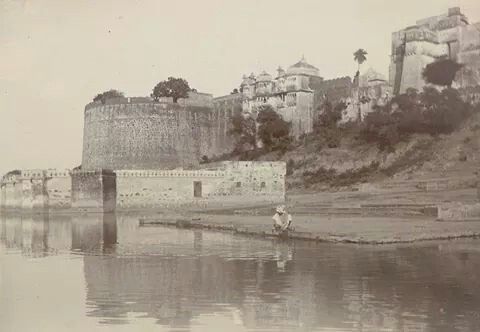
The loyalty the EICo received from the maharajas of Rajputana was not due to any particular love of foreign rule but a shared history, caused by centuries of grinding tyranny under the Marathas and the deprecations of the Pindaris. Their states were close to ruin, strife among the chiefs in their principalities was commonplace and the wild tribes of the Bhils, Minas and Mers, loyal to no one and feared by all, took advantage of the worsening situation in Rajputana to engage in their own predatory activities. In short, the rulers stood “in dire necessity of an overlordship which could afford them full protection against internal anarchy.” The British responded to the different calls for assistance by offering treaties of alliance and in some form starting with the Treaty of Friendship, Alliances, and Unity between Mewar and the EICo, signed on the 13th of January 1818. The EICo took it upon itself to protect Mewar and restore through their “best exertions” those territories Mewar had lost. The Maharana agreed to act in “subordinate cooperation” and to acknowledge the superiority of the EICo – for this he would be allowed to maintain his sovereignty as long as he desisted from political machinations with other Rajputana states and paid a substantial tribute to the EICo. It amounted to one-fourth of the entire revenue of Mewar for the first five years, and then three eighths ad infinitum.
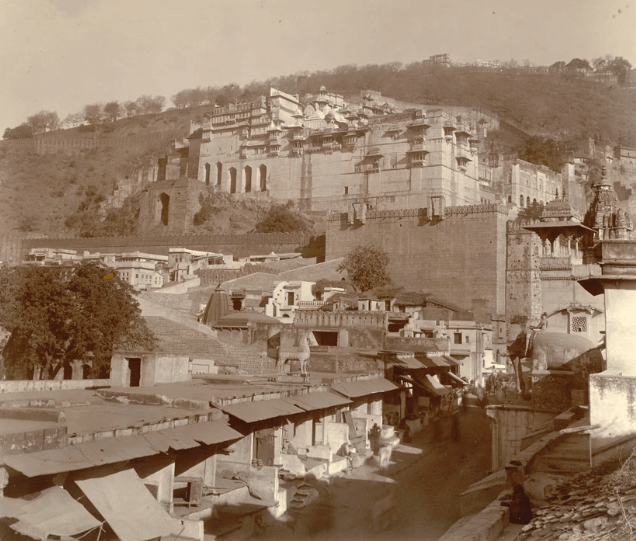
For their part, the British did what they promised. The Maratha incursions were curbed, the Pindaris destroyed and the wild tribes suppressed. The rebellious chiefs were compelled “to submit to order and surrender the usurped State lands” and under guarantees of protection, the peasantry, and traders could take up once again their vocations. The task of achieving this rather lengthy list was given to James Tod, the first of many political agents to the various states of Western Rajputana.
“Clothed with this ample authority, he applied himself to the arduous task of endeavouring to repair the ravages of foreign invaders who still lingered in some of the fortresses, to heal the deeper wounds inflicted by intense feuds, and to reconstruct the framework of society in the disorganised states of Rajasthan.”
His portfolio included Mewar, Kota, Sirohi and Marwar and in 1821, Jaisalmer fell into the fold.
“…so successful in his efforts to restore peace and confidence that within less than a year some 300 deserted towns and villages were repeopled, trade revived, and, despite the abolition of transit duties and the reduction of frontier customs, the state revenue had reached an unprecedented amount. During the next five years, Tod earned the respect of the chiefs and people, and was able to rescue more than one princely family, including that of the Ranas of Udaipur, from the destitution to which they had been reduced by Maratha raiders.”
Tod believed that each princely state should be inhabited by only one community, that is, the original inhabitants and under this policy, he successfully expelled the Marathas, the Pindaris and anyone else he felt was not inherently a part of Rajputana. He then went on to redraw the map of Rajputana through various treaties, thus encoding each state with its rightful territory as opposed to the rather blurry idea of what they thought they owned. While these ideas were successful, his criticism of what he called “national degradation” of the Rajput territories did not find him many friends in the halls of the EICo.
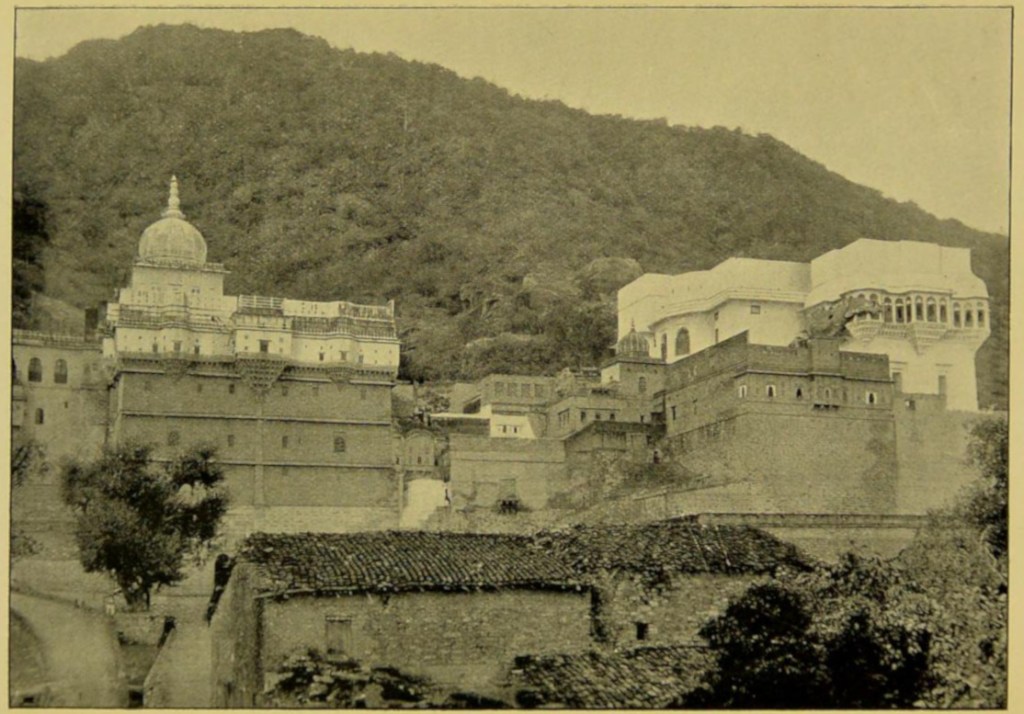
While all of this might have looked favourable for the rulers whose lands were slowly recovering from strife and turmoil, things were not so promising for Tod. His superior, David Ochterlony suspected his meteoric rise in Rajputana was nothing short of impossible and Calcutta, viewing the favouritism he was apt to show to the princes under his charge, believed it was due to corruption. In short, they could not imagine that Tod had managed to restore order to Rajputana without resorting to underhand means. In 1822, his power to govern seriously curbed, and Tod resigned citing ill-health and went home.
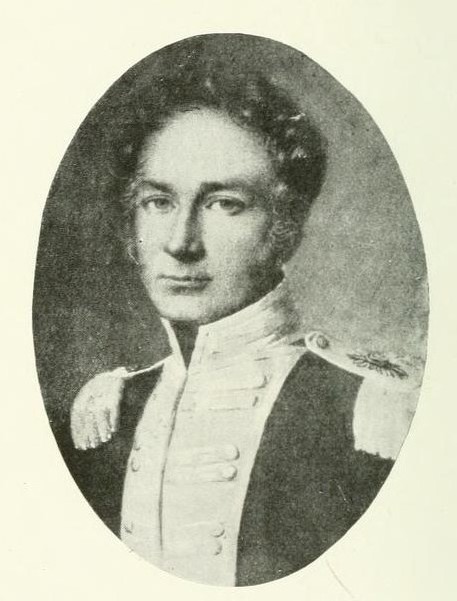
Over the next decades, reforms would be brought into place, engrained systems overturned and in typical EICo fashion, the feudal nature of the Rajputana provinces would be redesigned in the spirit of progress and enlightenment as dictated by the beliefs of the day. The political agents continued to pressure and interfere with the internal affairs of the state while ignoring the medieval conditions that still held true outside the princely palaces. The maharajas and much less the nobles had not learned to rule by legislation; their will was regarded as law — they “took no interest in matters of political, social and economic development of the people. The society was divided into two classes, the oppressive class of feudal aristocracy at the top and the pauperised and ignorant masses at the bottom.” Unfortunately, while British influence had brought about a measure of stability, it had also robbed the maharajas of their will and power to rule, their every decision under the critical eye of the erstwhile political agent and as such, the political agents became the real authority in Rajputana. For the landowners, for whom this new system brought few advantages, it further impeded their feudal rights and privileges and in 1857, many of them saw an opportunity to rise against what to them was the rule of this foreign and “universal landlord.”
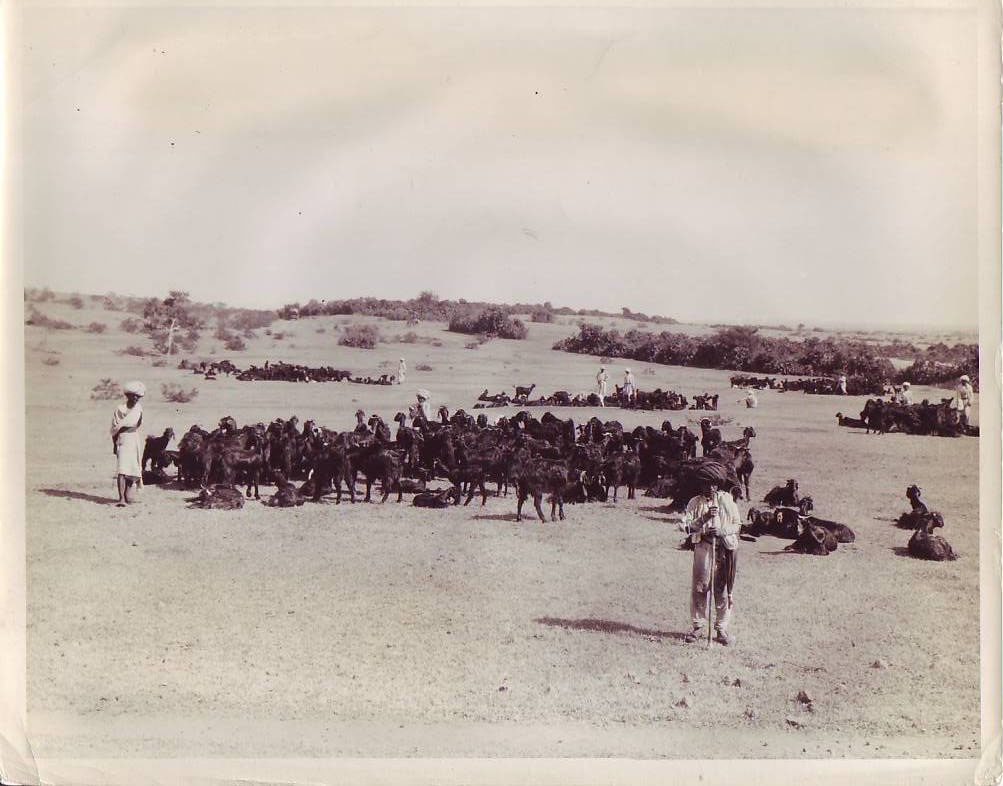
However, the British had some sway in Rajputana in 1857, and one of these was history. They had emancipated Rajputana from the tyranny of the Marathas and the Pindaris, and the rulers shared a common fear: if the military hordes amassing in North India were to descend upon their state, it would be a return to the lawlessness they had, but recently escaped from. They were concerned about the revival of Mughal power at Delhi, which had effectually kept them as virtual slaves for nearly three centuries. The rebels’ declaration of Bahadur Shah Zafar as their leader confirmed that — as such, it seemed better to side with the evil they knew, i.e. the British, than risk an evil that was, at best, unquantifiable. They were also no longer strong enough to hold their ground in a fight — their personal troops were, for the most part, poorly equipped and, in some cases, merely decorative.
While this might have held true for the Maharajas, it did not necessarily resonate with all of their subjects, especially the jagirdars (landowners). They saw the mutiny as a way to set back time in their favour. The raising of the various contingents, for example, had not been simply to assist the British whenever they required; these same forces had been used to keep opponents of their rule in check. Forts had been besieged, and battles waged against chieftains who saw the British as encroaching on their vested interests. Throughout the first half of the 19th century, sporadic risings continued to occur, but the determined cause lay foremost in the British insistence on forcing their ideology on the people. The abolition of sati, or widow burning, was seen as an affront to their tradition, the landowners resented the abolition of their personal troops which they had used to keep their personal areas under control; they disliked the high-handed manner with which their sovereigns now treated them, who, with the advent of British rules, could turn their backs on time-honoured agreements. While previously, a ruler would have been loath to incur the wrath of his subsidiaries, now he could afford to do so. The landowners, in turn, saw a gradual dissolution of their own power and feudal rights. In 1857, peace in Rajputana was merely a front — underneath, the province was simmering on the brink of an uprising.
While he was the implementor of indirect rule in Rajputana, he was also its strongest critic. He saw the system as detrimental to the states, taking away their right to nationhood, and as “utterly subversive to the stated goal of preserving them as viable entities.” In short, Tod believed creating states with nominally powerful puppet rulers was nothing short of dangerous in the long run. In 1829, he wrote,
“Who will dare to urge that a government, which cannot support its internal rule without restriction, can be national? That without power unshackled and unrestrained by exterior council or espionage, it can maintain its self-respect? This first of feelings these treaties utterly annihilate. Can we suppose such denationalised allies are to be depended upon in emergencies? Or, if allowed to retain a spark of their ancient moral inheritance, that it will not be kindled into a flame against us when opportunity offers?”
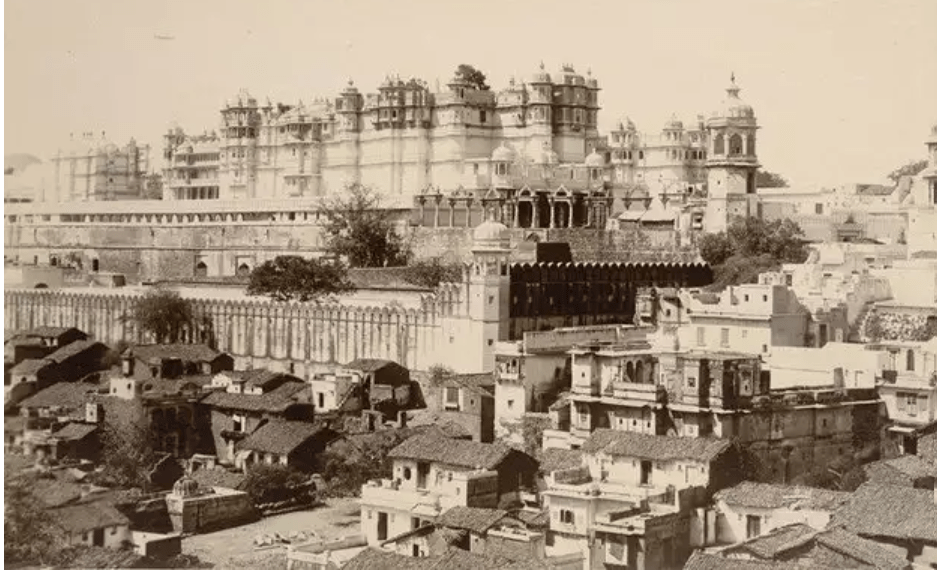
Ultimately, however, for all the trouble the chieftans would cause during the mutiny, their intentions were not necessarily founded only in the fervor of “patriotic sentiments.
“Nor did they possess the organising capacity so essential in case of popular upheavals. Being mostly self- centered and selfish in their aspirations the jagirdar rebels of Rajasthan failed, despite their personal bravery and sacrificing zeal, to inspire the millions to make a common cause agains the British. For months they went on waiting for a suitable opportunity; and when the opportunity came, they failed to rise in time and their belated efforts were destined to succumb.
Above all, the ruling princes, who carried with them for the most part, their own troops and the majority of their subjects, being awfully bewildered and confused, saw in the efforts of the Jagirdar rebels their own ruin and as such stuck fast to the protecting power which had given them full protection against the feudal anarchy in the past…In the absence of proper lead and uniform policy the dormant anti- British ferment in Rajasthan was destined to die a natural death and the sporadic agitations, engineered by leaderless chieftians of feudal Rajasthan, were crushed with a heavy hand.”
Their own vested interests, mutual quarrels and selfish motives would ultimately be their downfall – the only link that bound the rebellious was their mutual hostility against the British; but the fall of Delhi broke their backs. Where they had once been ready to peldge their allegience to Bahadur Shah Zafar, they had waited too long and his diposal from the throne left them leaderless and without a goal. They were “destructive heros moving in a dissolving society, “ fighting for values which they had already been losing and by failing to make a common cause with the mutineers, who for their part had mostly ignored the dissent brewing in Rajputana, their agitations ultimately dissolved into isolated revolts. However the legends of their struggles are imortalised to this day in the bardic poems still recited in the land of deserts.
Sources:
Gupta, R. K., and S. R. Bakshi, eds. Rajasthan Through the Ages. 5 vols. New Delhi: Sarup & Sons, 2008.
Khadgawat, Nathu Ram. Rajasthan’s Role in the Struggle of 1857. Jaipur: General Administration Department, Government of Rajasthan, 1957.
Saxena, K. S. The Political Movements and Awakening in Rajasthan, 1857-1947. New Delhi: S. Chand & Co., 1971.
Tod, James. Travels in Western India, Embracing a Journey from Kamod to Alexandria, Performed on His Return to Europe. London: W. H. Allen, 1839.
 Mutiny Reflections