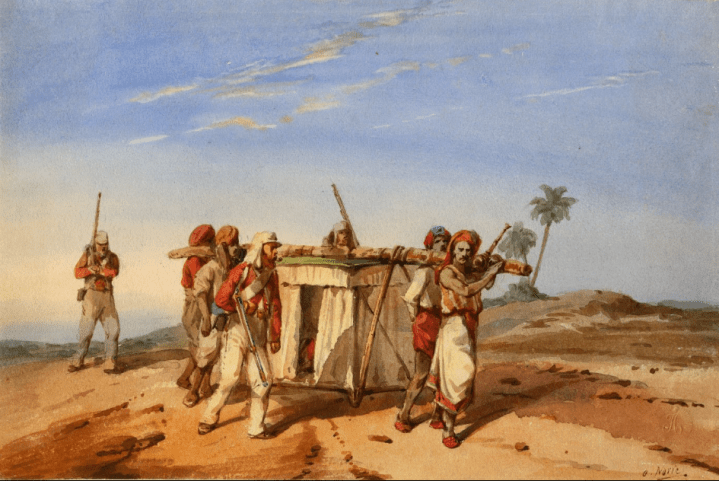
I will relate an anecdote which, though well-known and laughed at in India, is not so widely spread at home. One of our great Parliament men, no matter whom, in describing one of the battles of the Suttlege campaign, to add to the horrors of his description, said, ” On the advance of our troops, hundreds of ferocious dhoolies rushed down the hill, and in a few minutes the plain was swept of the wretched wounded.” (Jones)
They carried Lieutenant George Younghusband in a doolie to Fatehgarh. The road was strewn with the bodies of mutineers; many of them had had their clothes taken by the camp followers and now lay naked. The cavalry had done their awful work, shown in the cuts from lances and slashes from swords that marked the corpses. No one had come out to bury them as yet; who they were or where they came from was now anyone’s guess.
Reverend Mackay rode next to Younghusband’s doolie, trying to conceal the dying man from the sights on the march; he ordered him carried on the left side of the road, so the breeze blew the stench of decay and the dust away from him. Dr Ross and a native doctor endeavoured to keep the doolie bearers steady, but the jolting on the uneven road could hardly be helped. In severe pain, he arrived at Fatehgarh to await death. He died peacefully, “without a struggle or a groan,” just after three in the morning on the 4th of January, watched over by his orderly and servants, with the Reverend Mackay at his side until the end.
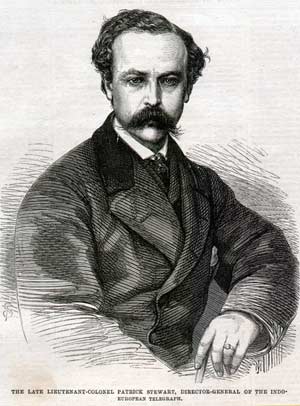
Along the way from Cawnpore, Lieutenant Patrick Stewart of the Engineers had been busy erecting a telegraph line along the road, and it reached Fatehgarh with the troops. He had been attached to the Telegraph Department when the mutiny broke out and was specially appointed by Sir Colin Campbell to keep communications open with the Government during the advance on Lucknow. During their stay at Cawnpore, Stewart was one of the young men busily attending to the telegraph during the battle on the 6th of December and “was the first who ever marked the successive days’ progress of an army by telegraph posts and stations, and his escapes from the enemy’s horse were numberless; but nothing could daunt his spirit of enterprise and energy.”
Sir Colin Campbell arrived to find Fatehgarh devoid of rebels. As his spies had told him, they had fled precipitously to Rohilkhand, and the tail end of their rout was seen as the head of his force arrived at the fort. They had made no attempt to break the Bridge of Boats and had left the fort open, but the gate was shut. They had, however, left an unpleasant surprise.
“There is a tope of considerable extent lining the parade ground,” wrote Anson, “where we are pitched, and this tope was made use of as a convenient shelter for innumerable workshops in wood and iron connected with the gun-carriage agency. All these workshops were made of temporary materials, wood and thatch, and underneath the tope, all sorts of buggies, carriages, carriages, boxes, loot of every description, including ladies’ dresses and crochet work, were heaped up in mad confusion. The brutes set fire to the tope, and it and everything under blazed and crackled away sky-high. On our arrival, there were mountainous heaps all smouldering away and a blaze here and there. Our people set to and brought away half-burnt- buggies, palkee gharries, chairs, portmanteaux, dresses, boxes, etc., everything, in fact, you can imagine.”
Expecting the rebels might still be holding the fort, which was in the midst of the town by the banks of the Ganges, the main gate was blown open. Inside, they found one of their own 10-inch howitzer double charged with grapeshot and the muzzle directed at the entrance, but there was no one to man it. The fort was empty. As the fort had been an arsenal before the mutiny, it was expected that at least the government property would be destroyed; however, the steam engines were found in working order as were the guns and on closer inspection, not a single plank of valuable timber had been removed. The foundry and powder factory, along with large quantities of metal and material for both, were found intact — some brass guns in their lathes, half turned with many more just cast, showed with just what haste the rebels had abandoned the fort. A detachment was sent to secure the fort, one regiment was marched down to take possession of the bridge of boats while the remainder of the army encamped on the old parade ground, not far from the ruins of the station church.
Although the Nawab of Farrukhabad had absconded (note Farrkuhabad was the principal town and home to the Nawab; Fatehgarh was an extension that included the cantonments & civil lines, separated from each other at a distance of three miles) his Nazir of the Collectorate, one Mohsin Ali Khan (alternately, Azim Khan, Wazim Khan and Najib Khan), had not. He was determined to hold out until the very end and, with “some Pathans, a tribe of Mussulman hillmen and heavy guns,” had barricaded himself in the palace. So on his arrival, in the late afternoon of the 3rd of January, the Civil Commissioner, John Power, who would be given the ominous title “Hanging Power,” issued an ultimatum that morning demanding that Khan give himself up and open the gates. Otherwise, the city would be handed over to Campbell’s troops and sacked as punishment for the deaths of the Europeans of Fatehgarh.
 Mutiny Reflections
A gruesome history.
LikeLiked by 1 person
Malleson & the conventional historians of 1857 tend to not mention these incidents. But I feel it needs to be told. It is tough reading though.
LikeLiked by 2 people