“The work fell chiefly on the Cavalry and Horse Artillery. Major Ouvry, who commanded them, must have been a proud man that day, for they behaved splendidly. Two of Blunt’s guns also, under an old Addiscombe friend of mine named Cracklow, did excellent service. The 9th Lancers, under Drysdale, performed wonders; and the three squadrons of Punjab Cavalry, under their gallant young leaders, Probyn, Watson, and Younghusband, and the squadron of Hudson’s Horse, under Hugh Gough, showed of what good stuff they were made.” (Frederick Roberts, “Forty-One Years in India”)
The Battle of Bulandshahr was contested on the 28th of September 1857 at a town of that name, 42 miles distant from Meerut. It was fought by the Delhi Column under Brigadier Greathed against the forces of Walidad Khan, a somewhat notorious rebel leader and unrepentant plunderer who had been wreaking havoc throughout the district for months. When not destroying telegraph wires and poles, he was looting his way through the villages in his path. By the time Greathed arrived in Bulandshahr, the town was firmly in the hands of the rebels – men who had fled Delhi after its fall had greatly added to the already dramatic numbers. A detailed description of the battle can be found in“Fleeting Intelligence II” Here, we shall take a look at seven desperately won Victoria Crosses.
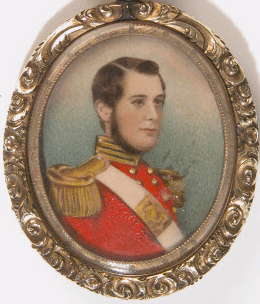
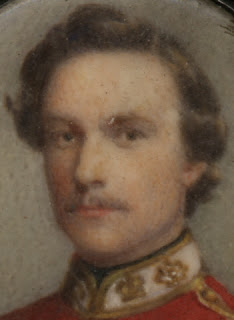
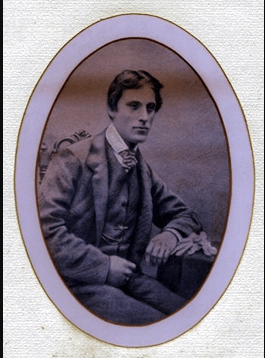
A portrait of a young man sporting the Newgate fringe-styled whiskers, with his gold epaulettes and mentioned often in the letters of Brevet-Major O.H.S.G. Anson during the Siege of Delhi as “Young Anson” where he was “…highly spoken of as possessing the most determined courage, together with a great amount of intellect.” Although an officer of the 84th, Captain Anson would be attached to the 9th Lancers and served as ADC to Hope Grant. The Ansons are something of a tangled family and in the words of the brevet-major, “Fancy young Anson telling me the other day that the General did not know that I was Sir George Anson’s son, that, in fact, he knew nothing about his own family, and hardly ever saw one of them but his own immediate brother, Lichfield, with whom he was very intimate; but he knew little or nothing even of his family; didn’t know how many brothers and sisters young A. had, nor how many of the latter were married. He was, in fact, notorious for ignoring his own kith and kin.” So much for the General. As for Young Anson, born on the 5th of March 1835, he was the third son of Thomas Anson, 1st Earl of Lichfield. Anson was commissioned into the Rifle Brigade on the 27th of May 1853 and saw service in Crimea, where he was promoted to captain. Exchanging into the HM’s 84th (the same regiment as O.H.S.G Anson), he was swiftly appointed ADC to his uncle, the Honorable George Anson – the portrait is said to have been painted at Lucknow around this time. History dealt swiftly with the general who had “notoriously ignored his kith and kin” and it would be left to his nephew to deal with his affairs at Simla, for which he took a week off from the Siege of Delhi in July. In all, he was a jovial young man who liked a game of chess at which he was soundly trounced by the brevet-major, but above all, he never backed out of a fight. Unfortunately, according to Captain Garnet Wolseley, Anson’s horse was ” a big, flea-bitten, greyish Gulf Arab…” not that it mattered much as Anson was also “..an indifferent horseman and a bad swordsman.” However, Wolseley did admit that when there was a cavalry charge, Anson would be there. For his pains during the Siege of Delhi, he had been wounded in the hand. During the melee that now ensued, Anson lost control of his horse, which, as his hand had still not healed, plunged and reared straight into a group of mutineers who lost no chance to shoot at him. As the horse galloped on, a ball passed through Anson’s coat flap – both horse and rider made a very fortunate escape. However, it would be at Bulandshahr that he would settle his reputation. “For conspicuous bravery at Bolundshahur, on the 28th September, 1857. The 9th Light Dragoons had charged through the town and were reforming in the Serai; the enemy attempted to close the entrance by drawing their carts across it, to shut in the cavalry and form a cover from which to fire upon them. Captain Anson, taking a lance, dashed out of the gateway and knocked the drivers off their carts.” During the melee, Anson, still suffering from his wounded hand, lost control of his horse, which plunged and reared straight into a group of mutineers who lost no time in shooting at him. As the horse galloped on, a ball passed through Anson’s coat flap – both horse and rider made a very fortunate escape. The citation, however, continues.
” At Lucknow, at the assault of the Secundra Bagh, on 16th November, 1857, he entered with the storming party on the gates being burst open. He had his horse killed, and was himself slightly wounded. He has shown the greatest gallantry on every occasion, and has slain many enemies in fight.” (Despatch from Major-General Sir James Hope Grant, K.C.B., dated 12 August 1858)
Wolseley certainly never doubted Anson’s ability at hand-to-hand combat.”I can see him how, in my mind’s eye, with his mouth firmly closed and determination marked on every feature of his face. H was in every sense a soldier, absolutely indifferent to danger, he revelled in these hand-to-hand encounters..” and he always killed his man. Anson would remain ADC to Hope Grant until the end of the mutiny and return home with a brevet majority. Gazetted on the 24th of December 1858, Anson received his VC from Queen Victoria at Buckingham Palace in 1859. He returned to his soldierly ways as ADC once again, to Hope Grant during the China War. Once again, the indefatigable Anson showed his mettle – amid the fighting at the North Taku Fort, he cut the ropes holding a drawbridge. Pleased with his ADC, Grant sent Anson home with his despatches, to announce the capture of Peking. He was also given the choice between a brevet lieutenant-colonelcy or majority – Anson chose the latter and thus sealed an end to his military career, unable to gain permission to change back into a regiment – every application was denied. In 1863, he married Amelia Maria Claughton. The marriage remained childless. War would no longer feature in Anson’s life unless it was a battle of wits and minds – in 1859 he was elected Member of Parliament for Lichfield, a seat he held until 1868 – although he did lose the following election, a petition granted him his seat back and after the next election, he was able to hold his seat until 1874. He did throw his backing into the London Scottish Volunteers (a volunteer rifle brigade) of which Sir Hope Grant was the honorary colonel.
Unfortunately, his life would not be the long and colourful one his compatriots imagined for him. At the age of 37, he was struck down by “a rupture of a vessel in the lungs, the consequence of a long-neglected cold, “ leaving him an invalid. Repeated trips to the South of France to treat his complaint were finally of no avail – he died, aged 42, in Cannes, France, where he lies buried at Cimetiere du Grand Jas de Cannes.
Private James Reynolds Roberts
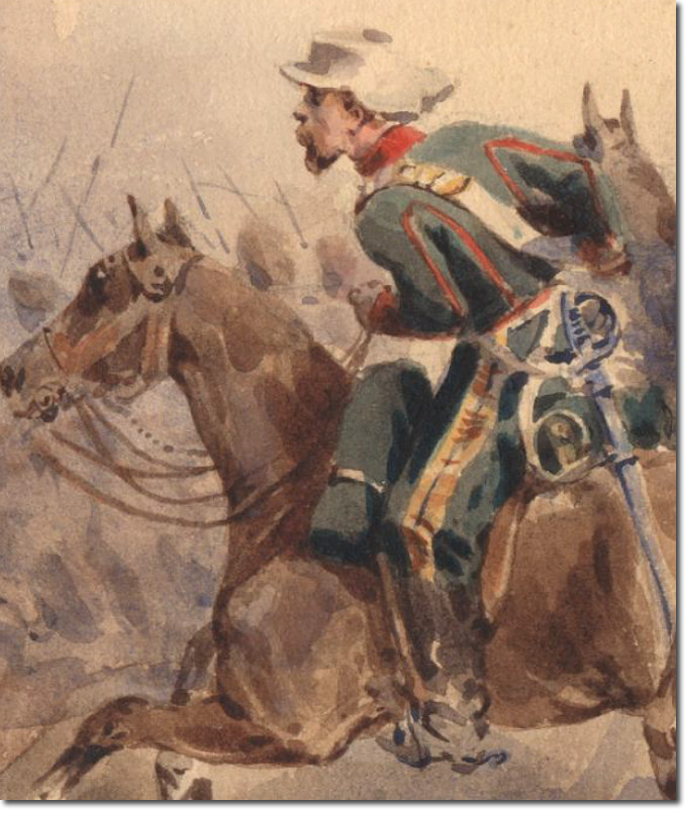
There are no pictures of Private James Reynold Roberts so Orlando Norie’s painting, depicting the 9th Lancers in action during the Indian Mutiny shall have to suffice.
Born in Bow, London, in 1825 or 1826, James Reynolds Roberts enlisted in the 9th Lancers – little is known about his life before he joined, and there would be precious little left of his life after the mutiny. For now, we shall look at the one moment that could have changed his destiny. During the battle, 31-year-old Roberts was one of the men in charge of the 9th Lancers through the street at Boulandshahr; he was wounded in the bridle hand. While Anson lanced the drivers, the injured Roberts was rescuing Farrier Stillman, who had been shot off of his horse. The two men were quickly surrounded by sepoys, but Roberts managed to hold them off until they, in turn, received assistance. His efforts did not save Stillmann – he died shortly after of his injuries- but it did secure for Roberts the Victoria Cross. He fought his way through the Relief of Lucknow and back again the following year for the final recapturing of the city. He was gazetted on Christmas Eve, 1858, and following the mutiny, he returned home. Ill with an abscessed liver and no longer able to serve, Roberts died in Middlesex Hospital, Marylebone, London on the 1st of August, 1859. A month later, his brother, as his next of kin, received the VC by registered post. James Reynolds Roberts was buried in an unmarked grave at Paddington Old Cemetery, Kilburn, London.
His medals – Victoria Cross Indian Mutiny Medal ( 1857-58 )with 3 clasps: “Delhi” – “Relief of Lucknow” – “Lucknow” are held by the 9th/12th Lancers Regimental Museum in Derby Museum and Art Gallery.
Lieutenant Robert Blair &the Man Who Saved Him, Private Patrick Donohue
Robert Blair, VC
Robert Blair was born on the 13th of March, 1834, in Linlithgow, Scotland. When Blair was but a boy of 5, Patrick Donohue, a young 19-year-old Irishman from Nenagh, County Tipperary, enlisted in the 17th Lancers, stating his occupation as “coachmaker.” He transferred to the 9th Lancers, who were about to embark for India. While the regiment would be badly decimated by cholera after arriving in Cawnpore, Donohue was one of the lucky ones. He went with the regiment to Gwalior State, and on the 29th of December, 1839, he fought in the Battle of Punniar. He then fought his way through both Sikh Wars and added Sobraon, the Passage of the Chenab, Chillianwallah and Gujerat to his growing list of engagements.
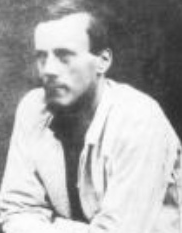
As for Robert Blair, the son of William Blair and his wife Jane Christian (née Nourse), life went on as it would do for a young man of his standing. His family had long links to India – most recently, a relative, Captain E.M. Blair, was lost in the disastrous retreat from Afghanistan, leaving his widow, Susan, grieving her loss. Her four children would all feature in the Indian Mutiny, but only one would make his name a household one. In education, Robert was not left wanting. As a graduate of the University of Glasgow and a Snell exhibitor (this was an annual scholarship awarded to students of the University of Glasgow which allowed them to pursue postgraduate studies at Balliol College Oxford) at Balliol College, Oxford, he was a young man of some promise. Having studied law, it was expected he would follow in his father’s footsteps, but Fate, however, had other plans. In 1853, he was commissioned as a cornet into the 9th Lancers, from whence his father purchased his lieutenancy for him on the 2nd of November 1855 – Blair exchanged into the Queen’s Bays in December 1856. In the meantime, Blair chose to remain with the 9th Lancers until the Bays arrived in India, so his service with the 9th Lancers was technically on attachment. As a result, he would be the only officer of the Queen’s Bays to receive not only the Delhi clasp for his Mutiny Medal but also one for Lucknow. A rather ambitious young man, Robert made a rash vow with a fellow officer and friend, one Alfred Stowell Jones, that they would do all they could to win a VC. Jones was first to fulfil his vow at Badli-ki-Serai on the 8th of June. Robert would have to wait until Bulandshahr, but the price he paid was dear. Following the capture of the guns at Bulandshahr, Blair was sent out a short distance in the advance, accompanied by a sergeant and 12 troopers to bring in an abandoned ammunition wagon. As his party approached, they were surprised by a body of some 50 rebel cavalrymen who galloped out from their hiding place behind a few adjacent houses. Without a pause, Blair instantly formed up his men and, seeing there was nothing else for it, charged the sowars. As they dashed through them, the small band managed to kill nine, four of whom were slain by Blair. It nearly proved to be his undoing. While in the act of running one adversary through with his sword, another dealt him a massive blow to the shoulder, which practically severed it at the joint. The wound continued in a slash down his back. This is where Private Patrick Donohue comes in. Seeing Blair wounded and unable to defend himself, Donohue rode with some fury and, followed by a few other men, managed to extricate Blair from his predicament and bring him safely back. Once in the camp, Blair was taken to the surgeon. His shoulder was taken out of its socket, and after some rather gruesome surgery which involved excising the joint, it was placed back in. Fortunately, Blair was not awake – he found some respite in chloroform. The surgeon saved his arm, but it would remain stiff and unusable at the shoulder joint, though he would still be able to move his arm from the elbow. His arm, too, would be significantly shorter than the other one. The two men, if they ever spoke, is not recorded. Needless to say, they were both gazetted for the Victoria Cross. With the severity of his injury making it impossible for Blair to continue with the column, he would eventually return home – he received his VC on the 2nd of August, 1858, presented by Queen Victoria, at Southsea Common in Portsmouth. A month before receiving his cross, Blair was promoted to captain, and before the year was through, he returned to India. As for Private Donohue, the fight had continued. Although wounded at the Musabagh on the 19th of March 1858, we can let his medal list speak for itself.
Victoria Cross
Gwalior Campaign Star ( 1843 )
‘Punniar Star’
Sutlej Medal ( 1845-46 )
Reverse: ‘Sobraon 1846’
Punjab Medal ( 1848-49 )
2 clasps:
“Chilianwala” – “Goojerat”
Indian Mutiny Medal ( 1857-58 )
3 clasps:
“Delhi” – “Relief of Lucknow” – “Lucknow”
Army Long Service & Good Conduct Medal
Private Patrick Donohue was presented with his medal at Windsor Castle by the Queen on 4th of January 1860. Although he would not be discharged from service until 1864, Donohue went to America in April 1862 – it is of little concidence that his younger brother Timothy had made the decision to emigrate to those fair shores and they both arrived in New York the same month. While Timothy enlisted in the 69th New York Infantry Regiment, it would appear Patrick was not so inclined. Timothy would win the Medal of Honor for his part in the American Civil War, when at the Battle of Fredricksburg on the 13th of December, 1862, he “Voluntarily carried a wounded officer off the field from between the lines; while doing this he was himself wounded.” As for Patrick, at the time of his discharge due to chronic bronchitis in 1864 in Dublin, he had served 25 years and 90 days with the 9th Lancers, still a private. He died on the 16th of August, 1876 at Ashbourne, Co. Meath and was buried in an unmarked grave in the Donaghmore Roman Catholic Churchyard, near Ashbourne. For Robert Blair, a grave was dug for him at Cawnpore adjoining that of Captain William Peel VC- he died on the 28th of March 1859 of smallpox. The inscription at the Kacheri Cemetery read:
“VC, Capt, 2 Dragoon Guards, eldest son of Wm, of Avontoun, and Jane Christian NOURSE or BLAIR; served with 9 Lancers & R.A. at Siege of Delhi, & won VC at Bulandshahr where he was severely wounded on 28 Sep 1857. Born at Avontoun, Linlithgowshire, 13 Mar 1834, d Cawnpore 28 Mar 1859.
He was 25 years old.
“Private Jordan, the man who so gallantly stepped forward to Drysdale’s assistance, has lost the middle finger of one of his hands. Did I tell you of young Anson’s sending one of our lances through the head of a hackeryman who would persist in placing his cart across the road to stop the way? He also was of good service to Drysdale shot with his pistol a Sepoy who was firing a pistol at Drysdale on the ground.” (O.H.S.G. Anson)
Robert Kells
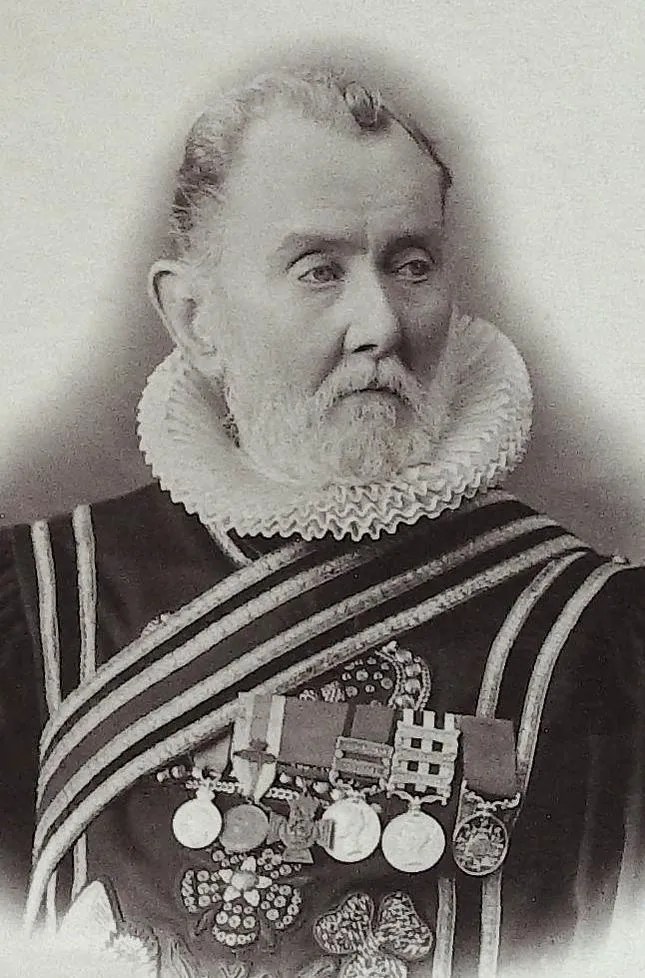
Sergeant Robert William Kells during his service as The King’s Bodyguard of theYeomen of the Guard
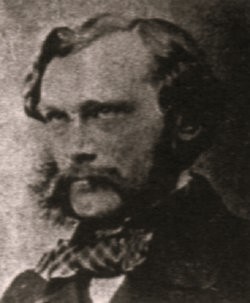
Robert William Kells was born in Meerut on the 7th of April, 1832, the son of a serving soldier – it was little wonder then, at the age of just 12, Kells enlisted with the 9th Lancers, a boy-soldier indeed. He would fight in the Second Sikh War at both Chillianwallah and Gujerat, never wavering from his regiment or for that matter, ever leaving India.
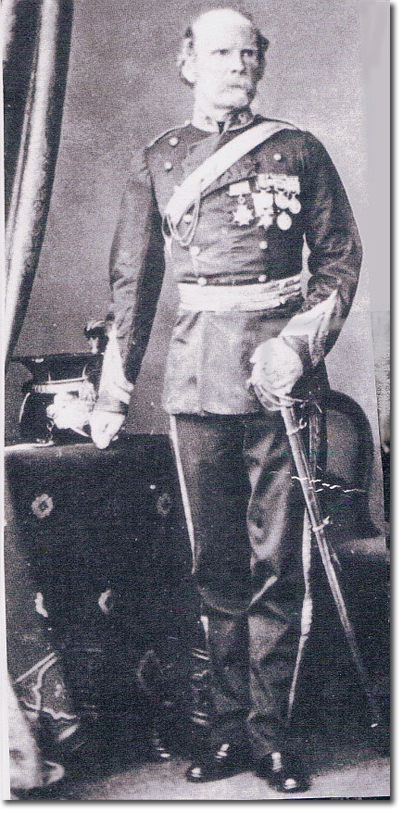
Lieutenant-General Sir William Drysdale, KCB
On the 28th of September, one man who was having a bad time of it was one William Drysdale, captain of the 9th Lancers. He was, according the Brevet-Major Anson, “…going at full-speed when his horse was shot under him, so you may conceive what a burster he must have come down.” Drysdale tumbled heavily off his horse and landed on the ground, his collarbone broken, and the rebels were closing in. Misfortune, however is not always fatal. Seeing Drysdale laying in the street, injured but still alive, Lance Corporal Kells and Private Jordan reined in and charged in his direction, placing themselves squarely between Drysdale and the men who were coming to kill him. Then, until further assistance could be sent their way, the two men defended Drysdale. Both Kells and Drysdale were recommended for the VC – as for Private Jordan, he sadly died of his wounds. In the end, only Kells was awarded the VC and Drysdale, after having his collar bone set, would not go on sick leave. Like Lance Corporal Kells, he continued to fight his way through the mutiny. Kells’s citation appeared in the Gazette on the 19th of December 1858. His would be one of 15 crosses forwarded by the War Department for presentation in India, but by the time the medals reached dry land, the Lancers were on their way home to England. By some mischance, it had been overlooked that Kells had transferred out of the Lancers and was now serving with the 1st Bengal European Light Cavalry (renamed the 19th Hussars in 1862) – his VC, however, made the return journey to England, looking for its recipient. Not to be found in England, it was sent again to India, reaching Kells at Allahabad in 1860. Kells retired from the Hussars in 1869, though not from choice. Discharged after 24 years and 6 months in 1869 on the 20th of April following a bad fall from a horse and a bad bout of illness. he opted to leave India for the first time in his life. Kells travelled to England. In 1881, he applied for and was appointed Yeoman of the Queen’s Bodyguard, a position he would hold for the next 24 years of his life, which ended peacefully on the 14th of April 1905. He was buried at Lambeth Cemetery in South London. He had been the 200th man to join the Yeoman of the Queen’s Bodyguard.
Medals of Sergeant Robert Kells, 9th ( Queen’s Royal ) Lancers
Victoria Cross
Royal Victorian Medal ( RVM )
Punjab Medal ( 1848-49 )
2 clasps:
“Chilianwana” – “Goojerat”
Indian Mutiny Medal ( 1857-58 )
3 clasps:
“Delhi” – “Relief of Lucknow” – “Lucknow”
Queen Victoria Jubilee Medal ( 1887 )
clasp:
“1897” ( Diamond Jubilee )
King Edward VII Coronation Medal ( 1902 )
Army Long Service & Good Conduct Medal ( LSGC )
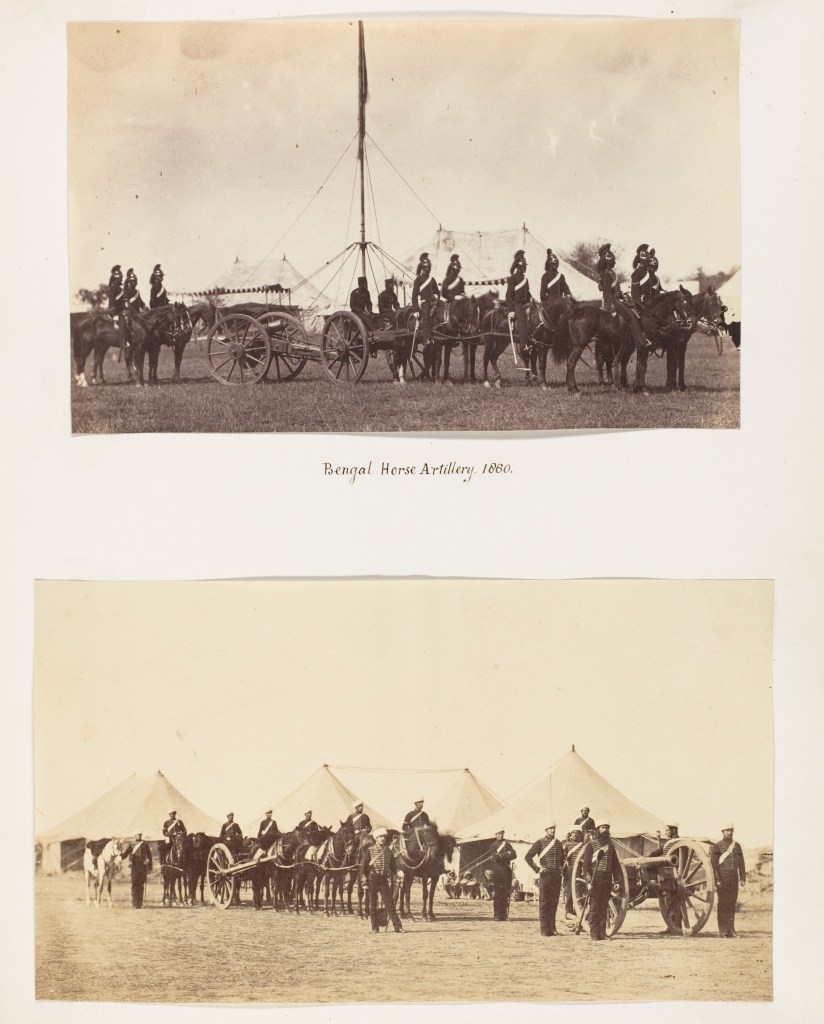
The final two VCs belong to men of the Bengal Horse Artillery. While the Lancers galloped and charged, the artillery was doing what they knew to do best, man their guns. This, of course, is the theory. However, at Bulandshahr, 2 guns advanced further than they should have, and as a result, their crews were perfect targets for the wily musket fire of the rebels. In hardly any time, most of the men of the desperately exposed crews had been killed; however, two men continued to operate their gun despite all odds. They succeeded in not only clearing the road but opening the way for the advance of the cavalry and infantry.
Serjeant Bernard Diamond and Gunner Richard Fitzgerald, Bengal Horse Artillery
“For an act of valour performed in action against the rebels and mutineers at Boolundshur, on the 28th September 1857, when these two soldiers evinced the most determined bravery in working their gun under a very heavy fire of musketry, whereby they cleared the road of the enemy after every other man belonging to it had been either killed or disabled by wounds.” (Despatch of Major Turner, Bengal Horse Artillery, dated Boolundshur, 2nd October 1857 – “No. 22131”. The London Gazette. 27 April 1858. p. 2051).
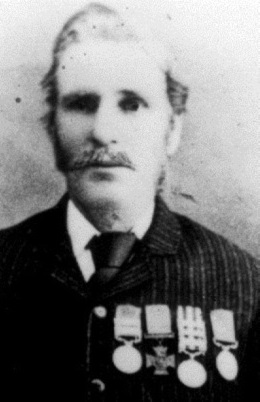
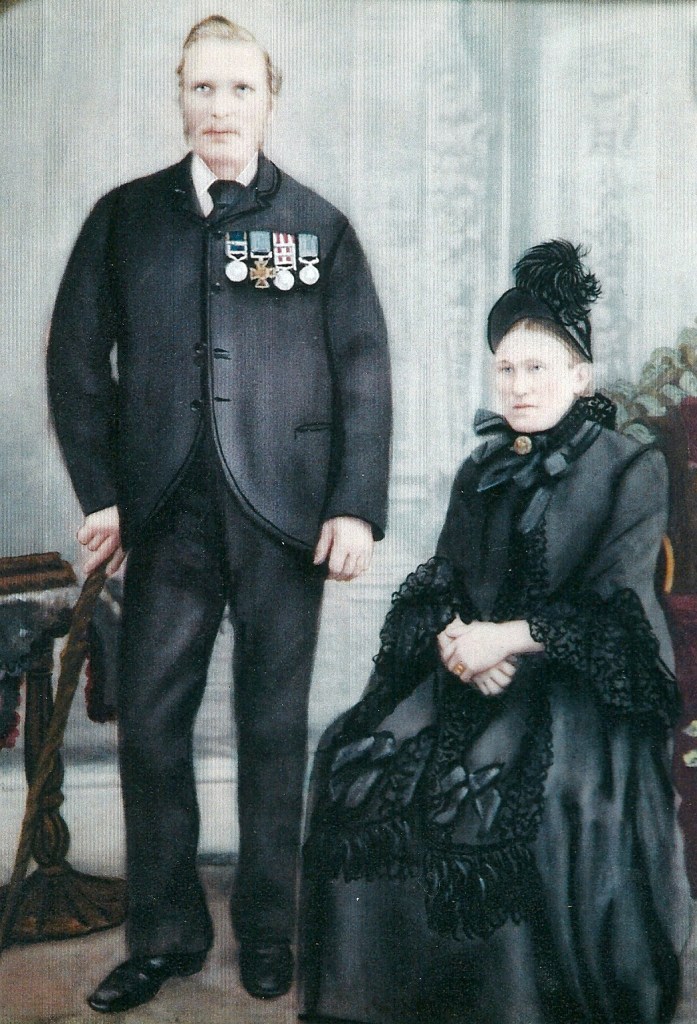
Sergeant Bernard Diamond
Born on the 2nd of June, 1827, the son of Bernard and Margaret Diamond (née McConnell), in Portglenone, County Antrim, Ireland, Bernard Diamond was working as a labourer at the time of his enlistment in the Bengal Horse Artillery in 1847. He arrived in India in time for the battles of the 2nd Sikh Wars – Chillianwallah and Gujerat. In 1854, he was promoted to Sergeant and settled down to marry a widow named Mary Collins. Three years later, at Bulandshahr, after the ferocity of Delhi, he was winning the Victoria Cross. Not that the mutiny ended for Diamond at Bulandshahr. He continued to march with the Delhi Column, taking the Battle of Agra and the Relief of Lucknow in his stride – he was wounded three times, and the last wound was a blow to the head that would blind him in his left eye. It would spell the end of his military career, albeit slowly, as he would not receive his discharge for medical reasons until 1866.
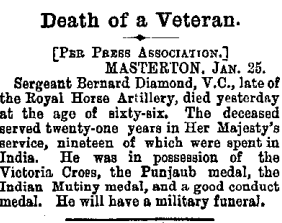
With his wife Mary and their children in tow, Bernard Diamond emigrated to New Zealand in 1875. The family settled in the Wellington area in 1887. Although he was gazetted in on the 24th of April 1858, it is uncertain when and where he received his medal, though it was most likely in India. He died in Masterton, New Zealand, on the 24th of January 1892.
Sergeant Bernard Diamond was awarded the following medals Victoria Cross Punjab Medal ( 1848-49 ) 2 clasps:”Chilianwala” – “Goojerat” Indian Mutiny Medal ( 1857-58 ) 3 clasps: “Delhi” – “Relief of Lucknow” – “Lucknow” Army Long Service & Good Conduct Medal
Gunner Richard Fitzgerald
Born in St. Finbar’s, Cork, Ireland, in 1831, Richard Fitzgerald listed his occupation as “carpenter” at the time of his enlistment in December 1851. He enlisted for 12 years of service (Regt. Nr. 7412) and arrived in Calcutta on the troopship Soubahdar on the 15th of November, 1852. His list of medals shows that, besides the Victoria Cross, Fitzgerald was awarded the Mutiny Medal with one clasp for Lucknow. Following the mutiny, he remained in India. In 1861, he volunteered to transfer to the Royal Artillery, listing himself as “Local in India” and then, following his retirement in 1872, Richard Fitzgerald quietly dropped out of history. In 1884, he was no longer drawing his pension and two years later, the War Office suspended his VC pension – it is presumed Richard Fitzgerald died in India in 1884 or thereabouts, but where and when remains a mystery. His medals, too, were supposed to be lost after the Bristol Museum, where they had been held, was demolished by bombs in 1941. It turned out, however, that his medals had been stored in the Art Gallery & Museum of Antiquities along with other artefacts, including coins and medals, and thus remained relatively out of harm’s way. This still does not explain how his medals ended up in Bristol. As part of the Eberle Collection, the medals remain there to this day. (Nb. – Eberle was a local Bristol councillor and founder of a Veterans Association to assist destitute veterans of Crimea and the India Mutiny – he would buy their medals as a way of providing them with a quick source of income; apparently, he would then let them borrow their medals back to wear at special occasions), it would appear Fitzgerald’s medals were not bought from the man himself but purchased at an auction in 1898 and sold for the sum of £40.-. However, as long as the vendor remains unidentified, the story of Fitzgerald’s medals remains shrouded in the same strange cloak as the man. Fitzgerald received his VC in India the following year, but where and when is unknown.
Extract from report dated 28th September 1857: Lieutenant G. Cracklow, Commanding 2nd Troop, 3rd Brigade, Horse Artillery to Captain C.H. Blunt, Commanding in charge 2nd Troop, 3rd Brigade
“I beg to bring to your notice the gallant conduct of Sergeant Diamond and Gunner FitzGerald. These two men, when the rest of the crew were disabled, served the gun under a heavy musketry fire; their coolness and daring elicited the admiration of all present.“
Extract from report dated 28th September 1857: Captain C.H. Blunt to Major F. Turner, Commanding Artillery with Movable Column, Camp Bolundshadur:
I beg to call to your notice the high commendation which Lieutenant Cracklow has, in his report, bestowed on Sergeant Diamond and Gunner FitzGerald. This commendation has been confirmed and strengthened by several officers in Her Majesty’s 9th Lancers, who were witnesses of their gallant conduct.”
Extract from report dated 28th September 1857: Major F. Turner to Captain Bannatyne, Major of Brigade, Movable Column, Camp Bolundshadur
“I have great pleasure in pressing upon Lieutenant-Colonel Greathead’s attention the very gallant conduct of Sergeant Diamond and Gunner FitzGerald of the 2nd Troop, 3rd Brigade, Horse Artillery, who, after the rest of their gun’s crew were disabled, continued to serve it under a very heavy fire of musketry, and I trust that by Colonel Greathead, this gallant conduct as also that of 2nd Lieutenant Cracklow, may be brought to the notice of Major General Wilson, Commanding Delhi Field Force, and Commandant of Artillery.”
The man who would not stop firing at Bulandshahr has disappeared from all memory, and all that remains are a few extracts to remind us of his valour.
Sources:
Anson, O. H. S. G. With H.M. 9th Lancers During the Indian Mutiny. Edited by Harcourt S. Anson. London: W.H. Allen & Co., 1896. Best, Brian. The Victoria Crosses That Saved an Empire: The Stories of the VCs of the Indian Mutiny. Barnsley: Frontline Books, 2016. Bourchier, George.Eight Months’ Campaign Against the Bengal Sepoy Army, During the Mutiny of 1857. London: Smith, Elder & Co., 1858. Gough, General Sir Hugh Old Memories. London: William Blackwood & Sons, 1897 Knollys, Henry, ed. Incidents in the Sepoy War, Compiled from the Private Journals of General Sir Hope Grant. Edinburgh: William Blackwood & Sons, 1873 Knollys, William Wallingford. The Victoria Cross in India. London: Dean & Son, 1891. Ouvry, Henry Aimé. Cavalry Experiences: Letters and Journals of a British Cavalry Officer. Milton Keynes: Leonaur, 2012. Roberts, Frederick Sleigh, Field Marshal Lord. Forty-One Years in India: From Subaltern to Commander-in-Chief. Vol. 1. London: Richard Bentley & Son, 1897 Stewart, Rupert, ed. The Book of the Victoria Cross. London: Hugh Rees, Ltd., 1916. Wilkins, Philip A.The History of the Victoria Cross. London: Archibald Constable & Co., 1904
 Mutiny Reflections
Your continuum amazes me!
LikeLiked by 2 people
Thank you… I am trying in my humble way to cover every aspect possible. There is always just a little more to do.
LikeLiked by 2 people