On to Bansi and Back to Amorha
On the 18th and the 28th of May, the first reinforcements for the Sarun Field Force arrived in the form of the two companies of the right wing of the HM’s 13th Regiment. They were shortly afterwards joined by a detachment of the 6th Madras Cavalry commanded by Colonel Byng, who, after serving in the Saugor and Nerbudda territories from late 1857 to early 1858, was transferred further north to the Gorakhpur district to serve with the Sarun Field Force. Their arrival would prove providential.
On 29 May, Rowcroft received an urgent request from Mr Wingfield to send a strong detachment to Bansi, 32 miles north of Basti, for he suspected mischief was brewing. Nazim Muhammad Hasan had quite suddenly arrived and had brought with him a rebel force of up to 4000 and six guns. He had booted the Raja of Bansi, along with his family and adherents, out of the town and forced them to flee to the jungle fort of Sunnowlee, 12 miles north of Bansi. Not content with sending the Raja packing, the Nazim not only followed him, but besieged the fort.
The Raja of Bansi, Mahendra Singh, had, in the early days of the mutiny, proved himself one of the few allies the British had in the district. He had rescued several British officers fleeing from Gonda and had sent them safely to other stations, and for a time had sheltered not only Mr Wingfield but other fugitives before contriving ways to send them onwards. He had then been left, in the proverbial drink, when Gorakhpur was abandoned. A board of rajas tried their hand at establishing some form of rule, but the Raja of Satasi decided he preferred rebellion, the Raja of Majhauli opted for complete retirement, leaving the Raja of Bansi alone, unable to do anything outside the borders of his own estates. His nearest ally, the Rani of Basti, had problems. She had remained loyal to the British cause although, as a niece of Kunwar Singh of Jagdispur, she was under singular pressure to join the rebel cause. Meanwhile, the Raja of Nagar and his kinsmen had risen and started their own civil war, seizing land they believed was rightfully theirs and “which tradition assigned to their race,” and the zamindars of Amorha had all declared their allegiance with Oudh. Matters were not improved when the Raja of Bansi’s own clan members turned on him, and one of them took it on himself to drive away the local police. On the same day, a band of local rebels plundered a neighbouring tehsil. If the Raja did not have enough worries, Muhammad Hasan (a man who had once been in the employ of the Oudh Government and had for a time sheltered Captain Lennox and his family on their flight from Fyzabad) now showed up in Captainganj. He swiftly took over and declared himself Nazim of Gorakhpur.
The Nazim tried to establish some form of order, if only for his own profit. By preserving the governmental records, he could ascertain the revenue demand; he bestowed “distinctions” on the Nagar Raja and any other chief who turned up and made his submission, giving himself the right of rule. He set about raising his own army to not only maintain his newfound authority but to assist the rebels.
“Such a step was in truth needed, for his administration resembled rather anarchy than government. Throughout the district the strong preyed upon the weak, and everywhere the auction-purchasers were ousted. His rule was not received with general favour, and even the rebels claimed full powers in their respective estates. Others did not acknowledge his authority: such were the Raja of Bansi, who refused to surrender the treasure in the tahsil, and actually defeated a formidable force sent to coerce him; and the Rani of Basti, who refused to allow the nazim to pass through the town, or to permit the rebel thanadar to take up his residence there. The Raja of Bansi was afterwards compelled to yield to superior force, and to receive the tahsildar appointed by Muhammad Hasan; but the Rani maintained her attitude of resistance to the end, and when Gorakhpur was retaken, she attacked the flying rebels and captured a large brass gun.”
Against all odds, the Raja of Bansi never wavered from his loyalty to the British and in his time of trial, it would not do, in Wingfield’s estimation, to abandon him. Once again, Rowcroft detached Major Cox to deal with things.
Force Under Major Cox
1 squadron BYC – 10 officers, 93 rank and file
1 squadron 6th Madras Cavalry – 3 officers, 90 rank and file
Detachment 4/5 Artillery – one 9-pounder, one 24-pounder howitzer. One officer, 16 rank and file
Detachment Naval Brigade – two 12-pounder mountain howitzers, one 24-pounder rocket tube. Two officers, 26 rank and file
Detachment HM’s 13th Regiment – 8 officers, 203 rank and file
Detachment Bengal Police Battalion – 1 native officer, 20 rank and file
— 473 men, all ranks
On 30 May, at 2 a.m., Cox was ready to march, accompanied by the ever-enthusiastic Mr Wingfield. The idea was to spare HM’s 13th as much fatigue as possible, and although the case was indeed urgent, the march to Bansi would be accomplished in the three stages, a slow and cumbrous proceeding.
Within a day of Cox marching off, Rowcroft, already worried about dividing his force, received even more unwelcome news. Early on the 31st, the Tehsildar and Thanadar of Captainganj, surrounded by no less than 600 matchlock men, arrived in camp. They reported that 600 sepoys and a bevvy of other rebels, with 2 guns, had advanced on Captainganj. They also had information that from Amorah an even larger force was advancing. This was very much an unwelcome state of affairs, and Rowcroft had to act as quickly as possible to prevent the rebels from gaining a foothold in Captainganj, and thus able to attack his new camp at will.
The assembly sounded, and Rowcroft ordered the headquarters of the Sarun Field Force with the two remaining 12-pounder howitzers of the Naval Brigade to march with haste to Captainganj. By 7 pm, they were on their way, with the intention to arrive before 11 that night, giving the force a few hours to rest before attacking the rebels at daybreak. The 4th Madras Cavalry under Captain Clerk were to be at Captainganj before dark to keep an eye not only on the rebels’ movements but, if necessary, keep them in check until the remainder of the force arrived. At Basti, all baggage and stores were placed in the hospital compound, and Rowcroft set his last 50 men around it as a guard.
An hour before his men were to set off, a report came from Captainganj and once again proved to Rowcroft that while his spies were undoubtedly efficient, those of the rebels were just as adept. The rebels had been informed of Rowcroft’s plans and had decided, quite suddenly, to change theirs. Instead of occupying Captainganj, they had already begun to retreat. They had plundered the place, burnt down the lines of the irregulars and had attempted to burn down the gateway of the tehsil. The tehsil itself was built of brick, and they were unable to get to the treasure within, and the men defending it had done their work admirably. Rowcroft countermanded the order to march, and the camps were duly re-pitched. The cavalry, however, was told to push on until daybreak and ensure the rebels were well cleared off. They were then to return to Basti.
Major Cox is Very Busy
As for Major Cox, there was no such saving grace. He arrived at Bansi on 1 May, to find that the Nazim, having heard of his arrival, had broke off the siege of the fort and scarpered, retreating a few miles towards Bansi. For all intents, it looked as if he would now proceed to the north-west. The Bansi Raja was able to return the same evening to his fort, and Major Cox pursued the Nazim for two marches towards Dumuriaganj, along the south bank of the River Rapti. The Bansi Raja, eager to assist, took the north bank with his men. They came up on the Nazim’s rear guard. After putting them to the sword, the work was considered done.
Cox decided there was little point in returning to Basti just yet, so marched the detachment to Harriah, some six miles from Captainganj, arriving on 8 June. Here he was reinforced by 90 rank and file of HM’s 13th, 20 Royal Marines and 40 of the 4th Madras Cavalry who Rowcroft had sent down to hold the place and to do service under Cox, should he need them. It was a prudent move.
Amorha
“So, while dogging like bloodhounds the track of the rebels, they suddenly doubled round to Amorah once more, and made a stand there, on the same memorable battle-field, where they had already received so many fatal blows. And on our approaching the locality, we beheld literally an army of vultures settled down on the blood-stained plains on which we had fought so often, and so fat and unwieldy had they become on the flesh of rebels, that not one among their countless numbers seemed disposed to quit the scene of their festivities, or move out of our way as we positively rode through them, amidst shocking sights which, in compassion to the feelings of my readers, I pass over in silence.” (Nash)
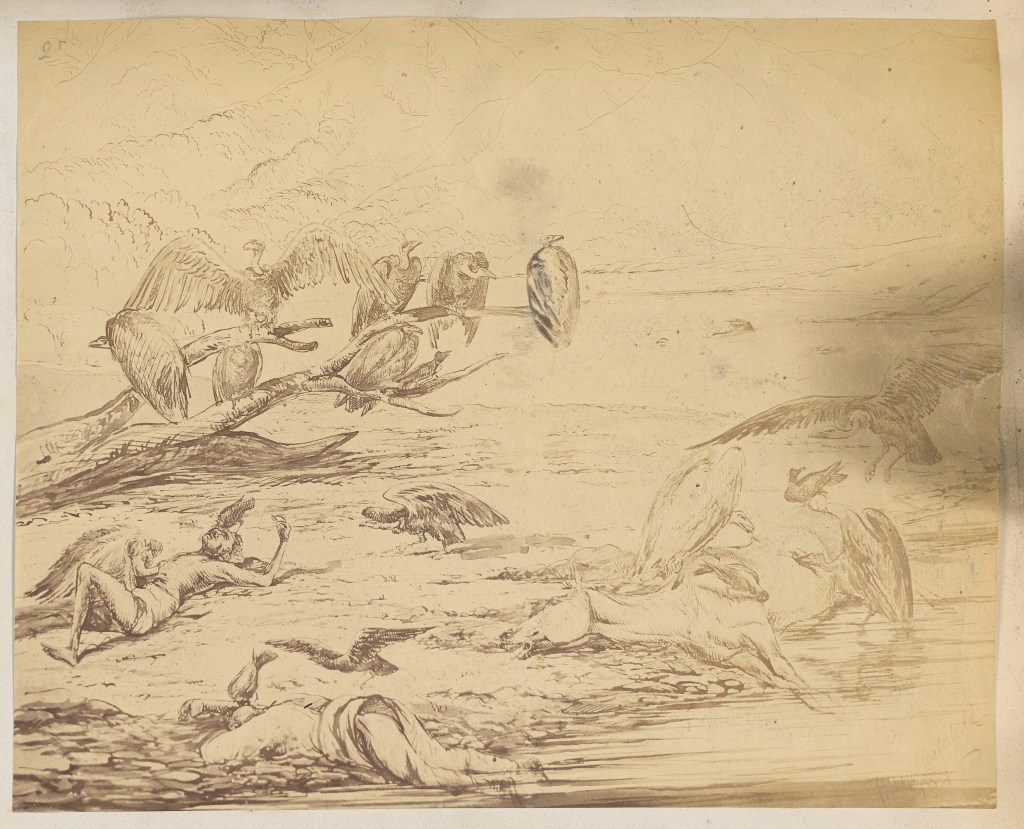
On 9 June, Cox was informed that the scene of action had shifted once again, to Amorha, to find that the Nazim had settled himself with over 1000 of his men. They occupied a house known as the Rani’s House, the residence of Rani Talash Kanwar, who had been killed (or had taken her own life) on 2 March following the first battle for Amorha. The Nazim had ordered an earthwork to be constructed around not only the house but the adjacent buildings, defended by two guns. He had also occupied Rowcroft’s old fortifications on the Basti Road, which he had not only rebuilt but improved. Here there were two more guns, strategically placed to sweep a bridge, 700 yards to the fore.
Cox had, in this case, the advantage of hindsight. He knew that a direct attack on the Rani’s house was pointless as the road passed close to a thick bamboo jungle; he well understood all the approaches to the old fortifications as well and therefore decided to attack from a different direction altogether. During the night, he directed a bridge of rafts built over the Ramburka River at a ford, which would bring his force to Amorha by the Gaighat Road instead.
The tents were now struck and the baggage packed; Cox left them on the ground under a small guard and at 2.30 in the morning, set off with 250 men of the HM’s 13th, 85 of the BYC, Captain Vine and his 6th Madras Cavalry sowars and two Foot Artillery guns. He sent Major Richardson on the direct road to Amorha with the remainder of the cavalry, numbering 88 men, the Naval Brigade’s two 12-pounders and 55 infantry soldiers, with the orders to “consider his a false attack, not to pass the river while the fort was occupied, but to open fire on it from his side of the bridge.”
At daybreak, Cox and his men arrived at a nullah in the rear of the Rani’s House, and the village and the rebel picquets opened fire. The Richardson now threw the Royal Marines out in skirmishing order, and they rapidly returned fire; Lieutenant Turnour galloped his guns forward and commenced throwing shot and shell into the main body, who after 15 minutes of this appalling treatment, retreated into the Rani’s House and the adjacent buildings. The nullah was quickly forded, and Major Cox, once again throwing out skirmishers, forced the rebels to give up not only the Rani’s house but also the surrounding positions. Meanwhile, Richardson had been held back by the very persistent firing of the rebel picquets who adamantly barred his way to Amorha. Taking cover, he and his men now endeavoured to keep them in check. For Lieutenant Nash, who mentioned the action “closely resembled” those he had already witnessed, it passed by him without more than cursory remark, but he does state,
“In one respect, however, there was a novel exception, in our encountering the mutineers on this occasion before the sun had risen. They were accordingly punished with terrible severity. Drawn up in two divisions, and led by the usurper of the Gorukpur district, they fought with all the energy of despair, until the naval howitzers and Enfield rifles had stretched their best men hors de combat on all sides. Then the Corps, en masse, were let loose in pursuit, and with hearts as hard as stones, and tempers rendered furious by aggravating exposure, they irresistibly swept over the retreating hordes, in the final scene of another sanguinary and crushing defeat.”
As it was, Cox pursued the rebels with infantry skirmishers and kept up a continuous fire from the guns under Lieutenant Welch to ensure no one was considering remaining in Amorha. He then sent the cavalry after them. These went around the bamboo jungle, while Cox cleared it with a company of HM’s 13th, in extended order, pushing the column through the village until they reached the old fortifications. By now, anyone who had escaped the onslaught was well on the road to Belwa, and Cox now sent a squadron of cavalry under Captain Vine to see them on their way. The sepoys, in their flight, broke up into successively smaller groups until pursuit was finally impossible. Vine chased them for four miles, and continued charging the groups “at every opportunity offered” but soon gave it up as a bad venture. He left behind 15 dead sepoys.
With the day’s work at an end, Cox left the Madras Cavalry and one troop of the BYC to cover the “destruction of the houses & c., recently occupied by the enemy,” while he marched the remainder of the force back to Harriah. By 8.30 am the following morning they arrived, the last of the artillery trundling in shortly after – they had been marching for 14 hours and had spent barely an hour in action at Amorha. For his returns, Cox merely notes, “Lieutenant A.R.J. Ellis, Bengal Yeomanry Cavalry, severely wounded, sword cut on right arm.”
After Rowcroft left Amorha, the rebels who had taken his place in the demolished fortifications had decided it was apt to tear open the graves of the Sarun Field Force men who had died of wounds and disease in that forlorn place. The sailors of the Pearl were horrified to find the bodies had been disinterred and, with savage barbarity, the corpses had in part been rent asunder and the very bones smashed. Cox ordered the horrible remains collected and reburied and the graves restored. The war in the Gorakhpur District was indeed a dehumanising one.
The rains were now setting in and while in other areas the large campaigns were winding down, there was no such luck for Sarun Field Force.
Sources:
Behan, T. L. Bulletins and Other State Intelligence for the Year 1858. 4 parts/vols. London: Harrison & Sons, London Gazette Office, 1860.
Behan, T. L., ed. Bulletins and Other State Intelligence. Parts 1 & 2 [1857–1858]. London: Harrison and Sons, 1858–1859.
Malleson, G. B. History of the Indian Mutiny, 1857-1858, Commencing from the Close of the Second Volume of Sir John Kaye’s History of the Sepoy War. Vol. 2. London: W.H. Allen, 1879.
Malleson, G. B., ed. Kaye’s & Malleson’s History of the Indian Mutiny of 1857-8. Vol. 4. London: W.H. Allen, 1889.
Nash, John Tulloch. Volunteering in India: An Authentic Narrative of the Military Services of the Bengal Yeomanry Cavalry During the Indian Mutiny and Sepoy War. London: George Philip & Son, 1893.
Nevill, H.R. Basti: A Gazetteer, being Volume XXXII of the District Gazetteer of the United Provinces of Agra and Oudh. Allahabad: Government Press, 1907
Williams, E. A. The Cruise of the Pearl Round the World, with an Account of the Operations of the Naval Brigade in India. London: Richard Bentley, 1859.
To follow the Sarun Field Force and the Trans-Gogra Campaign, FIBIS has complied a modern day map which can be found at this link:
https://www.google.com/maps/d/viewer?f=q&source=s_q&hl=en&geocode&ie=UTF8&hq&hnear&t=p&msa=0&z=8&mid=15gZy_L1UvFXW6LR4B7wguNF3y9U&ll=26.423502737961396%2C83.0807882357232
 Mutiny Reflections