5 May – The Battle of Bareilly

“Before we started this morning, I called the syce and told him to keep my best horse close to the litter. Alison and Baird gave the same directions to their servants. This little piece of foresight saved all our lives, although I had a hard struggle for my own. Among all horrible deaths, I think being sliced to pieces as one lay helplessly in a litter has a high place.” (Russell)
At 2 in the morning on 5 May, at Faridpur, the still air hot and oppressive, Sir Colin’s force was preparing to move. They were still one march from their objective, Bareilly. The men were aware that at the end of their road that day, there would be no rest, but they would be expected to fight. In their haversacks were three days’ worth of rations as ordered by Sir Colin. For Lieutenant Gordon-Alexander, this of course, presented a difficulty. He reasoned the weather was too hot to attempt carrying a fowl; he satisfied himself with hard-boiled eggs instead, dry commissariat biscuits and the largest water-bottle he could find. The advance guard was ready to move at 4 am, followed by the whole force half an hour later. Gordon-Alexander, with 60 men in his company, were in charge of the artillery park and siege train, while the army’s baggage carried on elephants and camels followed him up with its own guard, consisting of two companies of the 82nd and one of the 22nd Punjabis. The rear was brought up by Remmington’s troop of Bengal Horse Artillery, a squadron of the 5th Punjabis and the 17th Irregular Cavalry.
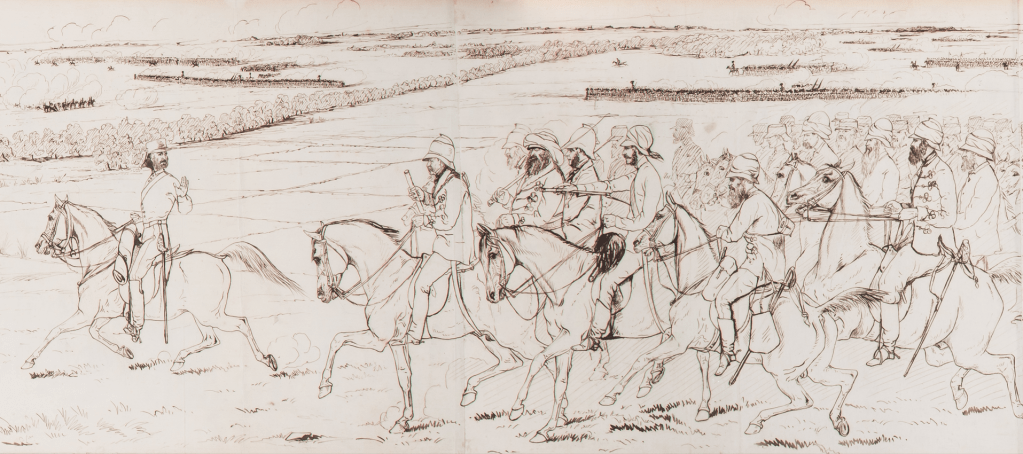
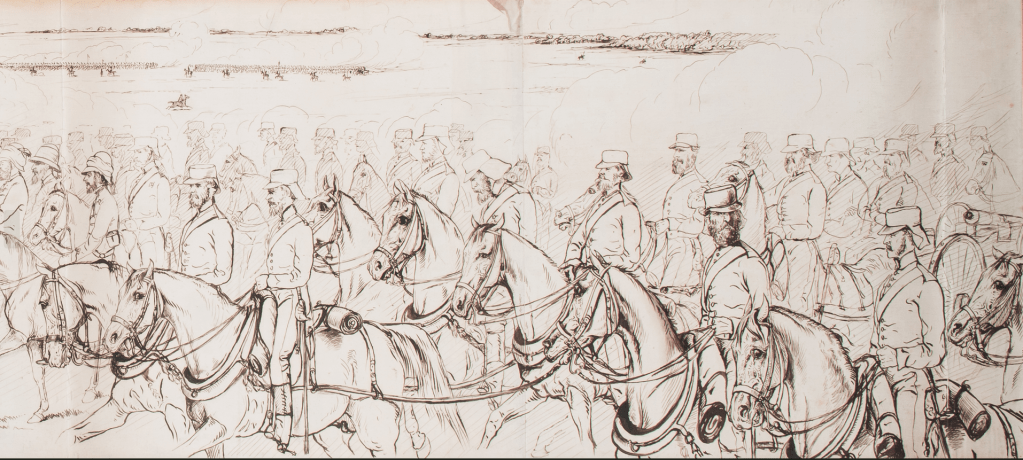
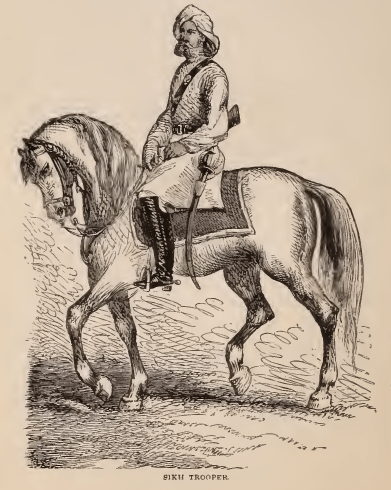
To allow for the baggage and siege train to come up, who finally trundled up to the main body at 6 in the morning, Sir Colin Campbell ordered the advance to recommence, this time in order of battle. Right and left of the road the advance was now covered by a line of cavalry skirmishers, with the 2nd Punjabis taking the left and the Lahore Light Horse on the right. The 78th Highlanders followed in support along the road, flanked on both sides by squadrons of the 9th Lancers on either side and by Tomb’s troop and half of Remmington’s troop of Bengal Horse Artillery. In columns, followed the 42nd and 93rd Highlanders. They marched on either side of the road with the heavy, bullock-drawn batteries on the road between them, flanked by Lind’s Multani Horse, the 1st Punjab Cavalry and the two squadrons of Carabineers and one squadron of 9th Lancers. In support were the 79th Highlander and the 4th Punjab Rifles, with seven companies and the Headquarters of the 64th Foot and one wing of the Baluchis.
For Gordon-Alexander, the day was certainly starting to be a busy one.
“Being warned by staff officers to keep my charge, the siege train, as closely locked up as possible, by dint of much shouting, and galloping backwards and forwards up and down the line of waggons, etc., for I was now mounted, having come to the conclusion that every infantry officer should be mounted on the line of march, I had managed to get the train, which was entirely drawn by bullocks, two waggons abreast on the road, and closed up to the rear of the main column.”
Meanwhile, well before sunrise, Khan Bahadur Khan had drawn up his men on the open plain some five miles from Bareilly. It was already seven in the morning when proceedings opened. Sir Colin advanced some 100 yards, and the Khan opened up with artillery. Tombs’ Bengal Horse Artillery was sent to reply. Riding in the centre of Tombs’ troop was Henry Wylie Norman (on Campbell’s staff) – as Tombs led his guns forward and prepared for action, the rebels took the opportunity to fire again, this time with round shot. The shot fell short and ricocheted but hit a sergeant at No. 3 gun, the centre driver of No 4 gun, and Norman’s horse, killing the poor animal outright. The shot grazed Norman, rendering him hors de combat – his ankle was not broken, but the shock was severe enough for Norman in the first instant to believe he had lost his limb. With typical nonchalance and his ankle bound up, Norman insisted his doolie bearers keep him as far front as possible, turning him into a witness to the battle of Bareilly, albeit from a prone position.
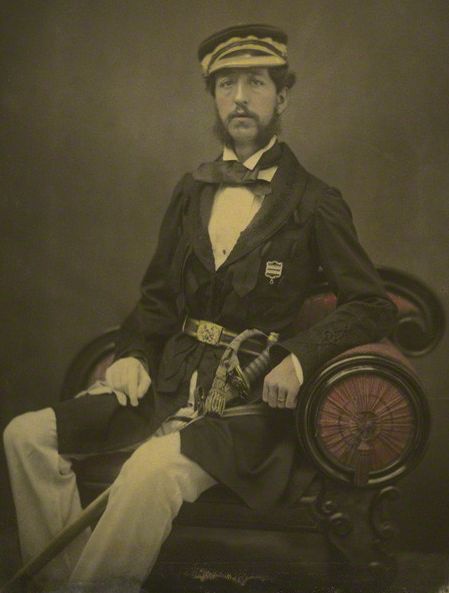
“Bullets fired point-blank from loop-holed walls missed him, shot and shell exploded at his feet, killing and maiming those about him, and every danger seemed to be averted from him as if by an invisible hand.”
Tombs’ guns made their reply a sure one, and the rebel guns answered once more. Suddenly stopped as the men withdrew to the north bank of the river, leaving their guns behind. As the north bank was liberally dotted with dense groves of trees that effectively obscured the view, it was now unclear what the rebels were up to. Except for a strong body of cavalry hovering about in the distance on the left, the rest seemed to have vanished. The river, not being defended, offered no obstacle to the advancing army; the left of the first held the bridge, allowing for the right to cross, then the first line advanced to about three-quarters of a mile towards Bareilly. The heavy guns were then rapidly pushed over and placed in position to effectively rake the rebels’ second line. Sir Colin Campbell now ordered another halt for the baggage and siege train to close up and reformed his troops.
The heavy guns opened fire on Khan’s second line of defence, sending shots towards the Cantonment Bazar on the edge of the steep banks of the left of the river, and across the road into the city on Campbell’s right. The rebels, in accustomed fashion, had entrenched themselves in the old houses and enclosures of the suburbs, but unrelenting, Sir Colin was determined to “give them a pounding before he went at them.” He had however, not reckoned at that moment with the Ghazis who suddenly emerged from the old cavalry lines.
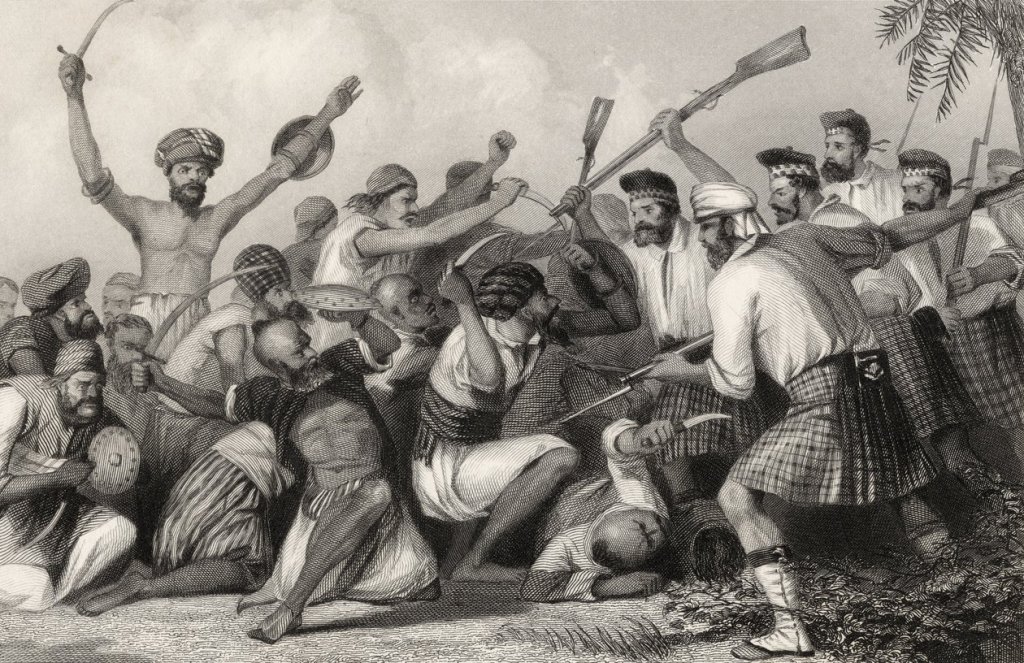
The Sikhs and our light company advanced in skirmishing order, when some seven to eight hundred matchlock-men opened fire on them, and all at once a most furious charge was made by a body of about three hundred and sixty Rohilla Ghazis, who rushed out, shouting ”Bismillah! Allah! Allah! Deen! Deen!” Sir Colin was close by and called out, “Ghazis, Ghazis! Close up the ranks! Bayonet them as they come on.” However, they inclined to our left, and only a few came on to the Ninety-Third, and these were mostly bayoneted by the light company, which was extended in front of the line. The main body rushed on the centre of the Forty-Second, but as soon as he saw them change their direction, Sir Colin galloped on, shouting out, Close up, Forty-Second! Bayonet them as they come on !” But that was not so easily done; the Ghazis charged in blind fury, with their round shields on their left arms, their bodies bent low, waving their tulwars over their heads, throwing themselves under the bayonets, and cutting at the men’s legs.”
The Ghazis broke through the 4th Punjab Infantry and, with untold fury, attacked the 42nd, who “standing firm, received this mad charge unbroken and bayonetted the fanatics as they rushed to close quarters.” To his immense surprise, Colonel Cameron of the 42nd was suddenly pulled off his horse by Ghazi who leapt up, grabbed him by his collar while he was busy fending off another Ghazi on the other side of his horse; to this rather unequal tussle, up rushed Colour-Sergeant Gardiner, who grabbed the tulwar of one of the attackers and used it to slice off the head of the other, while a second man of the 42nd pistoled a third attacker. General Walpole happened to find himself likewise engaged, barely hanging onto his horse and fighting desperately, with a tulwar slash across his hand, but no one seemed particularly interested in running to his rescue at that moment – the bayonets of the 42nd took care of his assailants. Hard by the fight was Norman, in his doolie.
Not one of the Ghazis fell back; they fought on in the face of the Highlanders, giving neither quarter nor ground, and were killed to a man.
“The Commander-in-Chief himself saw one of the Ghazis, who had broken through the line, lying down, shamming dead. Sir Colin caught the glance of his eye, saw through the ruse, and called to one of the Forty-Second, ‘Bayonet that man!’ But the Ghazi was enveloped in a thick quilted tunic of green silk, through which the blunt Enfield bayonet would not pass, and the Highlander was in danger of being cut down, when a Sikh sardar of the Fourth Punjabis rushed to his assistance, and took the Ghazi’s head clean off with one sweep of his keen tulwar. These Ghazis, with a very few exceptions, were grey-bearded men of the Rohilla race, clad in green, with green turbans and cummerbunds, round shields on the left arm, and curved tulwars that would split a hair. They only succeeded in wounding about twenty men — they threw themselves so wildly on the bayonets of the Forty- Second! One of them, an exception to the majority, was quite a youth, and having got separated from the rest, challenged the whole of the line to come out and fight him. He then rushed at Mr Joiner, the quartermaster of the Ninety-Third, firing his carbine, but missing. Mr Joiner returned the fire with his revolver, and the Ghazi then threw away his carbine and rushed at Joiner with his tulwar. Some of the light company tried to take the youngster prisoner, but it was no use; he cut at everyone so madly that they had to bayonet him.”
For Gordon-Alexander, the battle was seen from afar. Telling his men to find shelter under the trees that lined the roads but to remain close to the wagons, he rode off to the left to see “how things were going on in front.” Riding up a bank, a half mile from the river, he joined Tombs’ Horse Artillery troop, which was positioned just left of the siege train.
“I looked down on the Highland Brigade extended in line on the other side of the nullah on my extreme right, with the 4th Panjabis on their left much nearer us. Whilst I was thus watching them, a considerable body, perhaps 2,000, of the enemy’s white – clothed cavalry emerged from the ruined cantonments in front of Tombs’ guns on the other side of the nullah, and proceeded to descend its steep sides, with the evident intention of attacking our baggage, the greater part of which, on camels and elephants, was between Tombs’ position and the highroad where my siege -train was standing.”
By some mistake, there was no cavalry support for Tombs’ guns and likewise hardly any infantry, except for a few men of the 82nd and a part of the baggage guard. Nonplussed by this sudden turn of events, Tombs asked Gordon-Alexander how many men he had with him; answering he had fifty on guard over the siege train, Tombs ordered him to bring them up and, if he might, be quick about it.
“Although they were somewhat scattered along the road, I got them together by sound of bugle within five minutes, and then led them through that surging mass of baggage animals at the double to Tombs’ guns. His guns were all loaded with round shot, which he fired off and then reloaded with grape, and when my party reached his battery, dodging sometimes under the legs of the camels, his men, who were all standing by their guns, gave us a cheer. We lay down on our faces in sections between the guns, with fixed bayonets, I having warned my men not to commence firing, however near the enemy might approach, until I gave the signal by bugle. Some of my men had been almost in a fainting state owing to the heat, but now forgot all about that terrible sun, and were intensely eager to try conclusions with our adversaries.”
The rebel cavalry, which had disappeared out of sight when they descended into the nullah, suddenly reappeared on the top of a steep bank on the side of Tombs’ position, where they formed up “in capital order, squadron by squadron in line.” They then advanced the final 900 yards uphill towards Tombs. With the same collected calm he had shown throughout the mutiny, Tombs waited until he was sure that the damage would be at its most terrific. His guns, charged with grapeshot, opened with devastating effect. Gun after gun swept through the cavalry ranks, each gap quickly closed up by the men in the rear, but they continued their advance. At 500 yards, they broke into a gallop, and Tombs ordered Gordon-Alexander to open fire with his rifles. “A leader, with a standard- bearer behind him, were both killed within 100 yards of the muzzles of the guns, just after the main body of these adventurous Rohilla horsemen had turned in sudden and headlong flight downhill, plied with grape by Tombs and the rifle bullets of my party.”
Of course, while Gordon-Alexander was thus engaged, the remainder of the rebel cavalry, whom he did not see, charged the baggage. Just as the Ghazi attack ended, another opened up.
“The commotion caused by this attack was barely over when word was passed that the enemy were concentrating in front for another rush, and the order was given for the spare ammunition to be brought to the front. I was detached with about a dozen men of No. 7 company to find the ammunition guard and bring our ammunition in rear of the line. Just as I reached the ammunition camels, a large force of the rebel cavalry swept round the flank and among the baggage, cutting down camels, camel-drivers, and camp-followers in all directions. My detachment united with the ammunition guard and defended ourselves, shooting down a number of the enemy’s sowars. I remember the Rev. Mr Ross, chaplain of the Forty – Second, running for his life, dodging round camels and bullocks with a rebel sowar after him, till, seeing our detachment, he rushed to us for protection, calling out, ‘‘Ninety-Third, shoot that impertinent fellow!” Bob Johnston, of my company, shot the sowar down. Mr Ross had no sword nor revolver, and not even a stick with which to defend himself. Moral—When in the field, padres, carry a good revolver!”
For William Russell, who had been tossed about in his doolie since early morning, it was something of a relief to finally have been set down under some trees. The heat was immense, and when he looked out of his doolie, the scene was peaceful. The plain was scattered over with camp-followers, and his own bearers were sitting off to the side, noddingly sleepy. Still in pain and hot to distraction, Russell had removed nearly all his clothes and lay, panting in only a shirt as he listened to the sounds of the distant battle. Quite suddenly, musketry fire burst out just to the front of the trees – Russell leaned out of the doolie and saw, “saw a long line of Highlanders, who seemed as if they were practising independent file firing on a parade ground, looking in the distance very cool, and quiet, and firm; but what they were firing at I in vain endeavoured to ascertain. A few native troops seemed to be moving about in front of them.” Lying next to him in his own doolie was Baird, and little further off, Alison. Neither of them had any idea what the commotion was about, and Russell, rather tired of the scene, closed the door of his doolie and went to sleep. How long he slept, he had no idea, but he certainly remembered waking up.
Suddenly, his doolie was lifted violently off the ground and just as jarringly was dropped to the ground. Outside, he could hear a “confused clamour of shrieks and shouting…” and amid the screams, he could hear his bearers shouting, “Sowar! Sowar!” as they rushed off, with “terror on their faces.” Those placid camp followers whom Russell had seen were now all on their feet, and running in wild confusion, all trying to make it to the road. Elephants trumpeted shrilly while their mahouts urged them across the open fields, followed by grunting camels and their drivers, among them ran women, children and horses, a surging mass of humanity and animals, all running in perfect panic. Still in his doolie, Russell tried to understand what he was seeing.
“And, heavens above! within a few hundred yards of us, sweeping on like the wind, rushed a great billow of white sowars, their sabres flashing in the sun, the roar of their voices, the thunder of their horses, filling and shaking the air. As they came on, camp-followers fell with cleft skulls and bleeding wounds upon the field; the left wing of the wild cavalry was coming straight for the tope in which we lay. The eye takes in at a glance what tongue cannot tell or hand write in an hour. Here was, it appeared, an inglorious and miserable death swooping down on us in the heart of that yelling crowd. At that instant, my faithful syce, with drops of sweat rolling down his black face, ran towards me, dragging my unwilling and plunging horse towards the litter, and shouting to me as if in the greatest affliction. I could scarcely move in the dooly. I don’t know how I ever managed to do it, but by the help of poor Ramdeen, I got into the saddle. It felt like a plate of red-hot iron; all the flesh of the blistered thigh rolled off in a quid on the flap; the leech-bites burst out afresh; the stirrup-irons seemed like blazing coals; death itself could not be more full of pain. I had nothing on but my shirt. Feet and legs naked — head uncovered — with Ramdeen holding on by one stirrup-leather, whilst, with wild cries, he urged on the horse, and struck him over the flanks with a long strip of thorn — I flew across the plain under that awful sun. I was in a ruck of animals soon, and gave up all chance of life as a troop of sowars dashed in among them. Ramdeen gave a loud cry, with a look of terror over his shoulder, and leaving the stirrup-leather, disappeared. I followed the direction of his glance and saw a black-bearded scoundrel, ahead of three sowars, who was coming right at me. I had neither sword nor pistol. Just at that moment, a poor wretch of a camel-driver, leading his beast by the nose-string, rushed right across me, and seeing the sowar so close, darted under his camel’s belly. Quick as thought, the sowar reined his horse right round the other side of the camel, and as the man rose, I saw the flash of the tulwar falling on his head like a stroke of lightning. It cleft through both his hands, which he had crossed on his head, and with a feeble gurgle of ‘ Ram! Ram!’ The camel-driver fell close beside me with his skull split to the nose. I felt my time was come. My naked heels could make no impression on the panting horse. I saw, indeed, a cloud of dust and a body of men advancing from the road, but just at that moment, a pain so keen shot through my head that my eyes flashed fire. My senses did not leave me; I knew quite well I was cut down, and put my hand up to my head, but there was no blood; for a moment a pleasant dream of home came across me; I thought I was in the hunting-field, that the heart of the pack was all around me; but I could not hold on my horse; my eyes swam, and I remember no more than that I had, as it were, a delicious plunge into a deep cool lake, in which I sank deep and deep, till the gurgling waters rushed into my lungs and stifled me.”
It was Forbes-Mitchell who saved “Our Special” as Mr Russell was known amongst the men. Just as the sowar lifted his arm to swoop down on Russell’s head, Forbes-Mitchell fired at the very moment when Russell fell off his horse. Horrified he might have shot them both, Forbes-Mitchell rushed up to find the sowar was dead, but Russell was only unconscious, with blood pouring out of his nose. Forbes-Mitchell ordered some men to bundle Russell into a doolie, and he rushed off to deliver the ammunition. He would find out, the next day, that the Special was still alive and possibly the only man in history whose life had been saved by sun stroke.
With Lind’s Multani Cavalry hard on their heels, this last determined attack by Khan Bahadur Khan was broken. Tombs’ artillery gave them one final send-off, as the Multanis and the 6th Dragoons chased the sowars across the open plain, swords and sabres cleaving heads. Back in Bareilly, the 79th and the 93rd advanced into the suburbs to their front, clearing the houses of the last Ghazis who now joined their comrades in death. Without accurate information, Sir Colin Campbell erroneously believed he was now in Bareilly and had taken the city. In fact, he had taken the ruined cantonments and the suburbs; Bareilly proper was still some miles away. It is therefore not surprising he decided to call it a day; after six hours of fighting, and the rebels on the retreat, it seemed like he had achieved another victory. What he had actually managed was to clear a path for Khan Bahadur Khan to leave, with his honour intact. No sooner had dusk fallen than the wily Rohilla led the bulk of his force out of Bareilly and took the road to Pilibhit, thirty-three miles to the north-east, leaving behind only a nominal force to make a show of resistance.
At three in the afternoon, all proceedings came to an end. Seven guns had been captured, and losses in dead and wounded were, considering the heat which measured over 45°C in the shade, just significant enough for Sir Colin to call it a day. Ground was swiftly marked out on the Bareilly side of the river; the scattered camp followers, wary mahouts and camel drivers were coaxed out of hiding. The baggage and the siege train crossed the bridge, but no tents, except those of the medical establishment, were pitched. The men were left to shift about in what shade they could find. While the mango groves were certainly a blessing during the day, by nightfall, they were swarming with insects, and it was a choice between sleeping in the open or being stung to bits.
“As night drew on, the cantonments were secured, the baggage was collected, and we bivouacked on the plain, strong piquets being thrown out. My company was posted in a small field of onions near a pucca well with a Persian wheel for lifting the water. We supped off the biscuits in our haversacks, raw onions, and the cool water drawn from the well, and then went off to sleep. I wish I might always sleep as soundly as I did that night after my supper of raw onions and dry biscuits.” (Forbes-Mitchell)
 Mutiny Reflections