Metahi – 26 May
It was still dark when the horse artillery and cavalry under Lieutenant Colonel Riddell (Royal Artillery) left camp. By the time dawn broke, they had moved around to the south-west of Duleeppore for the sole purpose of attracting the rebels’ attention. These were apparently so convinced that Lugard was sending them as a precursor to a larger attack on their position that they promptly began preparing themselves, wholly unaware of what he was actually up to.
Lugard formed up eight companies of the 10th Foot under Brigadier Douglas in the jungle close to the Jagdispur post where they were to remain until he sent them the order to move down; the remainder of the troops (two companies 10th Foot, five companies 84th Foot, 100 Rattray’s Sikhs, Punjab Sappers, 4 battery guns of Madras Artillery under Lieutenant Campbell and some cavalry) were moved directly on Metahi. He left the camp in charge of a party of 84th Foot with some Sikh cavalry, and the Jagdispur post he reinforced with a company of Madras Rifles. Meanwhile, Major Carr, whom he had moved from Arrah to the east side of the jungle, was reinforced with one more company of the 84th and 50 Sikh cavalry. They were to patrol along and watch the eastern portion of the jungle and remain so until further orders. And so it began.
The rebels, convinced that Lugard was planning the dodge he had made on Metahi as on the 20th of May, quickly took up the same position as before. However, they were unaware that Lugard now ordered Brigadier Douglas’ column to move down; as soon as Lugard ascertained that Douglas had penetrated the jungle to the same level he himself was at, and the rebels still none the wiser, he advanced his skirmishers. The rebels quickly fired off their howitzers, allowing Lugard to now ascertain exactly where they were hiding.
“A cheer and a rapid rush settled the affair: the guns were secured by the Grenadier Company of the 84th Foot, whilst the 10th pursued the rebels through the jungle south, down to Chitowrah, and through the dense jungle to the west of that place, scattering them, and driving them completely out into the open county, at a distance, however, of several miles from where the artillery had been posted. Two elephants were captured, and many rebel sepoys killed in this rapid pursuit, which nothing but the excitement of the chase, and the high spirit and powers of endurance of the soldiers enabled them to carry out. The greater proportion, however, at last dropped, thoroughly exhausted, and it was some hours before they could move to camp, then distant some seven miles.
I am happy to say no casualty occurred in my force.”
If nothing else, the guns Le Grand had lost in April were now back in British hands, but it was hardly an inconvenience for the rebels.
No End in Sight
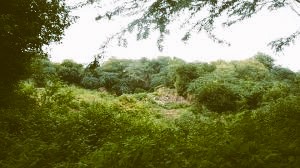
If only it were the end of the fighting in Bihar. Unfortunately, it was but a small victory. While battles like Metahi caused some consternation in the rebel camp, it by no means dampened their resolve to fight. They continued to divide themselves into small parties; some then hassled the villagers with plundering raids, others pestered the British. They openly continued to threaten not only Jagdispur but Arrah and other stations; once peaceful villagers were now caught between marauding rebels and the British, who chased them. The jungles continued to provide them with shelter, and a means to escape and “in vain were their positions marked, encircled and then marched upon from different quarters. The smallest delay on the part of the converging columns gave them the opportunity, of which they were ever prompt to avail themselves, to escape.” Following their defeat at Metahi, the rebels wasted no time in showing Lugard what they could do. One party attacked and completely destroyed an indigo factory near Dumraon, another plundered the village of Rajpur near Baksar, and a third threatened the railway works at Karamnasa. For the British, the toll on their health and numbers would soon begin to show.
“…the British troops had suffered greatly from the heat and exposure to the sun. But in the presence of the occurrences just recorded, Lugard was compelled to keep them actively employed. To facilitate their movements and to lessen the chances of the escape of the enemy, he set to work to intersect the jungles by roads. On the 2nd June, he divided his force into two parts, the one at Keshwa, the other at Dalilpur ( Duleeppore), opposite points on the edge of the jungle. Between these, he cut a broad road. Occupying this with a line of posts as a base, he attacked the rebels from the outside on the 4th, and defeated them with great slaughter, the 10th and 84th showing great dash and daring. But still, many managed to escape.”
For Lugard, the situation was becoming frustrating. The rebels moved with such rapidity that they were able to elude not just his spies, but by the time he arrived at their last known position, they were gone. Rattray’s Sikhs took up the work of scouts, but as soon as they picked up the rebel trail in one direction, they surfaced somewhere else. Constant patrolling was the order of the day, and the Sikhs broke up into smaller parties, each taking control of a portion of the road the rebels were known to be crossing and re-crossing, but to no avail. In one incident, they were within four miles of a Sikh position and still managed to pass by them and disappear into the jungle before a message could even be sent to Lugard. The villagers, who had proved to be of some help in other districts, provided no information at all; however, after all they had been through until now, it was hardly surprising. If they spoke to the British, the rebels burned their villages; if they did not speak to the British, the outcome was just the same.
The 10th Regiment of Foot, like the Sikhs, acted as scouts. Sixty of their number were mounted, and Lugard put them to good use, dogging the steps of the rebels at every turn. Unfortunately, the constant marching killed off their horses so rapidly from sheer exhaustion that the riders were constantly needing replacements. Yet they continued to follow the rebels through the jungles.
The 10th must have been heartily sick of the Jagdispur jungles by now. On one occasion, as related by our intrepid Private Malcolm, one company of the 10th was sent out from the main body to a position some one mile to the front. However, they were inadequately provisioned, and their supplies ran so short that they spent one day without eating anything at all. Resourceful men will find a way, and some men of the 10th fell upon two bullocks, left behind by the terrified peasantry, with every intention of making a decent meal of their looted spoil. They had no sooner begun the process of cooking the beasts when the sound of distant firing was heard, and the men, hungered to distraction by the smell of roasting meat, were ordered to fall in.
“The half- cooked meal was left just as it was, and the company fell back upon the position lately occupied by the regiment. But no regiment was to be found, though the march was continued till nightfall. The regiment had moved without information reaching the detached company. There was nothing to be done but to encamp till morning, and await events. Luckily, early next morning, a mounted man of the 10th, who had been sent out to seek the lost company, was sighted, and the detachment joined the regiment without delay.”
Meanwhile, both Lugard and Douglas were forced to continually shift camp, trying to get at least one step ahead of the rebels.
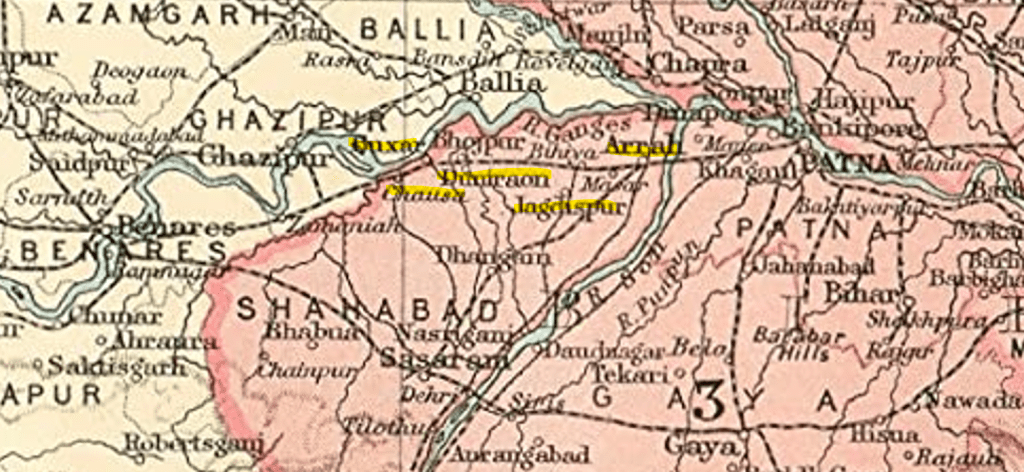
To give an idea of what the British were facing, we shall look at the dispatch from Brigadier Douglas that encompasses just five days, starting on 7 June.
Sir,
I HAVE the honor to state, for the information of Brigadier-General Sir Edward Lugard, K.C.B., that according to his instructions, I proceeded on the evening of the 7th instant, with a force as per margin,(3 guns Royal Horse Artillery; 3 troops Military Train; 1 troop 4th Madras Cavalry; Her Majesty’s 84th Regiment) en route to Buxar. I arrived at Shahpoor at 11 p.m. and bivouacked.
8th. Marched to Saumgunge, 12 miles, and encamped. Two men of the 84th died from sunstroke this day.
9th. Marched to Buxar, 14 miles, and encamped.
10th. Understanding that the rebels occupied the village of Ghamur, I advanced to attack them; at 3 miles from Buxar, crossed the Sarronuddy by a plank bridge; when within a mile of the Korumnassa river, I received information that a body of the enemy had crossed to this side of the river. I sent forward the cavalry and horse artillery, under command of Major Mitchell (Royal Horse Artillery). The artillery advanced to the riverside, marked by the cavalry, and discovered the enemy, who had re-crossed the river, in a tope at some 500 yards; they fired about twelve rounds, dispersed and killed several of the enemy. The river not being fordable, and there being no bridge, the cavalry and artillery returned to the main body; the force then proceeded to Chawsa, 9 miles from Buxar, and encamped. During the afternoon, a bridge of boats was thrown across the Korumnassa by Captain Wilkinson (Deputy Assistant Quartermaster-General), and a guard sent over for its protection.
11th. No certain information of the enemy’s movements could be obtained; crossed the river at 4 a.m., and advanced through Barra to Ghamur; a thick tope of trees surrounds the village; at about 1,200 yards distance, a number of people were seen in the tope; two companies of the 84th advanced in skirmishing order and drove them off. I then moved to the rear of and round the village, sending skirmishers through it, but could not discover the enemy; the accounts of his movements were very conflicting. I sent the cavalry and artillery forward to Sheopoor Ghaut, to intercept them if they were crossing the river, having heard that the main body had taken that direction; but they did not see them. I heard afterwards that they had gone south and south-west. I burned the villages of Ghamur and Barra, re-crossed the Korumnassa and encamped near Chawsa.
Three men of the Royal Horse Artillery died during the night from the effects of the sun, and 1 man of the 84th, 1 horse, and 1 trooper of Rattray’s Seikhs were slightly wounded while burning the villages; the detachment of this regiment joined me on my marching out of Buxar. The heat during the operations was intense, and the troops suffered much, particularly the 84th Regiment, who have now been thirteen months in the field. I consider this regiment at present to be quite unfit for active service; the men have no positive disease, but they are so exhausted that they can neither eat nor sleep.
12th. I returned to Buxar and encamped. In the village of Ghamur, 4-5 brood mares belonging to the Government were recovered and handed over to Mr Jackson, of the stud establishment here, who accompanied the force.
In conclusion, I beg to state that I have every reason to be satisfied with the way in which all did their duty. I have, &c.,
JOHN DOUGLAS, Brigadier
So the relentless skirmishing continued. Brigadier Douglas, using all the experience he and Lugard had by now gathered, pursued the rebels with as much energy and vigour as their tired troops could muster and chased them from pillar to post, only to have the main body continually elude them. By the 15th of June, Lugard, although he had not managed to expel them from Bihar, could report some satisfaction that at least the jungles within his control were free of rebels.
And it had started to rain.
The monsoon broke out with its accustomed ferocity, turning the jungle into a quagmire of pools and seething vegetation. Roads, unmetalled and in their infancy, turned to mud, making further operations nearly impossible. On 15 June, tired and his health all but destroyed, Brigadier Lugard retired from the field and handed over command to Brigadier Douglas. The Azamgarh Field Force was broken up, the troops were sent into quarters, and Corfield returned to Seesaram. The rebels, seeing this was indeed a respite that would last as long as the rains did, quickly reoccupied their old positions and began taking on new recruits from all parts of the country.
“The rebels on their side were very persevering. Ammar Singh reoccupied Jagdispur, and his adherents, in small parties, kept the districts in continued disturbance throughout July, August, and September. They seemed to be ubiquitous. Many places in opposite directions were attacked about the same time. Their principal depreciations, however, were confined to the country south of the Ganges and west of the Son river.”
As for Her Majesty’s 10th Regiment of Foot, the welcome news finally reached them when they arrived in Benares – they were going home. They landed in England in July, and the jungles of Jagdispur would be fought over again by other men. For now, we too shall leave Bihar.
____________________________________________________________________
 Mutiny Reflections